A typical 30 lb adult dog that is spayed or neutered needs about 744 calories a day. With a dry food of 380 calories per cup, that is about 2 cups a day, split into two meals. The right amount for your dog depends on its weight, age, activity, body shape and the food in the bowl, which is what the calculator below works out.
The dog food calculator gives you daily calories, cups and grams of food, the amount per meal and a treat allowance. If your dog is overweight it switches to a weight loss plan with a goal weight and the number of weeks to reach it. It also covers puppies, seniors, working dogs and pregnant or nursing mothers.
How to use the dog food calculator
- Enter your dog’s weight and age. Pick the breed if you know it. The breed fills in the typical adult weight, which matters most for puppies.
- Check the life stage and activity. The calculator picks puppy, adult or senior from the age. Change it if your dog is pregnant or nursing. Choose the activity level that matches a normal week, not the busiest day.
- Pick the body shape. Look at your dog from above and from the side. If it looks heavier than ideal, the calculator sets a goal weight and feeds for that weight instead.
- Enter your food. Type the calories per cup from the bag. If you leave it blank, the calculator uses a typical dry food of 380 calories per cup and marks the result as an estimate.
How the calculator works out calories
Every answer starts with your dog’s resting energy requirement (RER): the calories its body burns at rest in a day. The formula used by veterinarians is:
RER = 70 × (weight in kg)0.75
The calculator then multiplies RER by a factor for life stage and activity, taken from the 2021 AAHA Nutrition and Weight Management Guidelines. A 30 lb (13.6 kg) dog has an RER of 496 calories. As a neutered adult with normal activity it gets a factor of 1.5, which gives 744 calories a day.
| Dog | Factor × RER |
|---|---|
| Spayed or neutered adult | 1.4 to 1.6 |
| Intact adult | 1.6 to 1.8 |
| Inactive or gains weight easily | 1.0 to 1.2 |
| Weight loss | 1.0 (at goal weight) |
| Active (light work) | 1.6 to 2.0 |
| Working (moderate work) | 2.0 to 5.0 |
| Puppy under 4 months | 3.0 |
| Puppy 4 months to adult | 2.0 |
| Last 3 weeks of pregnancy | 3.0 |
| Nursing | 3.0 to 6.0 or more |
Puppies use a different formula from the National Research Council (NRC 2006). It compares the puppy’s current weight with its expected adult weight, so a puppy gets fewer calories per pound as it grows. Pregnant and nursing dogs also use NRC formulas, based on body weight, the week and the size of the litter.
These numbers are starting points. Two dogs of the same weight and age can differ by 20% or more in what they burn. That is why the calculator shows a range and why your dog’s weight over the next few weeks is the real test.
Dog food calculator by weight: feeding chart
This chart shows daily calories and cups of dry food for a healthy adult dog that is spayed or neutered, has normal activity and an ideal body shape. Cups assume a food with 380 calories per cup. If your food has more calories per cup, feed less; if it has fewer, feed more.
| Dog weight | Calories a day | Normal range | Dry food a day | Grams a day |
|---|---|---|---|---|
| 5 lb (2.3 kg) | 194 | 181–207 | ½ cups | 50 g |
| 10 lb (4.5 kg) | 326 | 305–348 | ⅞ cups | 85 g |
| 15 lb (6.8 kg) | 442 | 413–472 | 1 ⅛ cups | 115 g |
| 20 lb (9.1 kg) | 549 | 512–585 | 1 ½ cups | 145 g |
| 30 lb (13.6 kg) | 744 | 694–794 | 2 cups | 195 g |
| 40 lb (18.1 kg) | 923 | 862–985 | 2 ⅜ cups | 245 g |
| 50 lb (22.7 kg) | 1,091 | 1,018–1,164 | 2 ⅞ cups | 285 g |
| 60 lb (27.2 kg) | 1,251 | 1,168–1,335 | 3 ¼ cups | 330 g |
| 70 lb (31.8 kg) | 1,404 | 1,311–1,498 | 3 ¾ cups | 370 g |
| 80 lb (36.3 kg) | 1,552 | 1,449–1,656 | 4 ⅛ cups | 410 g |
| 90 lb (40.8 kg) | 1,696 | 1,583–1,809 | 4 ½ cups | 445 g |
| 100 lb (45.4 kg) | 1,835 | 1,713–1,958 | 4 ⅞ cups | 485 g |
| 120 lb (54.4 kg) | 2,104 | 1,964–2,244 | 5 ½ cups | 555 g |
| 150 lb (68.0 kg) | 2,487 | 2,322–2,653 | 6 ½ cups | 655 g |
An intact dog needs about 13% more than these figures. A dog that mostly rests needs about a quarter less.
Calories by activity level
Activity changes calorie needs more than anything else. A herding or sled dog can need two to three times the calories of a dog of the same weight that sleeps most of the day.
| Dog weight | Low | Normal | Active | Working | Senior (normal) |
|---|---|---|---|---|---|
| 10 lb | 239 | 326 | 392 | 653 | 261 |
| 25 lb | 476 | 649 | 779 | 1,298 | 519 |
| 50 lb | 800 | 1,091 | 1,309 | 2,182 | 873 |
| 75 lb | 1,085 | 1,479 | 1,775 | 2,958 | 1,183 |
| 100 lb | 1,346 | 1,835 | 2,202 | 3,670 | 1,468 |
- Low: mostly rests, with short walks. Many indoor dogs and older dogs belong here.
- Normal: one or two walks a day and some play.
- Active: long daily walks, runs or hikes, or dog sports a few times a week.
- Working: herding, hunting, field or sled work most days. Racing sled dogs in the cold can need far more than this table shows.
Dog food calculator by breed
Breed matters because it sets the adult size. A Labrador and a Beagle of the same age need different amounts because they weigh different amounts, not because of the breed name. The table below gives the daily calories for the 20 most popular AKC breeds at their average adult weight. Pick the breed in the calculator to see the amount for your own dog’s weight.
| Breed | Adult weight | Calories a day | Dry food a day |
|---|---|---|---|
| French Bulldog | 16–28 lb | 590 | 1 ½ cups |
| Labrador Retriever | 55–80 lb | 1,367 | 3 ⅝ cups |
| Golden Retriever | 55–75 lb | 1,328 | 3 ½ cups |
| German Shepherd Dog | 50–90 lb | 1,385 | 3 ⅝ cups |
| Dachshund (Standard) | 16–32 lb | 629 | 1 ⅝ cups |
| Poodle (Standard) | 40–70 lb | 1,172 | 3 ⅛ cups |
| Beagle (13-15 inch) | 20–30 lb | 649 | 1 ¾ cups |
| Rottweiler | 80–135 lb | 1,869 | 4 ⅞ cups |
| German Shorthaired Pointer | 45–70 lb | 1,212 | 3 ¼ cups |
| Bulldog (English Bulldog) | 36–55 lb | 1,008 | 2 ⅝ cups |
| Cane Corso | 88–123 lb | 1,904 | 5 cups |
| Cavalier King Charles Spaniel | 13–18 lb | 453 | 1 ¼ cups |
| Yorkshire Terrier | 4–7 lb | 209 | ½ cups |
| Australian Shepherd | 40–65 lb | 1,132 | 3 cups |
| Doberman Pinscher | 60–100 lb | 1,570 | 4 ⅛ cups |
| Pembroke Welsh Corgi | 22–30 lb | 673 | 1 ¾ cups |
| Miniature Schnauzer | 11–20 lb | 453 | 1 ¼ cups |
| Boxer | 50–80 lb | 1,328 | 3 ½ cups |
| Pomeranian | 3–7 lb | 194 | ½ cups |
| Bernese Mountain Dog | 70–115 lb | 1,696 | 4 ½ cups |
Breeds with a high risk of weight gain, such as Labrador Retrievers, Beagles and Pugs, often do best at the low end of the range. If you have a puppy, the puppy weight calculator estimates its adult weight, which the calculator here uses to set puppy portions.
Puppy feeding chart
A puppy needs the most calories per pound when it is small and growing fast. As it gets closer to its adult weight, the calories per pound drop. This chart uses the NRC growth formula for puppies at one quarter, one half and three quarters of their expected adult weight, fed a puppy food with 380 calories per cup.
| Expected adult weight | At ¼ adult weight | At ½ adult weight | At ¾ adult weight |
|---|---|---|---|
| 10 lb | 2.5 lb: 322 kcal (⅞ cups) | 5 lb: 421 kcal (1 ⅛ cups) | 7.5 lb: 438 kcal (1 ⅛ cups) |
| 25 lb | 6.2 lb: 640 kcal (1 ⅝ cups) | 12.5 lb: 837 kcal (2 ¼ cups) | 18.8 lb: 872 kcal (2 ¼ cups) |
| 50 lb | 12.5 lb: 1,077 kcal (2 ⅞ cups) | 25 lb: 1,407 kcal (3 ¾ cups) | 37.5 lb: 1,466 kcal (3 ⅞ cups) |
| 75 lb | 18.8 lb: 1,460 kcal (3 ⅞ cups) | 37.5 lb: 1,907 kcal (5 cups) | 56.2 lb: 1,987 kcal (5 ¼ cups) |
| 100 lb | 25 lb: 1,811 kcal (4 ¾ cups) | 50 lb: 2,366 kcal (6 ¼ cups) | 75 lb: 2,465 kcal (6 ½ cups) |
- Feed puppies three or four meals a day until about 6 months, then two.
- Use a food labeled for growth or for all life stages. For a puppy expected to weigh more than 70 lb as an adult, choose one labeled for large-size dogs, which controls the calcium level.
- Small breeds are usually adult at 9 to 12 months. Large and giant breeds keep growing until 15 to 24 months.
- Weigh your puppy every two weeks. A puppy that gets round or loses its waist is getting too much, even if it still looks hungry.
Dog food calculator for weight loss
More than half of US dogs are overweight or obese, according to the Association for Pet Obesity Prevention. Extra weight raises the risk of arthritis, diabetes and breathing problems, and it shortens life. In a lifetime study of Labrador Retrievers, dogs fed 25% less than their littermates lived a median of 1.8 years longer.
To plan weight loss, the calculator does three things:
- Estimates the goal weight from body shape. Vets score body condition from 1 to 9, with 5 as ideal. Each point above 5 means about 10% extra weight. A dog that scores 7 weighs about 20% more than its ideal weight.
- Feeds for the goal weight, not the current weight. Daily calories are set to the RER of the goal weight, as the AAHA guidelines recommend. An 80 lb Labrador with a heavy build has a goal of about 67 lb and gets 903 calories a day, down from 1,552 for maintenance.
- Sets a safe pace. Dogs should lose 1% to 2% of their body weight a week. Faster loss costs muscle. The calculator shows the weeks to the goal at 1.5% a week; for the Labrador above, that is about 13 weeks.
| Current weight | Maintenance | A bit heavy | Heavy | Very heavy |
|---|---|---|---|---|
| 20 lb | 549 kcal | Goal 18 lb: 341 kcal (⅞ cups), about 7 weeks | Goal 17 lb: 319 kcal (⅞ cups), about 13 weeks | Goal 15 lb: 301 kcal (¾ cups), about 18 weeks |
| 40 lb | 923 kcal | Goal 36 lb: 573 kcal (1 ½ cups), about 7 weeks | Goal 33 lb: 537 kcal (1 ⅜ cups), about 13 weeks | Goal 31 lb: 505 kcal (1 ⅜ cups), about 18 weeks |
| 60 lb | 1,251 kcal | Goal 54 lb: 777 kcal (2 cups), about 7 weeks | Goal 50 lb: 727 kcal (1 ⅞ cups), about 13 weeks | Goal 46 lb: 685 kcal (1 ¾ cups), about 18 weeks |
| 80 lb | 1,552 kcal | Goal 73 lb: 964 kcal (2 ½ cups), about 7 weeks | Goal 67 lb: 903 kcal (2 ⅜ cups), about 13 weeks | Goal 62 lb: 850 kcal (2 ¼ cups), about 18 weeks |
| 100 lb | 1,835 kcal | Goal 91 lb: 1,139 kcal (3 cups), about 7 weeks | Goal 83 lb: 1,067 kcal (2 ¾ cups), about 13 weeks | Goal 77 lb: 1,005 kcal (2 ⅝ cups), about 18 weeks |
Large cuts to a regular food also cut protein, vitamins and minerals. If the new amount is much less than the bag suggests, switch to a food made for weight loss, which has fewer calories per cup and more nutrients per calorie. If your dog has not lost weight after three weeks, feed about 10% less and check again. If it still does not lose, see your vet: low thyroid function and some medicines cause weight gain.
How to check your dog’s body shape
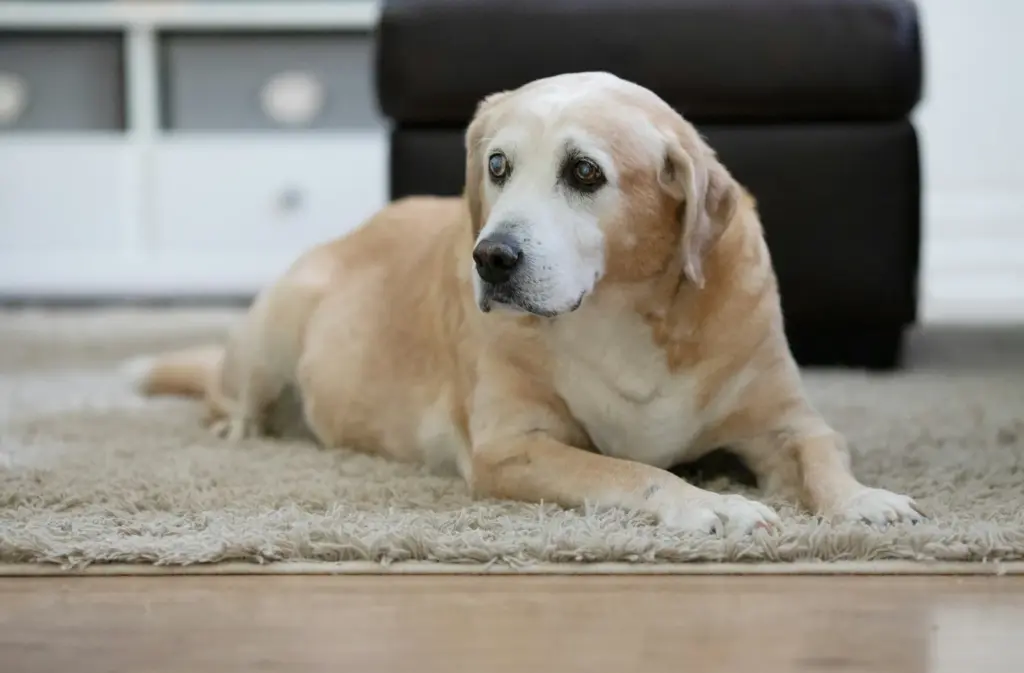
- Too thin: ribs, spine and hip bones are easy to see. No fat can be felt.
- Ideal: ribs are easy to feel under a thin layer of fat. From above there is a clear waist behind the ribs. From the side the belly tucks up.
- A bit heavy: ribs can be felt with some pressure. The waist is visible but not obvious.
- Heavy: ribs are hard to feel. There is no clear waist and fat sits over the lower back.
- Very heavy: ribs cannot be felt. The belly hangs and fat sits on the neck, legs and base of the tail.
How much to feed a senior dog
Older dogs burn fewer calories. They move less and lose muscle, which burns more energy than fat. In a study by Laflamme and colleagues, 11-year-old dogs needed about 25% fewer calories than 3-year-old dogs of the same breeds. The calculator lowers the factor by 20% once a dog reaches the last quarter of its breed’s typical lifespan, and it never goes below the RER.
Some seniors have the opposite problem. A dog that is losing weight without a diet needs a vet visit, because kidney disease, dental pain and cancer often show up first as weight loss.
Feeding a pregnant or nursing dog
For the first five weeks of pregnancy a dog needs about the same food as before. From week 6 to the birth at about week 9, her needs rise quickly. A 50 lb dog that needs 1,237 calories a day early in pregnancy needs about 1,941 in the last weeks.
Nursing takes even more. Milk production peaks around the fourth week, and a large litter can raise what the mother needs to three or four times her normal amount. These figures are for a 50 lb mother:
| Puppies in litter | Week 1 | Week 2 | Week 3 | Week 4 |
|---|---|---|---|---|
| 2 | 2,323 | 2,541 | 2,704 | 2,813 |
| 4 | 3,140 | 3,575 | 3,902 | 4,120 |
| 6 | 3,548 | 4,092 | 4,501 | 4,773 |
| 8 | 3,956 | 4,610 | 5,099 | 5,426 |
Most vets advise feeding a puppy or all-life-stages food from late pregnancy until the puppies are weaned, and letting a nursing mother eat as much as she wants. Use the calculator as a check that she is eating enough, and ask your vet about any mother that is losing weight fast.
How to read the calories on a dog food bag
In the US, every bag must print a calorie statement, usually near the guaranteed analysis. It looks like this: “Calorie content (calculated): 3,800 kcal/kg, 380 kcal/cup”. Kcal is the same as the calories in this guide. Enter the per-cup number in the calculator; add the per-kg number too if you want an exact gram amount.
Calories per cup vary a lot between foods. Most adult dry foods have between 300 and 450 calories per cup, and some weight-control foods are near 220. Switching foods without checking can change your dog’s intake by a third.
The feeding table on the bag is a broad guide for a whole weight band. A Tufts University study of weight-loss foods found that the bag directions ranged from 0.73 to 1.47 times the dogs’ resting needs, so some labels would make a dog gain weight. Use the bag’s table as a check and the calculator for your dog’s own number.
Measure with a scale if you can. In a 2011 study, portions of kibble measured with a cup ranged from 18% too little to 80% too much. A kitchen scale and the gram amount from the calculator remove that error. If you use a cup, use a real 8 oz measuring cup and level it off, not the scoop that came with a bin.
Feeding wet food or mixing wet and dry
Wet food has far fewer calories per gram than kibble because it is about 75% water. A 13 oz can of regular wet food has about 400 calories, about the same as one cup of dry food. The can label gives the calories per can.
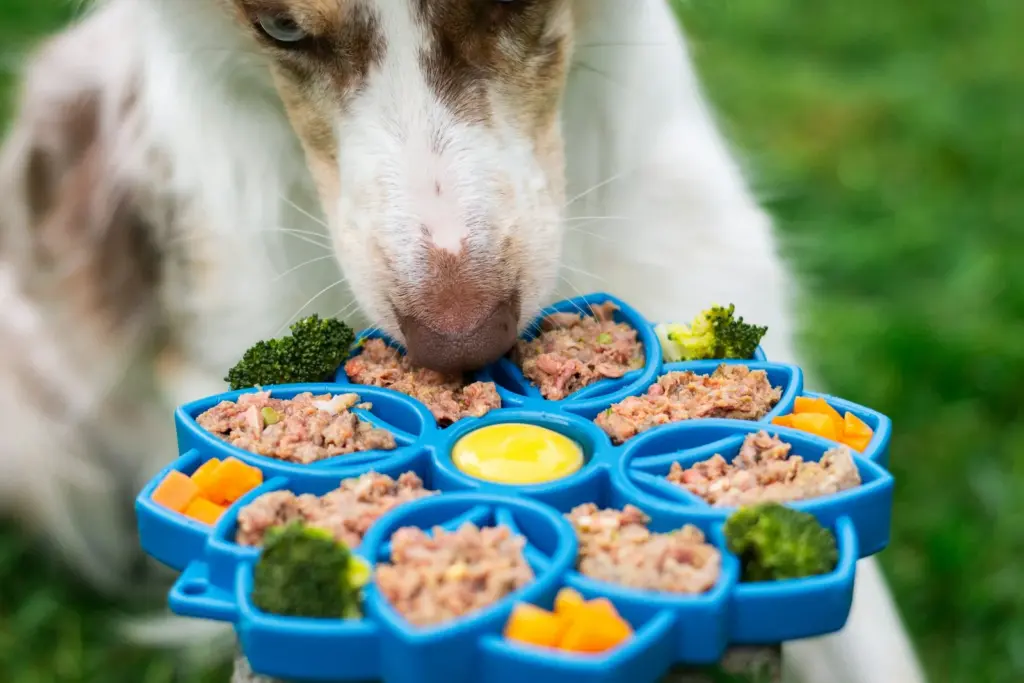
When you mix the two, split the calories, not the volume. Choose “Dry + wet” in the calculator and set how much of the daily calories should come from wet food. It gives you the cups of dry food and the share of a can that add up to the right total. Adding a can of wet food on top of a full dry portion is one of the most common causes of weight gain.
Treats, chews and table food
Treats should be no more than 10% of daily calories. The calculator keeps 10% aside for treats by default and lowers the food amount to match. For the 30 lb dog above that is 74 calories of treats and 1 ¾ cups of food. Turn the treat option off if you do not give treats.
- A large dental chew can have 100 to 200 calories.
- Pieces of kibble taken from the daily portion make good training treats with no extra calories.
- Plain green beans and carrot slices are low-calorie treats most dogs like.
- Never give grapes, raisins, onions, garlic, chocolate, xylitol or cooked bones.
How many times a day to feed a dog
- Puppies under 6 months: three or four meals a day.
- Adults and seniors: two meals a day, about 8 to 12 hours apart.
- Large, deep-chested breeds such as Great Danes and German Shepherds: two or three smaller meals, and no hard exercise for an hour after eating, to lower the risk of bloat.
The calculator splits the daily amount into the number of meals you choose.
How to tell if you are feeding the right amount
Weigh your dog every two to four weeks for the first two months on a new amount, then once a month. Check its body shape at the same time.
- Gaining weight and getting rounder: feed 10% less.
- Losing weight and ribs getting easier to see: feed 10% more.
- Steady weight and an ideal shape: keep the amount.
Small changes add up. An extra 10% a day is enough for a dog to gain several pounds in a year.
See your vet before a weight loss plan for a dog with a health condition, and whenever a dog’s appetite or weight changes without a clear reason. For more tools, see the calculators page, including the dog years calculator.
Sources
- Cline MG, Burns KM, Coe JB et al. (2021). 2021 AAHA Nutrition and Weight Management Guidelines for Dogs and Cats. J Am Anim Hosp Assoc 57(4):153-178. AAHA guidelines (RER formula and life stage factors, Box 1).
- National Research Council (2006). Nutrient Requirements of Dogs and Cats. National Academies Press. doi:10.17226/10668 (growth, gestation and lactation equations).
- Laflamme D (1997). Development and validation of a body condition score system for dogs. Canine Practice 22(4):10-15.
- Laflamme DP et al. Effect of age on maintenance energy requirements of adult dogs, as summarized by the Purina Institute.
- Kealy RD et al. (2002). Effects of diet restriction on life span and age-related changes in dogs. JAVMA 220(9):1315-1320. doi:10.2460/javma.2002.220.1315
- Linder DE, Freeman LM (2010). Evaluation of calorie density and feeding directions for commercially available diets designed for weight loss in dogs and cats. JAVMA 236(1):74-77. doi:10.2460/javma.236.1.74
- German AJ et al. (2011). Imprecision when using measuring cups to weigh out extruded dry kibbled food. J Anim Physiol Anim Nutr 95(3):368-373. doi:10.1111/j.1439-0396.2010.01063.x
- Association for Pet Obesity Prevention. Pet obesity survey.
- Breed weights: AKC breed pages and breed standards, as compiled for the florafaunafun.com puppy weight calculator.
The tables and the calculator use the same formulas. All conversions to cups, grams and cans are florafaunafun.com calculations.
How much should I feed my dog by weight?
A healthy neutered adult dog with normal activity needs about 326 calories a day at 10 lb, 744 at 30 lb, 1,091 at 50 lb, 1,404 at 70 lb and 1,835 at 100 lb. With a dry food of 380 calories per cup, that is about 7/8 cup, 2 cups, 2 7/8 cups, 3 3/4 cups and 4 7/8 cups a day. Active dogs need more and dogs that mostly rest need less.
How many cups of food should a dog eat a day?
It depends on the dog's weight and the calories per cup of the food. For a food with 380 calories per cup, a 20 lb adult dog eats about 1 1/2 cups a day, a 50 lb dog about 2 7/8 cups and an 80 lb dog about 4 1/8 cups. Check the calories per cup on your bag, because foods range from about 300 to 450.
How do I calculate how many calories my dog needs?
First work out the resting energy requirement: 70 times the dog's weight in kilograms raised to the power 0.75. Then multiply by a life stage factor: 1.4 to 1.6 for a neutered adult, 1.6 to 1.8 for an intact adult, 1.0 to 1.2 for an inactive dog, 2.0 to 3.0 for a growing puppy and 1.0 at the goal weight for weight loss. These factors come from the 2021 AAHA guidelines.
How much should I feed my dog to lose weight?
Feed the resting energy requirement of the dog's goal weight, not its current weight. For an 80 lb dog with a goal of 67 lb, that is about 903 calories a day, compared with 1,552 for maintenance. Aim for a loss of 1% to 2% of body weight a week, weigh the dog every two to four weeks and use a weight loss food so the dog still gets enough protein and vitamins.
How much should I feed my puppy?
A puppy needs two to three times the calories of an adult dog of the same weight. The amount depends on its current weight and its expected adult weight. For example, a puppy that will weigh 50 lb as an adult needs about 1,077 calories a day at 12.5 lb and about 1,407 at 25 lb. Feed three or four meals a day until about 6 months.
Is the feeding guide on the dog food bag accurate?
It is a rough guide for a wide weight band. A Tufts University study of weight loss foods found that the bag directions ranged from 0.73 to 1.47 times the resting energy needs of the dogs, so some labels would cause weight gain. Use the calories per cup on the bag with a calculator, then adjust by your dog's weight.
How many times a day should I feed my dog?
Feed adult and senior dogs two meals a day, about 8 to 12 hours apart. Feed puppies three or four meals a day until about 6 months of age. Large, deep-chested breeds do well with two or three smaller meals and rest after eating.
Do senior dogs need less food?
Most do. Older dogs move less and lose muscle, and one study found that 11-year-old dogs needed about 25% fewer calories than 3-year-olds of the same breeds. A senior dog that loses weight without a diet should see a vet.
How much wet food should I feed my dog?
A 13 oz can of regular wet food has about 400 calories, so a 30 lb neutered adult that needs about 744 calories a day would eat close to two cans if fed only wet food. Check the calories per can on the label. When you mix wet and dry food, split the daily calories between them instead of adding wet food on top.
How do I know if I am feeding my dog the right amount?
Weigh your dog every two to four weeks and check its shape. At an ideal weight you can feel the ribs under a thin layer of fat and see a waist from above. If the dog gains weight, feed 10% less. If it loses weight and the ribs show, feed 10% more.
How many treats can I give my dog?
Treats should be no more than 10% of daily calories. For a 30 lb dog that needs 744 calories a day, that is about 74 calories of treats. Lower the food amount by the same number of calories.