Add prices to see costs
How to use the sheep feed calculator
- Add your sheep. Make one group for each kind of sheep you keep: ewes, a ram, weaned lambs or bottle lambs. Set how many there are and roughly what they weigh. For ewes, pick what she is doing now, because a ewe nursing twins needs about twice the feed of a resting ewe.
- Pick your hay and grain. Choose the hay you actually have. Late-cut, stemmy hay has less energy, so the calculator adds grain to make up the difference.
- Plan the winter. Set how many days you will feed hay, what size bales you buy and how you feed them. Add prices if you want a cost.
The results show how much hay and grain to put out each day for each group and for the whole flock, how many bales you need for the winter, how much water and mineral to expect and what it will cost. Each group gets a check for energy and protein so you can see whether the ration is short. Copy the link to save your plan, or print it and pin it in the barn.
How much hay does a sheep eat per day?
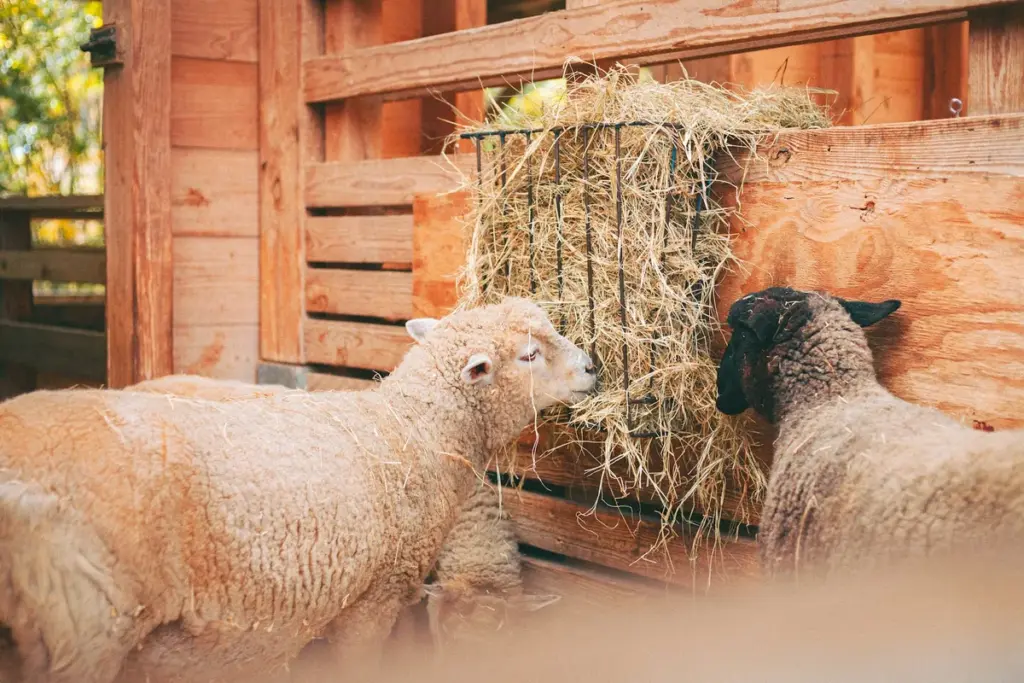
A sheep eats 2.5 to 3% of its body weight in dry matter a day. Hay is about 88% dry matter, so that works out to 2.8 to 3.4% of body weight in hay. A 150 lb ewe eats about 3.5 lb of hay a day when she is resting and up to 6 or 7 lb when she is nursing twins.
What she eats is not what you put out. Sheep pull hay out of the feeder, sort out stems and lie on whatever falls. Plan for 10% waste with a good hay rack and 15 to 30% when hay goes on the ground.
The table shows hay eaten per ewe per day on good grass hay, before waste.
| Ewe stage | 110 lb (50 kg) | 130 lb (59 kg) | 150 lb (68 kg) | 175 lb (79 kg) | 200 lb (91 kg) |
|---|---|---|---|---|---|
| Resting | 2.4 lb1.1 kg | 2.5 lb1.1 kg | 2.9 lb1.3 kg | 3.1 lb1.4 kg | 3.3 lb1.5 kg |
| Early pregnancy | 2.9 lb1.3 kg | 3.1 lb1.4 kg | 3.3 lb1.5 kg | 3.5 lb1.6 kg | 3.7 lb1.7 kg |
| Last 6 weeks, twins | 3.2 lb1.5 kg+ 0.75 lb corn | 3.5 lb1.6 kg+ 0.90 lb corn | 3.4 lb1.5 kg+ 1.15 lb corn | 3.7 lb1.7 kg+ 1.15 lb corn | 4.0 lb1.8 kg+ 1.10 lb corn |
| Nursing twins | 4.8 lb2.2 kg+ 0.25 lb corn | 5.0 lb2.3 kg+ 0.50 lb corn | 5.4 lb2.5 kg+ 0.60 lb corn | 5.7 lb2.6 kg+ 0.90 lb corn | 5.9 lb2.7 kg+ 1.20 lb corn |
Stage matters more than weight. A 150 lb ewe nursing twins needs more than twice the energy of the same ewe in summer, and her stomach cannot hold twice the hay. That gap is what grain fills.
How much hay does a sheep need for winter?
Multiply the hay you put out per day by the number of days you will feed hay, then divide by the weight of your bales:
A 180 lb ewe on good grass hay from a rack needs about 3.5 lb a day. Over a 150-day winter that is 528 lb, or 11 small square bales of 50 lb each. Ten ewes need about 106 small bales, or 7 round 4×5 bales.
| Bales for | 90 days | 120 days | 150 days | 180 days |
|---|---|---|---|---|
| 1 ewe, small square (50 lb) | 7 bales317 lb · 144 kg | 9 bales423 lb · 192 kg | 11 bales528 lb · 240 kg | 13 bales634 lb · 288 kg |
| 10 ewes, small square (50 lb) | 64 bales3,170 lb · 1,438 kg | 85 bales4,227 lb · 1,917 kg | 106 bales5,284 lb · 2,397 kg | 127 bales6,341 lb · 2,876 kg |
| 1 ewe, round 4×5 (850 lb) | 1 bale317 lb · 144 kg | 1 bale423 lb · 192 kg | 1 bale528 lb · 240 kg | 1 bale634 lb · 288 kg |
| 10 ewes, round 4×5 (850 lb) | 4 bales3,170 lb · 1,438 kg | 5 bales4,227 lb · 1,917 kg | 7 bales5,284 lb · 2,397 kg | 8 bales6,341 lb · 2,876 kg |
Weigh a few bales before you count on these numbers. Small square bales sold as “50 lb” often weigh 40 to 45 lb, and Penn State found that most producers overestimate the weight of their round bales. Buy 10% more than the calculator says to cover a long spring or a bad batch of hay.
How much grain should I feed my sheep?
Resting ewes, rams outside breeding season and sheep on good pasture do not need grain. Grain is for the times when a sheep needs more energy than hay can supply:
- Getting ready to breed (flushing): 0.5 to 1 lb a day for 2 to 3 weeks before the ram goes in. This helps thin ewes most. Skip it for fat ewes.
- Last 6 weeks of pregnancy: 0.5 to 1 lb for a single lamb, 1 to 1.75 lb for twins. Most of the lamb’s growth happens in this window, and an underfed ewe risks pregnancy toxemia.
- Nursing lambs: about 1 lb of grain for each lamb she is nursing, so 2 lb for twins. Cut grain back 1 to 2 weeks before weaning to help dry her off.
- Finishing lambs: 1.5 to 2 lb a day for a 70 to 100 lb lamb, with hay making up at least 10% of the diet.
- Rams before breeding: 0.5 to 1 lb a day for a month before breeding season.
Start low and build up. Raise grain by no more than about 10% of the total diet every 4 days. A sudden jump in grain causes acidosis, which can kill a sheep within a day or two. The calculator prints a step-up schedule whenever a ration includes grain.
Use whole corn, barley, oats or a pelleted sheep feed. Sheep chew whole grain well, so there is no need to pay extra for cracked or rolled grain. Corn has the most energy per pound. A 16% protein sheep pellet costs more but also covers protein.
Feeding ewes through the year
Resting ewes
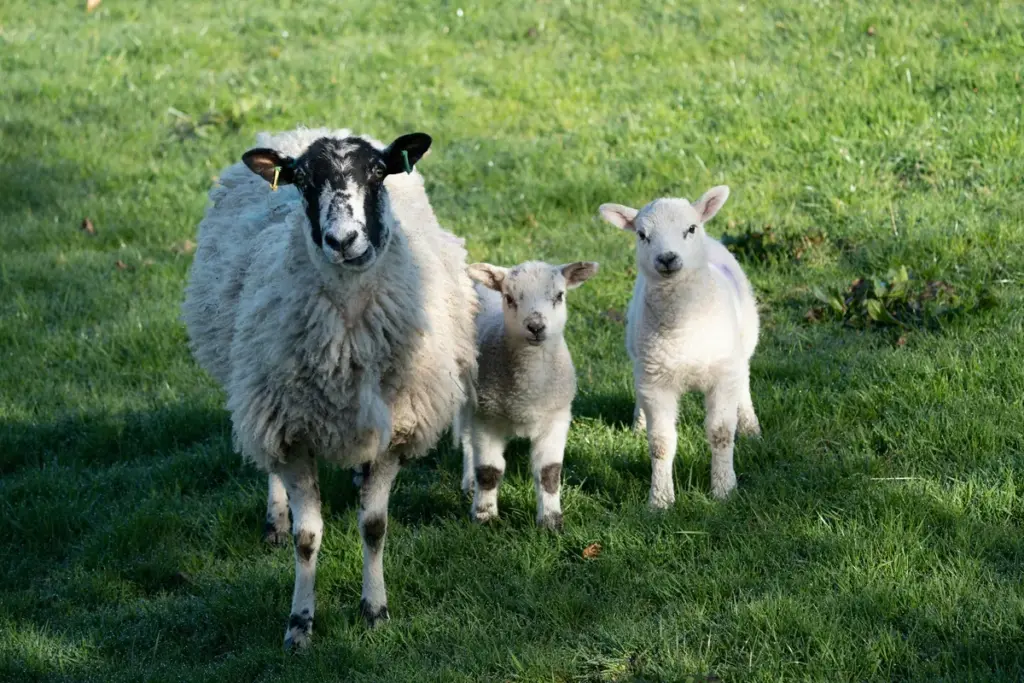
After weaning and through early summer, a ewe only needs to hold her weight. Good grass hay or pasture covers her needs. This is the time to let thin ewes regain condition and to let fat ewes slim down before breeding.
Early pregnancy (first 15 weeks)
Needs rise only a little. Feed her as a resting ewe and keep her condition steady. Avoid big changes in feed during the first month, when embryos are implanting.
Last 6 weeks of pregnancy
About 70% of a lamb’s growth happens in the last 6 weeks. At the same time the lambs take up room in her belly, so she can eat less hay. Feed the best hay you have and add grain. A ewe carrying twins on average grass hay needs about 1.2 lb of corn a day by lambing. If you don’t know whether a ewe carries one lamb or two, have her scanned, or feed for twins.
Nursing ewes
Milk production peaks 3 to 4 weeks after lambing. A ewe nursing twins needs the most feed of the year: all the good hay she will eat plus about 2 lb of grain. After 8 weeks the lambs eat more solid food and her milk drops, so she needs less.
Body condition
Feel along the backbone behind the last rib. If the spine feels sharp and you can easily feel between the bones, she is thin. If you can barely feel the spine, she is fat. Feed thin ewes as if they were about 20 lb heavier and fat ewes as if they were 20 lb lighter. Pick “Thin” or “Fat” in the calculator to do this for you.
Feeding lambs after weaning
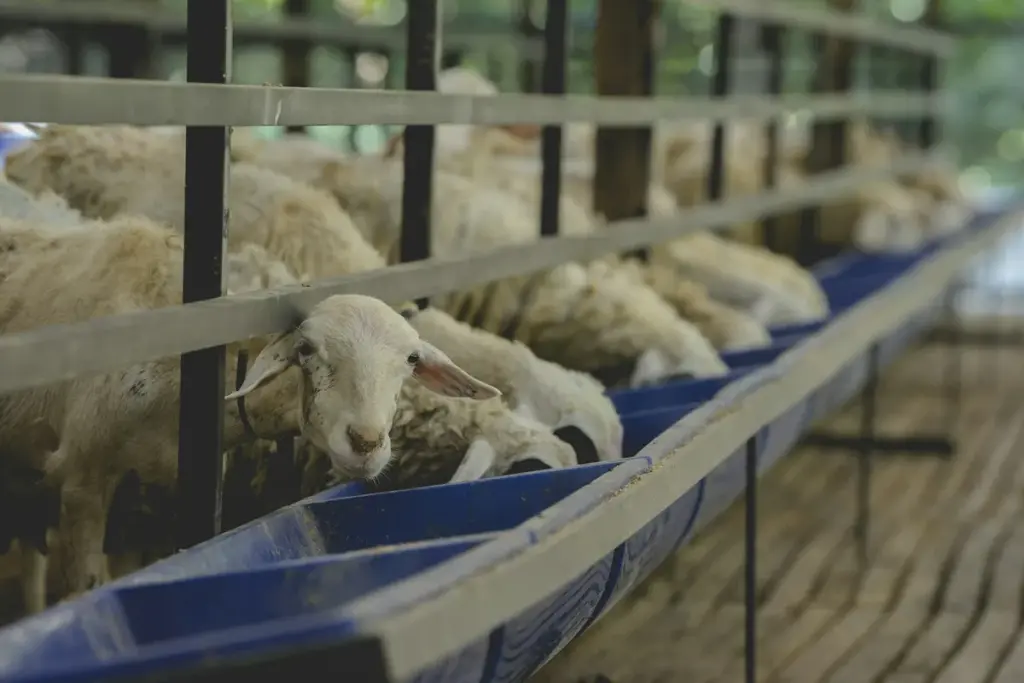
A weaned lamb eats about 3.5 to 4.5% of its body weight a day, more than an adult for its size. Lambs you keep for breeding grow on good hay or pasture with a little grain. Lambs you finish for market get a high-grain diet that builds up over 2 to 3 weeks.
A 70 lb finishing lamb needs about 1.8 lb of alfalfa hay and 1.7 lb of corn a day, plus about 1.4 oz of soybean meal for protein. Ram and wether lambs on grain need about twice as much calcium as phosphorus in the diet to prevent urinary stones. Alfalfa hay helps. Many lamb feeds include ammonium chloride for the same reason.
Vaccinate lambs with CD&T before they start on grain. Enterotoxemia (“overeating disease”) strikes the fastest-growing lambs on rich feed.
Bottle lamb feeding chart
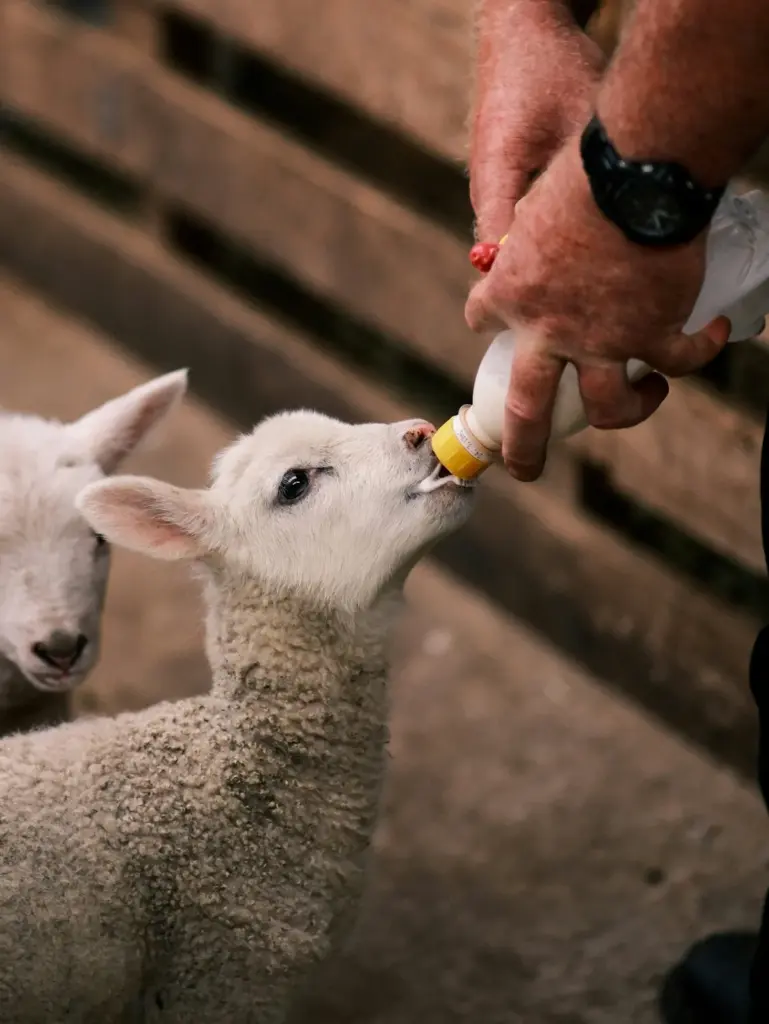
An orphan or rejected lamb needs colostrum first: about 10% of its body weight in the first 24 hours, split into 4 feedings, the first within an hour of birth. A 10 lb lamb needs about 16 oz (2 cups). Use ewe colostrum, a colostrum replacer or frozen cow or goat colostrum.
After the first day, switch to a lamb milk replacer with about 30% fat and 23% protein. Calf and multi-species replacers are too low in fat for lambs and cause bloat and scours.
| Age | Per feeding | Feedings a day | Daily total | What else |
|---|---|---|---|---|
| Days 0–1 | 2–4 oz (60–120 mL) | 6 | 12–24 oz | Colostrum replacer for the first 24 hours (10% of body weight in 4 feedings) |
| Days 2–4 | 4 oz (120 mL) | 4–6 | 16–24 oz | Switch to lamb milk replacer. Fresh water always |
| Days 5–14 | 6–8 oz (175–235 mL) | 4 | 24–32 oz | Creep feed from day 7 |
| Days 15–21 | 12 oz (355 mL) | 3 | 36 oz | Hay from week 3 (day 21) |
| Days 22–30 | 12 oz (355 mL) | 3 | 36 oz | Keep creep in front of them |
| Day 31 to weaning | 16 oz (475 mL) | 2 | 32 oz | Wean at 6+ weeks, 25–30 lb and 0.5 lb of creep a day |
- Feed bottle milk at 90 to 100°F. Warm it in a water bath, not a microwave.
- Feed at the same times each day. Small, regular meals prevent bloat.
- Offer lamb creep feed (18 to 20% protein) and clean water from about day 7, and soft hay from week 3.
- Wean when the lamb is at least 6 weeks old, weighs 25 to 30 lb and eats at least 0.5 lb of creep feed a day.
- Plan on about 20 lb of milk replacer powder per lamb from birth to weaning.
Feeding rams
Outside breeding season a ram needs about the same as a resting ewe of his weight: good hay and loose mineral. A month before breeding, add 0.5 to 1 lb of grain a day so he goes into the season in good condition, because rams lose weight fast while working. Keep the calcium to phosphorus ratio at 2 to 1 or higher to prevent urinary stones.
Which hay is best for sheep?
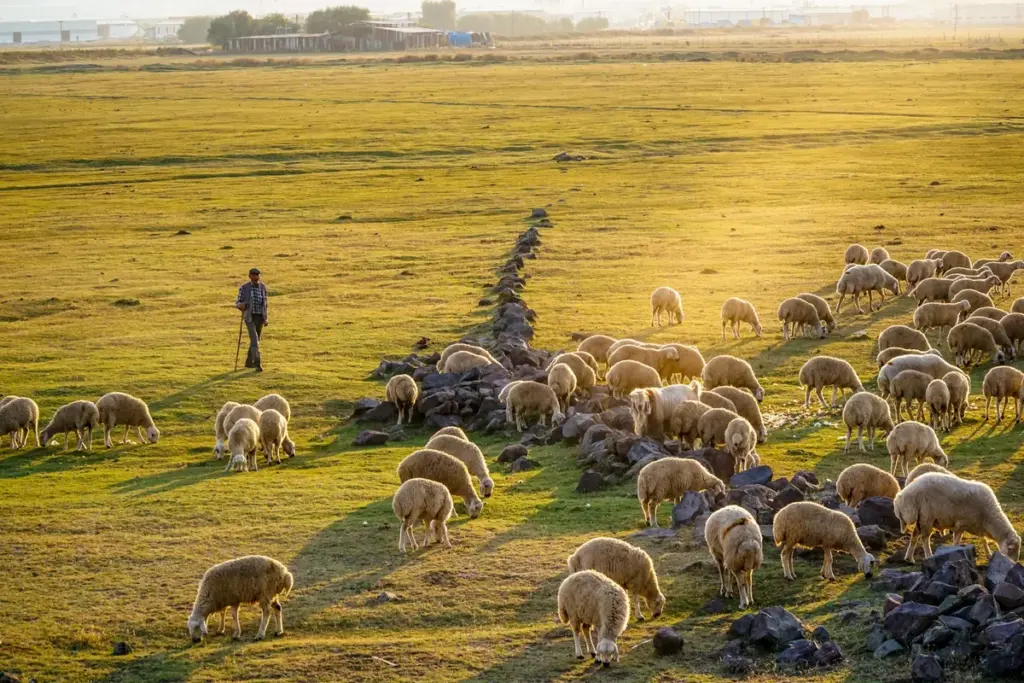
Leafy, early-cut hay is best. It has more energy and protein, and sheep waste less of it. Check for green color, plenty of leaves, soft stems, a sweet smell and no dust or mold.
- Grass hay (orchardgrass, timothy, brome): fine for resting ewes and rams. Late-cut, stemmy grass hay may not hold a pregnant ewe’s weight without grain.
- Alfalfa or clover hay: about 17% protein, high in calcium. Ideal for late pregnancy, nursing ewes and growing lambs. It is more than a resting ewe needs.
- Grass-alfalfa mix: a good all-round hay for a mixed flock.
Never feed moldy hay. Mold causes abortion and listeriosis in sheep. A forage test costs about $25 to $35 and tells you exactly what your hay contains, which matters most if you buy a whole winter’s supply at once.
Pasture
Green, growing pasture meets the needs of most sheep with no hay or grain. Stocking rates run from about 2 to 10 ewes per acre depending on rainfall, grass and grazing management. Start at the low end and add sheep as you learn your pasture. Dormant winter pasture has little energy, so feed hay alongside it.
Feeding sheep in cold weather
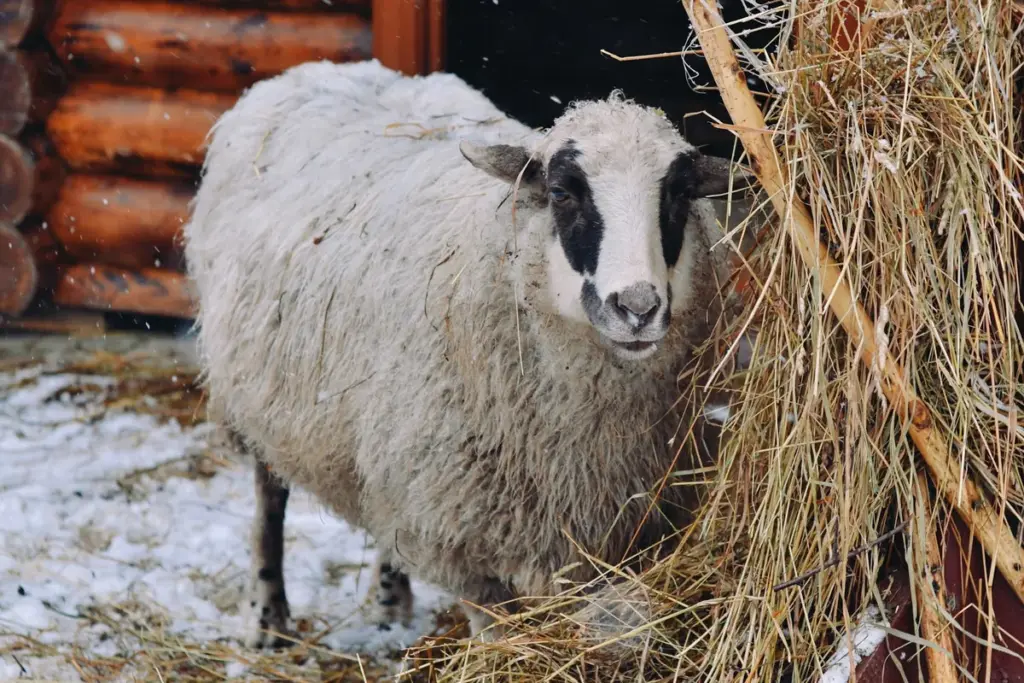
A sheep in a full fleece stays comfortable down to about 28°F. A freshly shorn sheep starts to feel the cold at 50°F. Below those temperatures, add about 1% more energy for each degree of cold. On a 0°F day a ewe in full fleece needs about 28% more energy than she does in mild weather.
Hay is the best way to provide it. Digesting hay produces heat, so offer extra hay on cold nights. Wind and wet fleeces make the cold worse, so a windbreak or open shed saves feed. Pick “Cold” or “Very cold” in the calculator to add the extra energy.
Water, salt and minerals
A resting ewe drinks about 1 gallon of water a day, a pregnant ewe 1.5 to 2 gallons and a nursing ewe 2 to 3 gallons, more in hot weather and on dry hay. Snow is not enough. Keep water from freezing in winter with a heated bucket or tank heater, because sheep that drink less also eat less.
Offer a loose sheep mineral free choice. Sheep eat less mineral from blocks than from loose mixes. Expect each sheep to eat about 0.75 to 1 oz a day.
If you keep goats with your sheep, feed them separately. Goats need more copper than sheep, so the two cannot share a mineral. The goat feed calculator works out hay and grain for a goat herd, and the chicken feed calculator covers backyard poultry. All our farm and pet tools are on the calculators page.
How to cut hay waste
- Use a hay feeder or rack instead of the ground. A good feeder cuts waste from 15 to 30% down to about 10%.
- Feed once or twice a day and only what the flock cleans up. Several days of hay at once means more trampling.
- Put out round bales in a feeder with a basket or slats. Most waste happens on the first day of a new bale.
- Buy better hay. Penn State measured about 4 times more waste with poor, stemmy hay than with good hay.
- Store hay off the ground and under cover. A round bale left outside on bare ground can lose up to a third of its feed value to rot.
How the calculator works
The calculator uses the nutrient requirements of sheep from the National Research Council (NRC), as published by Oregon State and Cornell extension. For each group it looks up how much the sheep can eat (dry matter intake) and how much energy (total digestible nutrients, TDN) and protein it needs for its weight and stage. Weights between table rows are interpolated.
It then balances the ration in four steps:
- Energy from hay first. If the sheep can meet its energy needs from the chosen hay without eating more than it can hold, the ration is hay only.
- Grain fills the gap. If not, it works out how much grain to add so the sheep gets enough energy at full appetite. Grain is capped at the share NRC uses for that stage.
- Protein check. If the ration is short of protein, some of the grain is swapped for soybean meal.
- From dry matter to what you put out. Amounts are converted to hay and grain as fed, then the hay is raised for the waste of your feeding method.
Worked example: a 150 lb ewe in the last 6 weeks of pregnancy with twins, on average grass hay (58% TDN, 10% protein) and whole corn.
- She can eat 4.16 lb of dry matter a day and needs 2.76 lb of TDN and 0.47 lb of protein.
- Hay alone would take 4.77 lb of dry matter to meet her energy. That is more than she can eat, so she needs grain.
- 3.0 lb of hay dry matter plus 1.16 lb of corn meets her energy at full appetite.
- That ration is 13% short on protein, so 0.15 lb of the corn becomes soybean meal.
- As fed, with 10% waste from a rack: put out 3.8 lb of hay, 1.15 lb of corn and about 3 oz of soybean meal a day.
The result agrees with extension advice for ewes carrying twins: Ontario’s ministry of agriculture recommends 1.5 to 1.75 lb of grain for flocks lambing over 200%, and Penn State recommends 0.5 to 1 lb.
The cold-weather adjustment adds 1% energy per degree below 28°F for sheep in full fleece and 50°F for shorn sheep. Feed values for each hay and grain come from university feed composition tables. The numbers are a planning guide for healthy sheep. A forage test and your own eye on body condition will fine-tune them, and a veterinarian should guide feeding for sick, very thin or very old sheep.
Frequently asked questions
How much hay does a sheep eat per day?
How many bales of hay does a sheep need for winter?
Do sheep need grain?
How much grain should a pregnant ewe get?
How much should I feed a nursing ewe?
How much does it cost to feed a sheep?
How much should I feed a lamb?
How much milk replacer does a bottle lamb need?
How much water does a sheep drink a day?
Can sheep eat cattle, goat or horse feed?
What is the best hay for sheep?
Should sheep have free-choice hay?
How does cold weather change how much sheep eat?
Sources
- National Research Council. Nutrient Requirements of Sheep, 6th ed. (1985), tables as published by Oregon State University Extension and Cornell University.
- Penn State Extension. Feeding the Flock; Nutrition Throughout Pregnancy for Sheep Flocks; How Much Does That Bale Really Weigh?; Reduce Feed Costs by Reducing Hay Waste.
- Schoenian, S. Balancing a Ration, Artificial Rearing. Sheep 101.
- Ontario Ministry of Agriculture, Food and Agribusiness. Ewe Flock Nutrition (2023); Artificial Rearing of Lambs (2021).
- South Dakota State University Extension. Sheep Water Requirements and Quality Testing; Lamb Nutrition Management to Avoid Acidosis.
- University of Arkansas Cooperative Extension. FSA-9613.
- Montana State University Extension. Hay Winter Feeding Waste.
- Texas A&M AgriLife. Bale Weight: How Important Is It?