How much hay does a cow eat per day?
A cow eats a fairly steady share of her body weight each day. On average grass hay a dry, pregnant cow eats about 2% of her weight in dry matter. Dry matter is what is left of the hay once the water is taken out. Most baled hay is 88% to 90% dry matter, so the hay a cow eats as fed weighs a little more than her dry-matter intake.
Three things move the number. Heavier cows eat more. Nursing cows eat about 15% more than dry cows, because making milk takes extra feed. Hay quality matters too: cows eat more of good, leafy hay and less of coarse, stemmy hay. On poor hay a dry cow eats about 1.8% of her weight in dry matter. On good hay she eats about 2.5%.
The table below uses average grass hay (10% protein, 55% TDN, 89% dry matter) and a ring feeder.
| Animal | Weight | Dry matter eaten | Hay eaten (as fed) | Hay to put out (ring feeder) |
|---|---|---|---|---|
| Pregnant cow | 1,000 lb | 20 lb | 22 lb | 26 lb |
| Pregnant cow | 1,200 lb | 24 lb | 27 lb | 31 lb |
| Pregnant cow | 1,400 lb | 28 lb | 31 lb | 36 lb |
| Nursing cow | 1,000 lb | 23 lb | 26 lb | 29 lb |
| Nursing cow | 1,200 lb | 28 lb | 31 lb | 35 lb |
| Nursing cow | 1,400 lb | 32 lb | 36 lb | 41 lb |
| Growing heifer | 400 lb | 9.6 lb | 11 lb | 12 lb |
| Growing heifer | 600 lb | 13 lb | 15 lb | 17 lb |
| Growing heifer | 800 lb | 16 lb | 18 lb | 21 lb |
| Growing calf or steer | 400 lb | 10 lb | 11 lb | 13 lb |
| Growing calf or steer | 500 lb | 12 lb | 13 lb | 15 lb |
| Growing calf or steer | 700 lb | 15 lb | 17 lb | 20 lb |
| Mature bull | 1,800 lb | 36 lb | 40 lb | 46 lb |
| Mature bull | 2,200 lb | 44 lb | 49 lb | 56 lb |
Pregnant cows in the last three months before calving eat about the same amount of hay as in mid-pregnancy, but they need richer hay. Our cattle nutrition calculator checks whether your hay has enough protein and energy for each stage.
The weight you enter drives every number, so a good guess matters. Weight guessed by eye is often well off. If you have no scale, a livestock weight tape wrapped around the heart girth, just behind the front legs, gets you close.
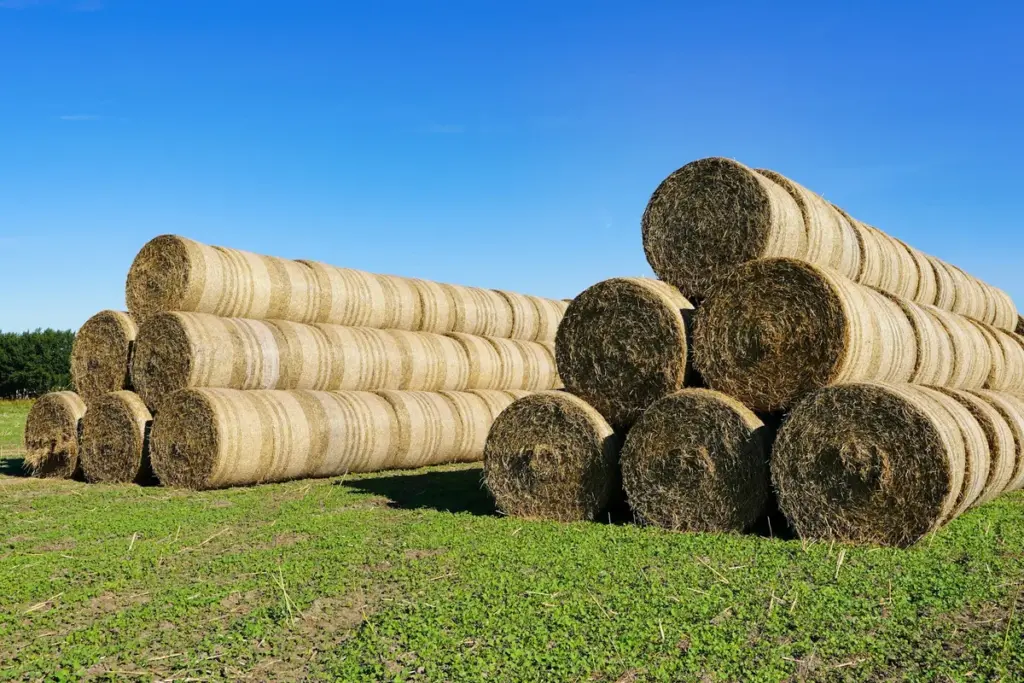
How many round bales per cow for winter?
Multiply the hay you put out each day by the number of days you feed, then divide by your bale weight.
Worked example: 20 pregnant cows weighing 1,200 lb, fed average grass hay from a ring feeder for 150 days, with 1,000 lb round bales (a typical 5×5).
- Each cow needs about 31 lb of hay put out a day (30.6 lb before rounding).
- 30.6 lb × 20 cows = 613 lb a day for the herd.
- 613 lb × 150 days = about 92,000 lb, or 46 tons.
- 92,000 lb ÷ 1,000 lb per bale = 92 round bales.
That works out to about 4.6 bales per cow, so plan on 5 round bales per cow for a 150-day winter. Bale size changes the count. The same cow needs about 6 bales of 4×5 (800 lb), 5 bales of 5×5 (1,000 lb) or 4 bales of 5×6 (1,441 lb). Over a full year with no grazing, one cow goes through about 5.6 tons, or 12 round bales of 1,000 lb.
Bale weight varies more than any other number here. Two 5×5 bales from different balers or fields can differ by a few hundred pounds. Weigh a few of yours if you can, and enter that weight in the calculator. Bales stored outside and uncovered also lose part of their weight to rot and weather, so add about 10% for those.
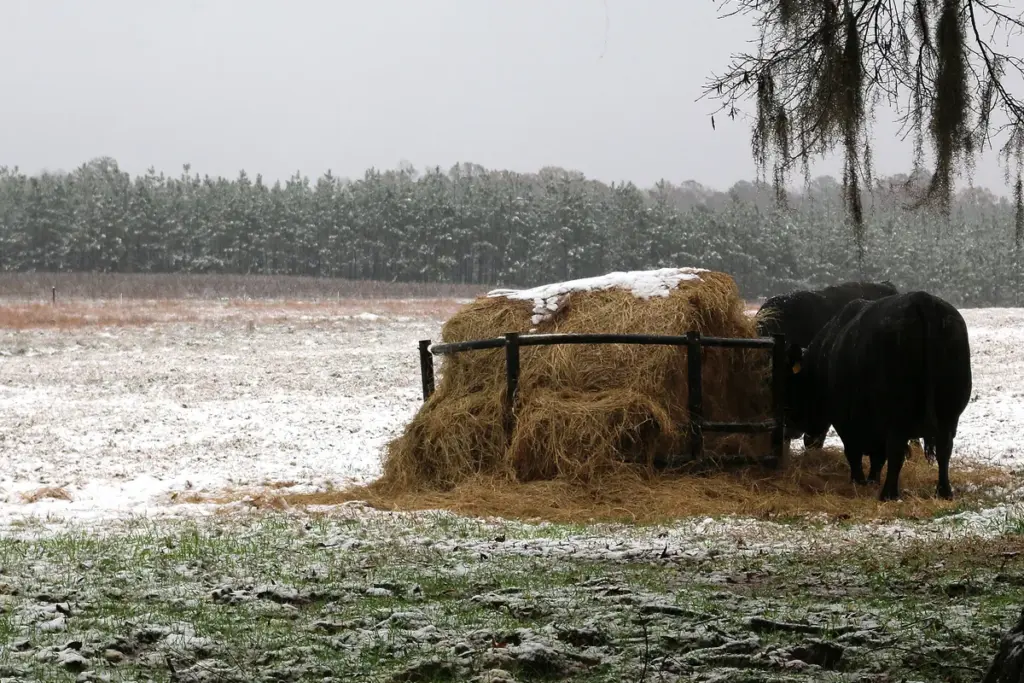
Hay waste by feeder
How you feed decides how much hay you buy. Cattle pull hay out of a feeder, trample it, bed on it and soil it. The table shows the hay a 1,200 lb pregnant cow needs put out each day with each method, and the bales a 20-cow herd needs for 150 days.
| Feeding method | Hay wasted | Put out per cow per day | Wasted per cow per day | 5×5 bales, 20 cows, 150 days |
|---|---|---|---|---|
| Cone, basket or bunk feeder | 5% | 28 lb | 1.4 lb | 86 |
| Ring feeder with a sheeted bottom | 12% | 31 lb | 3.7 lb | 92 |
| Unrolled on the ground | 25% | 36 lb | 9 lb | 108 |
| Whole bale on the ground, no feeder | 45% | 49 lb | 22 lb | 148 |
A bale dropped in the pasture with no feeder wastes almost half of it. Moving from no feeder to a ring saves 56 bales on 20 cows in one winter, which pays for a ring quickly. Open-bottom rings waste more than sheeted ones. Unrolling works best when you put out no more than one day’s hay at a time; with more, waste climbs past 25%.
How much grain to feed a steer
It depends on what the steer is for. A growing calf or a stocker steer at 400 to 700 lb usually runs on hay or pasture. On average grass hay alone it gains less than 1.5 lb a day, so most owners add some grain or distillers grains. The calculator suggests an amount for your hay.
A finishing steer is different. It eats a grain ration, not hay. The calculator uses a farm-mixed ration of 75% shelled corn, 15% dried distillers grains and 10% grass hay (dry-matter basis) for a steer gaining about 3.3 lb a day.
| Finishing steer weight | Feed eaten (as fed) | Feed to put out (5% bunk waste) |
|---|---|---|
| 700 lb | 20 lb | 21 lb |
| 1,000 lb | 26 lb | 27 lb |
| 1,200 lb | 30 lb | 31 lb |
At 1,000 lb that ration is about 20 lb of corn a day. Steers need several weeks to move from hay to a ration this rich. Raise the grain a little at a time, and talk with your vet or an extension agent before you start, because a fast switch can cause acidosis and bloat. Lighter steers also need a little more protein than this ration supplies, which the calculator flags.
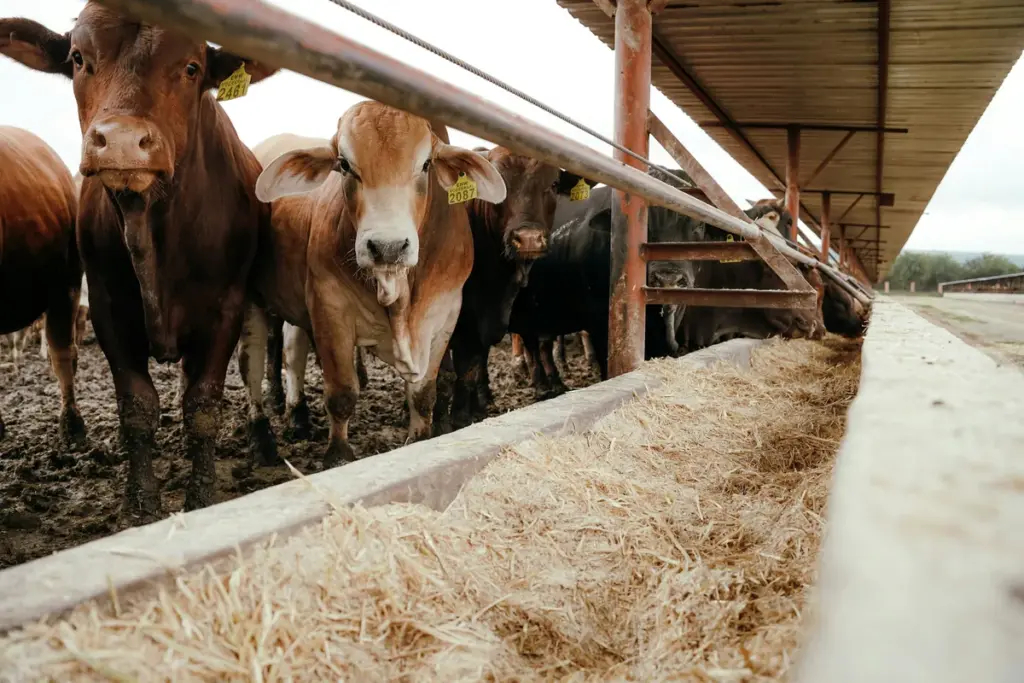
Water
Cattle drink more as the weather warms and as they start making milk. The figures below are gallons per head per day from the NASEM 2016 water table.
| Animal | 40 °F | 60 °F | 80 °F | 90 °F |
|---|---|---|---|---|
| Pregnant cow | 6.7 | 8.3 | 11.4 | 13.7 |
| Nursing cow | 11.4 | 14.5 | 17.9 | 17.9 |
| Growing calf, 500 lb | 4.7 | 5.8 | 7.8 | 11.1 |
| Finishing steer, 1,000 lb | 8.7 | 10.8 | 14.5 | 20.6 |
| Mature bull, 1,800 lb | 8.7 | 10.8 | 14.5 | 20.6 |
Cows eat less hay when they can’t drink, so frozen tanks cut intake as well as water. In winter, break ice at least once a day or use a heated waterer.
How this calculator works
The calculator does four steps.
- Dry matter eaten. For cows and bulls it uses a share of body weight that depends on hay quality: 1.8%, 2.0% or 2.5% for dry cows and bulls, and 2.0%, 2.3% or 2.7% for nursing cows, on poor, average and good hay. For heifers, growing calves and finishing steers it reads intake from the NASEM 2016 requirement tables for that weight.
- Hay eaten as fed. It divides the dry matter by the hay’s dry-matter percentage.
- Hay to put out. It adds the waste for your feeder, taken as a share of the hay offered.
- Herd and season. It multiplies by head and days, then divides by your bale weight and rounds up to whole bales.
Key assumptions:
- Average grass hay is 10% crude protein, 55% TDN and 89% dry matter. Good hay is 12% protein and 60% TDN. Poor hay is 7% protein and 50% TDN.
- Round bale weights are 800 lb (4×5), 1,000 lb (5×5) and 1,441 lb (5×6). Small squares are 50 lb.
- Heifers grow about 1 lb a day toward a 1,200 lb mature weight. Growing calves gain about 1.5 lb a day.
- Bale counts include feeder waste but not storage loss.
- Supplements replace hay pound for pound of dry matter, so total intake stays the same.
The same method appears in UF/IFAS guidance: a 1,300 lb dry cow at 2% of body weight eats 26 lb of dry matter a day, which is what the calculator returns for that cow.
Frequently asked questions
How much hay does a cow eat per day?
How much hay does a cow need for the winter?
How many round bales does a cow need for winter?
How much hay does a steer eat per day?
How much grain does a steer eat per day?
How much does it cost to feed a cow per day?
What is the difference between dry matter and as fed?
How do I reduce hay waste when feeding cattle?
How much water does a cow drink per day?
Sources
- Gadberry, S. Beef Cattle Nutrition Series Part 3: Nutrient Requirement Tables (MP391). University of Arkansas System Division of Agriculture. Tables generated from the Nutrient Requirements of Beef Cattle, 8th revised edition (NASEM 2016).
- Hersom, M. Basic Nutrient Requirements of Beef Cows (AN190). UF/IFAS Extension.
- 2014 Feed Composition Table. BEEF magazine, reprinted by Alabama Cooperative Extension System.
- Meehan, M., G. Stokka and M. Mostrom. Livestock Water Requirements (AS1763). NDSU Extension.
- Choose the Right Hay Feeder to Reduce Waste and Cut Cost. K-State Beef Tips, December 2024.
- Van Emon, M., M. Hoffman, R. Endecott and E. Glunk. Evaluating Hay Feeding Methods on Heifer Performance, Hay Waste, and Economics. Montana State University, 2017.
- Hersom, M., T. Thrift and J. Yelich. Implications of Round Bale Dimensions on Hay Use (AN326). UF/IFAS Extension.
- Banta, J. Bale Weight: How Important Is It? (ANSC-PU-157). Texas A&M AgriLife Extension, 2022.
- Barkley, M. and R. Meinen. How Much Does That Bale Really Weigh? Penn State Extension.