Search “animals in Guatemala” and you’ll get jaguars, quetzals, and howler monkeys on repeat. All real, all spectacular, and all living comfortably in Mexico, Belize, Honduras, and half of Central America too. None of them are only in Guatemala.
This is a different list. Every animal here is endemic — meaning it exists nowhere else on the planet. No populations across the border, no second home in a neighboring country. Guatemala or nothing. Some are venomous, one is already gone forever, and a few live in valleys so specific you could draw a circle around their entire global range on a map.
Table of Contents
- Endemic vs. native: the difference that matters
- Guatemalan Beaded Lizard
- Guatemalan Black Iguana
- Abronia Alligator Lizards
- Atitlán Grebe (extinct)
- Guatemalan Myotis Bat
- Maya Mouse
- Lake Atitlán Pupfish
- Why Guatemala breeds so many endemics
Endemic vs. native: the difference that matters
This trips up almost every list out there, so let’s settle it first.
Native means an animal lives somewhere naturally, without human help. A jaguar is native to Guatemala. It’s also native to Brazil, Mexico, and a dozen other countries. Native just means “belongs here,” not “only here.”
Endemic means an animal’s entire natural range sits inside one place — in this case, inside Guatemala’s borders. Wipe it out here and it’s gone from Earth. That exclusivity is the whole point of this list, and it’s exactly what those quetzal-and-jaguar roundups quietly ignore.
Worth knowing: many “Guatemalan” endemics are reptiles, fish, and small mammals rather than the charismatic megafauna tourists picture. Big animals roam; small animals stuck in an isolated valley or a single lake are the ones that turn endemic. Keep that in mind as the list gets weirder.
Guatemalan Beaded Lizard
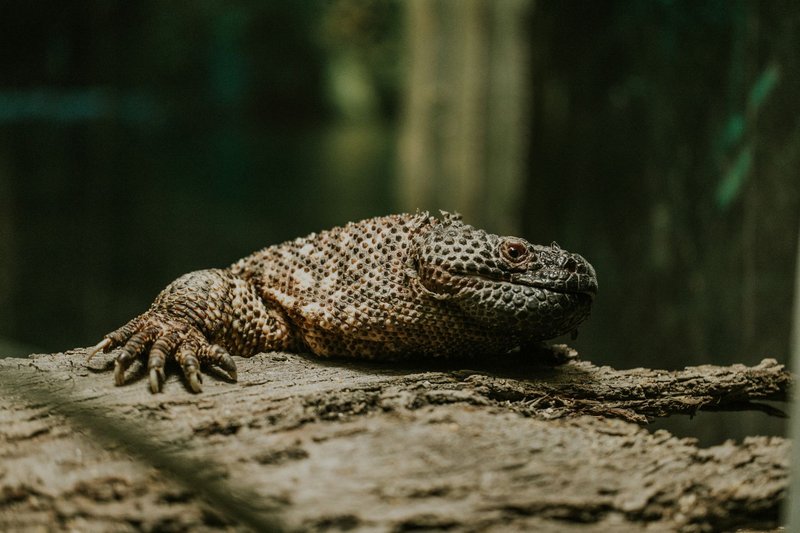
Heloderma charlesbogerti — Critically Endangered
Start with the headliner. The Guatemalan beaded lizard is one of the only venomous lizards on Earth, a cousin of the Gila monster, and it lives in a single dry pocket of the country: the Motagua Valley in the east. That’s it. The entire global population of wild adults has been estimated in the hundreds.
It’s a heavy, bead-skinned animal with black and yellowish-pink blotches, and it delivers venom by chewing rather than striking — the toxin runs up grooves in its lower teeth as it holds on. For decades it was treated as a regional subspecies until genetic work confirmed it as its own thing, found nowhere outside that arid Guatemalan valley. The IUCN Red List tracks it as Critically Endangered, hammered by habitat loss and collection for the illegal pet trade — and it’s far from alone in that fight, as our rundown of endangered species in Guatemala makes clear.
Conservation here is genuinely tight-knit. A local program nicknamed the lizard escorpión and turned a feared animal into a regional mascot, which is a big reason it still exists at all. If a single animal earns this list its title, it’s this one.
Guatemalan Black Iguana
Ctenosaura palearis
The Guatemalan spiny-tailed iguana — locally the garrobo — also calls the Motagua Valley home and is tied to the same dry forest as the beaded lizard. It’s a stocky, dark iguana with a ridge of spines down its tail, and it likes to bask high in the cavities of mature trees, especially the gnarled Beaucarnea “ponytail palms” the valley is known for.
Its limited range makes it vulnerable to the exact same pressures: shrinking dry forest and collection. The upside is that protecting one valley protects both species at once, which is why the Motagua dry forest gets outsized conservation attention for such a small patch of land.
Abronia Alligator Lizards
Abronia spp.
Here’s where Guatemala quietly racks up endemics most people never hear about. Abronia are arboreal alligator lizards — small, armored, often startlingly colored in greens and blues — that live in the cool, wet cloud forests of Guatemala’s highlands. Several species in this genus are endemic to specific Guatemalan mountain ranges and nowhere else, which is part of why the broader catalog of reptiles of Central America leans so heavily on this corner of the map.
The catch is that cloud forest is naturally patchy: each mountaintop is its own island of cool, humid habitat. A lizard adapted to one isolated peak can’t cross the hot lowlands to reach the next one, so populations diverge into separate species. That’s how a single country ends up hosting multiple Abronia found only within its borders — and why deforestation of even one ridge can erase a species outright.
Atitlán Grebe (extinct)
Podilymbus gigas — Extinct
This is the one that should sting. The Atitlán grebe, locally called the poc, was a large, flightless-ish diving bird that lived on exactly one body of water: Lake Atitlán in the western highlands. One lake. The whole species.
Its collapse is a textbook case of how fast a single-location endemic can vanish. In the late 1950s, non-native largemouth bass were introduced to the lake for sport fishing. The bass ate the small fish and crustaceans the grebes depended on — and reportedly the grebe chicks themselves. Add shoreline development, reed habitat loss, and falling water levels, and a population once in the hundreds cratered. Despite a dedicated rescue effort (including a guarded refuge built by conservationist Anne LaBastille), the last birds were recorded around 1989, and the species was declared extinct.
There is no other Atitlán grebe anywhere. When a species lives in one lake, the lake is the species — and you only get to learn that lesson once per bird.
Guatemalan Myotis Bat
Myotis cobanensis
Bats are the great endemic sleeper category, because so many are known from just a handful of specimens. The Guatemalan myotis is described from the Cobán region in the north-central highlands and is considered endemic to the country. It’s a small, plain-faced insect-eating bat — the kind of animal that gets cataloged in a museum drawer and then waits decades for anyone to confirm where else it lives.
In its case, the answer so far is: nowhere else. It’s listed as Data Deficient, scientist-speak for “we know it’s real and we know it’s Guatemalan, but we haven’t found enough of them to say much more.” That uncertainty is itself part of the story — endemics this obscure can blink out before they’re ever properly studied.
Maya Mouse
Peromyscus mayensis — Endangered
A deer mouse with a startlingly small world. The Maya mouse is restricted to high-altitude pine and cloud forest in the western highlands near Huehuetenango, at elevations most people associate with hiking rather than rodents. Its known range is tiny — a few square kilometers of cool montane forest — which puts it squarely in the Endangered column.
It’s an unglamorous animal that makes the point better than any big cat could: endemism isn’t about being impressive, it’s about being trapped somewhere unique. A mouse that evolved to a specific cold, wet mountaintop simply has nowhere else it can live, and that’s precisely what makes it Guatemalan and nothing else.
Lake Atitlán Pupfish
Profundulus and allies
Lake Atitlán lost its grebe, but its waters still hold endemic fish. Several Central American killifish and pupfish in Guatemala’s lakes and rivers have ranges narrow enough to count as endemic, including small-bodied fish associated with the Atitlán basin and the highland drainages around it.
These fish run into the same villain as the grebe: introduced sport fish that outcompete and eat them, plus pollution and water extraction from a growing population around the lakeshore. A fish confined to one watershed has no escape route when its only home degrades — same trap, smaller animal.
Why Guatemala breeds so many endemics
So why does a country smaller than the state of Tennessee punch so far above its weight on animals found nowhere else?
Geography. Guatemala is a crumpled landscape — volcanic highlands, isolated cloud-forest peaks, a hot dry valley walled off by mountains, deep lakes, and lowland jungle, all stacked close together. Each of those becomes a habitat island. A cloud-forest lizard can’t cross the dry Motagua Valley; a dry-valley iguana can’t survive the wet highlands; a lake fish can’t walk to the next lake. Isolation plus time equals new species, over and over.
That’s the engine, and it’s also the warning. The same isolation that creates a single-location endemic leaves it with zero backup population. The Guatemalan dry forest of the Motagua and the cloud forests of the highlands are among the most threatened habitats in Central America, and several species here are one bad decade from following the Atitlán grebe.
So skip the next list that calls a jaguar “uniquely Guatemalan.” The genuinely unique residents are a venomous lizard guarding a dry valley, a handful of jewel-toned lizards perched on separate mountaintops, and a diving bird that taught the hard way what “found only here” really costs.