The Comoros is four small volcanic islands wedged between Madagascar and the East African coast, and its real wildlife story isn’t the length of the species list. It’s how lopsided that list is. No native land mammals to speak of except bats. A handful of birds found nowhere else on Earth, most of them clinging to a single cloud forest on a single mountain. Geckos and chameleons that evolved into their own species while their cousins stayed behind on Madagascar.
This is what biologists call an oceanic island archipelago — land that rose straight out of the sea on volcanic hotspots and was never connected to a continent. Everything that lives here had to fly, swim, raft across open water, or get carried by humans. That filter is why the Comoros’ native animals look the way they do, and why a few of them are now among the rarest creatures alive.
Here’s what actually lives on these islands, organized by class, leading with the endemics that make the place worth knowing about.
Table of Contents
- Why Comoros wildlife is so unusual
- Mammals: bats, a borrowed lemur, and the sea
- Birds: the Mount Karthala four
- Reptiles: geckos and a flat-nosed chameleon
- Insects and the endemic butterflies
- Marine life around the islands
- Which species are in trouble
Why Comoros wildlife is so unusual
The Comoros islands are young — Grande Comore (the largest) is geologically recent, and its volcano, Mount Karthala, still erupts. There was never a land bridge. So unlike mainland Africa with its lions, antelope, and primates, the Comoros got colonized slowly and selectively by whatever could cross open ocean.
That explains two things at once. First, why mammal diversity is almost nonexistent: terrestrial mammals are bad at crossing seawater, so the only ones that made it on their own were bats, which fly. Second, why so much of the fauna looks Madagascan rather than African. Madagascar is the nearest large landmass, and over millions of years its day geckos, chameleons, and Charaxes butterflies dispersed eastward, then drifted into their own Comoran forms in isolation.
The one famous exception proves the rule. The Comoros has a lemur — the mongoose lemur on Mohéli and Anjouan — but lemurs are terrible ocean travelers and almost certainly didn’t get there on their own. The accepted explanation is that humans brought them from Madagascar, possibly centuries ago, which is why they don’t count as truly native. It’s a useful reminder that on islands, the line between “native” and “introduced” is often a line between “arrived by wing or current” and “arrived by canoe.”
Mammals: bats, a borrowed lemur, and the sea
If you want land mammals in the Comoros, you want bats. That’s the headline, and the bats are spectacular.
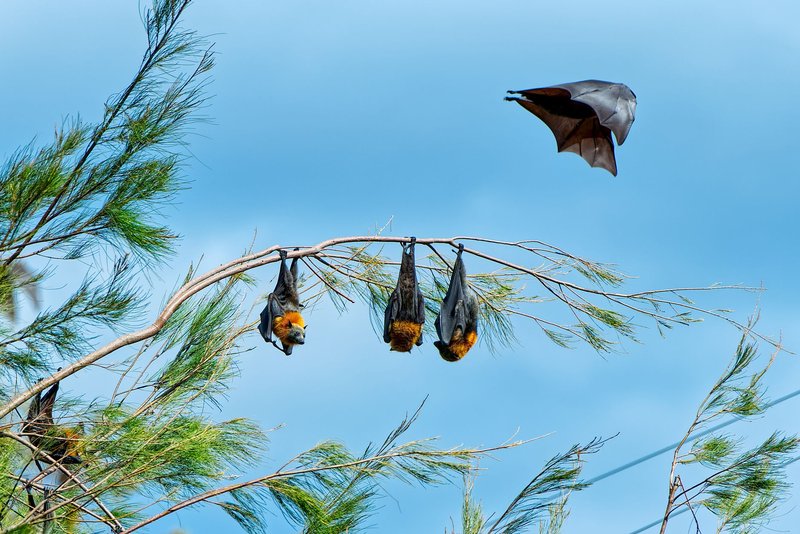
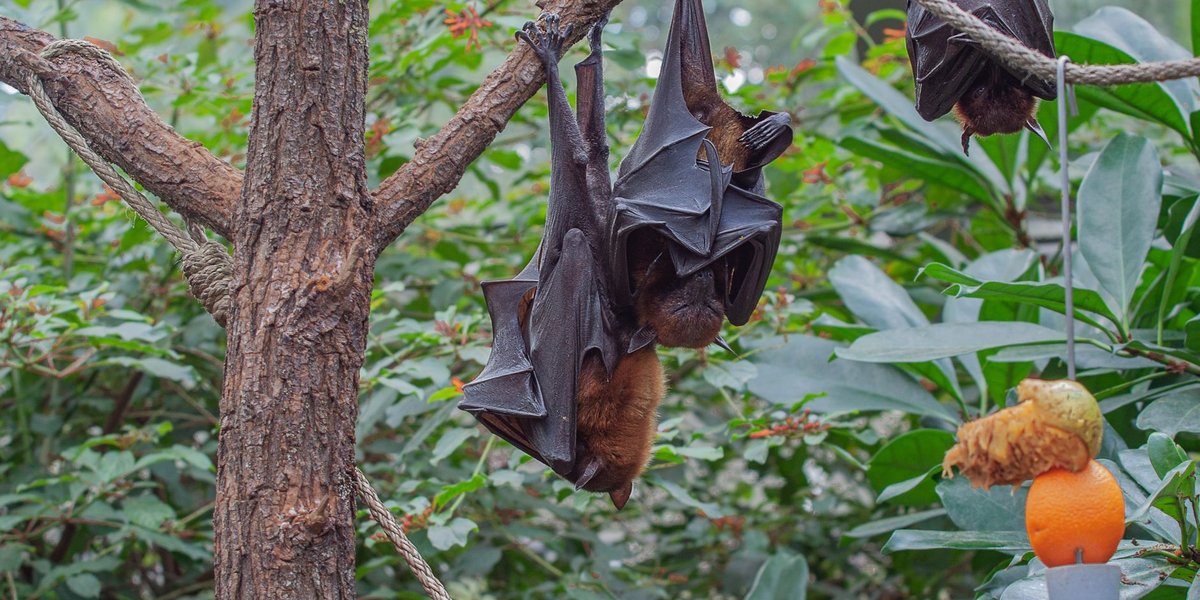
Livingstone’s fruit bat (Pteropus livingstonii) is the one to know. It’s one of the largest bats in the world, with a wingspan that can reach around four and a half feet — a black, leathery flying fox with a foxlike face and claws built for hanging in old-growth canopy. It lives only on Anjouan and Mohéli, roosting in the steep upland forests, and it is critically endangered. Population estimates have hovered in the low thousands at best. According to the IUCN Red List, habitat loss as the islands’ forests are cleared for farming is the central threat — this bat needs tall mature trees, and those are exactly the trees that disappear first. It’s one of several rare animals in the Comoros whose entire existence depends on a few square miles of upland forest.
The Comoro rousette (Rousettus obliviosus) is the other endemic fruit bat — smaller, cave-roosting, found across the archipelago. It’s less famous than Livingstone’s but every bit as endemic, and as a cave species it depends on undisturbed roosts the way the flying fox depends on undisturbed forest.
Beyond bats, the native terrestrial mammal column is essentially blank. The mongoose lemur (Eulemur mongoz) on Mohéli and Anjouan is the celebrity you’ll see on lists of “Comoros animals,” with its reddish cheeks and that unhurried lemur stare. But it’s an introduced species — brought over from Madagascar by people — which makes its presence a story about human movement, not natural colonization. It’s still worth seeing, and it’s still threatened in its Comoran range, but it isn’t a native.
The richest mammal life around the Comoros is in the water, which brings us to the marine section below.
Birds: the Mount Karthala four
Birds are the Comoros’ best self-made endemics, because birds can cross water and then evolve in isolation once they settle. The crown jewels live on Grande Comore, in the forests wrapping Mount Karthala, and there are four of them that birders fly across the world for.
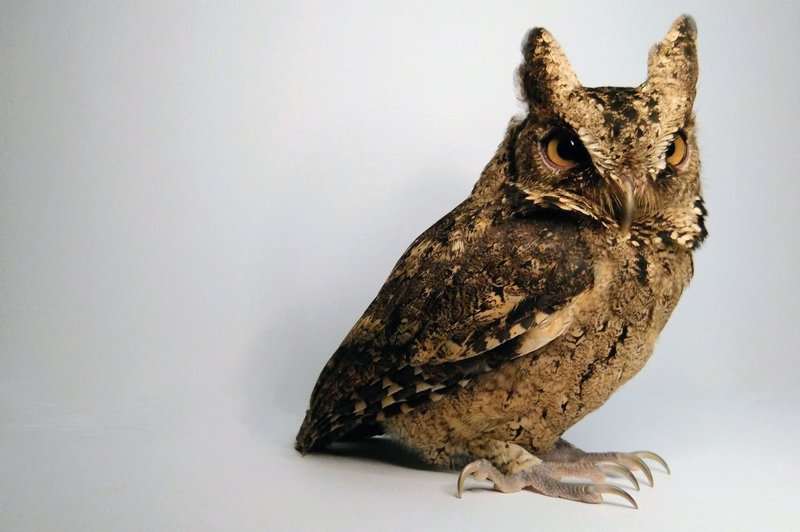
Karthala scops owl (Otus pauliani) — a tiny owl restricted to the upper forests of the volcano. Its entire global range is essentially one mountainside, which makes it one of the most range-restricted owls anywhere.
Grand Comoro flycatcher (Humblotia flavirostris) — a small, brownish flycatcher placed in its own genus, found only in Karthala’s montane forest. When a bird gets its own genus, it usually means it has no close living relatives — an evolutionary one-off.
Grand Comoro drongo (Dicrurus fuscipennis) — a glossy black drongo with the family’s forked tail, endemic to Grande Comore and uncommon even there.
Mount Karthala white-eye (Zosterops mouroniensis) — a small green-and-yellow white-eye that lives in the highest heath and forest near the summit, often above the cloud line.
What unites these four isn’t just that they’re endemic. It’s that they share a single fragile address. They depend on Karthala’s native forest, and that forest is shrinking under agriculture and invasive plants. Lose the forest, lose all four at once — which is exactly why ornithologists treat Mount Karthala as one of the most important bird sites in the western Indian Ocean. BirdLife International has flagged the area as a key biodiversity site for precisely this reason.
The broader Comoros also hosts endemic forms of more widespread families — sunbirds, pigeons, and a Comoros blue pigeon among them — but the Karthala four are the ones that define the archipelago’s avian identity.
Reptiles: geckos and a flat-nosed chameleon
Reptiles are where the Madagascar connection shows up most clearly, because Madagascar’s geckos and chameleons are world-class dispersers, and the Comoros caught a few.
The Comoro day geckos are the standouts — bright green, diurnal lizards in the genus Phelsuma, the same group that gave the world the gecko on the insurance ads. Several Phelsuma forms occur in the Comoros, including island-restricted ones, basking on tree trunks and walls in the open daylight rather than hiding like most geckos. There are also more cryptic ground geckos working the leaf litter.
The flapnose chameleon (Furcifer cephalolepis) is endemic to Grande Comore — a small chameleon named for the flap-like scale projection near its snout. Like all chameleons it’s slow, deliberate, and built for ambush, swiveling those independent eyes through the brush. It’s a genuine Comoran original, not found on Madagascar or anywhere else.
These reptiles tie neatly to the islands’ biogeography: they’re proof that the Comoros got its fauna from the east, from Madagascar, and then let isolation do its work. Set them beside Madagascar’s own native animals and the family resemblance is obvious — a day gecko stranded on a young volcanic island for long enough becomes its own thing.
Insects and the endemic butterflies
Insects rarely make the highlight reel, but the Comoros has endemic Charaxes butterflies — large, fast, strong-flying nymphalids known for hooked wingtips and a habit of feeding on tree sap and fermenting fruit rather than flowers. Several Charaxes forms in the Comoros are found only here, another echo of the Madagascan lineage radiating into island endemics.
It’s the same evolutionary story playing out at a smaller scale: a strong-flying group reaches the islands, gets cut off, and diverges. Butterflies don’t get the conservation headlines the bats and owls do, but they’re part of the same endemic signature.
Marine life around the islands
The water around the Comoros holds the animal that put these islands on the scientific map. The coelacanth (Latimeria chalumnae) — a heavy, lobe-finned fish long thought extinct for 65 million years — was famously rediscovered in the western Indian Ocean, and the deep volcanic slopes around the Comoros became one of the key places it’s known to live. It’s a living fossil hauled up from a few hundred meters down, and for a long time the Comoros was the address most associated with it.
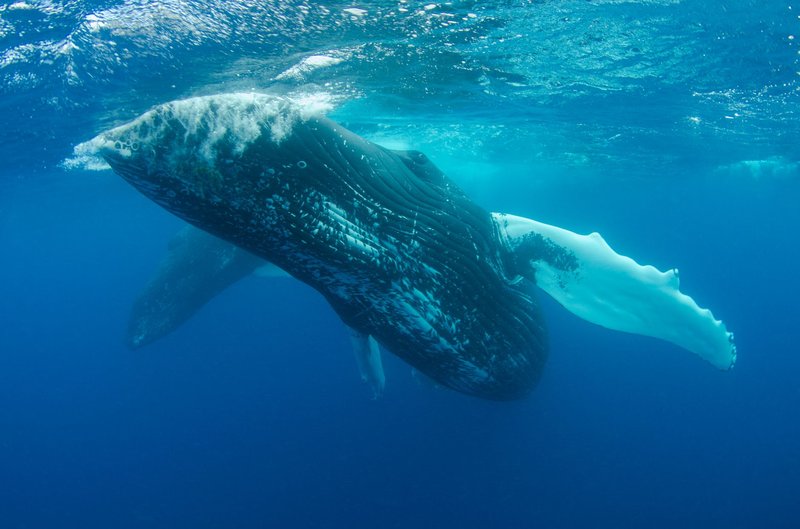
The seas here are also a marine mammal corridor. Humpback whales pass through and breed in these warm waters during the southern winter, and dolphins, dugongs, and several species of sea turtle — green and hawksbill among them — use the reefs and seagrass beds. Mohéli in particular is built around its marine park, and the islands’ richest, most accessible wildlife is arguably underwater rather than on land.
Which species are in trouble
The uncomfortable thread running through the Comoros’ native animals is how many of them are endangered, and for the same reason: the islands are small, the forests are being cleared, and an endemic species with nowhere else to go has no fallback.
The critically endangered Livingstone’s fruit bat is the clearest case — a giant bat down to a few upland forests, losing roost trees every year. The Mount Karthala birds share one mountain’s forest and decline as that forest fragments. The mongoose lemur, even as an introduced species, is threatened across its Comoran range. Sea turtles face poaching and bycatch. These are only a few of the endangered species in the Comoros, and almost every name on that list traces back to the same pressures.
The common cause is habitat — specifically, the loss of native forest to agriculture and the spread of invasive plants on islands where every patch of cloud forest matters. Conservation work on the ground, including captive breeding efforts for Livingstone’s fruit bat and the marine protections around Mohéli, exists precisely because these animals can’t be replaced from anywhere else. When an endemic island species is gone, it’s gone globally.
That’s the honest summary of the Comoros’ wildlife. A short list, but an extraordinary one — a young volcanic archipelago that pulled its fauna from Madagascar, mixed in a few self-made originals, and now holds species that exist on Earth in only this one strange, narrow place.