Type “snakes in the forest” into a search bar and you’ll get two completely different animals thrown onto the same list — a copperhead from a Virginia hardwood stand sitting next to an emerald tree boa from the Amazon canopy. Those aren’t the same encounter. A forest in Ohio and a forest in Ecuador share tree cover and not much else, and the snakes that live in each one reflect that.
This guide keeps the regions honest: five species you’ll realistically cross paths with in North American temperate forests, one old-growth specialist from the Pacific Northwest, and three built for tropical rainforest life. Every entry covers size, venom status, camouflage, and range. At the end, a real way to size up a snake on the trail, and what to do if you can’t avoid the encounter.
Table of Contents
- Temperate North American Forests
- 1. Timber Rattlesnake
- 2. Copperhead
- 3. Cottonmouth (Water Moccasin)
- 4. Eastern Garter Snake
- 5. Ring-Necked Snake
- Old-Growth Pacific Northwest Forest
- 6. Rubber Boa
- Tropical Rainforest
- 7. Emerald Tree Boa
- 8. Eyelash Viper
- 9. Boa Constrictor
- Venomous or Not? How to Tell at a Glance
- What to Do If You Meet One on the Trail
Temperate North American Forests
These are the forests most hikers actually walk through — Appalachian ridgelines, Midwest hardwood stands, southeastern pine flats. Five species show up here often enough that you should know them by sight.
1. Timber Rattlesnake
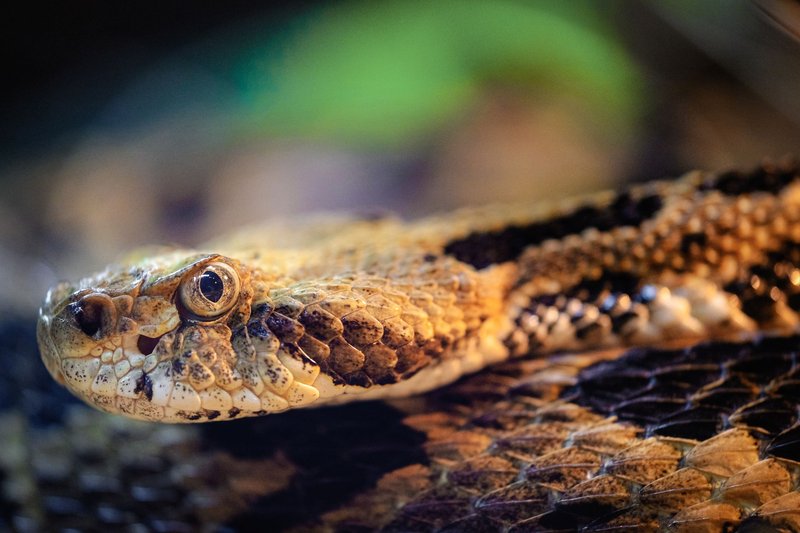
Venomous, and one of the largest pit vipers in the eastern U.S. — adults run 2.6 to 5 feet, with big males topping 6 feet. Its range traces the Appalachians from New Hampshire down to northern Florida, then west through southeastern Minnesota into Texas; it was last confirmed in Ontario in 1941 and hasn’t been seen there since. Timber rattlesnakes favor mixed pine-hardwood ridges and stay put when they sense you coming — they’re more likely to freeze mid-trail than strike, which is exactly why people step too close. According to the Smithsonian’s National Zoo, it’s one of the more docile members of its family, holding still rather than fleeing or attacking.
2. Copperhead
The copperhead’s hourglass pattern isn’t decoration — the wide end of each band sits on the flank and the narrow end on the spine, which breaks up its outline exactly the way dry leaf litter does. That’s the whole strategy: lie still in the leaves near a game trail and let camouflage do the hunting. Its range runs from Massachusetts west to Illinois and south through Georgia and Alabama, concentrated in shaded, leaf-heavy forest with dense canopy. Bites are venomous but rarely fatal, which doesn’t help much when the snake you nearly stepped on was invisible a second earlier.
3. Cottonmouth (Water Moccasin)
Cottonmouths stick to water’s edge — swamps, slow streams, drainage ditches, pond margins from southeastern Virginia to Florida, west to central Texas and north into southern Illinois. When threatened, they don’t run; they gape, showing the startling white interior of the mouth that gives them their name. That display has earned them a reputation as aggressive that the research doesn’t back up. A tracking study covered by the Orianne Society found that fewer than 20% of cottonmouths tried to bite even when researchers stepped directly on them — they’d rather gape, vibrate their tail, or leave.
4. Eastern Garter Snake
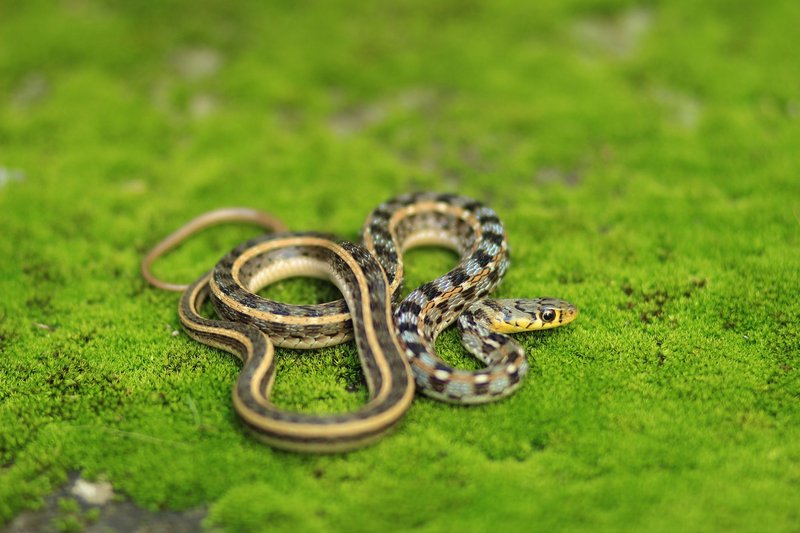
Nonvenomous and everywhere — described in New England as the region’s most widespread snake. Garter snakes favor the stone walls and brush lines where forest gives way to field, and about 80% of an adult’s diet is earthworms, with frogs making up most of the rest. If you pick one up, expect a musk spray, not a bite; they’d rather flee or flatten out than fight.
5. Ring-Necked Snake
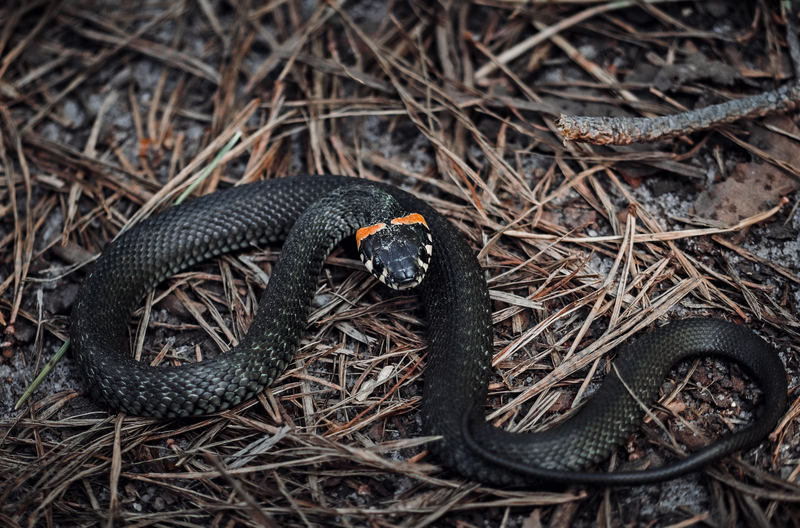
Small, nocturnal, and rarely seen by daylight, ring-necked snakes live under logs and loose bark in damp forest, feeding mostly on salamanders and earthworms. Their defense is one of the stranger tricks in the woods: threatened, they curl the tail into a corkscrew to flash a bright red-orange underside, a warning flare aimed at predators rather than people. If a predator ignores the warning and grabs one anyway, it releases a musk that’s been described as rancid cottage cheese soaked in dirty pennies — a smell distinctive enough that nobody who’s handled one forgets it.
Old-Growth Pacific Northwest Forest
6. Rubber Boa
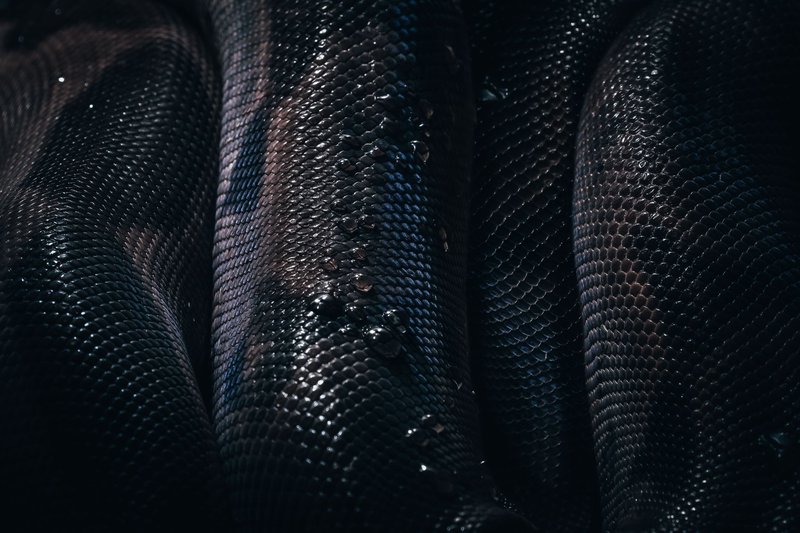
Old-growth coniferous forest, not open field, is rubber boa territory — the Washington Department of Fish & Wildlife notes it’s the most cold-tolerant boa on the continent, ranging as far north as British Columbia. It tops out around 2 feet, moves slowly, and spends daylight hours under rotting logs and stumps rather than basking in the open. Its blunt tail is shaped enough like its head that it can confuse a predator about which end to attack. Nonvenomous, a capable constrictor of mice and nestling birds, and by some records the longest-lived wild snake species known — individuals have been tracked for decades in the same patch of forest.
Tropical Rainforest
Rainforest snakes solve a different problem than temperate ones: the forest floor, understory, and canopy are effectively three separate hunting grounds, and species specialize accordingly—a pattern reflected across other rainforest animals.
7. Emerald Tree Boa
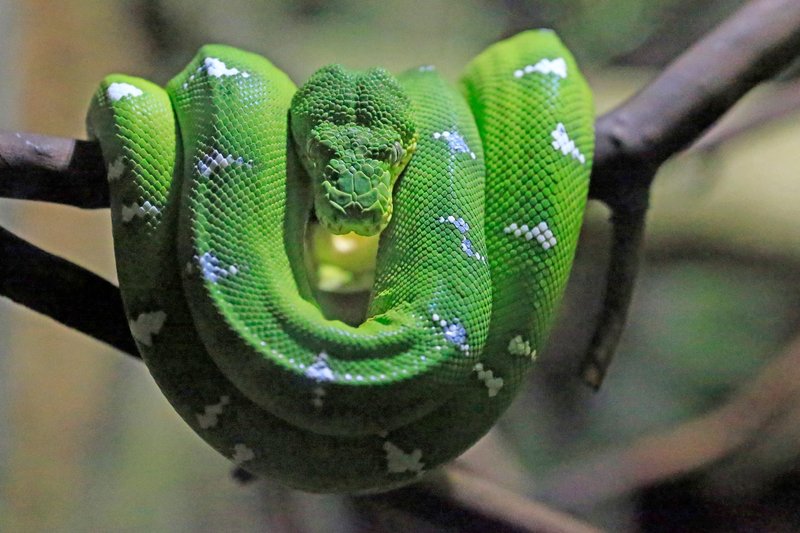
An Amazon Basin specialist — Brazil, Peru, Colombia, Venezuela, the Guianas — that spends nearly its entire life coiled in the branches, descending only to move between trees. Adults run over 6 feet, emerald green with a broken white zigzag stripe down the spine. Proportionally, it has some of the largest teeth of any snake species, useful for punching through feathers when it snatches birds mid-flight. Juveniles start on frogs and lizards and graduate to warm-blooded prey once they’re big enough to handle it. Nonvenomous — it kills by constriction, ambushing from a branch coil rather than chasing anything down.
8. Eyelash Viper
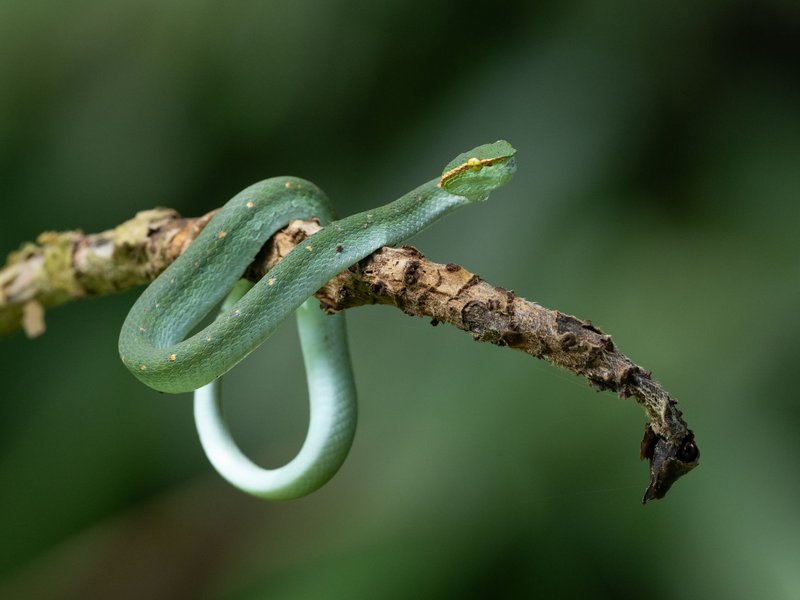
One of the smaller venomous snakes in Central America, averaging around 2 feet, named for the bristly modified scales above each eye that break up its outline against foliage. Color is wildly variable — green, yellow-gold, brown, orange, even red morphs turn up in the same population, from southern Mexico down through Costa Rica and Colombia into northern South America. It’s arboreal and ambushes from low branches, delivering a hemotoxic bite that’s rarely fatal to humans but still worth respecting; this is a snake you’re more likely to find at eye level than underfoot.
9. Boa Constrictor
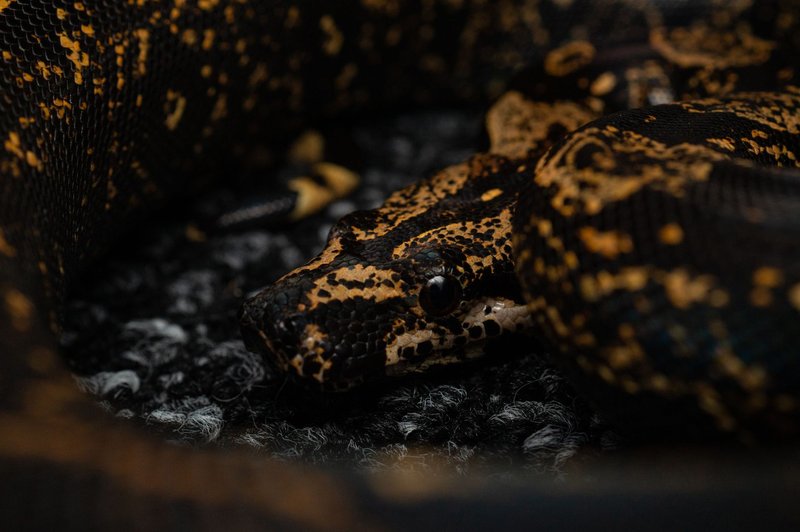
Heavier-bodied and more ground-based than its emerald cousin, the boa constrictor forages mainly on the rainforest floor at night but climbs when the hunt calls for it, sometimes suspending from branches 40 feet up to ambush prey below. Amazonian adults average 6 to 10 feet. Nonvenomous, and ecologically important — by keeping rodent populations in check, it does work that ripples through the rest of the forest food web.
Venomous or Not? How to Tell at a Glance
Pupil shape gets repeated as a rule of thumb — vertical, cat-like pupils in pit vipers, round pupils in nonvenomous species — and it’s genuinely useless in practice. Every snake’s pupils round out in low light, and coral snakes, which are highly venomous, have round pupils regardless. It’s also the kind of check that requires getting close enough to look, which defeats the purpose.
Head shape is a little more reliable but still not a clean rule. Pit vipers — rattlesnakes, copperheads, cottonmouths, eyelash vipers — tend toward a triangular head with a narrow neck, built to house venom glands. But plenty of harmless snakes flatten their heads into the same triangular shape when they feel threatened, specifically to look more dangerous. A garter snake doing its best defensive impression can momentarily fool you.
The more dependable cues: a heat-sensing pit between the eye and nostril (present only in pit vipers), a rattle, or a defensive display like the cottonmouth’s mouth gape. None of those require closing the distance. The honest answer is that no single feature — not color, not pattern, not head shape — reliably separates venomous from harmless across every species. Treat any snake you can’t positively identify as venomous until proven otherwise, and identify it from a photo afterward, not up close.
What to Do If You Meet One on the Trail
Most bites happen because someone put a hand or foot somewhere they couldn’t see it — reaching over a log, stepping across a rock ledge, gathering firewood in the dark. Stay on marked trails, watch where you place your hands and feet around logs and rock piles, and give any snake you spot a wide berth. It wants to leave as badly as you want it to.
If you do get bitten, the U.S. Forest Service is blunt about it: call 911 immediately and stay as still as possible, since movement speeds venom through the bloodstream faster. Skip the folk remedies — no cutting the wound, no sucking out venom, no tourniquet. Remove rings or tight clothing near the bite before swelling sets in, note the time, and get to a hospital. The snake, in nearly every one of these encounters, was never trying to start anything. It was just there first.