More than half of all land animals and plants on Earth live in rainforests, even though these forests cover about 6% of the planet’s land surface. That number gets quoted everywhere, and it’s true. But almost every “rainforest animals” list you’ll find treats “rainforest” as a synonym for “the Amazon.” Macaws, jaguars, sloths, poison dart frogs — all South American, all wonderful, and all missing the gorillas of the Congo and the orangutans of Borneo entirely.
This list fixes that. We’ve sorted 23 animals two ways: by the layer of the forest they call home (the floor, the understory, the canopy, the emergent treetops) and by the continent where they live. A jaguar and a gorilla never meet in the wild, and pretending they share an ecosystem flattens what makes each rainforest its own world.
Table of Contents
- Rainforests Have Floors (Four of Them)
- Quick-Fact Table
- Forest Floor Animals
- Understory Animals
- Canopy Animals
- Emergent Layer Animals
- Beyond the Amazon: Congo and Southeast Asia
- Frequently Asked Questions
Rainforests Have Floors (Four of Them)
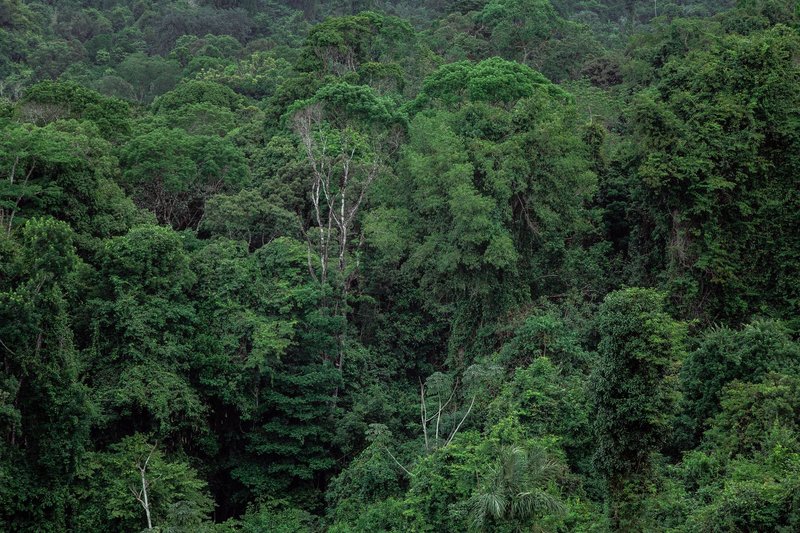
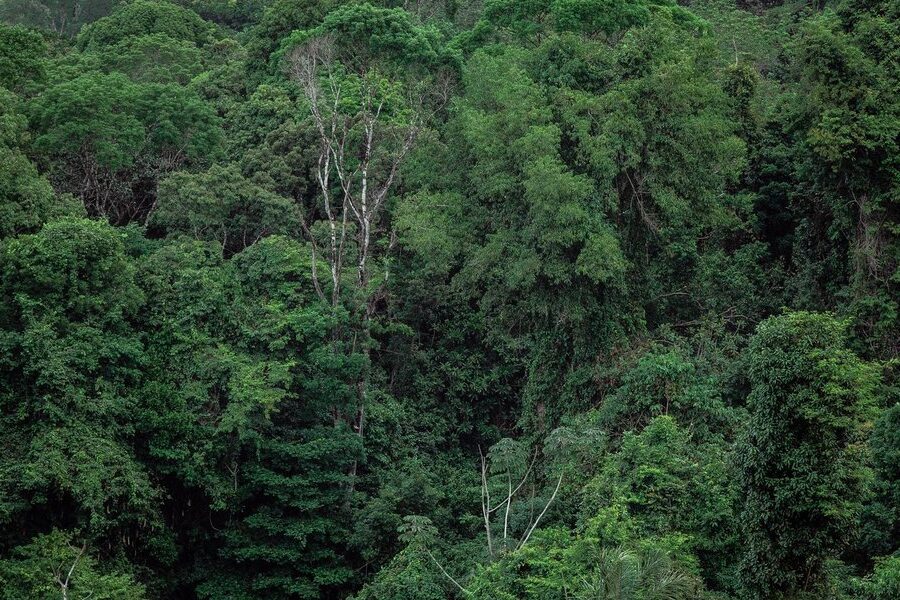
A tropical rainforest is stacked like a building, and animals sort themselves by floor.
- Forest floor — Dark and humid. Less than 2% of sunlight reaches it. Home to the big ground-dwellers and the decomposers.
- Understory — A tangle of shrubs and young trees below the main canopy. Still dim, full of insects, frogs, and ambush hunters.
- Canopy — The dense roof of leaves around 60 to 100 feet up. This is where most rainforest life happens: fruit, flowers, and the animals that eat them.
- Emergent layer — The handful of giant trees that punch through the canopy, exposed to full sun, wind, and the largest birds of prey.
Knowing the layer tells you almost everything about an animal’s body. Canopy animals have grip — prehensile tails, opposable thumbs, hooked claws. Floor animals have bulk and camouflage. Once you see the pattern, the whole list reads differently.
Quick-Fact Table
| Animal | Region | Layer | Diet | Conservation Status |
|---|---|---|---|---|
| Jaguar | Amazon | Floor | Carnivore | Near Threatened |
| Capybara | Amazon | Floor | Herbivore | Least Concern |
| Lowland tapir | Amazon | Floor | Herbivore | Vulnerable |
| Green anaconda | Amazon | Floor | Carnivore | Least Concern |
| Poison dart frog | Amazon | Understory | Insectivore | Varies by species |
| Jaguarundi | Amazon | Understory | Carnivore | Least Concern |
| Three-toed sloth | Amazon | Canopy | Herbivore | Least Concern |
| Howler monkey | Amazon | Canopy | Herbivore | Least Concern |
| Blue morpho butterfly | Amazon | Canopy | Nectar/rot | Not evaluated |
| Toco toucan | Amazon | Canopy | Omnivore | Least Concern |
| Kinkajou | Amazon | Canopy | Frugivore | Least Concern |
| Scarlet macaw | Amazon | Emergent | Frugivore | Least Concern |
| Harpy eagle | Amazon | Emergent | Carnivore | Vulnerable |
| Western lowland gorilla | Congo | Floor | Herbivore | Critically Endangered |
| Okapi | Congo | Floor | Herbivore | Endangered |
| Forest elephant | Congo | Floor | Herbivore | Critically Endangered |
| Bonobo | Congo | Canopy/floor | Omnivore | Endangered |
| African grey parrot | Congo | Canopy | Frugivore | Endangered |
| Bornean orangutan | SE Asia | Canopy | Frugivore | Critically Endangered |
| Sumatran tiger | SE Asia | Floor | Carnivore | Critically Endangered |
| Proboscis monkey | SE Asia | Canopy | Herbivore | Endangered |
| Rhinoceros hornbill | SE Asia | Canopy | Omnivore | Vulnerable |
| Reticulated python | SE Asia | Floor | Carnivore | Least Concern |
Forest Floor Animals
1. Jaguar
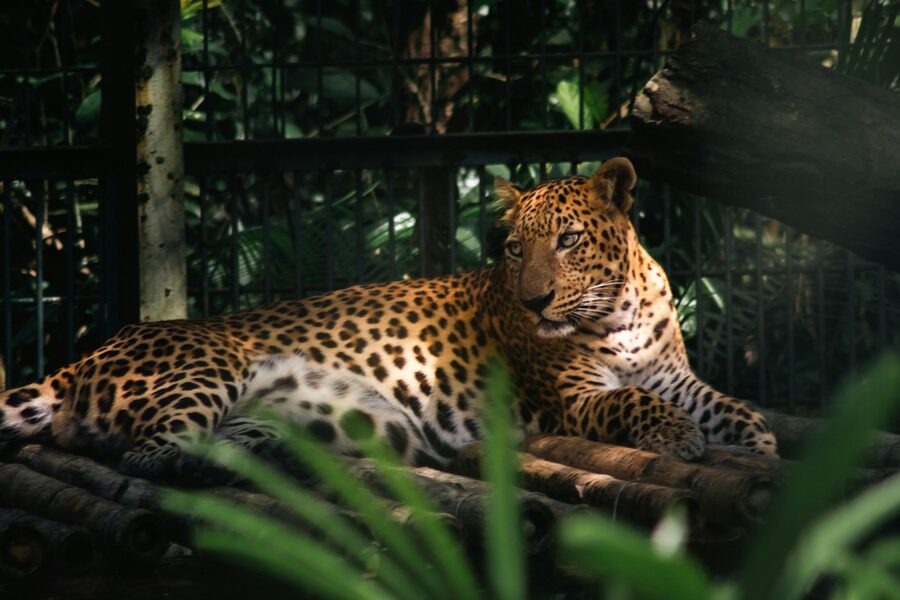
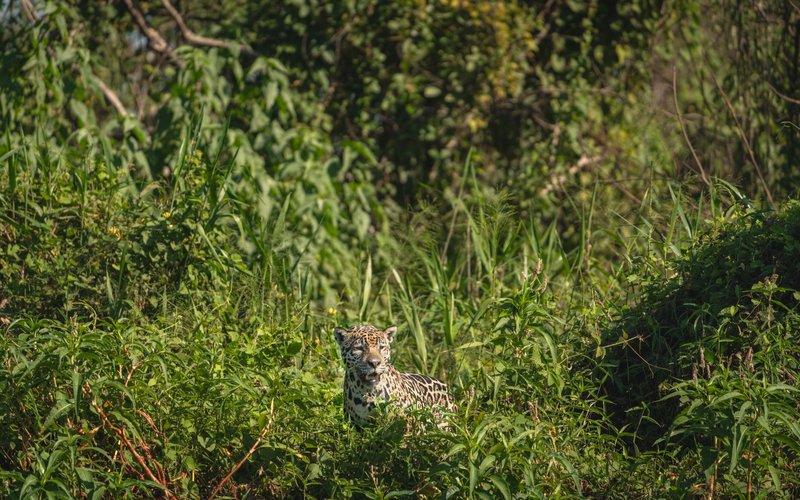
The jaguar has the strongest bite relative to size of any big cat, and it uses it differently than lions or tigers do. Instead of a throat clamp, a jaguar bites straight through the skull, piercing the brain. That’s why it can take prey most cats avoid — caimans, turtles, even the armored shells of river turtles. It’s the only one of the four “big cats” native to the Americas, and a healthy adult patrols a territory of dozens of square miles along Amazon riverbanks. The IUCN lists the jaguar as Near Threatened, with habitat loss the main pressure. It sits at the top of a hunting hierarchy that runs through every level of the forest, and the predators of each rainforest layer divide the territory so neatly that the jaguar rarely competes with the hunters above it.
2. Capybara
The world’s largest rodent, the size of a medium dog, and so relaxed that other animals literally use it as furniture — birds perch on its back, monkeys sit on it. Capybaras are semi-aquatic, with slightly webbed feet, and they dive underwater to escape jaguars and anacondas. They can hold their breath for up to five minutes. They live in groups of ten to twenty along Amazon waterways and graze on grasses and aquatic plants like oversized guinea pigs, which is exactly what they’re related to.
3. Lowland Tapir
A tapir looks like someone built a pig and a small elephant from the same kit. The short, flexible snout is a mini-trunk it uses to grab leaves and fruit. Tapirs are excellent swimmers and will walk along river bottoms to feed or hide. They’re also crucial seed dispersers — a single tapir spreads thousands of seeds across the forest in its dung, which is why ecologists call them “gardeners of the forest.” They’re listed as Vulnerable.
4. Green Anaconda
The green anaconda is the heaviest snake on Earth — not the longest (that’s the reticulated python), but the bulkiest, with big females topping 200 pounds. It’s an ambush predator that lies submerged in slow Amazon water with only its eyes and nostrils breaking the surface, then constricts prey and drags it under. It doesn’t venom anything; it suffocates. Despite the reputation, attacks on humans are extraordinarily rare. It hunts capybara, caiman, and deer.
Understory Animals
5. Poison Dart Frog
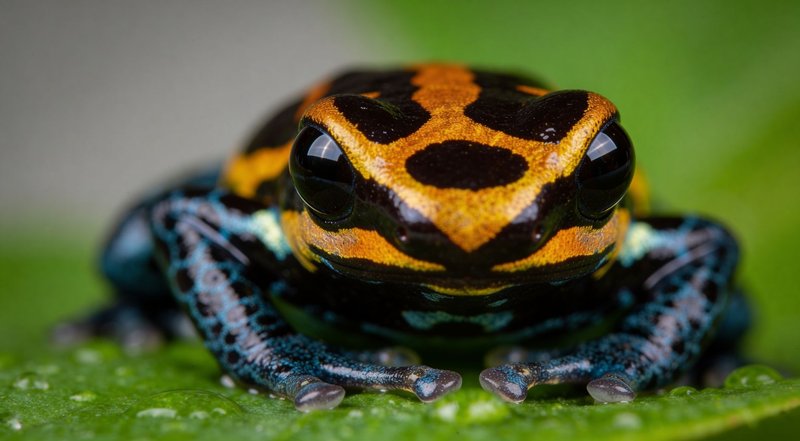
Some of these frogs carry enough toxin to kill ten adult humans, and the brightest colors usually mean the deadliest skin. The golden poison frog of Colombia is the most toxic of all. Here’s the twist: captive-bred dart frogs are completely harmless, because the poison comes from their diet of wild ants and mites. No toxic insects, no toxic frog. Indigenous Emberá people once tipped blow darts with the secretions, which is where the name comes from. Conservation status varies widely by species, with several critically endangered.
6. Jaguarundi
The cat nobody talks about. A jaguarundi is small, long-bodied, and weasel-shaped, with a coat that comes in either grey or rusty red. Unlike most cats, it’s active during the day and prefers the dense understory tangle to the open. It hunts birds, reptiles, and rodents close to the ground and makes an unusually wide range of sounds — chirps, whistles, even a bird-like call. It’s still listed as Least Concern across most of its range.
Canopy Animals
7. Three-Toed Sloth
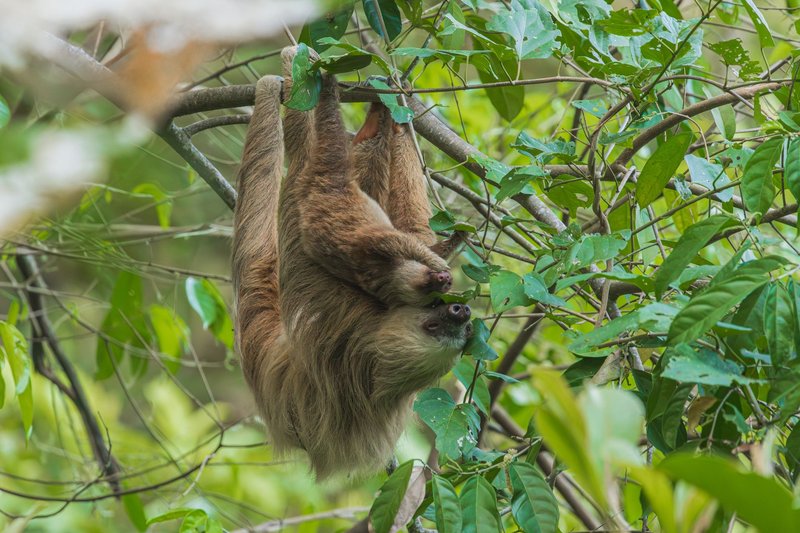
A sloth moves so slowly that algae grows in its fur, which is the point — the green tint is camouflage. That slow metabolism is a survival strategy in a world of jaguars and harpy eagles: a motionless sloth is nearly invisible. They digest leaves so slowly that a single meal can take a month to process, and they descend from the canopy only about once a week to defecate, the most dangerous thing they do all week. Their grip is so strong that sloths sometimes stay hanging from a branch after death.
8. Howler Monkey
The loudest land animal in the Americas. A howler’s call carries up to three miles through dense forest, produced by an enlarged hyoid bone in the throat that works like an amplifier. Troops howl at dawn to announce territory without ever having to fight over it — sound is cheaper than blood. They spend most of their lives in the canopy eating leaves, using a prehensile tail that works like a fifth limb, strong enough to support their full weight.
9. Blue Morpho Butterfly
The brilliant blue isn’t pigment — it’s structure. Microscopic scales on the wings bend light so only blue reflects back, which is why a blue morpho seems to flash and vanish as it flies. The underside of the wing is dull brown with eyespots, so a resting morpho disappears. The wingspan reaches eight inches. Adults don’t even eat flowers; they feed on rotting fruit, tree sap, and fungus through a strawlike proboscis.
10. Toco Toucan
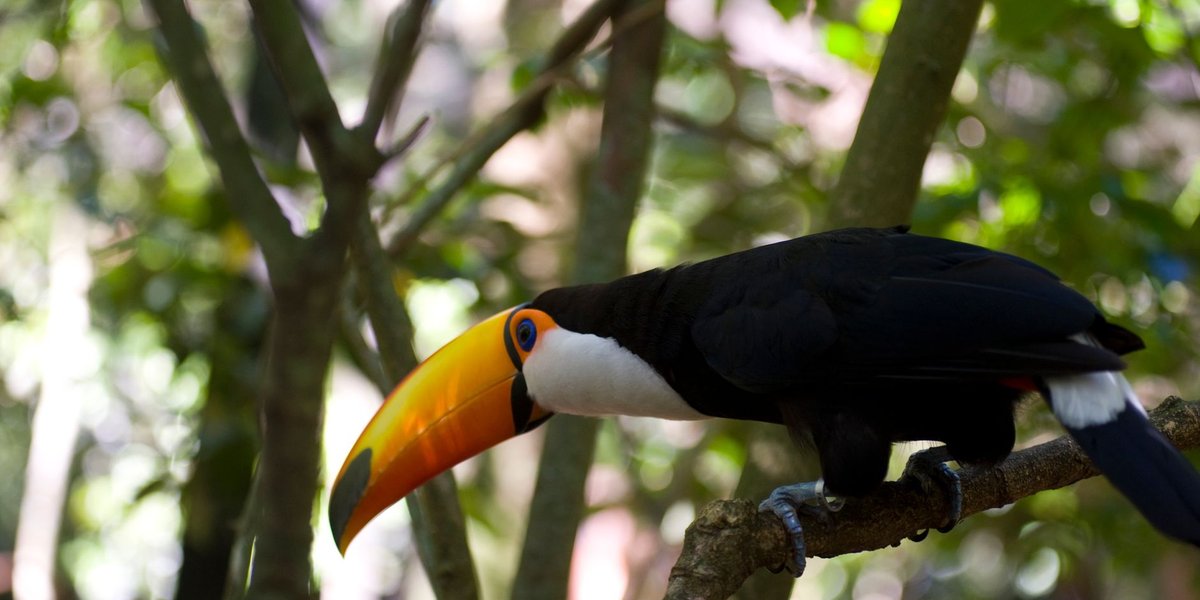
That oversized bill looks like it should be heavy, but it’s mostly hollow keratin and barely weighs anything. It’s a thermostat — toucans dump body heat through the bill by adjusting blood flow, the way an elephant uses its ears. The reach also lets them pluck fruit from branches too thin to perch on. Tocos are the largest toucan species and live in the Amazon’s canopy edges, eating fruit, insects, and the occasional egg.
11. Kinkajou
A rainforest animal most people have never heard of, and one of the few mammals with a fully prehensile tail it uses like a fifth hand. Kinkajous are nocturnal, golden-furred, and related to raccoons, not monkeys, despite living entirely in the trees. They’re major pollinators — their long tongues reach deep into flowers for nectar, picking up pollen as they go. Locals call them “honey bears” for their taste for it. If the kinkajou is new to you, it keeps company with plenty of other interesting forest animals you’ve probably never heard of that get crowded out of the usual lists.
Emergent Layer Animals
12. Scarlet Macaw
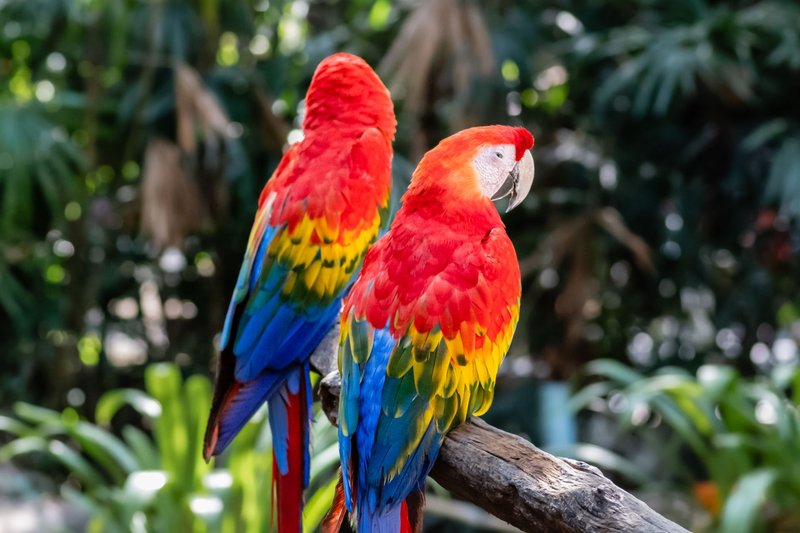
The poster bird of the Amazon, and for good reason — a three-foot wingspan in red, yellow, and blue. Scarlet macaws mate for life and can live 50 years or more in the wild. They gather at exposed riverbank clay licks to eat mineral-rich clay, which scientists think neutralizes toxins in the unripe seeds they eat. Their beaks generate enough force to crack Brazil nuts, the hardest shells in the forest. You’ll hear a flock before you see it.
13. Harpy Eagle
One of the most powerful birds of prey on the planet, with talons the size of a grizzly bear’s claws — about five inches. The harpy hunts from the emergent layer and snatches sloths and monkeys straight out of the canopy, killing animals nearly its own weight. A female can weigh 20 pounds. They build enormous stick nests in the tallest trees and raise just one chick every two to three years, which is part of why they’re listed as Vulnerable and disappearing as the giant emergent trees get logged.
Beyond the Amazon: Congo and Southeast Asia
The Amazon is the headline act, but the world’s second-largest rainforest sits in the Congo Basin, and the oldest rainforests on Earth — over 100 million years old — are in Southeast Asia. These forests have animals you won’t find anywhere else, and most of them are in serious trouble.
14. Western Lowland Gorilla (Congo)
The largest primate on Earth, and gentler than the chest-beating reputation suggests. Gorilla groups are led by a single silverback male, and the bulk of the diet is leaves, stems, and fruit. They build a fresh nest of bent branches to sleep in every single night, never reusing one. They’re Critically Endangered — poaching and the Ebola virus have wiped out huge portions of the population.
15. Okapi (Congo)
The okapi has zebra-striped legs and the body of a small horse, but its closest living relative is the giraffe — same long, blue-black prehensile tongue, long enough to clean its own ears. It was unknown to Western science until 1901, which is remarkable for an animal this size. Okapis are solitary, shy, and live only in the dense Ituri rainforest of the Democratic Republic of Congo. They’re Endangered.
16. African Forest Elephant (Congo)
Smaller than the savanna elephant, with straighter, downward-pointing tusks better suited to moving through dense forest. They’re vital seed dispersers — some Congo tree species barely regenerate without an elephant eating and spreading their seeds. Recently confirmed as a separate species, the forest elephant is Critically Endangered, hit hard by ivory poaching.
17. Bonobo (Congo)
Bonobos share about 98.7% of our DNA, tied with chimpanzees as our closest living relatives. They live only south of the Congo River and nowhere else on Earth. Famously, bonobo society is female-led and resolves conflict through social bonding rather than aggression — a sharp contrast to chimps. They split their time between the canopy and the forest floor, foraging fruit. Endangered, with a wild population concentrated in a single country.
18. African Grey Parrot (Congo)
The smartest bird in the world, by most measures. African greys can learn hundreds of words and use them in context, not just mimic — the famous research bird Alex understood concepts like color, shape, and quantity. They flock in the Congo canopy and eat fruit and nuts. Demand for the pet trade has been so intense that wild populations have collapsed, and the species is now Endangered.
19. Bornean Orangutan (Southeast Asia)
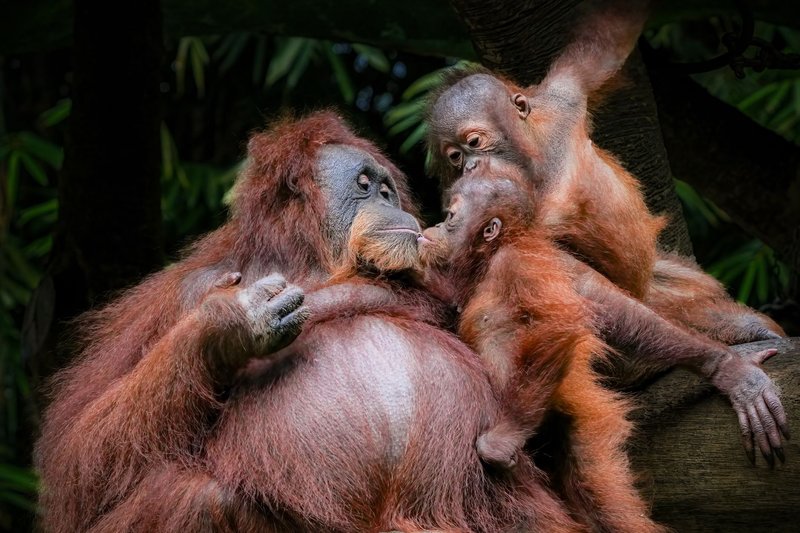
The only great ape in Asia and the largest tree-dwelling mammal alive. Orangutans are so heavy that they sway trees back and forth to cross gaps in the canopy rather than jumping. They’re strikingly intelligent — they use tools, build a new sleeping nest every night, and a young orangutan stays with its mother for up to eight years, one of the longest childhoods in the animal kingdom. Palm oil deforestation has made them Critically Endangered.
20. Sumatran Tiger (Southeast Asia)
The smallest living tiger subspecies, adapted for slipping through dense jungle, with the narrowest, darkest stripes of any tiger and slightly webbed paws for swimming. Fewer than 400 are thought to remain in the wild, all on the island of Sumatra. It’s Critically Endangered, and the loss of its rainforest to palm oil and paper plantations is the central reason.
21. Proboscis Monkey (Southeast Asia)
Found only in Borneo, and impossible to mistake — the males have a huge, pendulous nose that amplifies their honking calls and signals fitness to females. They’re champion swimmers with partially webbed feet, and they’ll leap from canopy branches into rivers, sometimes from 50 feet up. Their potbellied digestive system ferments leaves like a cow’s stomach. Endangered, as Borneo’s mangrove and riverine forests shrink. The proboscis monkey is one of a long roster of animals found only in Malaysia and the surrounding islands, a region whose isolation has bred species that exist nowhere else on Earth.
22. Rhinoceros Hornbill (Southeast Asia)
Named for the casque, the upturned horn on top of its bill that looks like a rhino’s. The nesting behavior is the strange part: the female seals herself inside a tree hollow with mud, leaving only a narrow slit, and the male feeds her through it for months while she raises the chicks in safety. It’s the state bird of several Malaysian regions and a key seed disperser. Listed as Vulnerable.
23. Reticulated Python (Southeast Asia)
The longest snake in the world, with reliably documented individuals over 20 feet and credible reports of much larger. The “reticulated” name refers to the net-like pattern that breaks up its outline against the leaf litter of the Southeast Asian forest floor. It’s a non-venomous constrictor that hunts everything from rats to deer and pigs. Unlike most giant snakes, it has adapted well to human-altered landscapes and remains Least Concern.
Frequently Asked Questions
What animals live in the rainforest? Rainforests host an enormous range, from jaguars and capybaras on the forest floor to sloths and macaws in the trees. The specific animals depend on the continent — the Amazon has macaws and anacondas, the Congo has gorillas and okapi, and Southeast Asia has orangutans and tigers. No single species lives in all three.
What is the most endangered rainforest animal? Several are Critically Endangered, including the Sumatran tiger (under 400 left), the Bornean orangutan, the western lowland gorilla, and the African forest elephant. Habitat loss from logging and palm oil, plus poaching, are the main threats across all of them.
What do rainforest animals eat? It splits by layer. Canopy animals mostly eat fruit, leaves, and nectar (sloths, monkeys, toucans). Forest-floor predators like jaguars and pythons hunt meat. Many large herbivores — tapirs, elephants — double as seed dispersers, which is why losing them damages the whole forest.
Why do so many rainforest animals live in the canopy? The canopy is where the food is. Most of a rainforest’s fruit, flowers, and new leaves grow in that sunlit roof of branches, so the animals follow. It’s also safer than the open floor, which is why canopy species evolved prehensile tails, gripping hands, and strong claws to stay up there.
How do rainforest animals adapt to their environment? Through specialized bodies built for their layer. Prehensile tails and opposable thumbs for climbing, bright warning colors or camouflage for defense, hollow bills that shed heat, and toxic skin fueled by diet. The okapi’s tongue, the toucan’s bill, and the sloth’s algae-coat are all answers to the same problem: surviving a crowded, competitive forest.