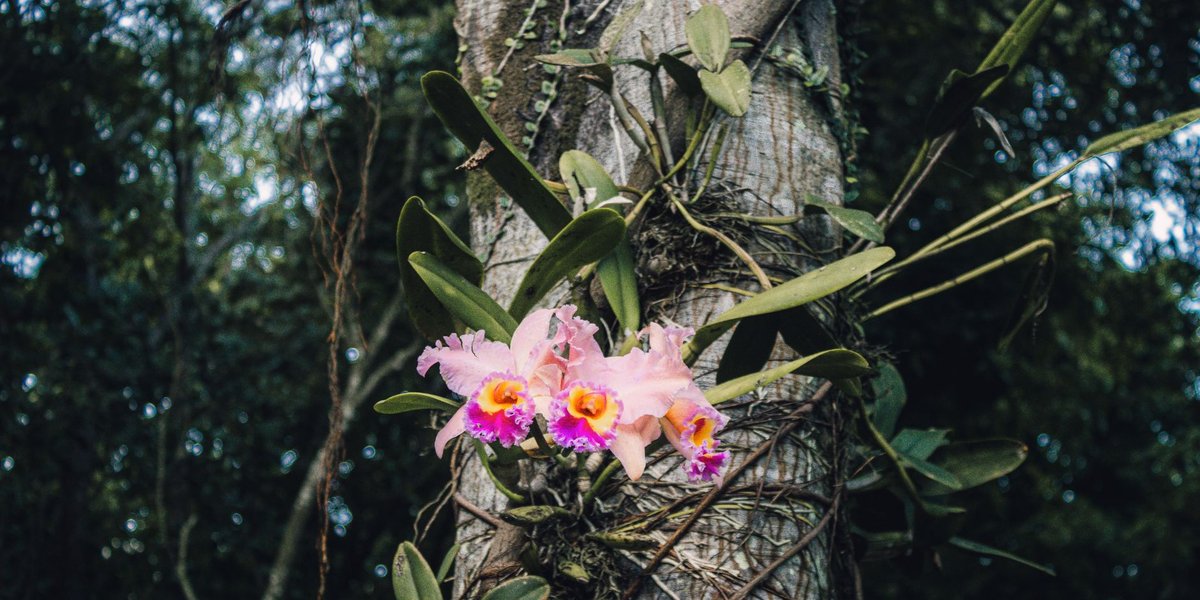
Look up in a tropical rainforest and most of the orchids aren’t in the soil. They’re 30 meters overhead, wedged into the bark of a branch, roots dangling in open air, surviving on rain, fog, and whatever leaf litter blows their way. That’s the part the “28,000 species, three growth types” articles tend to skip: rainforest orchids aren’t plants that happen to grow in the forest. They’re plants that solved the problem of living where almost nothing else can.
The orchid family is the largest family of flowering plants on Earth, with around 28,000 accepted species, and the tropics are where the family went genuinely strange. This is a guide to how those orchids physically pull it off, which ones to know by region, the borderline-criminal tricks they use to get pollinated, and why a lot of them are in trouble.
Table of Contents
- Why most rainforest orchids live in trees
- The adaptations that make it work
- Notable species by region
- How rainforest orchids fool their pollinators
- What’s threatening them
- The takeaway
Why most rainforest orchids live in trees
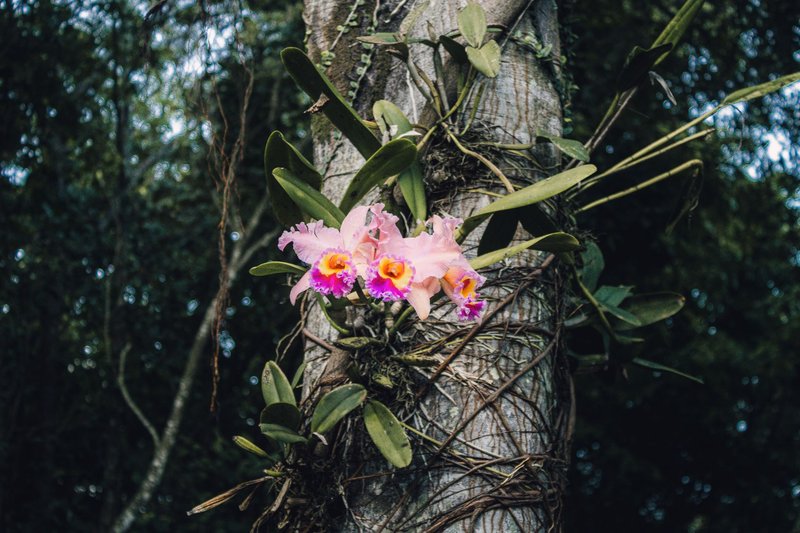
The rainforest floor is a bad place to be a small plant. Almost no light reaches it — the canopy intercepts the overwhelming majority of incoming sunlight before it gets anywhere near the ground. So a huge share of tropical orchids skipped the floor entirely and moved up.
Botanists sort them into three strategies. Epiphytic orchids grow on other plants, usually tree trunks and branches, without taking nutrients from them — they’re tenants, not parasites. Lithophytic orchids do the same thing on rock faces. Terrestrial orchids root in the ground the conventional way, and in tropical rainforests they’re the minority. Epiphytes dominate, and that single choice drives nearly every weird feature that follows.
Living on a branch means no soil to hold water, no soil to hold nutrients, and nothing to anchor you when the wind comes through. An epiphytic orchid has to invent a substitute for all three. That’s the real story of rainforest orchids — a plant solving, mid-air, every problem that soil normally solves for free.
The adaptations that make it work
The clever part isn’t that orchids climbed into the canopy. It’s the toolkit they evolved once they got there.
Aerial roots wrapped in velamen. Epiphytic orchids send roots into the air rather than the ground, and those roots are sheathed in a spongy, silvery-white layer of dead cells called velamen. The velamen acts like blotting paper: when rain hits it, it soaks up water and dissolved minerals fast, then seals that moisture in against the dry stretches between storms. It’s also why a healthy orchid root looks chalky-grey when dry and turns green within seconds of getting wet.
Thick, water-hoarding leaves and pseudobulbs. Many tropical orchids store water in swollen stem segments called pseudobulbs — the little bulbous structures at the base of the leaves. Combined with thick, waxy leaves that limit evaporation, this lets the plant ride out the surprisingly arid microclimate of a sun-exposed branch. A rainforest is humid overall, but a perch high in the canopy dries out fast between downpours.
CAM photosynthesis. This is the adaptation that separates orchids from your average houseplant. Most plants open their leaf pores during the day to take in carbon dioxide, and lose water doing it. Many epiphytic orchids use crassulacean acid metabolism (CAM) instead: they open their pores at night, when it’s cooler and more humid, store the CO2 as an acid, and run photosynthesis during the day with the pores shut. The result is a plant that photosynthesizes without bleeding water under the midday sun — the same trick cacti use, evolved independently in the treetops.
Dust-like seeds. A single orchid seed pod can release hundreds of thousands to millions of seeds, each one essentially a speck of dust with no food reserves of its own. They blow on air currents and lodge in bark crevices high up. The catch: with no stored food, a germinating orchid seed depends on a partnership with specific soil and bark fungi (mycorrhizae) to feed it through its earliest stage. No fungus, no seedling. It’s a gamble at a massive scale, and the vast majority of those millions of seeds never make it.
Strip those four features out and a rainforest orchid is just a houseplant that froze to death on a branch. Together, they’re a complete life-support system for living on air.
Notable species by region
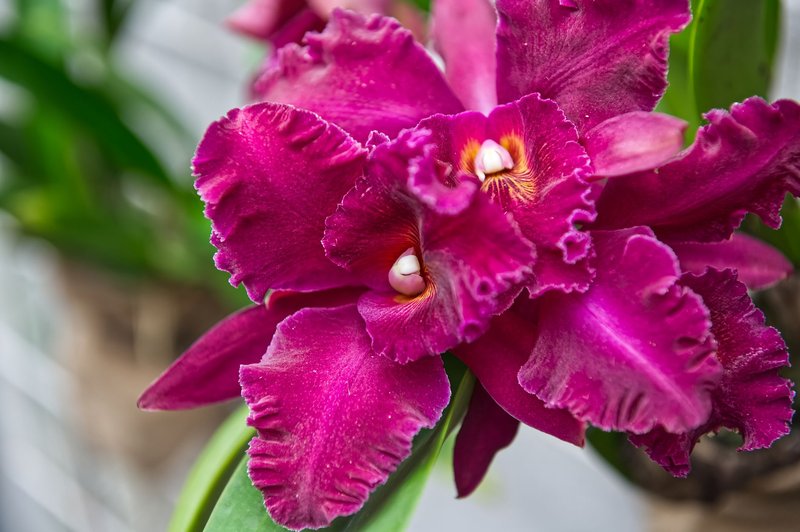
“Tropical rainforest orchid” covers three very different botanical worlds. Here’s how the major rainforest regions stack up, then the species worth knowing in each.
| Region | Signature genera | What sets them apart |
|---|---|---|
| Amazon Basin | Cattleya, Oncidium, Sobralia | Large, showy flowers; the “classic” corsage orchids trace back here |
| Southeast Asia | Dendrobium, Bulbophyllum, Phalaenopsis | Staggering species diversity; many tiny, bizarre, foul-smelling flowers |
| Australian rainforest | Dendrobium, Cooktown orchid | Fewer species, several iconic regional emblems |
Amazon and Central/South America
The American tropics gave the world the orchids most people picture. Cattleya is the headliner — big, ruffled, lavender-to-magenta blooms that became the original florist’s “orchid corsage.” Oncidium, the “dancing lady,” scatters dozens of small yellow flowers on branching sprays that genuinely look like a crowd of figures in skirts. Sobralia breaks the rainforest-orchid stereotype by growing terrestrially and producing large Cattleya-like flowers that often last only a single day before the plant fires off the next one. These genera are only a slice of the Amazon rainforest flora that shares their crowded, towering habitat.
Southeast Asia
If you want sheer variety and weirdness, this is the region. Bulbophyllum is the largest orchid genus of all, with well over 2,000 species, and many of them are pollinated by flies — which means they’re built to smell like rot, carrion, or worse. Dendrobium spans thousands of species from the Himalayan foothills through the islands, ranging from delicate sprays to robust canes. And Phalaenopsis, the moth orchid, is the flat-faced white-and-pink orchid sold in every supermarket on Earth — a wild epiphyte from the Southeast Asian rainforest before it became the world’s most domesticated orchid. Native orchids like these sit alongside the rest of the flowers of Malaysia, from the towering Rafflesia to the national red hibiscus.
Australian rainforest
Australia’s tropical rainforests, concentrated in the wet tropics of Queensland, host their own standouts. The Cooktown orchid (Dendrobium bigibbum) is the floral emblem of Queensland — a purple-pink epiphyte that grows on trees and rocks in the far north. It’s a textbook rainforest Dendrobium: tough, perched on bark, and built for a climate that swings between monsoon and dry season.
How rainforest orchids fool their pollinators
This is where orchids stop being pretty and start being genuinely cunning. A large fraction of orchid species don’t reward their pollinators at all — they deceive them, and a surprising number offer no nectar whatsoever.
Sexual deception. Some orchids mimic the appearance and scent of a female insect well enough that male wasps or bees try to mate with the flower. The frustrated male leaves with a packet of pollen stuck to his body and carries it to the next decoy. No nectar changes hands. The orchid gets pollinated for free by exploiting the insect’s instincts.
Food deception. Other orchids look and smell like flowers that do offer nectar — bright colors, the right perfume — but deliver nothing. Pollinators learn to avoid them eventually, which is exactly why these orchids tend to be scattered and uncommon rather than growing in dense stands. Rarity keeps the con working.
Carrion and dung mimicry. Many Bulbophyllum species are pollinated by flies, so they advertise to flies: smells of rotting meat, dung, or fungus, often paired with dull red-and-brown mottled flowers and sometimes a hinged lip that see-saws the insect into the right position. The fly shows up expecting a place to lay eggs, finds nothing, and leaves dusted with pollen.
The unifying trait is the pollinium — orchids package their pollen into compact masses rather than loose grains, and the whole packet gets glued onto a single visiting insect. That’s efficient, but it also makes many orchids dependent on one specific pollinator species. Lose that one insect, and the orchid can’t reproduce at all. Which leads straight to the next problem.
What’s threatening them
Tropical rainforest orchids sit at the intersection of two vulnerabilities: they need intact forest, and many need one specific partner to survive. Both are under pressure.
Habitat loss. Epiphytes live on mature trees in undisturbed canopy. Clear the forest for timber, agriculture, or cattle and you don’t just remove the orchids — you remove the trees they grow on and the fungi their seeds depend on, all at once. A logged-and-replanted forest doesn’t carry the same orchid community for decades, if ever.
Overcollection. Because rare wild orchids fetch high prices, poaching from the wild remains a real threat for desirable species — a pattern that shows up across many of the rarest rainforest plants and their conservation statuses. International trade in wild orchids is regulated — all orchids are listed under CITES, the convention controlling trade in endangered species — but enforcement in remote rainforest is thin.
Climate disruption. Orchids with tight relationships — one pollinator, one fungal partner, a narrow temperature and humidity band — have little room to adapt when the climate shifts under them. The IUCN Red List tracks a long and growing roster of threatened orchid species, and specialized rainforest epiphytes are heavily represented.
The cruel math is that the same specialization that makes a rainforest orchid so remarkable — the single pollinator, the specific fungus, the exact perch — is also what makes it fragile.
The takeaway
Tropical rainforest orchids are a master class in living without the things plants normally rely on. No soil, so they grow velamen-wrapped roots that drink from rain and fog. Full sun and dry air on an exposed branch, so they run CAM photosynthesis and hoard water in pseudobulbs. No guarantee of a pollinator, so they evolved deception elaborate enough to fool wasps into courtship. And across the Amazon, Southeast Asia, and the Australian tropics, the family ran that same playbook into tens of thousands of variations.
Knowing what holds them up there — the aerial roots, the night-shift photosynthesis, the con-artist flowers — is also a decent map of what we stand to lose. The next time you see a moth orchid on a supermarket shelf, remember it started life as an epiphyte clinging to a branch in a Southeast Asian rainforest, running on air.