New Zealand has roughly 2,400 native vascular plants, and about 80 percent of them grow nowhere else on Earth. That figure is the short answer to what makes the flora of New Zealand unusual. The longer answer starts 80 million years ago, when the landmass now called Zealandia broke away from Gondwana and drifted off alone.
What followed was a very long experiment with no land mammals. The only native ones are bats. Plants evolved without anything grazing at ground level, and the results still show in the forest today.
Contents
- Why New Zealand’s plants are so different
- Forest giants: kauri, rimu and the podocarps
- Tree ferns and the silver fern
- Pohutukawa and rata
- Alpine flora
- Divaricating shrubs: the plants built like tangles
- Native grasses and tussock
- Quick reference: species, Maori names and where to see them
- Threats to native plants
- How to identify what you’re looking at
- The Flora of New Zealand reference series
Why New Zealand’s plants are so different
Four traits explain most of what you’ll see on a walk.
Evergreen almost everywhere. Winters are mild, so there’s little pressure to drop leaves. Even the beech forests of the south are mostly evergreen, which gives the bush a dense, dark-green look all year.
Bird-dispersed seeds. With no native mammals to eat fruit, birds did the job. Many native plants produce small, brightly coloured berries sized for a beak, and several rely on birds for pollination too.
Small white or green flowers. Insects were the main pollinators, and plenty of them are short-tongued flies and beetles. Showy flowers like pohutukawa and the alpine buttercups are the exceptions.
Few chemical or physical defences. Plants that never met a deer or a possum didn’t need thorns or toxins. When mammals arrived with people, the flora had little to fall back on.
Forest giants: kauri, rimu and the podocarps
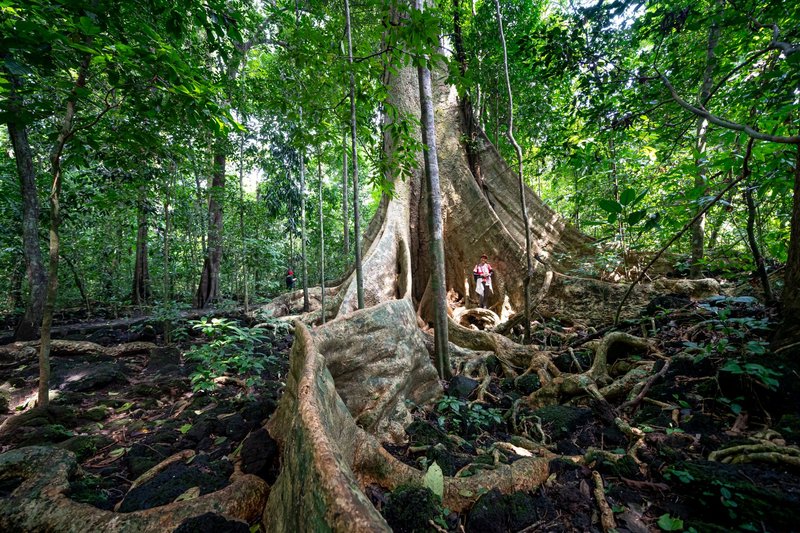
Kauri (Agathis australis) is the headline act. It’s a conifer from a lineage that goes back to the Jurassic, and it grows only in the north of the North Island. Tāne Mahuta, the largest living kauri, stands in Waipoua Forest on the Kauri Coast. It’s around 50 metres tall and well over 13 metres around the trunk, and it’s thought to be at least 1,250 years old. Māori carved waka (canoes) from kauri, and the gum was dug up in huge quantities by European settlers in the 19th century.
Kauri are under attack from a soil-borne disease. Kauri dieback, caused by the organism Phytophthora agathidicida, spreads in mud on boots. The Department of Conservation runs cleaning stations at track entrances in kauri forest. Use them. Every time.
The other giants are the podocarps, conifers that bear their seeds on fleshy stalks rather than in cones:
- Rimu (Dacrydium cupressinum) has drooping, weeping foliage and was the main timber tree for much of the 20th century.
- Tōtara (Podocarpus totara) has thick, furrowed bark that peels in long strips and wood that resists rot. Large tōtara logs were prized for carving.
- Kahikatea (Dacrycarpus dacrydioides) is the tallest tree in the country, reaching roughly 60 metres, and tends to grow in swampy ground.
- Mataī (Prumnopitys taxifolia) has bark that looks hammered, with round pits like a beaten metal pot.
Podocarp-broadleaf forest is the classic lowland forest type. Expect a canopy of these conifers over tawa and rewarewa, with ferns and vines underneath.
Tree ferns and the silver fern
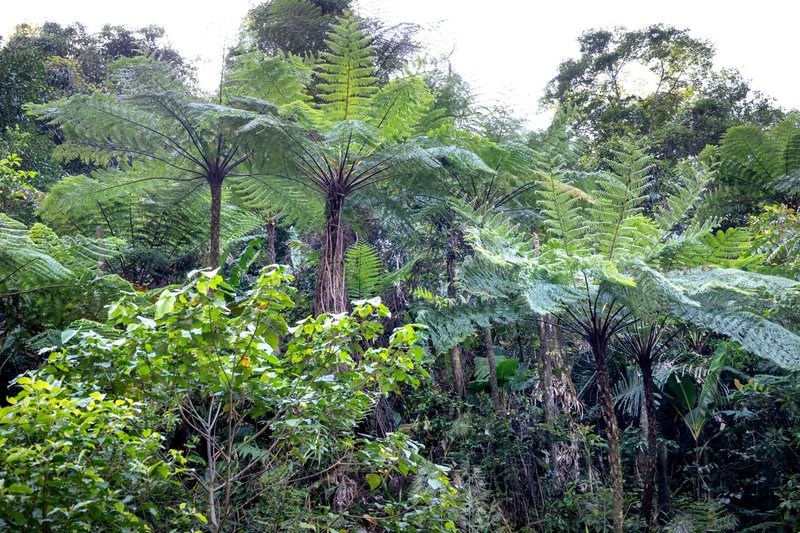
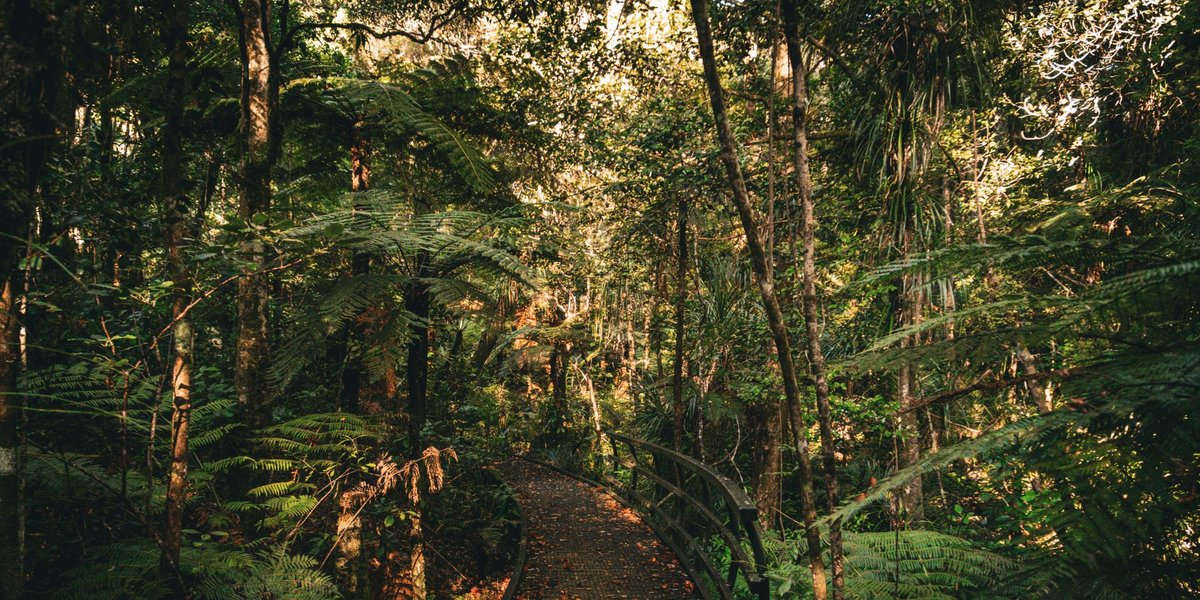
New Zealand has about 200 native ferns and allies, and the tree ferns define the understory. Mamaku (Cyathea medullaris), the black tree fern, is the tallest, with fronds up to several metres long on a black trunk. Ponga, the silver fern (Cyathea dealbata), is the one on the All Blacks jersey and the national emblem.
The underside of a silver fern frond is a bright silvery white. Māori laid fronds on the forest floor with the pale side up so a party could follow a trail by moonlight. The tip of an unfurling frond, the koru, is the shape behind a great deal of Māori art.
Look for tree ferns in almost any damp forest. Tongariro, Fiordland and the Catlins have some of the best.
Pohutukawa and rata
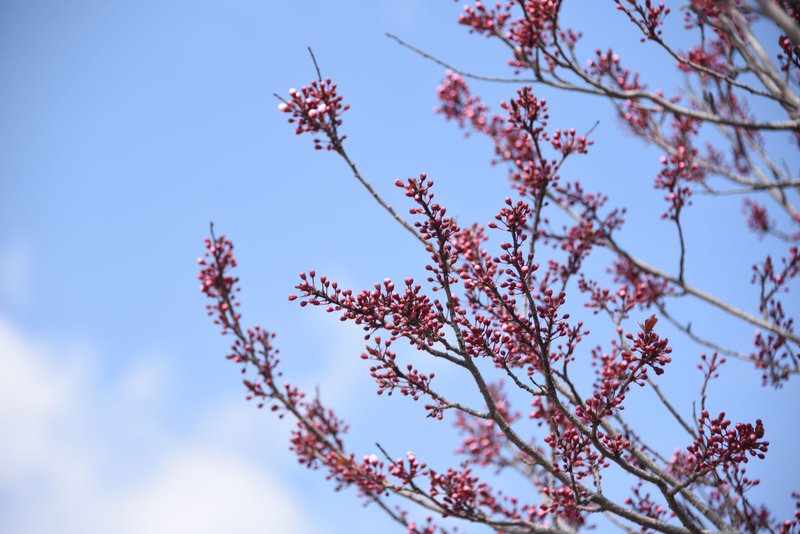
Pohutukawa (Metrosideros excelsa) clings to coastal cliffs and sea-facing slopes in the north. In December it flowers in dense red clusters of stamens, which is why people call it the New Zealand Christmas tree. Old trees spread sideways over beaches, with gnarled, aerial roots hanging from the branches. The Northland and Coromandel coasts and the Bay of Islands are the places to see it.
Its relatives, the rata, have a stranger life. Northern rata often starts as an epiphyte, seeding in the fork of a host tree. Its roots drop to the ground, thicken and eventually enclose the host. Southern rata (Metrosideros umbellata) forms red-flowering forests in the south of the South Island and on the subantarctic islands. Fiordland is a good bet.
Pohutukawa is one of the plants that suffered most from possums, which strip the foliage. Pest control has brought many stands back.
Alpine flora
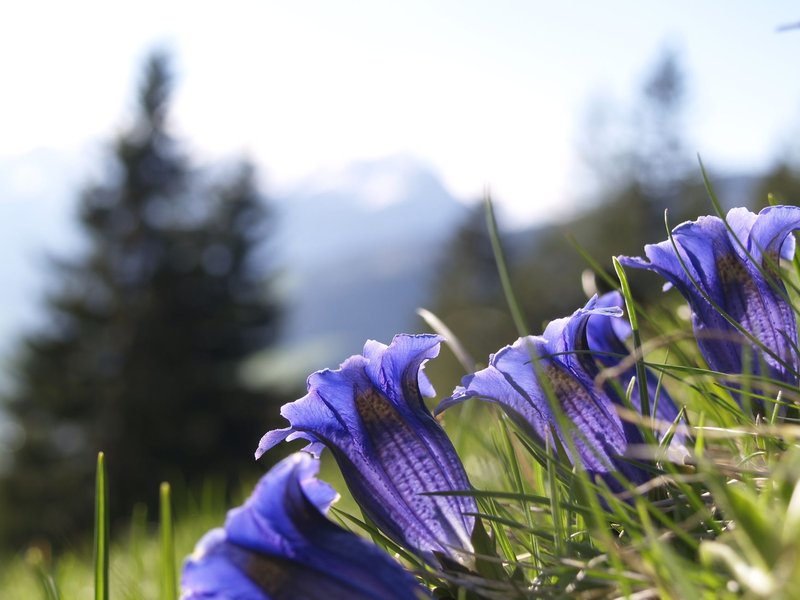
The Southern Alps rise above the treeline at about 1,000 to 1,400 metres, and the plants above it are among the country’s best. Most of New Zealand’s alpine plants are endemic, and the area is one of the most plant-rich alpine regions in the Southern Hemisphere.
The ones worth seeking out:
- Mount Cook lily (Ranunculus lyallii) is actually the world’s largest buttercup. It has big, round, glossy leaves and clusters of white flowers with yellow centres. It blooms in November and December, and the track up the Hooker Valley is the standard place to look.
- Mountain daisies (Celmisia) cover the slopes in white from spring to summer. There are more than 60 species, and the leaves are often silver and leathery. Arthur’s Pass National Park is a good place for them.
- Vegetable sheep (Raoulia species) are dense cushion plants that look like sheep or boulders from a distance. Up close they’re thousands of tiny, tightly packed leaves. The cushion traps warmth and holds in moisture.
- Edelweiss-like species, including Leucogenes grandiceps, which is called South Island edelweiss, are covered in white woolly hairs.
Alpine plants here have the same trouble as everywhere: a short growing season, wind, and cold. The flora just invented its own solutions, and cushions and hairy leaves show up repeatedly.
Divaricating shrubs: the plants built like tangles
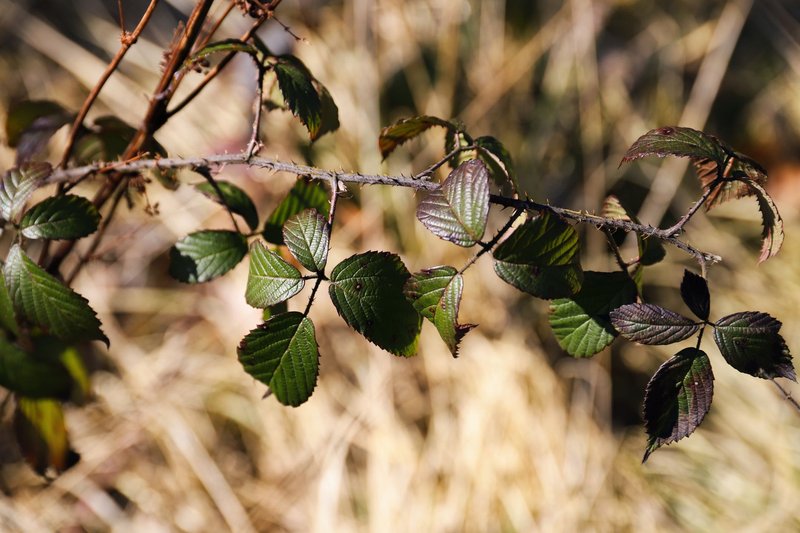
About 10 percent of New Zealand’s woody plants grow as divaricating shrubs, with wiry, interlaced branches and tiny leaves. Look at Coprosma, lancewood in its juvenile stage, and mingimingi. They look as if someone has tied the stems in knots.
There are two main theories. One says the shape protects against the cold and wind of the Ice Age. The other says it was a defence against moa, the giant flightless birds that browsed on shrubs until humans hunted them to extinction in the 1400s. The moa idea has some neat support. Some divaricating plants produce larger, less-tangled leaves on branches above the height a moa could reach. Neither theory has won outright.
Native grasses and tussock
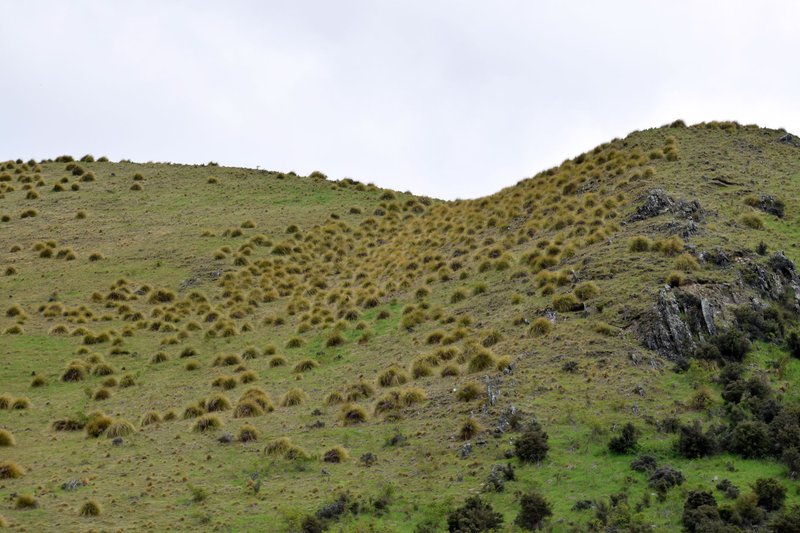
New Zealand is the tussock country. Snow tussock (Chionochloa) grows tall and golden across the high country of the South Island and turns the hillsides tawny. Around 20 species of Chionochloa are native, and they dominate large areas above the treeline. The tussocks of the Central Otago and Canterbury high country are a defining landscape.
Down on the coast, pīngao, a golden sedge, holds sand dunes in place and was woven by Māori into mats and baskets. Harakeke (New Zealand flax, Phormium tenax) is another cornerstone plant. Its fibre went into clothing, rope and baskets, and the tall flower stalks are loved by nectar-feeding tūī.
Quick reference: species, Maori names and where to see them
| Plant | Māori name | Where to see it |
|---|---|---|
| Kauri | Kauri | Waipoua Forest, Northland |
| Rimu | Rimu | West Coast and Fiordland forests |
| Tōtara | Tōtara | Podocarp forests across both main islands |
| Kahikatea | Kahikatea | Swampy forest on the West Coast and Waikato |
| Silver fern | Ponga / Silver fern | Almost any damp forest |
| Black tree fern | Mamaku | Wellington, Fiordland, the Catlins |
| Pohutukawa | Pōhutukawa | Northland and Coromandel coasts |
| Southern rata | Rātā | Fiordland and the West Coast |
| Mount Cook lily | Kōpūkupuku (also Mount Cook buttercup) | Hooker Valley, Aoraki / Mount Cook |
| Mountain daisy | Taiko (in some species) | Arthur’s Pass National Park |
| Vegetable sheep | Hierakoko (in some regional use) | Alpine areas of the South Island |
| Snow tussock | Wi / Tussock | Central Otago and Canterbury high country |
| Flax | Harakeke | Coastal and wetland margins across the country |
| Kawakawa | Kawakawa | Shady North Island forest and coast |
Kawakawa is worth a note. It’s a pepper relative with heart-shaped leaves that are often full of holes from insect nibbling. Māori use the leaves in herbal preparations, and the holes are said to mark the best leaves.
Threats to native plants
Most of the damage comes from introduced species. Possums, deer and goats strip foliage, and rats, stoats and pigs damage seeds and seedlings. Weeds such as wilding conifers, gorse, and old man’s beard crowd out native plants. According to the IUCN, a large share of New Zealand’s threatened species are plants, and the country’s own conservation agency tracks hundreds of them as at risk or threatened.
Fire and land clearance did their share earlier. Roughly three-quarters of the original forest cover was cleared after human arrival, much of it in the lowlands. What’s left is mostly in the mountains.
What you can do as a visitor or gardener:
- Clean your boots and gear at track entrances, especially in kauri forest.
- Stay on formed tracks so you don’t compact roots or trample alpine cushions.
- Buy native plants from local nurseries sourced from nearby seed, and avoid species on the weed lists.
- Don’t take cuttings, seeds or soil across regional borders.
How to identify what you’re looking at
Start with the leaf. Native forest trees often have thick, leathery leaves with smooth edges, while ferns and conifers are easy to separate on sight. Check the bark next. Mataī has circular pits, tōtara peels in strips, and kauri has smooth, mottled grey bark that flakes in patches.
Apps and field guides help, and the Department of Conservation’s native plants pages give a good introduction by group. For trees specifically, the shape of the crown from a distance tells you more than the leaf: kauri has a flat-topped, bushy crown, and rimu droops.
The Flora of New Zealand reference series
If you searched for “Flora of New Zealand” and expected a book, that’s a separate thing. The Flora of New Zealand is a multi-volume botanical series published by Manaaki Whenua Landcare Research. It covers ferns, flowering plants, grasses and more, written for botanists, with identification keys and technical descriptions. It’s a serious reference, not a field guide. For a casual walker, a pocket guide to native trees or alpine plants will do more for you, and an online version of the Flora is available for people who want the technical detail.
Pick one forest and one alpine walk, and you’ll see most of what makes the flora of New Zealand worth the trip: kauri and tree ferns at low elevation, then cushion plants and daisies above the trees. Both are within a day’s drive of each other in a few places.