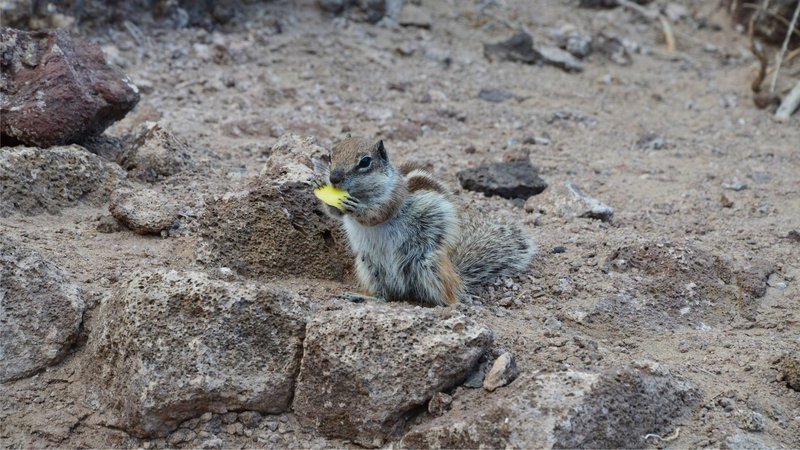
Harris’s antelope squirrel runs across bare desert ground in full midday sun — 100°F+ and no shade in sight — with its tail curled up over its back like a tiny parasol. Most desert animals are hiding. This one is foraging. That tells you almost everything you need to know about how its diet works.
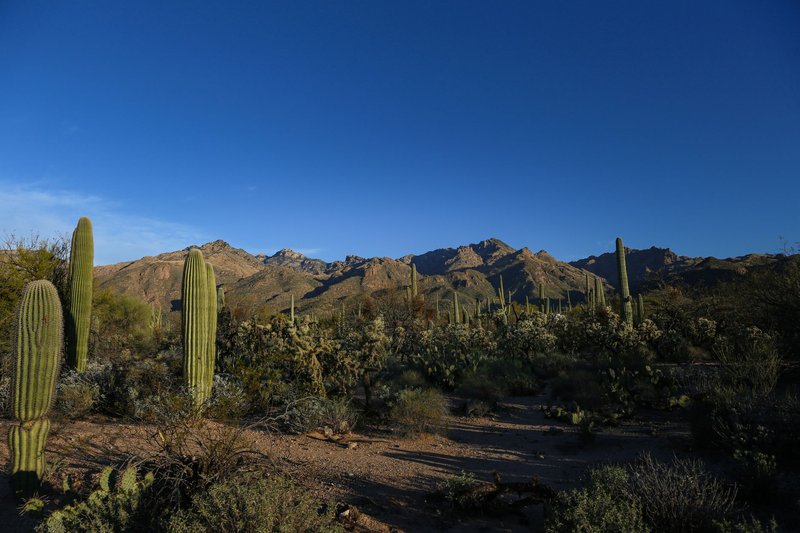
Ammospermophilus harrisii is a small ground squirrel native to the Sonoran Desert of southern Arizona and southwestern New Mexico, with a range dipping into northwestern Mexico. It’s one of the few desert rodents active year-round, no hibernation, no torpor — which means its diet has to fuel continuous activity through summer heat that would kill most small mammals outright.
Table of Contents
- The Core Diet: Seeds, Cactus, and Whatever Else Works
- Foraging Behavior: Cheek Pouches, Caching, and Timing
- Seasonal and Geographic Variation
- How Diet Connects to Heat Survival
- Comparison with Similar Desert Squirrels
- Can You Feed Them?
The Core Diet: Seeds, Cactus, and Whatever Else Works {#core-diet}
Harris’s antelope squirrels are omnivores, and genuinely opportunistic ones. Their diet breaks down into four main categories:
Seeds and grains — The dietary backbone. They eat seeds from grasses, forbs, and desert shrubs. Mesquite beans (Prosopis spp.) are a particularly important food source, especially in Arizona, where mesquite is abundant. The seeds are energy-dense and can be cached for later use.
Cactus fruit and pads — Saguaro, prickly pear, cholla, and barrel cactus all contribute. The fruit pulp provides water as much as calories, which is significant for an animal that rarely drinks standing water. The squirrels will climb into cactus to reach fruit — yes, climb into cholla — which is why you’ll sometimes see individuals with fur stained red from prickly pear juice.
Insects and invertebrates — Grasshoppers, beetles, caterpillars, and other invertebrates make up a meaningful portion of their summer diet when protein demand is high. According to the Animal Diversity Web, invertebrates are particularly important during the breeding season, likely because the protein supports reproduction and lactation.
Plant matter — Green vegetation when available: leaves, stems, flowers. This is opportunistic and seasonal, tied to rainfall-driven plant growth rather than a year-round staple.
Carrion is occasionally reported as well, which shouldn’t be surprising. An animal that needs to stay fueled through desert summers doesn’t pass up a free calorie.
Foraging Behavior: Cheek Pouches, Caching, and Timing {#foraging-behavior}
The foraging behavior is as interesting as the food list. Harris’s antelope squirrels use their cheek pouches to carry seeds back to burrow caches — a behavior called scatter hoarding. They don’t maintain one central larder; they spread cached food across multiple locations, which reduces the risk of losing everything to a competitor or flood.
In summer, they shift their activity windows hard toward early morning. On the hottest days (air temperature above 104°F / 40°C), they may disappear underground entirely by mid-morning and resurface in late afternoon. This isn’t true hibernation or torpor — they’re just waiting out the worst of the heat. When they do forage in peak summer, they use shade patches and burrows as thermal refuges, running between cover points rather than staying exposed.
Their tail posture during foraging — flipped up over the back — isn’t just a field identification feature. It functions as a partial shade umbrella for the squirrel’s spine, and the tail’s reflective white underside bounces some solar radiation away. It’s a behavioral and anatomical adaptation that buys extra minutes of safe foraging time.
Seasonal and Geographic Variation {#seasonal-variation}
The diet shifts with the seasons and the landscape.
Arizona vs. New Mexico — In Arizona’s Sonoran Desert, mesquite beans and saguaro cactus fruit dominate the summer diet. In New Mexico’s Chihuahuan Desert transition zones at the eastern edge of the species’ range, prickly pear becomes more central, and the grass seed component may be heavier depending on local vegetation.
Spring — Green plant material, forb seeds, and invertebrates take priority as vegetation flushes after winter rain. The squirrels are rebuilding body condition after winter, and protein from insects supports that.
Summer monsoon season (July–September in the Sonoran) — Saguaro and prickly pear fruit peak. This is effectively a feast period; the squirrels are caching heavily during this window.
Winter — Without hibernation, they rely on cached seeds and whatever they can find. Foraging time drops because thermal constraints work the other direction — cold mornings push activity toward midday. Mesquite pods that have fallen to the ground become a key resource.
How Diet Connects to Heat Survival {#heat-survival}
The most overlooked aspect of the Harris’s antelope squirrel diet is how much of it is about water, not just calories.
These squirrels are behaviorally hyperthermic — they tolerate body temperatures up to 107°F (41.7°C) during activity, higher than most mammals can sustain. They cool off in burrows between foraging bouts. But they rarely drink free water. Instead, they extract water from food: cactus fruit pulp, succulent plant tissue, and insect bodies all contribute.
Cactus fruit isn’t just a food preference — it’s hydration. A single large prickly pear pad contains significant water content, and squirrels that have access to cactus in summer are operating with a measurable metabolic advantage over those in drier microhabitats. This is why the species distribution tracks cactus density closely within the Sonoran Desert.
Seeds, by contrast, are dry and require metabolic water to process — which is why seed-only periods (like winter, when cactus fruit is unavailable) coincide with reduced activity and greater reliance on cached high-quality items rather than bulk feeding.
Comparison with Similar Desert Squirrels {#comparison}
Harris’s antelope squirrel shares territory with two close relatives:
White-tailed antelope squirrel (Ammospermophilus leucurus) — Found further north and west, into the Mojave Desert. Diet is similar in structure — seeds, insects, cactus — but proportions shift because Mojave vegetation differs. Less mesquite, more creosote. The white-tailed species also tolerates cold better, which extends its range into higher-elevation desert.
Nelson’s antelope squirrel (Ammospermophilus nelsoni) — Restricted to the San Joaquin Valley in California. Diet is more heavily seed-based, reflecting a grassland-scrub habitat rather than cactus desert.
The dietary flexibility that characterizes all three species is the genus’s main survival trait. None of them are dietary specialists. Being an omnivore that caches food, tolerates heat, and exploits every available resource is the antelope squirrel strategy, and it works.
Can You Feed Them? {#feeding}
Harris’s antelope squirrels do venture into desert suburbs and campgrounds in Arizona, and people do encounter them. A few practical notes:
Feeding wild squirrels is generally discouraged by wildlife managers — it disrupts natural foraging behavior, can create habituation problems, and introduces foods that aren’t nutritionally appropriate. Sunflower seeds and corn, common handout foods, lack the nutritional diversity these animals get from a varied wild diet.
If one shows up in your yard, it’s probably after something specific: a fallen citrus, a bird feeder, or insect-rich soil. Watching it work is more interesting than feeding it anyway — they cache efficiently, cheek pouches stuffed, moving between locations in under a minute.
Harris’s antelope squirrel diet isn’t complicated on the surface: seeds, cactus, bugs, green stuff, repeat. But the behavioral system around it — the timing, the caching, the water-from-food strategy, the heat tolerance that makes year-round foraging possible — is genuinely well-engineered for one of the harshest environments in North America. For an animal small enough to fit in your hand, it’s handling conditions that would shut down most wildlife. The diet is a big part of how.