Table of Contents
- The Short Answer
- Preferred Grass Species
- How Tsessebes Actually Graze
- Daily Feeding Schedule
- Seasonal Diet Shifts
- Water Needs and the Wet Season
- How the Tsessebe Compares to Topi and Blesbok
- FAQs
The Short Answer
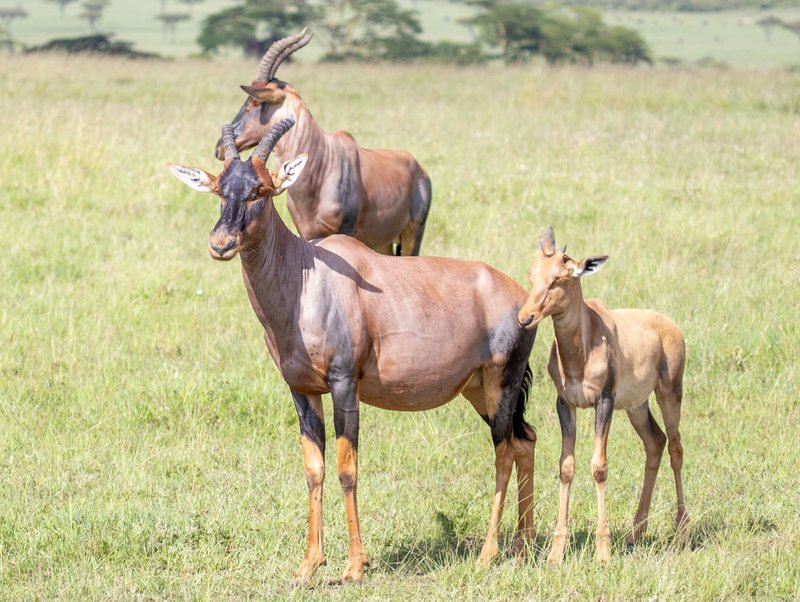
Tsessebes eat grass — almost exclusively. They’re obligate grazers, and unlike many savanna herbivores that supplement their diet with leaves, fruit, or bark, a tsessebe rarely strays from a grassy meal. What sets them apart isn’t what they eat, but how they choose it: tsessebes are selective about the growth stage of grass, actively seeking out fresh, leafy shoots over the dry, fibrous stalks that other grazers settle for.
Preferred Grass Species
Tsessebes show a clear preference for medium-height grasses in open savanna and floodplain habitats. The species most commonly documented in their diet include:
- Red oats grass (Themeda triandra) — arguably their favorite, and a dominant species across East and Southern Africa’s savannas
- Guinea grass (Panicum maximum) — a tall, leafy grass common in moist grasslands that tsessebes graze heavily during the wet season
- Bermuda grass (Cynodon dactylon) — grazed primarily where it’s available in shorter, more accessible patches
- Buffalo grass (Panicum coloratum) and related Panicum species — frequently exploited near seasonal wetlands
These aren’t random choices. Tsessebes select grasses with higher protein content and lower fiber ratios — the nutrient profile of actively growing shoots rather than mature, lignified stalks. When those aren’t available, they move.
How Tsessebes Actually Graze
A tsessebe doesn’t just wander and eat. Their grazing behavior is deliberate in a way that takes some observation to appreciate.
They consistently target new growth above roughly 8 cm in height — short enough to have concentrated nutrients, tall enough to crop efficiently with their elongated muzzle. Below that threshold, they tend to pass and let the grass grow. This is the opposite of some bovids that graze grass down to bare soil.
One of the more striking habits: tsessebes are among the first large grazers to move onto recently burned grassland. Post-fire regrowth produces dense flushes of tender shoots with very high nitrogen content — tsessebes exploit this aggressively. You’ll often find them on recently burned patches while taller, drier grass is still available nearby. They’re not being opportunistic; they’re being precise.
They also avoid overly waterlogged ground even when it supports lush grass growth, which is notable given how closely their range overlaps with floodplain systems in Botswana and Zambia. A wet floodplain in peak flood isn’t tsessebe territory — they wait for the edges.
Daily Feeding Schedule
Tsessebes are crepuscular feeders with a strong bias toward mornings. Their primary grazing window runs from just after sunrise until mid-morning, when temperatures begin climbing. They return to feed again in the late afternoon, tapering off near dusk.
During the middle of the day, they’re largely inactive — standing or lying in partial shade, ruminating. As ruminants, tsessebes ferment their grass in a four-chambered stomach, regurgitating and re-chewing cud during these rest periods to fully extract nutrients.
This pattern isn’t unique to tsessebes, but they’re particularly strict about it. In areas with significant predator pressure — lion, cheetah, leopard — the combination of open habitat preference and predictable feeding windows means they rely heavily on vigilance and their exceptional speed (they’re the fastest of the Damaliscus genus, capable of sustained speeds around 70–80 km/h) rather than concealment.
Seasonal Diet Shifts
The tsessebe’s diet changes considerably between wet and dry seasons — not in terms of what they eat (still grass), but in quality and availability.
Wet season: This is feeding season in the real sense. Grasses flush with new growth, protein content peaks, and tsessebes can be highly selective. They crop the top third of a grass stem and move on, rarely depleting a patch. Condition improves rapidly; females in late pregnancy and nursing use this window to build reserves.
Dry season: The options compress. Green, leafy growth disappears from most of the landscape. Tsessebes shift toward whatever residual green grass remains — often near riverbeds, seasonal pans, or areas of localized moisture. They’ll also tolerate slightly drier, more fibrous material out of necessity, though they remain selective compared to species like wildebeest or zebra that will strip a patch to the ground.
During severe dry seasons, tsessebes can lose significant body condition. They’re not browsers — they won’t fall back on shrubs or tree foliage the way impala do. That dietary rigidity is part of why they’re classified as Near Threatened by the IUCN: habitat conversion that replaces grassland with cropland or dense bush effectively removes their food source.
Water Needs and the Wet Season
Tsessebes are considered water-dependent when dry conditions persist, but they’re capable of going several days without drinking if the grass they’re consuming retains sufficient moisture — a common condition during and just after the wet season.
This makes them less tied to permanent water sources than buffalo or waterbuck, but more tied to them than eland or gemsbok. In practice, their distribution in the dry season clusters within roughly 10–15 km of reliable water, and herd movements often trace the drying pattern of seasonal rivers.
The relationship between water and diet is direct: wetter areas produce greener grass longer into the dry season, so tsessebes track water not only for drinking but for the feeding it supports nearby.
How the Tsessebe Compares to Topi and Blesbok
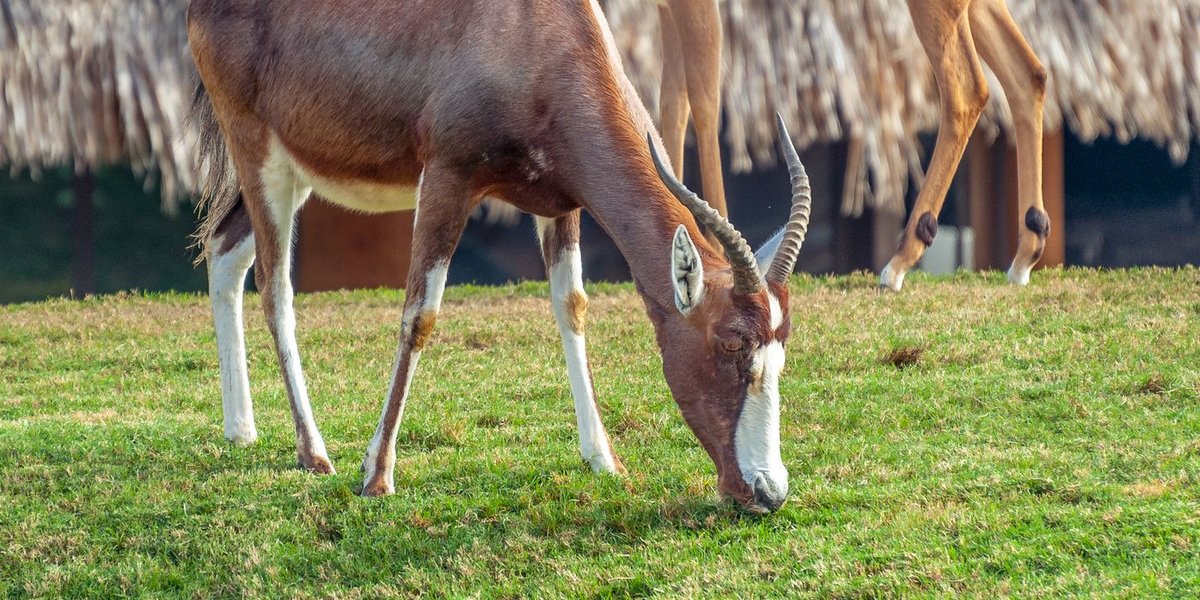
Tsessebes (Damaliscus lunatus lunatus) belong to the same genus as topi (Damaliscus lunatus jimela) and blesbok (Damaliscus pygargus), and their diets are broadly similar — all three are selective grass grazers that prefer medium-height fresh growth over dry stubble.
The differences are mostly ecological rather than dietary:
- Topi occupy similar East African grasslands and floodplains, and their feeding behavior is nearly identical to tsessebe. The two are so closely related they’re sometimes classified as subspecies. In shared habitat, they occupy the same feeding niche.
- Blesbok are restricted to the South African highveld and Karoo margins, where grasses tend to be shorter and more seasonal. They graze shorter swards than tsessebe, partly a consequence of what’s available, partly a structural preference.
The tsessebe’s longer face and slightly elevated shoulder height give it a mechanical advantage at cropping medium-height grasses — a design that’s less ideal for short-sward grazing than blesbok, and less suited to tall-grass feeding than buffalo.
FAQs
Do tsessebes eat leaves or browse? Rarely and only incidentally. Tsessebes are strict grazers; there’s no documented reliance on browse. If leaves end up in their mouth while grazing near a shrub, that’s coincidence, not diet.
Do tsessebes eat the same grass as wildebeest? They overlap considerably in range and grass species, but not in feeding style. Wildebeest are bulk grazers — they crop large patches uniformly and tolerate dry, mature grass. Tsessebes are selective, targeting specific growth stages. Where both species graze the same area, tsessebes tend to feed on the freshest patches and move on, while wildebeest follow to process what’s left.
Can tsessebes survive in degraded grassland? Not well. Heavily overgrazed land or areas dominated by unpalatable grass species and invasive shrubs don’t support tsessebes. Their dietary selectivity, which serves them well in healthy savanna, works against them when habitat quality drops. This is why population declines track closely with land-use change across sub-Saharan Africa — tsessebe range has contracted significantly since the mid-20th century, especially in West and Central Africa.
How much does a tsessebe eat per day? No precise field measurements exist for wild tsessebes specifically, but as a 120–150 kg ruminant antelope, a rough estimate based on similar species puts daily dry matter intake at around 2–3 kg — approximately 1.5–2% of body weight per day under normal conditions.
Are tsessebes competitive feeders? They’re not aggressive at feeding sites, but they’re fast enough to dominate spatial access. Tsessebes will move into a fresh patch and hold it through proximity and speed rather than confrontation. In mixed herds, they tend to be first movers on post-fire regrowth.