Most “British birds” lists are really Scotland-plus-Wales-plus-England all blurred together, and half of them are taxonomic checklists 600 species long. Useful if you’re a county recorder. Useless if a small brown bird just landed on your fence in Surrey and you want a name for it.
This list is the other thing. Fifteen birds you’ll genuinely encounter across England — in gardens, hedgerows, parks, and over open fields — with the details that actually separate one from another: the field marks, the size relative to a bird you already know, the song, and the time of year it shows up. England has lost roughly 73 million breeding birds since 1970, according to the RSPB’s State of Nature reporting, so knowing what’s on your patch is more useful than it’s ever been.
Contents
- Quick comparison table
- Garden regulars
- Robin
- Blue tit
- Blackbird
- House sparrow
- Wren
- Goldfinch
- Dunnock
- Great tit
- Bigger, bolder birds
- Magpie
- Wood pigeon
- Carrion crow
- Woodland and hedgerow
- Chaffinch
- Long-tailed tit
- Birds of prey you’ll actually see
- Red kite
- Buzzard
- How to attract more birds
- When to look: a seasonal note
Quick comparison table
A fast way to narrow things down. Sizes are nose-to-tail; “sparrow-sized” is the universal unit of British birdwatching for a reason.
| Bird | Size | Standout feature | Best place to spot |
|---|---|---|---|
| Robin | Sparrow-sized | Orange-red face and breast | Garden, fences, your spade |
| Blue tit | Smaller than a sparrow | Blue cap, yellow belly | Feeders, woodland |
| Blackbird | Bigger than a sparrow | Glossy black + orange bill (male) | Lawns, hedges |
| House sparrow | The benchmark | Chunky, streaky brown | Roofs, hedges, towns |
| Wren | Tiny | Cocked tail, loud voice | Low in dense cover |
| Goldfinch | Sparrow-sized | Red face, gold wing flash | Thistles, feeders |
| Dunnock | Sparrow-sized | Grey head, skulks low | Under hedges |
| Great tit | Sparrow-sized | Black head stripe down belly | Feeders, woodland |
| Magpie | Crow-ish | Black-and-white, long tail | Parks, fields |
| Wood pigeon | Large | White neck patch | Everywhere |
| Carrion crow | Large | All-black, solitary | Fields, bins |
| Chaffinch | Sparrow-sized | White wing bars | Woodland edge |
| Long-tailed tit | Tiny + tail | Ball of fluff with a stick | Hedgerows, in flocks |
| Red kite | Big raptor | Forked tail | Soaring over open country |
| Buzzard | Big raptor | Broad rounded wings | Fenceposts, soaring |
Garden regulars
These eight turn up at feeders and on lawns across England. Learn them and you’ve covered most of what lands in an average back garden.
Robin
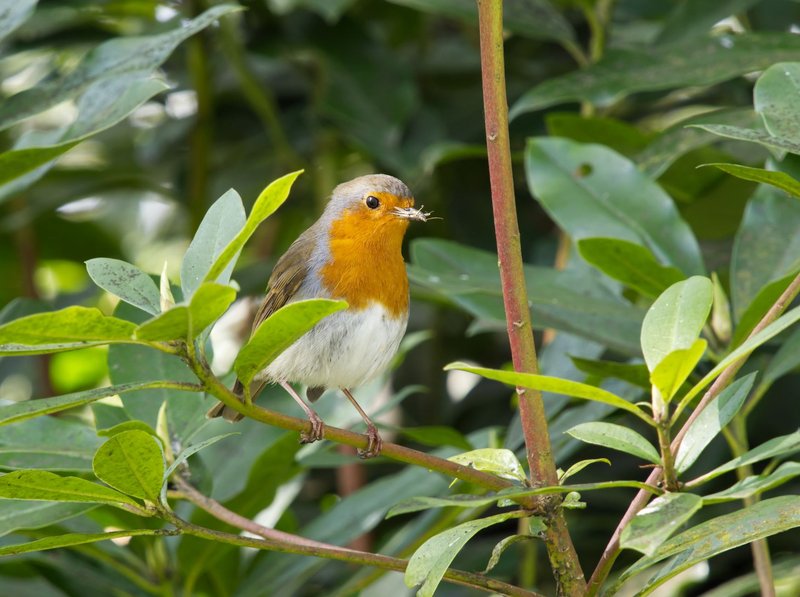
The one everyone knows, and the field mark does the work for you: that orange-red face and breast bleeding into grey-brown above. Roughly sparrow-sized, round-bodied, with thin dark legs and a habit of cocking its head at you while you dig. Robins follow gardeners because turned soil means exposed worms — in woodland they shadow wild boar and deer for the same reason.
Unlike most British songbirds, robins sing through winter, because both sexes hold territory year-round. The song is a wistful, silvery warble, often delivered from a low perch at dusk under a streetlight. They’re famously aggressive for such a small bird; that Christmas-card sweetness hides a creature that will fight rivals to the death over a hedge.
Blue tit
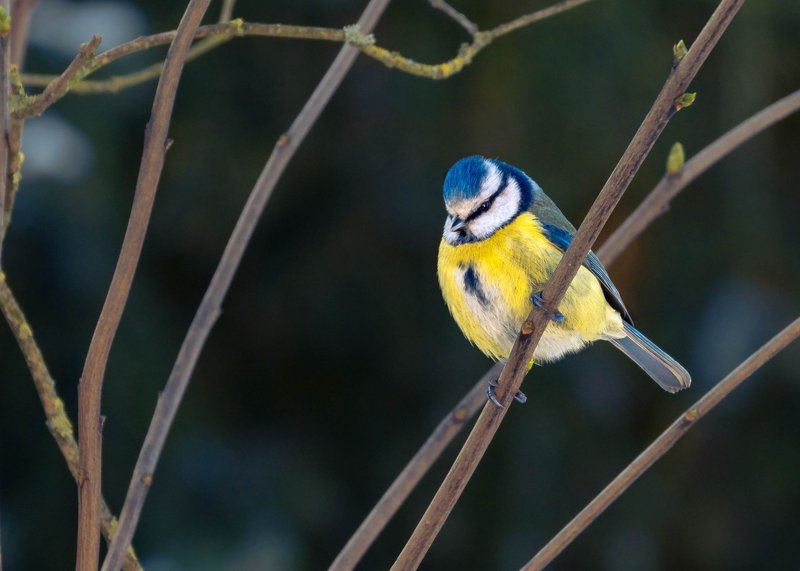
A pocket-sized acrobat, smaller than a sparrow, with a sky-blue cap, white cheeks, a dark eye-stripe, and a custard-yellow belly. They hang upside down off feeders and the thinnest twig-ends without a second thought, which is the easiest way to tell them apart from the chunkier great tit doing the same job more clumsily.
Blue tits time their breeding to the spring flush of caterpillars, and a single brood can demand hundreds of caterpillars a day. They’re the bird that famously learned to peck through foil milk-bottle tops across Britain in the mid-20th century — a genuine case of culture spreading through a wild population.
Blackbird
The male is unmistakable: glossy jet-black with a bright orange-yellow bill and a thin yellow eye-ring. The female throws people off — she’s warm dark-brown, often with a faintly speckled breast, and gets mistaken for a thrush or “some kind of brown bird.” Both are noticeably bigger than a sparrow, with a long tail and a bouncing, stop-start run across the lawn.
The song is the reason poets bother with blackbirds: a rich, fluty, unhurried melody from a rooftop or tree, strongest at dawn and dusk from March onward. Listen for the loud, panicky “chink-chink-chink” alarm call at dusk too — it’s one of the defining sounds of an English evening.
House sparrow
The reference bird every other entry compares itself to. Chunky and streaky brown, the male has a grey crown and a black bib; the female is plainer, a soft streaky buff-brown. They move in noisy, squabbling gangs around roofs, hedges, and pub gardens, and the call is an endless flat “cheep.”
Worth knowing: despite being the bird the word “common” was practically invented for, house sparrows are on the UK Red List. According to the British Trust for Ornithology, numbers have crashed dramatically in many towns and cities since the 1970s. If you’ve still got a sparrow colony in your hedge, you’ve got something worth keeping.
Wren
Tiny — one of the smallest birds in England — and shaped like a russet-brown ball with a short tail held cocked straight up. It creeps mouse-like through the bottom of hedges and log piles, often seen for half a second before it vanishes. The barring on the wings is fine and easy to miss; the silhouette and the tail are what give it away.
The voice is the shock. For a bird that weighs about as much as a £1 coin, the song is astonishingly loud and fast — a torrent of trills that ends in a hard rattle. The wren is also the most numerous breeding bird in Britain, which is wild given how rarely you actually get a good look at one.
Goldfinch
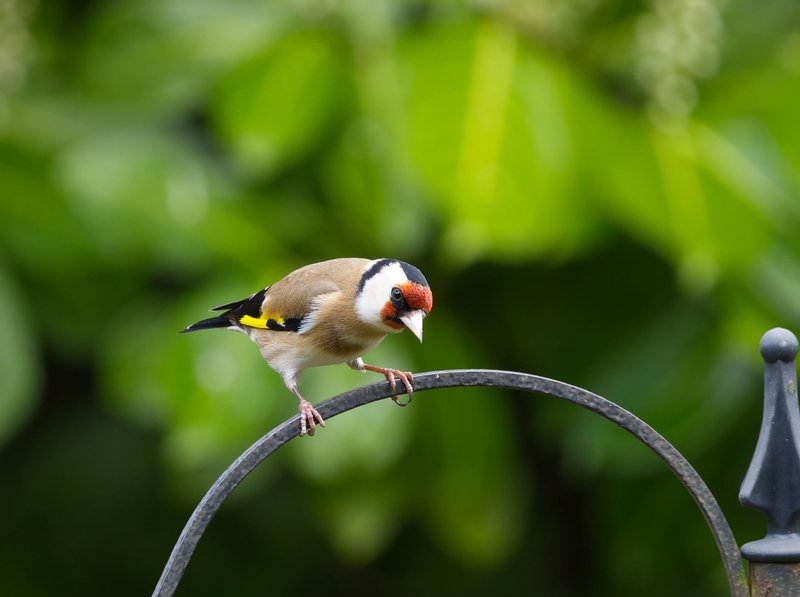
A flash of colour at the feeder: a bright red face mask, black-and-white head, and a brilliant gold band across each black wing that flares in flight. Sparrow-sized but slimmer, with a pointed pale bill built for prising seeds out of teasels and thistles. A flock of them has the lovely collective name of a “charm,” and the tinkling, liquid call lives up to it.
Goldfinches were scarce in gardens a generation ago. The spread of nyjer and sunflower-heart feeders changed that, and they’re now one of the more frequent garden finches across England — a rare conservation good-news story you can take partial credit for if you feed them.
Dunnock
The bird most often dismissed as “just a sparrow” and most often wrong. The dunnock is sparrow-sized but slimmer, with a fine pointed insect-eating bill (not the stubby seed-cracking sparrow bill), a slate-grey head and breast, and a streaky brown back. It shuffles along the ground under hedges with a nervous, twitchy gait, rarely venturing into the open.
Its private life is far stranger than its plumage. Dunnocks have one of the most tangled mating systems of any British bird, with females often holding territories overlapping several males. The song is a quiet, sweet, slightly flat warble — easy to overlook, like the bird.
Great tit
The bossy big cousin of the blue tit. Sparrow-sized, with a glossy black head, white cheeks, a yellow-green back, and — the clincher — a black stripe running down the centre of the yellow belly like a zip. A broad stripe usually means a male; a thin one, a female.
The song is your best winter ID: a clear, ringing two-note “tea-cher, tea-cher” that carries across the garden from late January. Great tits have one of the widest vocabularies of any English bird, with dozens of call types, so don’t expect every sound from one to match the textbook. The fifteen here are the everyday core, but if you want the bigger picture, the full list of birds of the United Kingdom runs to a hundred species you might eventually meet.
Bigger, bolder birds
The larger, louder species that dominate parks, verges, and the dawn rooftop chorus.
Magpie
Black and white with a long, trailing tail that shows an oil-slick sheen of green and blue in good light. Crow-sized but slimmer, and impossible to confuse with anything else once you’ve seen the tail. They strut across playing fields and parks in twos and small gangs, raucous and confident.
Magpies get a bad reputation for raiding other birds’ nests in spring, but the RSPB notes there’s no solid evidence that magpies are responsible for songbird declines — habitat loss and farming changes are the real culprits. They’re also among the most intelligent birds in the world, and one of the few non-mammals to recognise themselves in a mirror.
Wood pigeon
The big grey pigeon clattering out of a tree as you walk past. Far larger and plumper than a town pigeon, with a distinctive white patch on each side of the neck (absent in juveniles) and a white bar across the wing that flashes in flight. The cooing is a soft, repetitive five-note phrase that people often mistake for an owl.
Wood pigeons are now one of the most abundant and visible birds across England, equally at home in deep woodland and a city centre. They breed almost year-round and are the species most likely to crash gracelessly through your bird feeder.
Carrion crow
All-black, including the legs and the heavy bill, with a flat-headed profile and a hoarse, deliberate “caw.” The key ID is behaviour as much as plumage: carrion crows are usually alone or in pairs, while rooks (which have a pale bare face) gather in big rookeries. If a solitary all-black crow-shaped bird is eyeing your bins, it’s a carrion crow.
Like magpies, crows are problem-solvers — they’ll drop nuts onto roads for cars to crack, and learn the rhythms of bin collection. Once you start watching them, the “just a crow” dismissal stops making sense.
Woodland and hedgerow
Step away from the garden into a wood or along a hedgerow and these two become common.
Chaffinch
One of England’s most numerous birds and a regular at woodland-edge feeders. The male is striking — a slate-blue crown, pinkish-red face and breast, and a warm brown back — while the female is a plain buff-brown. The shared giveaway in both sexes is the bold white wing bars, obvious in flight and on the ground.
The song is a cheerful accelerating phrase that tumbles down to a flourish at the end, often described as a fast bowler’s run-up. Regional “dialects” exist, so chaffinches in one part of England can sound subtly different from those in another.
Long-tailed tit
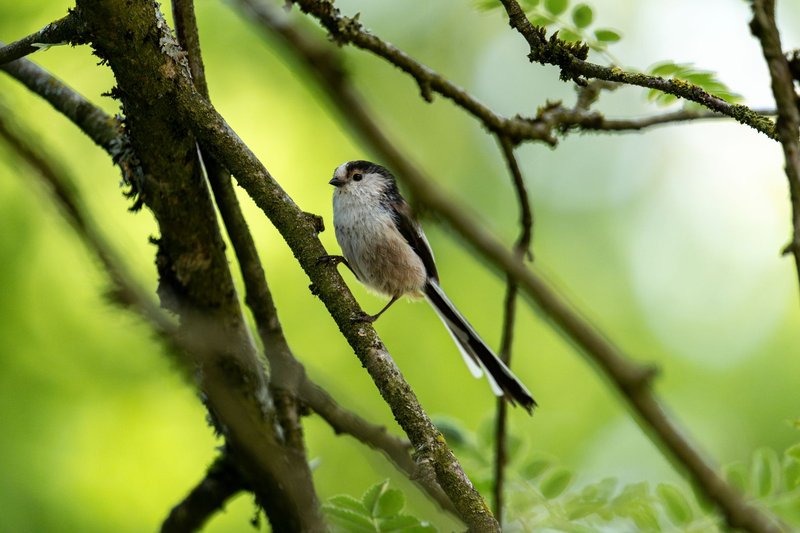
Barely believable the first time you see one: a tiny pink, black, and white ball of fluff with a tail longer than its body, like a lollipop in flight. They almost never travel alone — you’ll hear a thin, rolling “tsee-tsee-tsee” and then a procession of eight or ten will pour through a hedge one after another and be gone.
In winter, family flocks roost huddled in a row along a branch to survive the cold, and they build one of the most extraordinary nests in England: a stretchy, domed bag of moss, spider silk, and lichen lined with over a thousand feathers.
Birds of prey you’ll actually see
You don’t need a reserve and a telescope. These two raptors are now common over much of the English countryside and motorway.
Red kite
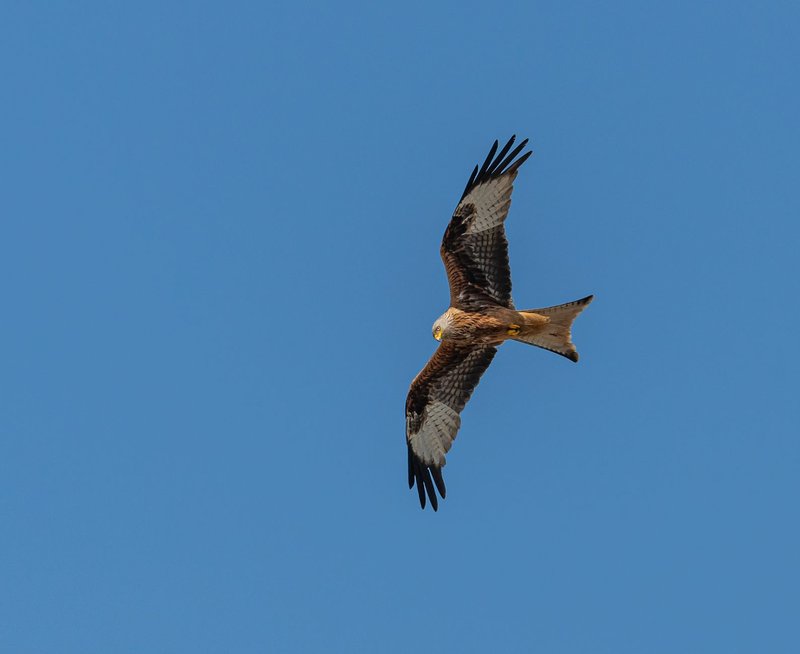
Big, rusty-red, and elegant, with long angled wings showing white patches underneath and — the single best field mark — a deeply forked tail it constantly twists like a rudder. They rarely flap hard; they hang and tilt over open country, scanning for carrion.
The red kite is one of England’s great conservation comebacks. Persecuted to near-extinction in Britain, it was reintroduced from the late 1980s, and according to the Natural History Museum the population has rebounded into the thousands of pairs. In the Chilterns you can now see a dozen wheeling over a single field.
Buzzard
The most common bird of prey in England, and the broad-winged silhouette you see soaring in lazy circles or hunched on a fencepost beside a field. Brown and variable — some quite pale-bellied, some chocolate — with broad, rounded wings held in a shallow V when gliding and a fanned tail. The call is a far-carrying, cat-like “mew.”
If you see a large raptor over English farmland and it isn’t forked-tailed, it’s almost certainly a buzzard. They’ve spread back across the entire country in recent decades after historic persecution eased, and they’re now a genuine roadside-fencepost regular.
How to attract more birds
Want more of these on your patch? A few things move the needle more than anything else:
- Offer varied food. Sunflower hearts pull in tits, finches, and sparrows; nyjer seed is goldfinch bait; mealworms bring robins and blackbirds; fat balls help everyone through winter. Keep feeders clean — dirty feeders spread disease that has hit greenfinches especially hard.
- Provide water. A shallow dish or birdbath, kept ice-free in winter, is used for drinking and bathing by nearly every species here.
- Leave some mess. A patch of nettles, a log pile, an un-pruned hedge, and seed heads left standing over winter feed insects and birds far better than a tidy garden does.
- Plant for them. Native hedging (hawthorn, blackthorn), berrying shrubs, and teasels give natural food and the dense cover dunnocks and wrens need — and many of the same flowers of England that look good in a border double as a seed and insect supply for the birds.
- Go easy on pesticides. Caterpillars and insects aren’t pests to a blue tit feeding chicks — they’re the entire food supply.
When to look: a seasonal note
Almost everything on this list is a year-round resident, which is part of why they’re the birds you’ll actually meet. But timing still changes what you see and hear. Winter is peak feeder season — natural food is scarce, so birds crowd in, and resident flocks are joined by extra blue tits, blackbirds, and chaffinches arriving from colder parts of Europe.
Spring flips the soundtrack on. From late February into June the dawn chorus builds, blackbirds and robins sing hardest at first and last light, and the great tit’s “tea-cher” rings out everywhere. Summer brings the chaos of fledglings — that scruffy, speckled “what is that” bird in July is very often just a young robin or blackbird that hasn’t grown into its colours yet. Learn the fifteen here in any season and the rest of England’s birdlife starts to fall into place around them.