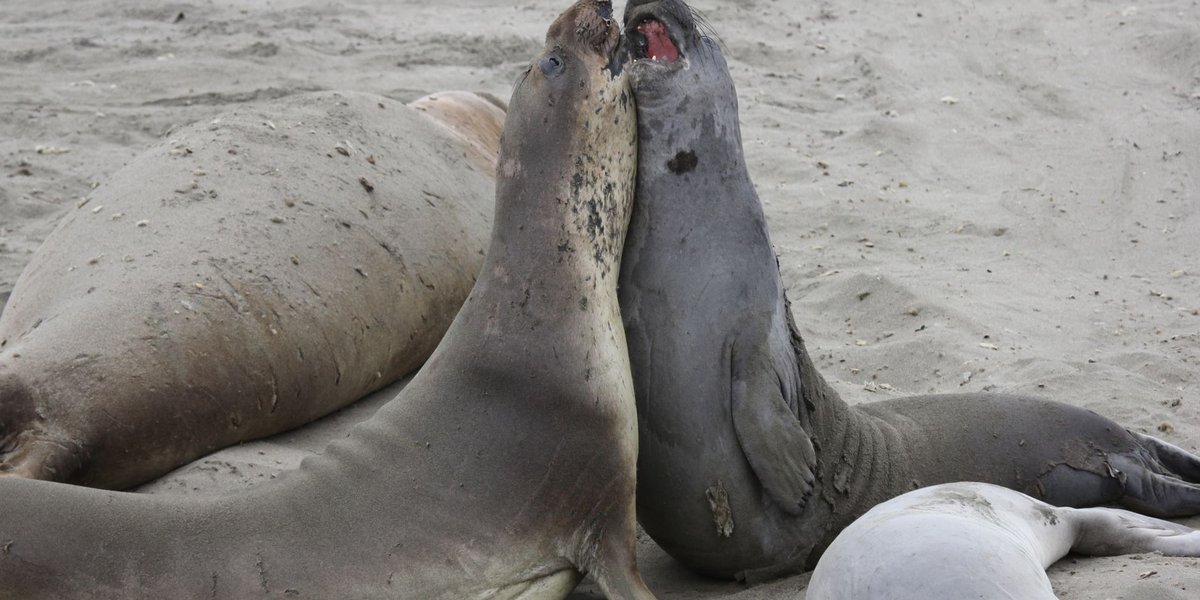
Northern elephant seals eat squid, deep-sea fish, rays, small sharks, and the occasional octopus — and they catch almost all of it in pitch-black water more than half a mile down. A two-ton male and a 1,300-pound female can share the same beach but hunt completely different prey in completely different parts of the ocean. That split, plus the fact that these animals stop eating entirely for weeks at a time, makes their diet a lot stranger than “fish.”
If you saw one hauled out on a California beach and wondered what fuels something that big, the short version is below. The longer version explains how they pull it off.
Table of Contents
- The Quick Answer
- The Full Prey List
- Males and Females Eat Differently
- How They Catch Food a Mile Down
- Do Elephant Seals Eat Sharks?
- How Much Do They Eat?
- The Months When They Eat Nothing
- What Pups Eat Before They Hunt
- Elephant Seal vs. Sea Lion Diet
The Quick Answer {#the-quick-answer}
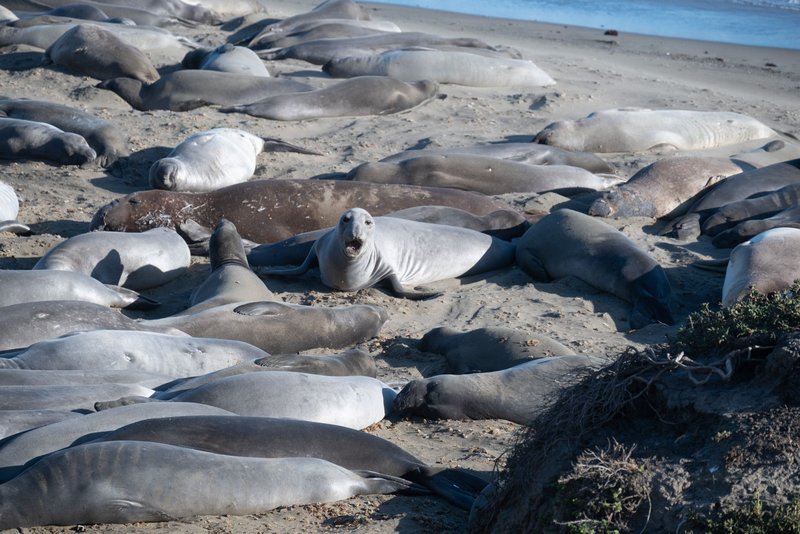
Northern elephant seals (Mirounga angustirostris) are deep-water predators that feed mainly on squid and mesopelagic fish — the dim “twilight zone” fish that live hundreds to thousands of meters below the surface. Their menu also includes rays, ratfish, hagfish, small sharks, eels, and crustaceans.
They are not surface skimmers. According to NOAA Fisheries, elephant seals spend most of the year at sea, diving almost continuously, day and night, in search of prey that most other marine mammals never reach. Squid does the heavy lifting in their diet — soft, abundant, and protein-rich — supplemented by whatever schooling and bottom-dwelling fish they encounter on a given dive.
One thing they almost never eat: anything from shallow, sunlit water. The food is down where the light isn’t.
The Full Prey List {#the-full-prey-list}
Researchers have documented well over 50 prey species in northern elephant seal diets, pieced together from stomach contents, fatty-acid analysis, and animal-borne cameras. Here’s a representative breakdown of the major groups.
| Prey group | Examples | Notes |
|---|---|---|
| Squid (cephalopods) | Octopoteuthis, Gonatus, Histioteuthis, market squid | The dietary staple; many are bioluminescent deep-sea species |
| Mesopelagic fish | Lanternfish (myctophids), Pacific hake/whiting | Schooling twilight-zone fish, hunted in open water |
| Demersal & benthic fish | Rockfish, ratfish, sablefish, eelpouts | Bottom-associated; favored by males on the shelf |
| Cartilaginous fish | Rays, skates, small sharks, chimaeras | Eaten more than people expect |
| Eels & elongate fish | Cusk eels, hagfish | Slow, easy targets near the seafloor |
| Crustaceans | Various deep-sea shrimp | Minor, opportunistic |
| Octopus | Deep-water species | Occasional |
The list reads like a survey of the deep Pacific because that’s effectively what an elephant seal is — a roaming, blubber-wrapped census of the twilight zone. The standouts are the squid. Genera like Octopoteuthis and Histioteuthis glow faintly in the dark, and there’s good evidence elephant seals use that faint light to find them, since their eyes are huge and tuned for low-light blue wavelengths.
Males and Females Eat Differently {#males-and-females-eat-differently}
This is the part most species profiles skip, and it’s the most interesting thing about how these animals feed.
After breeding season, male and female northern elephant seals swim in different directions and hunt in different ways:
- Females head far offshore into the open North Pacific and feed in the water column — chasing pelagic squid and lanternfish, diving and surfacing in a near-constant rhythm. They’re built for endurance hunting across thousands of miles of open ocean.
- Males travel north toward the continental shelf, the Gulf of Alaska, and the Aleutians, where they hunt along the bottom. Their prey skews toward benthic fish, rays, skates, ratfish, and small sharks scraped up off the seafloor.
The size difference drives it. Males weigh up to roughly 4,500 pounds — two to three times a female — and that bulk lets them stay down longer and work the productive but riskier coastal shelf, including waters patrolled by their own predators. Females trade size for range, covering open ocean where the food is more dispersed but the danger is lower. Same species, two foraging strategies, almost no overlap on the plate.
How They Catch Food a Mile Down {#how-they-catch-food}
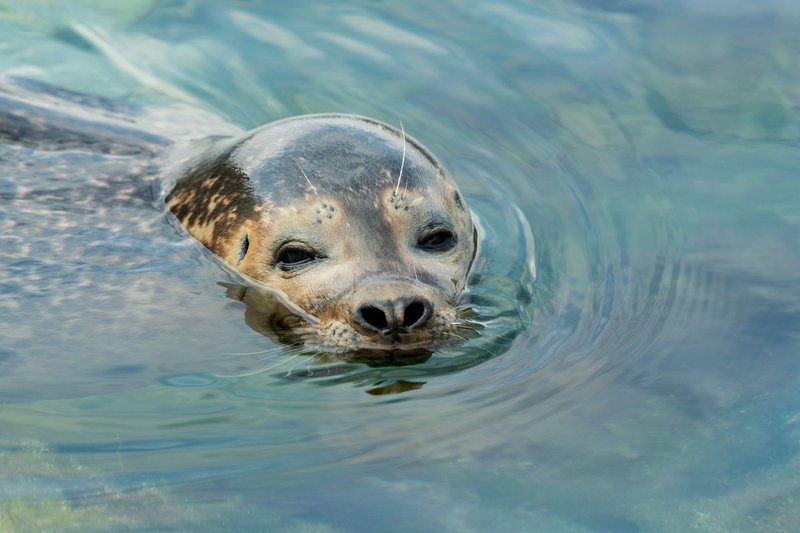
Elephant seals are among the most extreme divers of any air-breathing animal. Routine foraging dives run 300 to 800 meters, but they regularly push past 1,500 meters (about 5,000 feet), and individual dives can last close to two hours. The Marine Mammal Center notes they spend the vast majority of their ocean life submerged, surfacing for only a few minutes between dives before going straight back down.
A few adaptations make this possible:
- Oxygen storage in blood and muscle. Elephant seals carry far more oxygen-binding myoglobin in their muscles than land mammals, so they hunt on internal reserves rather than lung air.
- A collapsing chest and slowed heart. Lungs deflate under pressure to avoid the bends, and their heart rate drops dramatically to ration oxygen.
- Low-light vision. Their large eyes detect the faint glow of bioluminescent squid and the silhouettes of fish against the slightly brighter water above.
- Sensitive whiskers (vibrissae). In total darkness, they likely track the hydrodynamic wake left by swimming prey, the same way a harbor seal — one of many seal species among the mammals that start with S — can follow a fish it never sees.
They don’t chase fast prey in a sprint. The strategy is efficiency: glide down, ambush slow or schooling prey in the dark, swallow it whole, and surface to reload on oxygen. Repeat, more or less without pause, for months.
Do Elephant Seals Eat Sharks? {#do-they-eat-sharks}
Yes — but small ones. Northern elephant seals, especially males working the seafloor, eat small sharks, dogfish, skates, and rays, along with ratfish and chimaeras (the cartilaginous “ghost sharks”). These are bite-sized, bottom-dwelling cartilaginous fish, not the large predatory sharks people picture.
The relationship runs the other way too. Adult elephant seals are themselves prey for great white sharks and orcas, particularly around the breeding colonies at places like Año Nuevo and the Farallon Islands. So an elephant seal might swallow a small dogfish at depth in the morning and be hunted by a white shark near the surface that evening. Predator and prey, depending on the size of who’s involved.
How Much Do They Eat? {#how-much-do-they-eat}
A lot — but only during the part of the year when they eat at all.
Northern elephant seals spend roughly 8 to 10 months per year at sea, and they make two long foraging migrations annually (one after breeding, one after molting), covering on the order of 13,000 miles round trip — one of the longest migrations of any mammal. During those stretches they feed almost nonstop to rebuild the blubber they’ll later burn on land.
A foraging female may make several hundred dives a day for weeks on end. The point of all that eating isn’t day-to-day survival — it’s stockpiling fat. The blubber they pack on at sea is the fuel for the most demanding part of their year, when they don’t eat anything at all.
The Months When They Eat Nothing {#the-fasting-months}
Here’s the twist. For all that relentless deep-sea hunting, northern elephant seals fast completely on land for weeks at a stretch — and they do it twice a year.
- Breeding fast (winter): Dominant males hold their patch of beach and defend a harem for up to about 100 days without eating or drinking, living entirely off blubber while they fight and mate. Females fast for roughly a month while they give birth and nurse.
- Molting fast (spring/summer): Elephant seals undergo a “catastrophic molt,” shedding skin and fur in sheets. They haul out and fast again for several weeks while new skin grows in.
So the same animal that hunts a mile underwater for months will then sit on a beach and eat absolutely nothing for a third of the year. The deep-sea feeding and the long fasts are two halves of the same system: gorge at sea, then burn it all on land doing the things you can’t do underwater.
What Pups Eat Before They Hunt {#what-pups-eat}
Newborn pups don’t eat squid or fish — they drink milk, and it’s some of the richest milk in the animal kingdom. Northern elephant seal milk climbs to around 50% fat by the end of nursing (cow’s milk is roughly 4%). Over about four weeks, a pup roughly triples or quadruples its birth weight, ballooning from around 75 pounds to 250–300 pounds.
Then the mother weans abruptly, returns to sea, and leaves the pup behind. The fattened “weaner” lives off its blubber for several more weeks, teaching itself to swim and dive in the shallows before heading out to find squid for the first time with no instruction. A lot of first-year seals don’t make it, and learning to catch deep-sea prey on the first try is a big reason why.
Elephant Seal vs. Sea Lion Diet {#vs-sea-lion}
People often lump pinnipeds together — the same instinct that blurs the differences between seals and walruses — but elephant seals and California sea lions feed in almost opposite ways:
| Northern elephant seal | California sea lion | |
|---|---|---|
| Main prey | Deep-sea squid, mesopelagic & benthic fish | Anchovies, sardines, market squid, mackerel |
| Where they hunt | Open ocean and seafloor, 300–1,500+ m deep | Near-shore and coastal, mostly shallow |
| Dive depth | Routinely past 1,000 m | Usually under 300 m |
| Foraging trips | Months-long migrations | Shorter, closer to colonies |
The sea lion is a coastal, shallow-water generalist chasing schooling fish you’d recognize. The elephant seal is a long-haul deep diver eating animals most people have never heard of. If you see a pinniped barking on a dock or stealing from a fishing line, that’s a sea lion. The elephant seal is the one that vanished over the horizon two months ago and is currently 800 meters down in the dark.
That’s the real answer to what northern elephant seals eat: squid and twilight-zone fish, hunted deeper and farther than almost any other mammal, in a feast-or-famine cycle that swings between months of relentless hunting and months of eating nothing at all.