Most write-ups on Ivory Coast’s native plants are taxonomy lists — a Wikipedia category page, a paragraph buried inside a wildlife article, a dry entry in a country encyclopedia. None of them tell you which tree fed the chocolate industry, which nut opens diplomatic meetings, or why a shrub from the country’s forest belt now shows up in American supplement aisles. This is that guide: organized by ecological zone, with the species that actually explain how Ivory Coast’s plant life shapes its economy, its medicine cabinet, and its culture.
Table of Contents
- Why Ivory Coast’s Flora Is Worth Mapping
- The Coastal Mangroves and Lagoons
- The Rainforest: Taï National Park and the South
- The Savanna: Comoé National Park and the North
- Why the Forest Keeps Shrinking
- What This Adds Up To
Why Ivory Coast’s Flora Is Worth Mapping
Ivory Coast sits at the western edge of the Upper Guinean forest block, one of the planet’s biodiversity hotspots, and its plant inventory reflects that. Depending on which survey you trust, botanists have catalogued somewhere between 3,660 and 4,700 vascular plant species within its borders — the range exists because forest surveys and herbarium counts use different sampling methods, not because anyone’s guessing. That range runs from red mangroves rooted in brackish lagoon mud to baobabs standing alone in dry savanna grass, with a wall of primary rainforest in between.
The country’s plant life isn’t background scenery. Cocoa, palm oil, and timber built Ivory Coast’s economy on the back of introduced and native species alike, and that economic pressure is precisely what’s eating into the native flora described below. Understanding what’s actually native — as opposed to what’s merely grown here — is the first step to understanding what’s at stake.
The Coastal Mangroves and Lagoons
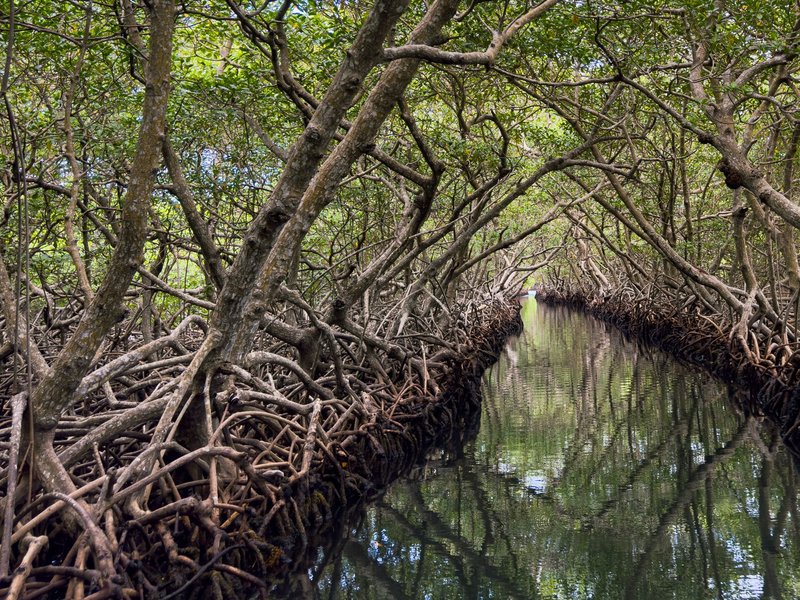
Ivory Coast’s southern coastline is stitched together by lagoons — Ébrié, Aby, Tadio — and the plants that hold those lagoon edges together do a job no ornamental garden plant does: they build land.
Red mangrove (Rhizophora racemosa) is the architect of that job. Its stilt roots arch out of the water before diving back in, trapping sediment and slowing erosion along the Ébrié Lagoon shoreline where Abidjan itself sits. Fishing communities along the coast still rely on the tangle of roots as a nursery ground — juvenile fish and shrimp shelter there before moving into open lagoon water.
Black mangrove (Avicennia germinans) grows just behind the red mangrove line, in the slightly drier, saltier ground the red mangrove can’t tolerate. It breathes through pencil-thin roots called pneumatophores that poke straight up out of the mud, and it excretes excess salt directly through its leaves — you can sometimes see the crystals on a hot day.
Raffia palm (Raphia hookeri) takes over where the lagoons turn to freshwater swamp. It has one of the longest leaves of any plant on Earth, sometimes stretching past 15 meters, and coastal communities have split those fronds into roofing thatch and woven fiber for generations. The sap taps into a sweet palm wine that’s still sold roadside near the coast.
The Rainforest: Taï National Park and the South
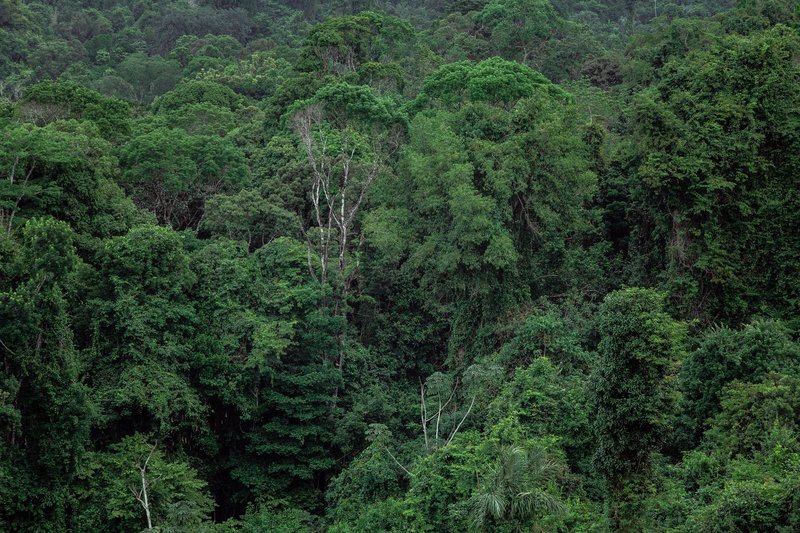
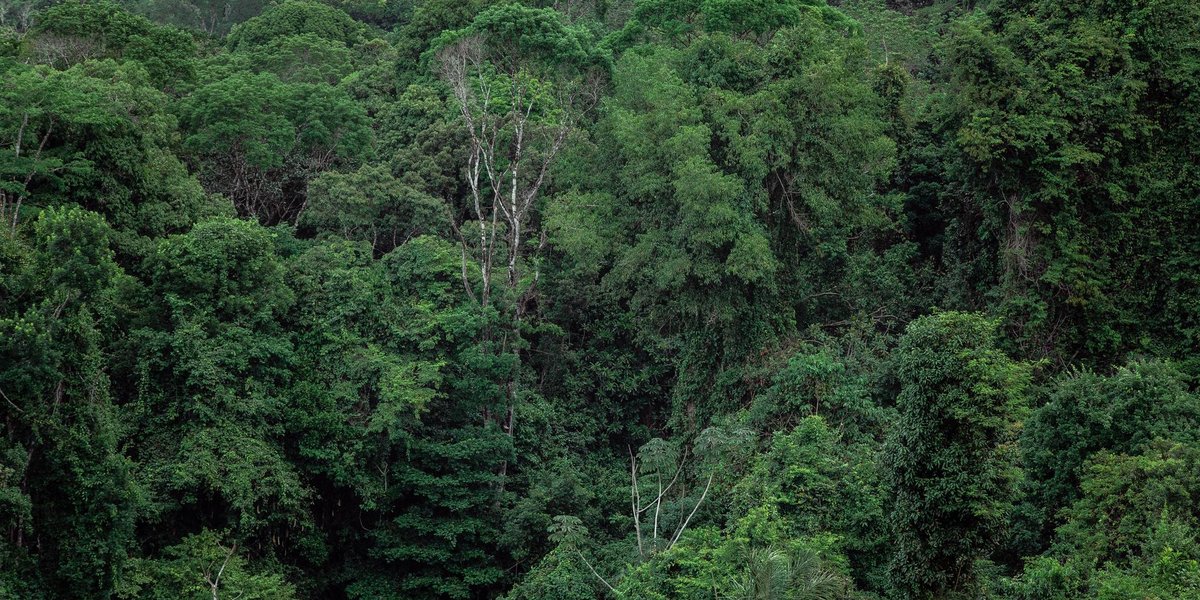
South of the savanna transition, Ivory Coast holds one of the last substantial blocks of untouched Upper Guinean rainforest — most of it inside Taï National Park, a UNESCO World Heritage site since 1982 and home to pygmy hippos and eleven monkey species that depend on an intact forest canopy. The species below explain why that canopy is worth protecting, and why it keeps getting cut anyway.
African oil palm (Elaeis guineensis) is native to this belt of West African forest, not an import — its wild ancestors still grow in Taï’s understory. Ivory Coast is now one of the world’s top palm oil producers, and nearly all of that production traces back to plantations of a tree whose original range was this exact forest zone.
Ivory Coast mahogany (Khaya ivorensis) carries the country’s name in its own species epithet, first described from Ivorian forest in the early twentieth century. It’s also a case study in what overexploitation does to a slow-growing hardwood: the IUCN Red List classifies it as Vulnerable, citing population declines driven by decades of logging for furniture-grade timber.
Iroko (Milicia excelsa) grows to emergent height above the rest of the canopy and produces one of West Africa’s most durable timbers — termite-resistant enough that it’s used as a teak substitute in outdoor construction. In several Ivorian and neighboring cultures, individual old-growth iroko trees are treated as spirit-inhabited and left standing even when everything around them is cleared.
Obeche, known locally as ayous (Triplochiton scleroxylon), is the opposite kind of timber tree: fast-growing, pale, and light enough to float, which makes it the region’s default plywood and veneer wood. It’s one of the most heavily exported hardwoods coming out of Ivorian forest concessions.
Kapok tree, or fromager (Ceiba pentandra), announces itself with a trunk wider than a car and buttress roots that can run higher than a person. Its seed pods burst into a silky floss once used to stuff mattresses and life jackets before synthetic fiber took over, and like iroko, old kapok trees carry spiritual weight in West African village life — many are left standing at the center of a clearing rather than felled.
Kola nut (Cola nitida) is arguably Ivory Coast’s most culturally loaded native plant. The caffeine-and-kolanin-rich nut is chewed fresh, ground into drinks, and above all presented as a formal gesture of welcome, respect, or negotiation across West Africa — no serious conversation between elders traditionally starts without kola changing hands first. It also has a direct line to global pop culture: early Coca-Cola recipes used kola nut extract for both flavor and caffeine, which is where the “cola” half of the name comes from.
Griffonia (Griffonia simplicifolia) is a woody climbing shrub native to this stretch of West African forest, according to Kew’s Plants of the World Online. Its seeds are unusually rich in 5-HTP, a serotonin precursor, and wild-harvested griffonia seed is now a genuine export commodity feeding the global mood-and-sleep supplement industry — a plant most people who take it have never heard of, let alone connected to an Ivorian forest.
Voacanga (Voacanga africana) is a small forest tree cultivated commercially in parts of Ivory Coast for its seeds, which yield alkaloids used as precursors in vinca-derived pharmaceuticals. It’s a rare example of an Ivorian native plant grown specifically for the international pharmaceutical supply chain rather than timber, food, or local medicine.
Uvariopsis guineensis is a smaller, less famous forest understory tree in the custard-apple family, part of the broader Guinean forest flora that stretches across Taï and similar reserves. It rarely gets a mention outside specialist botanical literature, which is exactly the kind of species that gets flattened into an anonymous line on a “flora of Ivory Coast” list — one of many forest species that exist here without ever becoming a household name.
The Savanna: Comoé National Park and the North
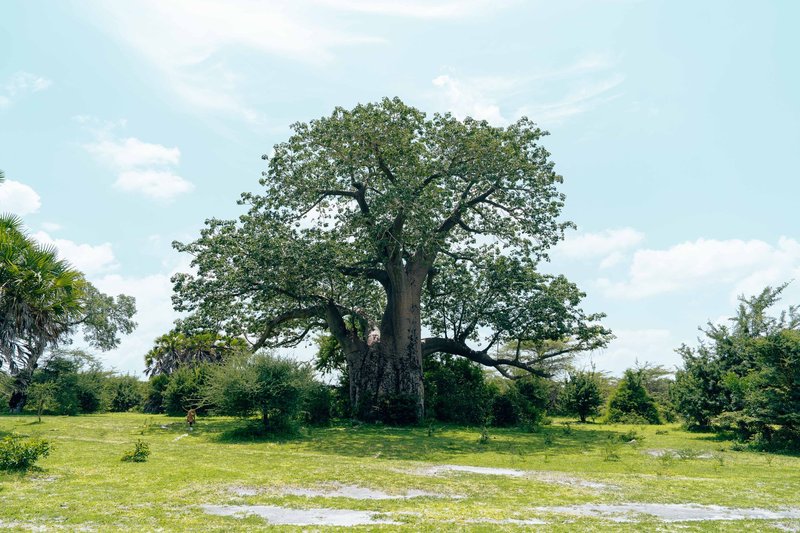
North of the forest zone, rainfall drops and the vegetation opens into savanna — grassland studded with fire-tolerant, drought-hardy trees. The clearest place to see the transition is Comoé National Park, one of West Africa’s largest protected areas at over 1.1 million hectares. Because the Comoé River cuts through it, the park holds savanna and pockets of gallery rainforest side by side — species that “belong” much further south turn up along its riverbanks.
Shea tree (Vitellaria paradoxa) is the economic backbone of the northern savanna belt. Its fruit kernel is pressed into shea butter, a fat used in cooking and skincare across West Africa long before it became a staple ingredient on cosmetics labels worldwide. The trees take over a decade to bear fruit and are almost never planted deliberately — harvesters rely on wild and semi-wild stands, which makes shea one of the rare cases where an entire regional export industry runs on unmanaged native trees.
Baobab (Adansonia digitata) is the savanna’s signature silhouette: a swollen, water-storing trunk that can run wider than it is tall, topped with branches that look more like roots. The fruit pulp is dried into a tart, vitamin-C-heavy powder used in porridges and drinks, and the tree’s ability to survive centuries — some individuals are estimated at over a thousand years old — has made it a landmark and meeting point in savanna villages, not just a food source.
African locust bean, or néré (Parkia biglobosa), produces long seed pods packed with a yellow, protein-rich pulp and seeds that get fermented into soumbara, a pungent seasoning paste that shows up in savanna cooking across the region. Like shea, it’s a tree that communities protect and harvest from rather than farm outright — clearing a mature néré tree for cropland is locally understood as giving up a multi-generational food source for one season’s yield.
Why the Forest Keeps Shrinking
The species above only survive where their habitat does, and Ivory Coast’s habitat has been disappearing fast. Forest cover has fallen from roughly 16 million hectares a century ago to under 3 million hectares of intact forest today, according to Global Forest Watch — a decline of around 90% in the space of a few human generations. Most of that clearing wasn’t driven by timber alone; cocoa farming, expanding to meet global chocolate demand, now accounts for the bulk of ongoing forest loss in the southwest, precisely where species like iroko, obeche, and griffonia still grow wild.
That’s the uncomfortable throughline connecting this whole list. Cocoa isn’t native to Ivory Coast — it arrived from the Americas in the colonial era — but it’s the crop responsible for clearing the ground that Ivory Coast’s actual native plants depend on. The forest that grows kola nut, mahogany, and voacanga is the same forest making way for the farms that make Ivory Coast the world’s largest cocoa exporter.
What This Adds Up To
Ivory Coast’s native plants don’t need a rebrand to matter — they already run through the country’s food, medicine, construction, and diplomacy. Shea butter and cocoa (even as an import) built export economies. Kola nut still opens conversations that timber deals and trade agreements later close. Mahogany named for the country is now rare enough to carry an IUCN warning label. None of that shows up on a taxonomy list, and it’s the reason a species-by-species tour of the coast, the rainforest, and the savanna tells you more about Ivory Coast than any single encyclopedia paragraph can.