Table of Contents
- TLDR
- Why East Timor’s Frog List Is So Short
- The Asian Common Toad (Duttaphrynus melanostictus)
- The Rice-Paddy Frogs (Fejervarya spp.)
- The Timor River Frog (Limnonectes timorensis)
- Everett’s Tree Frog (Litoria everetti)
- The Four-Lined Tree Frog (Polypedates cf. leucomystax)
- What’s Actually Threatening Them
- Where to Actually Find Them
TLDR
East Timor has seven confirmed amphibian species, all frogs and toads — no salamanders, no caecilians. In order of how often you’ll run into them: the Asian common toad (Duttaphrynus melanostictus), three still-undescribed rice-paddy frogs in the genus Fejervarya, the endemic Timor river frog (Limnonectes timorensis), Everett’s tree frog (Litoria everetti), and a rhacophorid tentatively identified as Polypedates cf. leucomystax. That’s the whole list. A country half the size of Massachusetts, sitting inside one of the planet’s most species-rich archipelagos, and its entire known amphibian fauna fits on one hand plus two fingers.
Why East Timor’s Frog List Is So Short

Timor sits in Wallacea, the belt of islands between the Asian and Australian continental shelves where Alfred Russel Wallace first noticed that species composition changes abruptly from one island to the next, even across narrow straits. Deep water kept most animals from island-hopping here the way they did across the shallow Sunda Shelf to the west. Frogs, with their salt-intolerant skin and short-range dispersal, got hit hardest by that barrier. Wallacea holds close to 50 native frog species across its entire island chain, and more than 30 of those exist nowhere else. Timor’s share of that total is small because Timor itself is a young, dry, seasonally parched island compared to wetter neighbors like Sulawesi.
The short list isn’t a sign nobody’s looked. It’s the first real look. A 2004 and 2009 field survey — the basis for the first formal herpetofauna report on Timor-Leste, published in ZooKeys — collected just over 100 amphibian specimens across the country and came away with seven species. Three of those turned out to be frogs science hadn’t named yet. That’s unusual for a landmass this size and this close to Australia and Indonesia, both of which have had herpetologists crawling over them for a century. East Timor spent decades under occupation and conflict before its 2002 independence, and fieldwork simply didn’t happen. The frogs were always there. Nobody had the runway to count them.
The Asian Common Toad (Duttaphrynus melanostictus)
If you spend one night near a village light in East Timor, this is the amphibian you’ll meet. Duttaphrynus melanostictus is stocky, dry-skinned, and covered in warts, with a ridge of bony crests running across the top of its skull between the eyes — a feature herpetologists use to separate true toads from nearly everything else that hops. Survey teams recorded it more often than any other amphibian on the island, which tracks with its reputation everywhere else in South and Southeast Asia: this toad thrives around people. Rice paddies, drainage ditches, garden edges, the space under a porch light where insects collect — that’s toad habitat.
It’s also not originally a Timorese species in the strict sense. D. melanostictus has ridden agricultural expansion across huge stretches of Asia and the Pacific, and researchers studying Timor’s reptiles have noted native predators like green pit vipers and monitor lizards declining in areas where the toad has become common, likely from eating a toxic animal they didn’t evolve alongside. It’s the most visible frog on the island. It’s also the one doing the most ecological damage.
The Rice-Paddy Frogs (Fejervarya spp.)
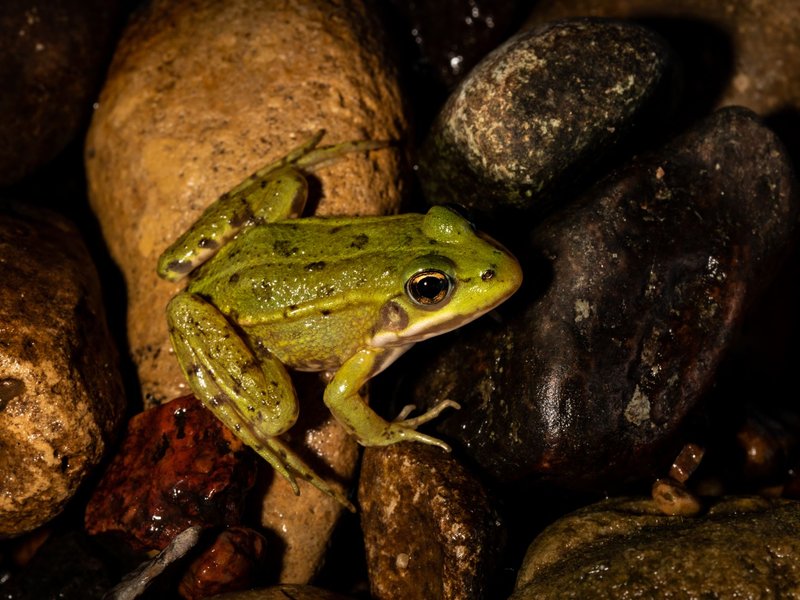
Three of Timor-Leste’s seven amphibian species don’t have names yet — not officially. Field teams collected specimens that resemble Fejervarya verruculosa, a rice-paddy frog described from the neighboring island of Wetar, but genetic and morphological work hasn’t formally split and named the Timorese populations. That leaves them sitting in the literature as Fejervarya cf. variants, distinct enough to flag, not yet distinct enough to christen.
Rice-paddy frogs are built for exactly what the name says: flooded agricultural land, irrigation channels, the shallow standing water that collects after monsoon rain. They’re small, mottled brown or olive, with pointed snouts and the kind of camouflage that makes them nearly invisible against wet mud until they jump. For a country where wet-rice cultivation is a major land use, these frogs are living in some of the most heavily modified habitat on the island — which is exactly why undescribed diversity like this tends to slip through the cracks. Nobody goes looking for a new species in a rice paddy.
The Timor River Frog (Limnonectes timorensis)
This is the one true Timor exclusive on the list — a species found nowhere else on Earth. Limnonectes timorensis belongs to a genus of fanged frogs named for the small tusk-like projections some species carry on their lower jaw, used in male-to-male combat over territory. It’s a river-associated species, sticking close to flowing water and the rocky, forested margins around streams rather than the open paddies favored by its Fejervarya neighbors.
Endemism on an island this size and this young is worth pausing on. Timor separated from the Australian and Sunda shelves without ever forming a permanent land bridge, which means L. timorensis likely descended from a founding population that arrived by chance — flood debris, storm rafting, something improbable — and then evolved in isolation long enough to become its own species. That’s the short version of how island endemics happen anywhere in the world. It’s also why losing this one frog to habitat loss would mean losing something that exists on no other landmass, not a shrinking range of a species that’s still common somewhere else.
Everett’s Tree Frog (Litoria everetti)
Named for the 19th-century naturalist and colonial collector Alfred Hart Everett, this tree frog belongs to the Australo-Papuan genus Litoria — a genus with far deeper roots on the Australian side of Wallace’s Line than on the Asian side, which makes its presence on Timor a small geographic clue in itself. Survey records place it at real elevation: around 1,200 meters, along the Meleotegi River near Eraulo in Ermera District, well up into Timor’s central highlands rather than down in the coastal lowlands where the toads and rice-paddy frogs concentrate.
That elevation preference matters for a practical reason. Highland streams in Timor run cooler and more consistently than lowland water sources that dry to a trickle in the dry season, and L. everetti appears tied to that more stable, forested habitat — dry and moist tropical forest and shrubland bordering rivers, rather than open agricultural land. It’s also recorded on Indonesian islands nearby (Alor, Sumba, Sawu) and in Indonesian West Timor, so it’s not a Timor endemic in the way the river frog is. But on the Timor-Leste side of the border, it’s a highland specialist in a country where most amphibian records cluster near sea level.
The Four-Lined Tree Frog (Polypedates cf. leucomystax)
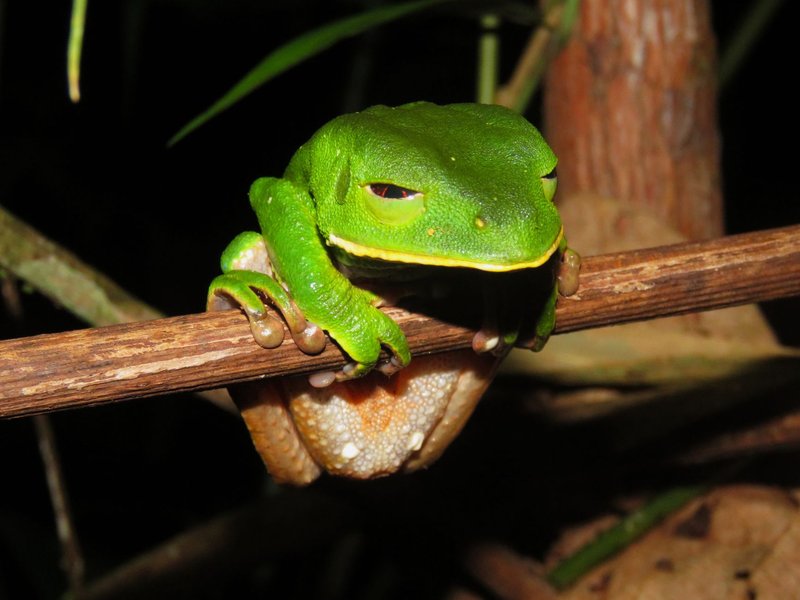
The seventh species carries the same “cf.” qualifier as the rice-paddy frogs — short for confer, researcher shorthand for “resembles this species closely enough to compare, not close enough to confirm.” Polypedates leucomystax, the species this Timorese population is compared against, is one of the most widespread tree frogs in mainland and island Southeast Asia, easily recognized by the pale stripe running along its upper lip and a build suited to life off the ground — long limbs, expanded toe pads, a slender frame built for climbing rather than burrowing.
Rhacophorid tree frogs like this one were recorded among the more frequently encountered amphibians in the 2004–2009 surveys, alongside the toad and the rice-paddy frogs. Whether Timor’s population turns out to be true P. leucomystax, a local subspecies, or another undescribed lineage entirely is an open question — one more thread in a fauna where nearly half the known species still need a final taxonomic answer.
What’s Actually Threatening Them
Habitat conversion is the front-line pressure. Timor-Leste’s population depends heavily on subsistence and swidden agriculture, and forest cleared for rice, maize, or coffee removes exactly the streamside and highland forest habitat that species like the Timor river frog and Everett’s tree frog depend on. Generalists like the Asian common toad don’t just tolerate that shift — they benefit from it, which skews future surveys toward finding more toads and fewer of the specialists.
Disease is the quieter risk. Chytridiomycosis, caused by the fungal pathogen Batrachochytrium dendrobatidis, has driven amphibian declines and extinctions across the tropics, and Wallacea’s isolated island frog populations are exactly the kind of small, geographically confined gene pools that get hit hardest when a pathogen like that arrives. Formal disease surveillance in Timor-Leste is thin — a function of the same limited fieldwork history that left three of the country’s frogs unnamed. Fewer than 10 percent of Wallacea’s land area sits inside a protected area, according to the Critical Ecosystem Partnership Fund’s regional assessment, and in Timor-Leste specifically, Nino Konis Santana National Park is the only site with full legal protected status. Everything outside that boundary — including the highland streams L. everetti needs — has no formal safeguard against clearing.
Where to Actually Find Them
You don’t need a permit or a guide to see most of this list. The Asian common toad and the Fejervarya rice-paddy frogs show up around any flooded field or village drainage after dusk, especially just after rain breaks a dry spell — that’s when calling activity peaks and you can locate frogs by ear before you ever see one. A flashlight with a red or amber filter disturbs them less than white light and makes eyeshine easier to spot low in the grass.
The harder species — Limnonectes timorensis and Litoria everetti — mean committing to higher ground. Streams feeding into the central highlands around Ermera and similar districts, where forest cover still lines the water, are the known habitat for both. Nino Konis Santana National Park in the country’s far east is the one place with legal protection built specifically around habitats like this, making it the most defensible starting point for anyone serious about seeing Timor’s frogs rather than just its toads. Go slow, go quiet, and go near water after dark — that’s the whole method the researchers behind the ZooKeys survey used to document this entire list in the first place.