TLDR
Trinidad and Tobago host 35 confirmed amphibian species across 12 families, and every single one is a frog or toad — the islands have no native salamanders and only one disputed caecilian record. A handful matter more than the rest: the Critically-endangered-turned-Endangered Golden Tree Frog, which lives its whole life inside one species of mountaintop bromeliad; the native (not invasive) cane toad, locally called crapaud; the Trinidad stream frog, whose males carry tadpoles around on their backs; and Tobago’s endemic Bloody Bay poison frog, confined to a few square kilometers of forest. Best viewing: guided night walks in the Northern Range or Tobago’s Main Ridge Forest Reserve, right after rain.
Table of Contents
- Why Two Small Islands Punch Above Their Weight
- The Headliners
- The Endemics: Found Nowhere Else on Earth
- Species at a Glance
- Where and When to See Them
- Common Questions
Why Two Small Islands Punch Above Their Weight
Trinidad wasn’t always an island. Until roughly 10,000 years ago it was attached to the South American mainland, part of the Orinoco Delta region, and when sea levels rose it kept a slice of that continental fauna instead of starting from scratch like most oceanic islands do. That’s why a landmass smaller than Delaware carries 35 amphibian species while similarly sized true islands in the Caribbean often have a handful.
Tobago tells a different story. It’s older, more isolated, and never had as direct a land connection, which is exactly why it evolved its own short list of endemics found on that island and nowhere else, not even 30 kilometers away in Trinidad.
Every one of the 35 species belongs to the order Anura — frogs and toads. There are no naturally occurring newts or salamanders (order Caudata) anywhere on either island, and the single historical record of a caecilian (a limbless, burrowing amphibian) is considered dubious by researchers at the University of the West Indies, which maintains the most current taxonomic checklist for the islands.
The Headliners
Skip past the checklist for a second. These are the species worth knowing by name.
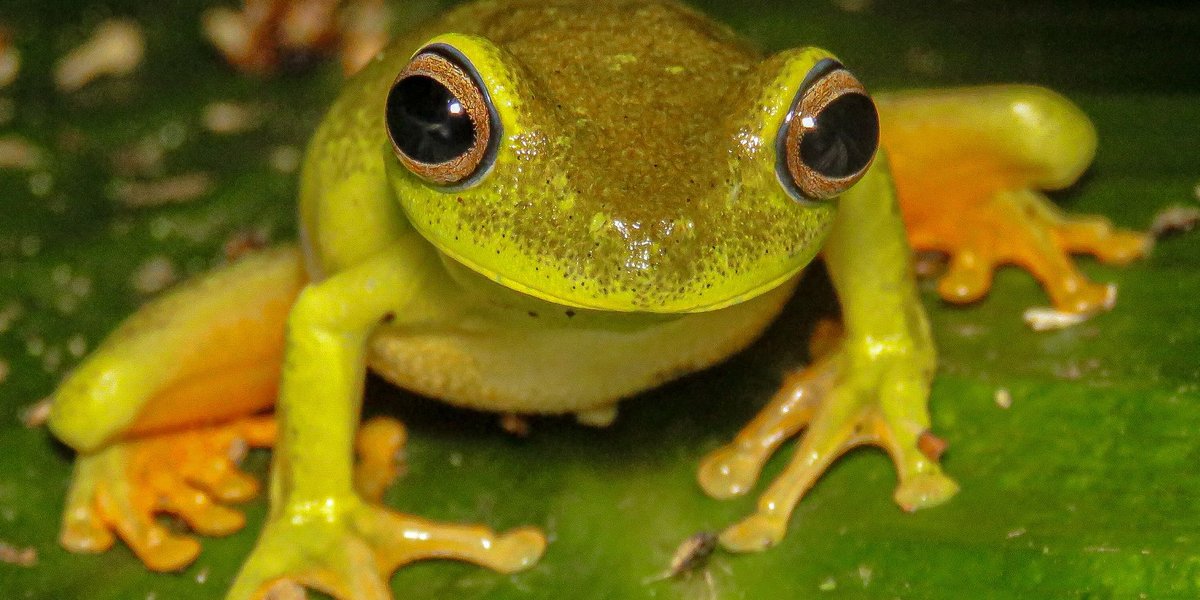
Golden Tree Frog (Phytotriades auratus). Three centimeters of brown skin striped in gold, and one of the strangest life histories of any frog anywhere. It exists on exactly two mountain peaks in Trinidad — El Tucuche and Cerro Aripo — plus one site in Venezuela, and spends its entire life cycle inside a single bromeliad species, Glomeropitcairnia erectiflora, which pools roughly 700 milliliters of rainwater in its leaf base. No bromeliad, no frog. Researchers have had to develop environmental DNA sampling techniques just to confirm the species is still present without tearing apart the plants it depends on, according to a study published via the National Center for Biotechnology Information.
Cane toad, locally called crapaud (Rhinella marina). Here’s the detail most articles get backwards: this toad is not an invader in Trinidad and Tobago. Its native range runs from South Texas down through Central America into the Amazon basin, and Trinidad and Tobago sit right inside that natural distribution — it’s the same species that turned into an ecological disaster after being introduced to Australia and other places it doesn’t belong, but here it’s a local. It’s also the toad most likely to wander into a yard, and its parotid glands secrete bufotoxins that can kill a dog that mouths one.
Trinidad Stream Frog (Mannophryne trinitatis). Males don’t just guard the eggs on land after fertilization — once they hatch, the tadpoles flip themselves onto their father’s back one at a time, and he carries them, sometimes for three or four days, until he finds a pool without predatory fish or shrimp in it. He’s picky on purpose: pools with the fish Rivulus hartii or the shrimp Macrobrachium carcinus get rejected outright, because either one will eat the tadpoles on sight.
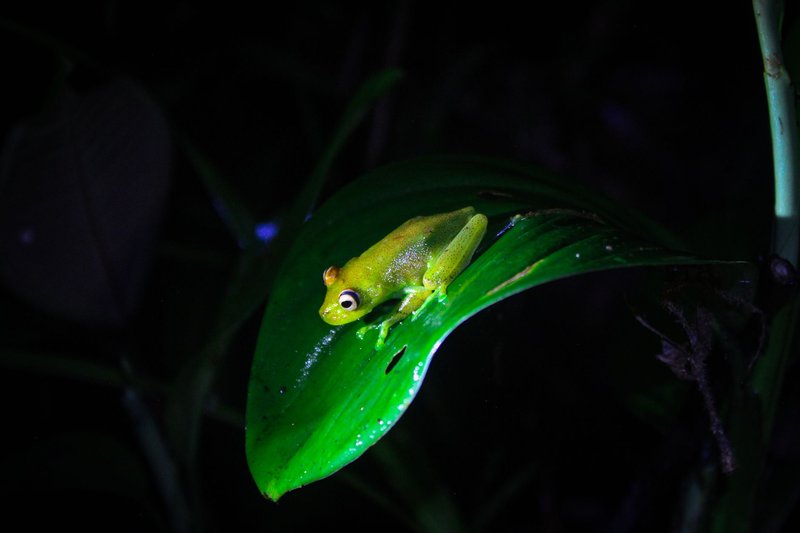
Tobago Glass Frog (Hyalinobatrachium orientale). Barely two centimeters long, lime green on top, and transparent on the belly — turn one over and you can watch its heart beat and see its liver through the skin. Found in the Main Ridge Forest Reserve, usually clinging to leaves overhanging streams at night.
The Endemics: Found Nowhere Else on Earth
Endemism is where Tobago earns its keep. The island’s isolation produced species that exist within a radius you could walk in an afternoon.
The Bloody Bay poison frog (Mannophryne olmonae) lives only in forest around Bloody Bay in northeastern Tobago and on tiny Little Tobago Island. It’s not actually poisonous — the “poison frog” name comes from its family, Aromobatidae, a group related to true dart frogs — but its restricted range has made it a conservation priority; the IUCN currently lists it as Vulnerable after a period in the mid-2000s when it was rated Critically Endangered following a sharp population crash.
The Tobago Stream Frog shares the same story of geographic isolation, turning up throughout the Main Ridge but rarely seen thanks to its dull brown coloring and small size.
Trinidad’s endemic contribution leans on litter frogs in the genus Pristimantis — direct developers that skip the tadpole stage entirely, hatching as miniature frogs straight from terrestrial eggs. Tobago has its own trio in the same genus, including P. charlottevillensis and P. turpinorum, both named for locations on the island where they were first described.
And then there’s the Golden Tree Frog again, which counts as endemic to Trinidad’s two highest peaks even by the country’s own standards — a species with a national range smaller than most golf courses.
Species at a Glance
| Species | Size | Habitat | Conservation Status |
|---|---|---|---|
| Golden Tree Frog (Phytotriades auratus) | ~3 cm | Bromeliads on two Trinidad mountain peaks | Endangered |
| Cane Toad / Crapaud (Rhinella marina) | 10–15 cm, up to 24 cm | Gardens, forest edges, wetlands, islandwide | Least Concern |
| Trinidad Stream Frog (Mannophryne trinitatis) | ~2.5 cm | Forest streams, Trinidad’s Northern Range | Least Concern |
| Tobago Glass Frog (Hyalinobatrachium orientale) | ~2 cm | Streamside vegetation, Main Ridge | Not fully assessed |
| Bloody Bay Poison Frog (Mannophryne olmonae) | ~2.5 cm | Forest floor near Bloody Bay, Tobago | Vulnerable |
| Litter Frogs (Pristimantis spp.) | 1.5–4 cm | Leaf litter, both islands | Varies by species |
Where and When to See Them
Timing matters more than location. Frogs call and move most after dusk, and activity spikes hard in the hour or two following rain — which, in the wet season (roughly June through December), is most nights.
In Trinidad, the Northern Range is the obvious target. Guided night walks out of the Asa Wright Nature Centre area put you on trails where stream frogs and litter frogs are calling within a few hundred meters of the trailhead; going with a local guide isn’t just convenience, it’s the difference between hearing a dozen species and actually seeing three of them, since most of what’s calling is small, still, and camouflaged.
In Tobago, the Main Ridge Forest Reserve — the oldest legally protected forest reserve in the Western Hemisphere, dating to 1776 — is the entire show. It’s compact enough that a single guided night walk can plausibly turn up the glass frog, the Tobago stream frog, and one or two Pristimantis species in the same two-hour loop.
Neither Golden Tree Frog site is a casual visit. Both El Tucuche and Cerro Aripo require a serious hike with a permit and, realistically, a researcher or specialized guide — this isn’t a species you stumble across.

Common Questions
Are any frogs in Trinidad and Tobago dangerous or poisonous?
Not to humans, in any meaningful sense. The cane toad is the one to actually worry about, but the danger is to dogs and cats that bite or mouth one — its skin secretions contain bufotoxins that can cause seizures and cardiac arrest in a pet within 15 minutes, per the Merck Veterinary Manual. Handling any of the islands’ frogs with bare hands and then touching your eyes or mouth is bad practice, but none carries venom capable of seriously harming an adult human.
How do I tell a native frog from a cane toad?
Look at the skin and the glands. Cane toads are dry, warty, and heavily built, with two large, kidney-shaped parotid glands bulging visibly behind each eye — no native frog on the islands has anything like them. True frogs in the local fauna (the stream frogs, litter frogs, and tree frogs) have smoother, moister skin and a leaner build built for jumping rather than the cane toad’s slow hop-and-walk gait. If it’s the size of a fist, dry to the touch, and barely moves when approached, it’s the toad.
Why does Trinidad have so many more species than Tobago?
Land bridge history. Trinidad was connected to South America until relatively recently, geologically speaking, and inherited a slice of the mainland’s amphibian diversity. Tobago’s longer isolation cut it off from that pipeline, trading species count for a small set of endemics unique to the island.