As an Amazon Associate we earn from qualifying purchases. Disclosure
The best binoculars for bird watching for most people are a pair of 8×42 roof-prism binoculars with ED or HD glass, a waterproof and gas-purged body and at least 16 mm of eye relief. The Vortex Diamondback HD 8×42 is the pair birders on Reddit’s r/birding recommend more than any other, and it is our top pick. On a tighter budget, buy the Celestron Nature DX 8×42. For a long-term upgrade, the Nikon Monarch M7 8×42 has the widest view of any pair below the premium tier, and the Swarovski EL 8.5×42 is the pair many birders buy once and keep for decades.
I learned what fog-proofing means at a field station in Costa Rica. At dawn the humidity fogged a borrowed pair of cheap binoculars from the inside, and the first trogon I ever saw was a green blur on a mossy branch. A few months later a volunteer on a dawn Audubon walk handed me his 8x42s to look at a singing warbler, and I saw the bird’s eye ring. That gap, between a pair that hides the bird and a pair that shows it, is what this guide is about. Every pair below is waterproof and fog-proof, focuses close enough for a bird at a feeder, and comes from a brand that repairs or replaces its binoculars.
Best birding binoculars at a glance
| Binoculars | Best for | Tier |
|---|---|---|
| Vortex Diamondback HD 8×42 | Best overall for most birders | Mid-range |
| Celestron Nature DX 8×42 | Best budget pair | Budget |
| Nikon Prostaff P3 8×42 | Light budget pair, glasses wearers | Budget |
| Vortex Crossfire HD 8×42 | Budget pair with the Vortex warranty | Budget |
| Athlon Midas UHD 8×42 | ED glass for less | Mid-range |
| Nikon Monarch M5 8×42 | Glasses wearers | Mid-range |
| Nikon Monarch M7 8×42 | Widest view under premium | Upgrade |
| Vortex Viper HD 8×42 | Upgrade with harness included | Upgrade |
| Zeiss Conquest HDX 8×42 | Near-premium glass | Upgrade |
| Swarovski EL 8.5×42 | A pair for life | Premium |
| Zeiss SFL 8×40 | Premium and light | Premium |
| Vortex Diamondback HD 8×32 | Travel and long hikes | Compact |
| Nikon Monarch M7 8×30 | Lightest pair worth owning | Compact |
| Celestron Nature DX 8×32 | Kids, teens and small hands | Compact |
| Vortex Binocular Harness | Any pair on a long walk | Accessory |
| LensPen Lens Cleaning Pen | Cleaning in the field | Accessory |
What makes binoculars good for birding?
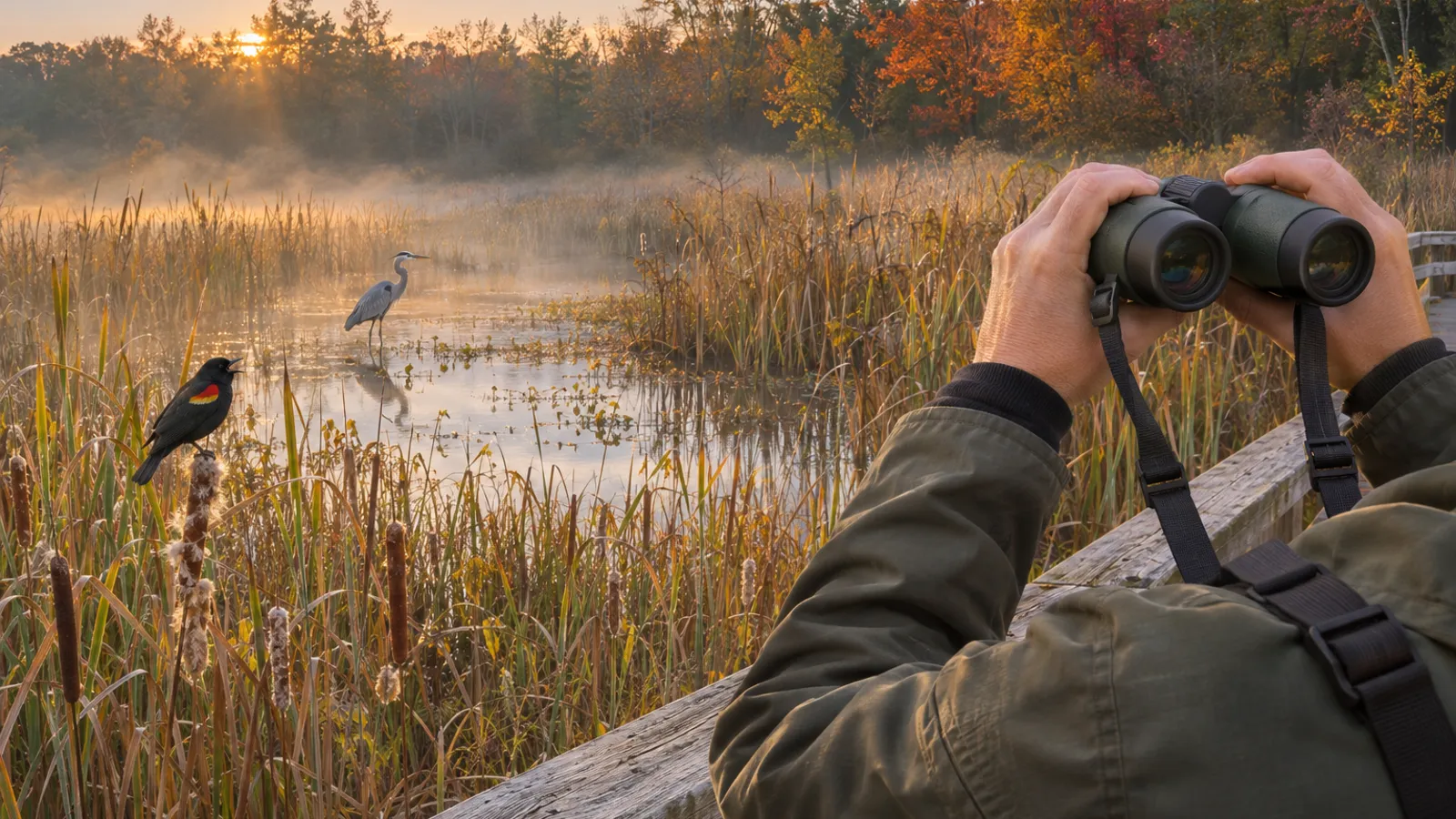
Birds move fast, sit in shade, perch at the top of a tree one minute and in a bush ten feet away the next. Binoculars for birding have to find a moving bird quickly, show its colors in poor light and focus close. Six specifications decide whether a pair does that.
- Magnification and lens size (8×42). The first number is magnification and the second is the width of the front lenses in millimeters. 8×42 is the standard birding size: 8 power is steady in the hand and gives a wide view, and 42 mm lenses gather enough light for dawn and dusk. 8×42 vs 10×42 has the full comparison.
- Field of view. The width of the scene you see, given in feet at 1,000 yards or in degrees. A wider view makes it easier to find a warbler moving through leaves. For an 8×42, 330 ft is narrow, 390 ft is good and 420 ft or more is wide.
- Close focus. The nearest distance at which the binoculars focus. Under 8 ft lets you watch a bird at a feeder, a sparrow in a hedge or a butterfly on a flower.
- Eye relief. The distance from the eyepiece at which you still see the full image. Glasses wearers need about 16 mm or more. Binoculars for glasses wearers explains how to check it.
- Glass and coatings. ED (extra-low dispersion) or HD glass cuts the purple and green fringing you see around a dark bird against a bright sky. Phase-corrected roof prisms and dielectric prism coatings make the image sharper and brighter. Fully multi-coated lenses are the minimum.
- Waterproof and gas-purged. O-ring seals keep rain out, and nitrogen or argon gas inside the barrels stops the lenses fogging from the inside when you walk from a warm car into cold air. Skip any pair that is only “water resistant”.
The warranty matters more for binoculars than for most gear, because birders drop them, sit on them and leave them on car roofs. Vortex and Athlon cover their binoculars for life with no receipt and no questions, and the warranty transfers to a second owner. Nikon, Celestron, Zeiss and Swarovski offer limited lifetime warranties that cover defects, and each repairs accidental damage for a fee.
Best binoculars for bird watching overall
Best overall
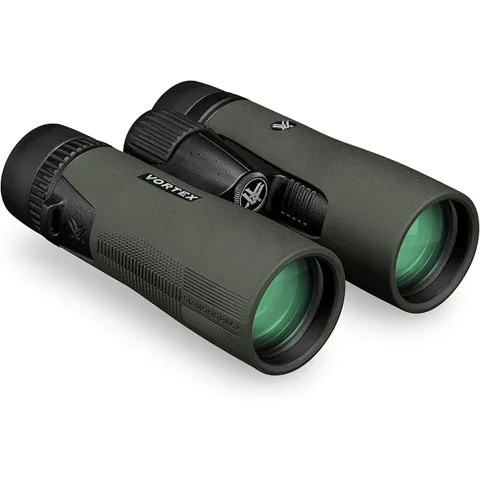
1. Vortex Diamondback HD 8×42
Ask r/birding which binoculars to buy and the Diamondback HD comes up in nearly every thread, usually in the first few replies. One commenter has used the same 8×42 pair for ten years; another calls it the best value at its price. It is the pair I see most often on group bird walks.
The Diamondback HD has HD glass that cuts color fringing, dielectric prism coatings for a brighter image, a wide 393 ft field of view, 17 mm of eye relief and a 5 ft close focus, so a chickadee on the feeder outside the window fills the view. The eyecups twist down for glasses. Vortex includes its GlassPak chest harness in the box, so you do not need to buy a strap.
The VIP warranty is the other reason birders buy it. Vortex repairs or replaces the binoculars if they break for any reason, including a drop, with no receipt or registration, and the warranty passes to the next owner. That makes a used Diamondback a safe buy.
- 8x magnification, 42 mm lenses, HD glass, dielectric coatings
- Argon purged, waterproof, fog-proof
- GlassPak chest harness included
- Also sold as 10×42 and 8×32 on the same listing
Good: the most recommended mid-range pair, with a harness and a lifetime warranty included. Not great: the image is less sharp at the edges than the Monarch M7 or Viper HD.
Best budget binoculars for birding
On r/birding, the most common advice to a beginner on a small budget is that a decent new pair starts at the price of the three binoculars below. Below that line, binoculars usually lose the things that make birding work: phase coating, gas purging and real waterproofing. If your budget is lower, the same threads say to buy a used pair of a good brand. A used Vortex keeps its warranty.
Best budget pair
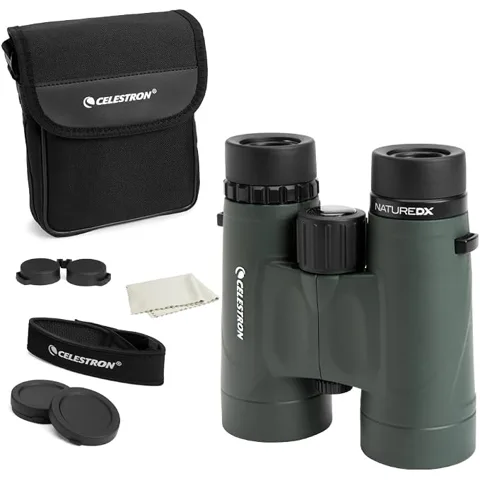
2. Celestron Nature DX 8×42
The Nature DX is the budget pair that birding sites and Reddit threads name most often, and it appears in the Audubon binocular guide’s entry-level group. It has phase-coated BaK-4 roof prisms and fully multi-coated lenses, the two features that separate real birding binoculars from toy-grade pairs at the same size.
The 388 ft field of view is wide for a budget pair and the 6.5 ft close focus Celestron lists works for feeder birds. It is waterproof and nitrogen purged, comes with a case, a neck strap, lens caps and a rainguard, and is covered by Celestron’s limited lifetime warranty.
- 8x magnification, 42 mm lenses, BaK-4 phase-coated roof prisms
- 388 ft field of view at 1,000 yards, 17.5 mm eye relief
- Waterproof, nitrogen purged, tripod adaptable
- Over 4,000 Amazon ratings
Good: the best-reviewed budget pair, with a wide view. Not great: it is heavier than the Nikon and softer at the edges of the image than ED-glass pairs.
Light budget pair
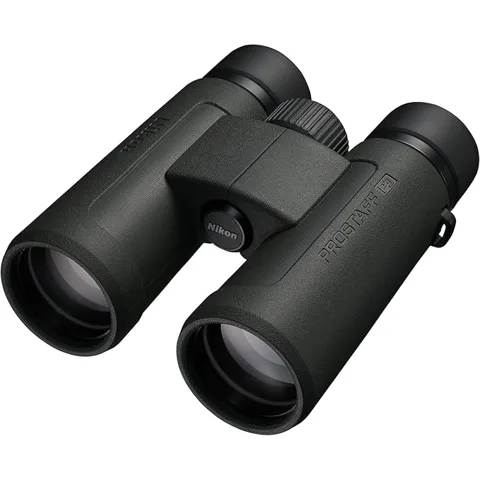
3. Nikon Prostaff P3 8×42
The Prostaff P3 is one of the lightest full-size pairs in this guide at about 1.3 lb, and its 20.2 mm eye relief is the longest here. Those two numbers make it the budget pick for anyone who wears glasses or carries binoculars on long walks. r/birding commenters recommend it as a first pair, and Nikon’s customer support is US based.
The lenses are multilayer coated and the prisms have a silver-alloy coating rather than dielectric. The 377 ft field of view is wide enough to find birds without hunting for them. One r/birding owner said the rubber lens caps fell apart within a year, so plan to replace the caps if you use them hard.
- 8x magnification, 42 mm lenses, multilayer coatings
- 377 ft field of view, 20.2 mm eye relief
- Nitrogen purged, O-ring sealed, 1.3 lb
- Turn-and-slide eyecups
Good: light, long eye relief and a trusted brand. Not great: the lens caps and eyecups are the weak points, and the image is less bright in shade than the Celestron.
Budget pair with a lifetime warranty
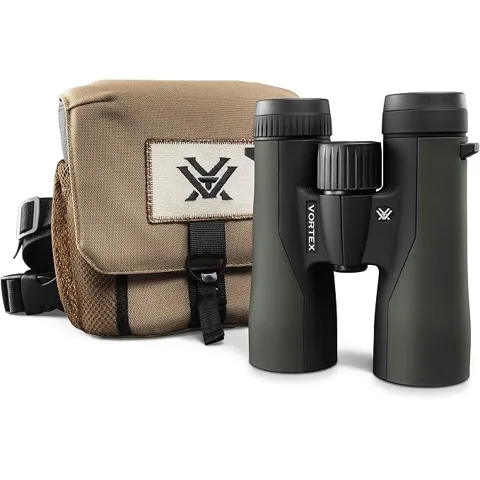
4. Vortex Crossfire HD 8×42
The Crossfire HD is the least expensive Vortex binocular that birders recommend, and it carries the same unconditional lifetime warranty as the Diamondback. An r/birding owner who paid less than the Celestron said they liked their Crossfire HD more. Another keeps a pair in the car for birds seen on the drive.
It has HD glass, fully multi-coated lenses, a 390 ft field of view and nitrogen purging, and it is tripod adaptable. The difference from the Diamondback HD is the prism coating: the Crossfire lacks dielectric coatings, so the image is dimmer in forest shade and at dusk. Commenters on r/birding sum it up as fine for open country and backyard birds, with the Diamondback better under trees.
- 8x magnification, 42 mm lenses, HD glass
- 390 ft field of view
- Nitrogen purged, waterproof, tripod adaptable
- Vortex VIP unlimited lifetime warranty
Good: the warranty of a much more expensive pair. Not great: dimmer than the Diamondback HD in shade and at dawn.
Best mid-range birding binoculars
Mid-range binoculars add ED or HD glass and dielectric prism coatings, and the jump in brightness and color from a budget pair is the largest step in the whole price range. r/birding’s advice on gift threads is direct: the difference between a good mid-range pair and a premium pair is smaller than most people expect, and the difference between a mid-range pair and a cheap one is large. The Diamondback HD above belongs in this group too.
ED glass for less
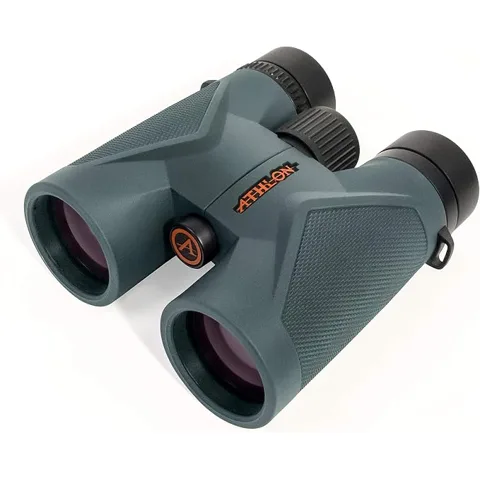
5. Athlon Midas UHD 8×42
The Midas UHD adds ED glass, which cuts the color fringing around a dark bird against a bright sky. It has ESP dielectric prism coatings and a wide 8.1 degree field of view, about 425 ft at 1,000 yards, which is wider than every other pair in this section. Athlon covers it with an unconditional lifetime warranty that transfers to a new owner.
On r/birding the Midas comes up as the pair that performs close to binoculars that cost twice as much. One owner received a pair as a gift ten years ago and still uses it; another calls it the best budget ED pair. The case and strap are basic.
- ED glass, ESP dielectric prism coating
- 8.1 degree field of view, 17.2 mm eye relief
- Argon purged, waterproof, 1.6 lb
- Athlon gold medal lifetime warranty
Good: ED glass and the widest view in its group. Not great: heavier than the Nikon Monarch M5; buy a harness to carry it.
Best for glasses wearers
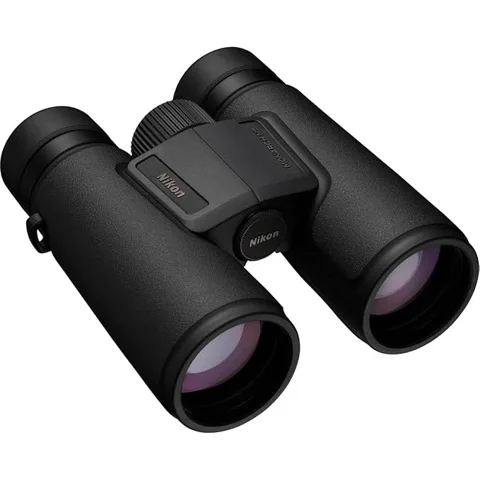
6. Nikon Monarch M5 8×42
The Monarch M5 has 19.5 mm of eye relief and turn-and-slide eyecups that lock at several heights, so glasses wearers see the full image without taking their glasses off. It also has ED glass and dielectric prism coatings, the same optical recipe as the Diamondback HD, in a lighter body.
It focuses as close as 8.2 ft. Monarchs are a long-time birding standard: one r/birding commenter has used the same pair for 15 years and another for five. The tradeoff is the field of view, 335 ft at 1,000 yards, which is the narrowest of the full-size pairs here.
- ED glass, dielectric prism coatings
- 19.5 mm eye relief, close focus 8.2 ft
- 1.4 lb, waterproof and fog-proof
- Nikon limited lifetime warranty
Good: long eye relief, ED glass and a light body. Not great: the narrowest view of any full-size pair in this guide.
Best upgrade binoculars for serious birders
The next tier adds wider fields of view, sharper edges and better build. These are the pairs birders buy as a second pair, once they know they will bird for years. On r/birding, the advice for a budget at this level is to look at the Nikon Monarch M7 and the Vortex Viper HD first.
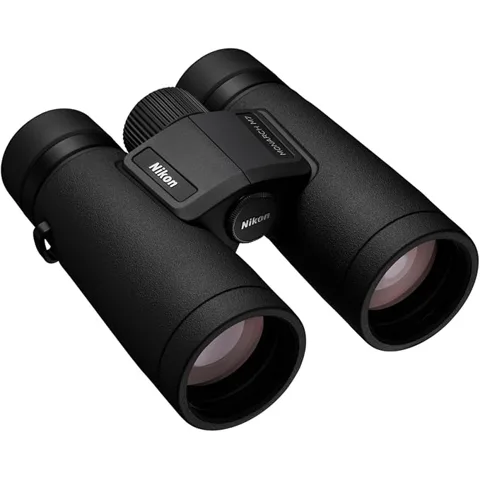
Widest view
7. Nikon Monarch M7 8×42
The Monarch M7’s field of view is 435 ft at 1,000 yards, the widest in this guide below the premium tier. A wide view is what lets you put binoculars up and find a moving bird without searching for it, and the top reply in one r/birding thread recommends the M7 as an all-round pair for that reason and for its color correction.
It has ED glass and multilayer coatings on the lenses and prisms, oil- and water-repellent coatings on the outer lenses, a locking diopter and turn-and-slide eyecups for glasses wearers.
- ED glass, multilayer lens and prism coatings
- 435 ft field of view, 17.1 mm eye relief, close focus 8.2 ft
- Waterproof, fog-proof, locking diopter
- Also sold as 10×42
Good: the widest view outside the premium tier, from a brand birders trust. Not great: at 23.6 oz it is heavier than the Monarch M5, and its eye relief is shorter.
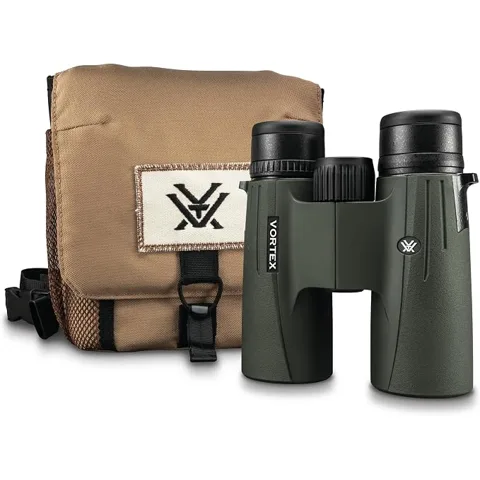
Upgrade with a harness included
8. Vortex Viper HD 8×42
The Viper HD sits one step above the Diamondback in Vortex’s line. It has a high-density glass system with XR anti-reflective coatings, which shows a brighter image at dawn and in forest shade, and a 409 ft field of view. The image is sharper at the edges than the Diamondback’s.
It has a locking diopter, so the focus setting for your right eye does not get bumped, and Armortek coatings that resist scratches on the outer lenses. Vortex includes its GlassPak chest harness and covers the Viper with the same unconditional lifetime warranty as its cheaper pairs.
- HD glass, XR lens coatings
- 409 ft field of view, 18 mm eye relief
- Argon purged, locking diopter, 1.5 lb
- GlassPak harness and lifetime VIP warranty
Good: brighter and sharper than the Diamondback, with the same warranty. Not great: a large price step over the Diamondback for a smaller step in image.
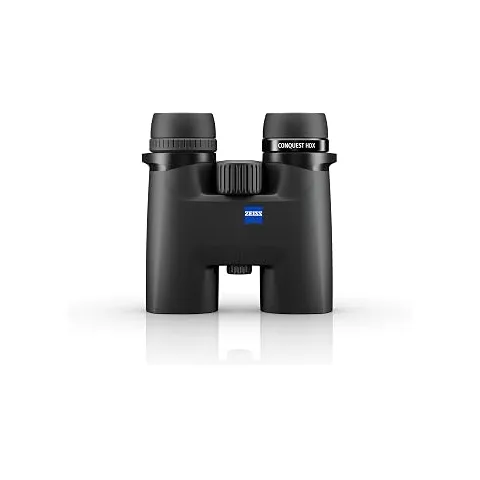
Near-premium glass
9. Zeiss Conquest HDX 8×42
The Conquest HDX is the least expensive Zeiss binocular that uses the company’s FieldFlattener lenses, the same idea as its premium pairs: the image stays sharp out to the edge instead of blurring in the outer third. It transmits 90% of the light, has ED glass and aspheric lenses and LotuTec coatings that shed rain.
The focus wheel goes from close focus to infinity in 1.3 turns, which is fast when a bird flies from a near branch to a far one. It has a magnesium body, a locking diopter, removable eyecups and flip-down lens covers.
- ED glass, aspheric lenses, FieldFlattener
- 90% light transmission, ZEISS T* and LotuTec coatings
- Nitrogen purged, magnesium body
- Fast 1.3-turn focus wheel
Good: edge-to-edge sharpness close to premium binoculars. Not great: few Amazon ratings so far, and the listing is often sold through other sellers.
Best premium binoculars for birding
Premium binoculars show a brighter, sharper image with truer color, and they hold up to decades of use. An r/birding owner of a Swarovski pair has sent it back to Austria three times in 20 years and gets it back refreshed each time. The top-voted post on r/birding about binoculars warns not to try the nicest pair in the store unless you are willing to spend that much, because once you look through one the difference is plain.
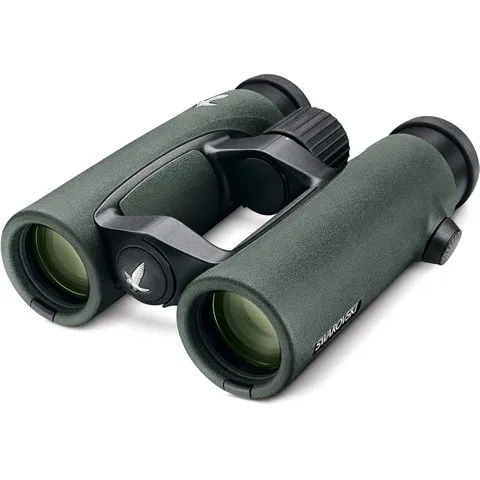
A pair for life
10. Swarovski EL 8.5×42
The Swarovski EL is the binocular you see around the necks of tour leaders and bird banders. Its open-bridge body leaves room for your fingers to wrap around the barrels, which makes it easy to hold steady, and the 8.5x magnification gives slightly more reach than an 8x without the narrow view of a 10x.
It has 20 mm of eye relief for glasses wearers and a 7.6 degree field of view. The box includes a field bag, lens covers and a strap. Swarovski covers the optics with a limited lifetime warranty and the other parts for ten years.
- 8.5x magnification, 42 mm lenses
- 20 mm eye relief, 7.6 degree field of view
- 1.4 lb, open-bridge design
- Field bag, covers and strap included
Good: the optical and service standard other binoculars are measured against. Not great: the price, and it is a target for theft; insure it.
Premium and light
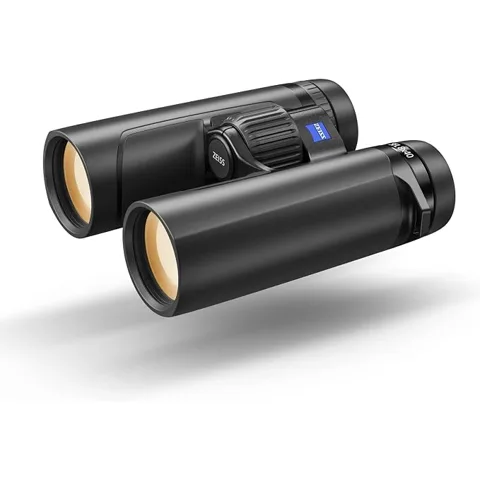
11. Zeiss SFL 8×40
The SFL (SmartFocus Lightweight) is Zeiss’s answer to the birder who wants premium glass without premium weight. Smaller 40 mm lenses and a magnesium body make it 19% lighter and 17% shorter than the Zeiss Victory SF 42, at about 1.4 lb, and the 420 ft field of view stays wide.
Zeiss uses Ultra-High Definition glass with FieldFlattener lenses, T* coatings and 90% light transmission. The 40 mm lenses give up a little brightness at the last minutes of dusk compared with a 42 mm pair, which matters for owls more than for warblers.
- 8x magnification, 40 mm lenses, UHD glass
- 420 ft field of view, 90% light transmission
- FieldFlattener, T* and LotuTec coatings
- About 1.4 lb
Good: premium sharpness in a body you can carry all day. Not great: slightly dimmer than 42 mm pairs at deep dusk.
Best compact binoculars for birding
A 32 mm or 30 mm pair weighs less, fits in a jacket pocket or daypack and is easier for small hands to hold. It shows a slightly dimmer image than an 8×42 at dawn and dusk and in deep forest, and in daylight most people cannot see the difference. An r/birding commenter recommends 8×32 for anyone who rarely birds at the very edges of the day. Skip the tiny 8×21 and 10×25 pocket pairs for birding: their view is narrow and dark.
Best for travel
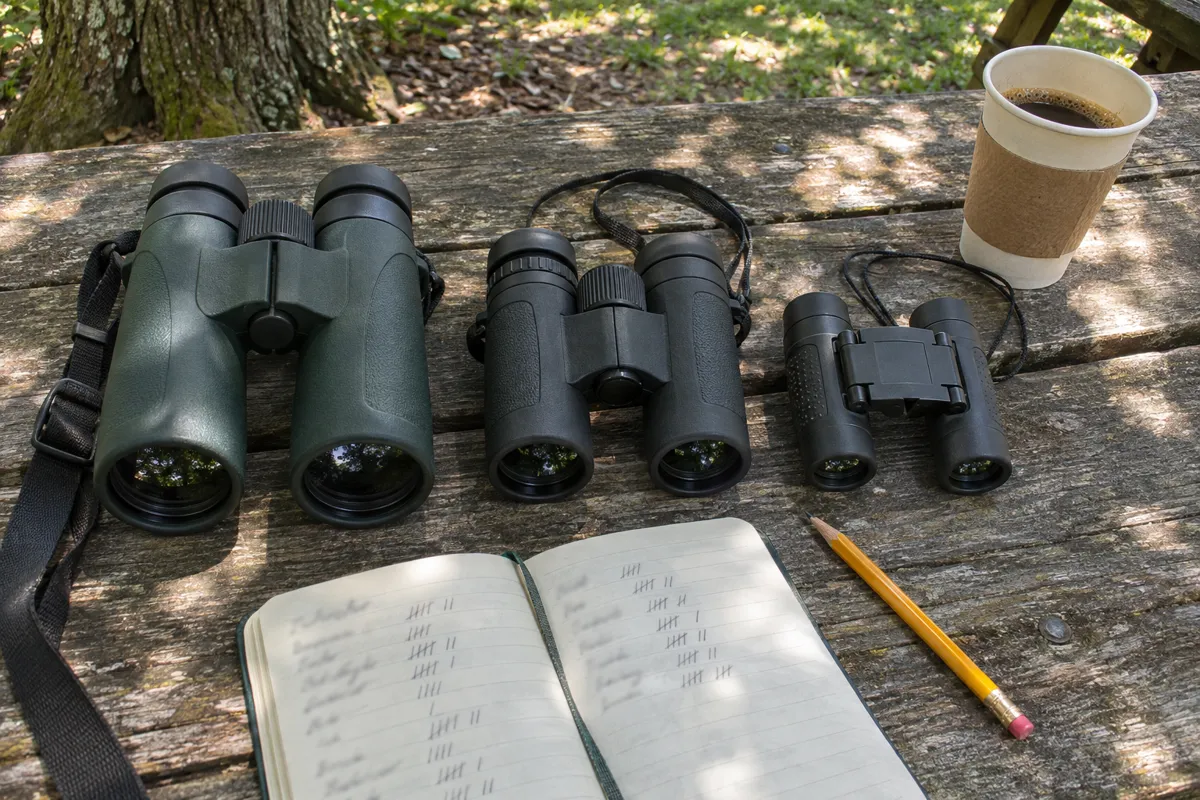
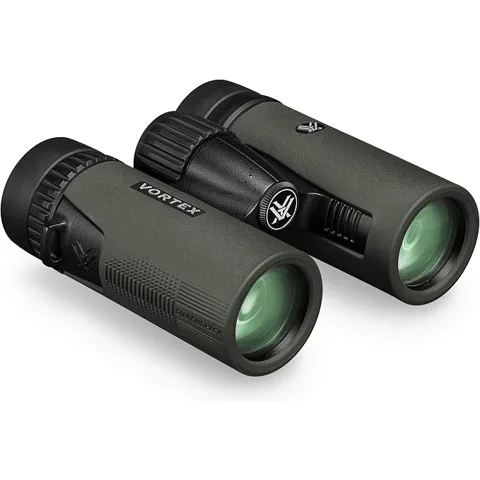
12. Vortex Diamondback HD 8×32
The 8×32 Diamondback HD has the same HD glass, dielectric coatings and lifetime warranty as our top pick in a smaller, lighter body. It is the pair to buy for travel, long hikes or as a second pair kept in the car.
It fits smaller hands better than the 8×42, so it is also a good choice for teenagers and for anyone who finds full-size binoculars tiring to hold. Unlike the 8×42, it does not include the harness.
- 8x magnification, 32 mm lenses, HD glass
- Dielectric coatings, argon purged
- Twist eyecups for glasses wearers
- Vortex VIP lifetime warranty
Good: our top pick in a travel size. Not great: harness not included, and dimmer than the 8×42 at dusk.
Lightest pair worth owning
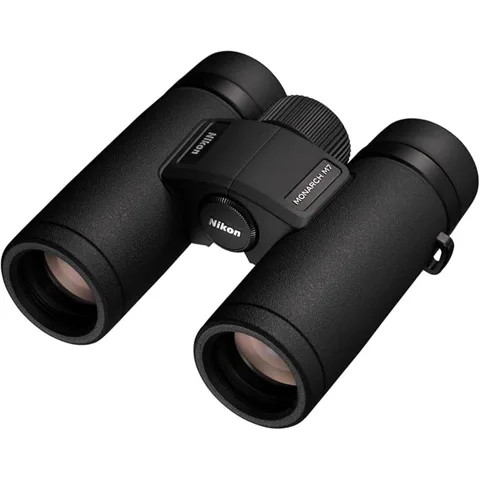
13. Nikon Monarch M7 8×30
The 8×30 Monarch M7 has the same ED glass and coatings as the 8×42 version above, in one of the smallest bodies that still gives a full-size birding view. Its field of view is wide for a compact pair, so it does not feel like looking through a tube.
It is the pair for someone who leaves full-size binoculars at home because they are heavy. Binoculars that come on every walk beat better binoculars left in a drawer.
- 8x magnification, 30 mm lenses, ED glass
- Multilayer lens and prism coatings
- Waterproof, fog-proof, locking diopter
- Turn-and-slide eyecups
Good: ED glass and a wide view in a small body. Not great: dimmer than a 42 mm pair in the first and last half hour of light.
Kids, teens and small hands
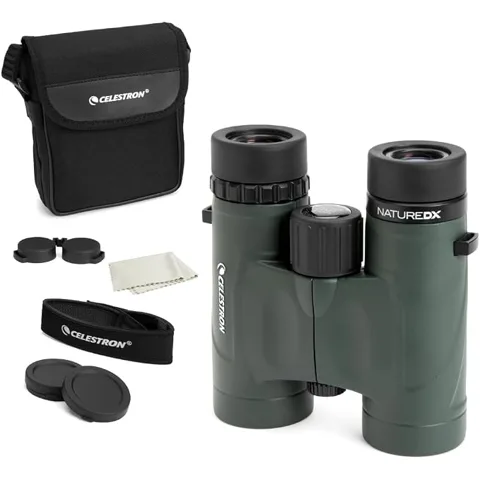
14. Celestron Nature DX 8×32
The 8×32 Nature DX is the budget compact pick and our choice for a child of about 10 or older who has outgrown toy binoculars. It uses the same phase-coated BaK-4 prisms and fully multi-coated lenses as the 8×42 version and weighs less.
The smaller barrels fit children’s hands and narrower faces, and the eyecups twist for glasses. Younger kids under 8 or so do better with lighter kids binoculars, like the pair in our gifts for bird lovers guide.
- 8x magnification, 32 mm lenses, BaK-4 prisms
- 17.5 mm eye relief, 7.4 degree field of view
- Waterproof and nitrogen purged
- Celestron limited lifetime warranty
Good: real birding optics sized for kids and travel. Not great: not as bright as the 8×42 version under trees.
8×42 vs 10×42 binoculars for birding
Most birders should buy 8×42. A 10x pair shows a bird 25% larger, which helps for shorebirds on a mudflat, ducks on a lake and hawks overhead. It also magnifies hand shake by the same amount, shows a narrower view and is harder to aim at a small bird that keeps moving. On r/birding, the advice is to start with 8x and buy 10x only if you mostly bird open country. One commenter put it plainly: 8×42 for all-round birding, 10×42 only if you never bird inside forests, and a spotting scope if you watch water most of the time.
I carried a 10x pair for my first hawk-watch season and liked the reach on raptors high over the ridge. Then I took them into a spring woodlot and spent the morning losing kinglets in the brush: by the time I found the bird in the narrow view, it had moved. I went back to 8x for everything except the hawk watch.
| 8×42 | 10×42 | |
|---|---|---|
| Image size | 8 times | 10 times (25% larger) |
| Field of view | Wider: easier to find birds | Narrower: about 20% less |
| Steadiness | Steadier by hand | Shows more hand shake |
| Brightness at dusk | Brighter (5.25 mm exit pupil) | Dimmer (4.2 mm exit pupil) |
| Best for | Woods, backyards, all-round birding | Shorebirds, waterfowl, hawk watching |
The Diamondback HD, Crossfire HD and Monarch M7 listings above also sell a 10×42 version. Avoid anything above 12x for handheld birding, and skip zoom binoculars: the top answer on an r/birding thread about them explains that at high power the small movements of your body make the bird jump out of view, and zoom optics are dimmer and less sharp than a fixed pair.
Best binoculars for bird watching with glasses
Eye relief is the distance behind the eyepiece where your eye sees the full image. Eyeglasses hold your eye about 10 to 15 mm back from the eyecup, so with short eye relief you see a black ring around a small image, like looking down a tunnel. For glasses wearers, look for 16 mm of eye relief or more and eyecups that twist or fold all the way down.
I wore glasses through graduate school and used binoculars with the eyecups up for most of a year before someone on a field trip told me to twist them down. The tunnel went away. If your binoculars show a dark ring, check the eyecups before you blame the binoculars. An r/birding commenter gives the same advice: eyecups down with glasses, up without.
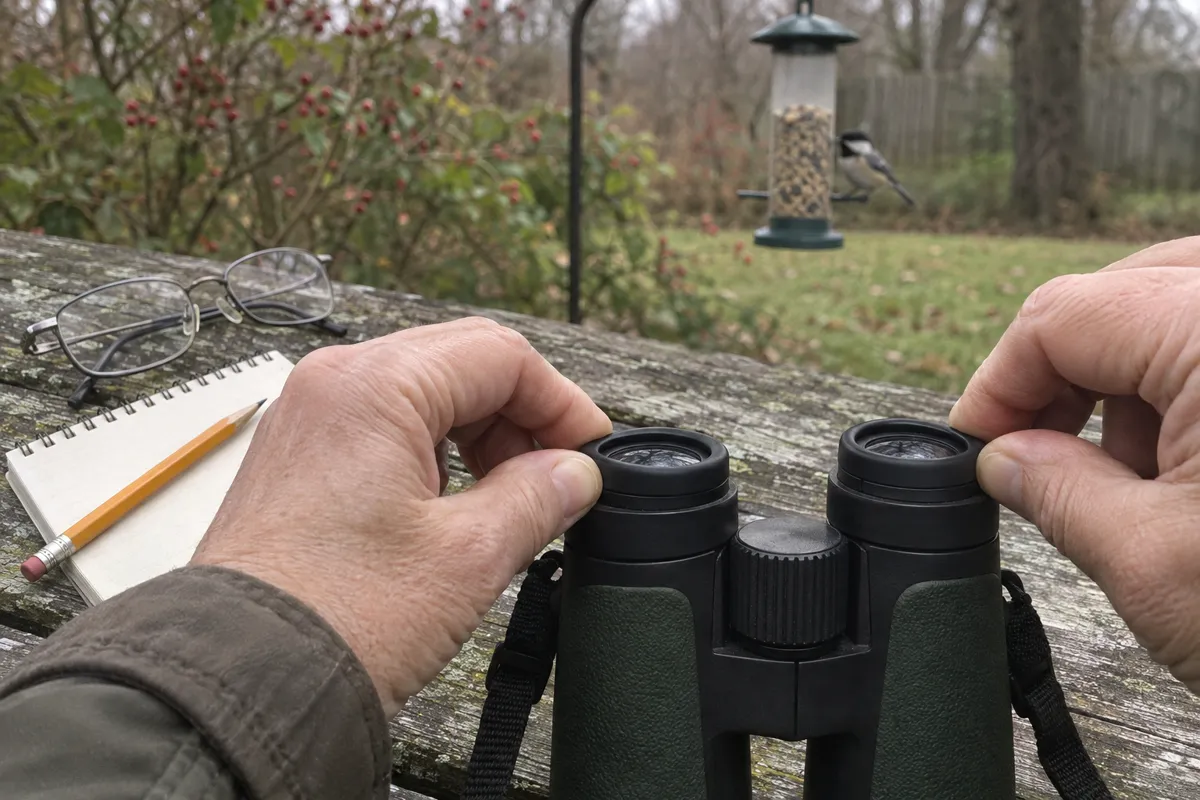
The best pairs here for glasses wearers are the Nikon Prostaff P3 (20.2 mm), the Swarovski EL (20 mm) and the Nikon Monarch M5 (19.5 mm). The Viper HD (18 mm), Monarch M7 (17.1 mm), Diamondback HD (17 mm), Nature DX (17.5 mm) and Midas UHD (17.2 mm) work for most frames. If your glasses have thick lenses or sit far from your face, choose one of the first three.
What r/birding recommends
Reddit’s r/birding gets a binocular question nearly every day, and the answers repeat. These are the points the most upvoted replies agree on.
- Most named pairs: Vortex Diamondback HD, Nikon Monarch M5 and M7, Athlon Midas, Celestron Nature DX, Nikon Prostaff and Vortex Crossfire HD. One commenter’s shortlist sums up the threads: Diamondback, Prostaff or Nature DX at the lower end, Monarch or Viper a step up.
- Buy 8×42 first. Nearly every first-pair thread ends with 8×42.
- Do not go too cheap. Very cheap new binoculars lack gas purging and good coatings. If the budget is small, buy a used Vortex, Nikon or Bushnell instead.
- Warranty counts. Vortex comes up again and again for its no-questions warranty, which also covers used pairs.
- Try before you buy. Outdoor stores and bird festivals let you hold several pairs. Weight, grip and how the eyecups sit on your face differ from person to person.
- Use the published reviews. Commenters point to the Audubon binocular guide and the Cornell Lab of Ornithology reviews, which test pairs at each price level.
Many birding clubs and Audubon chapters lend binoculars on their guided walks. Borrowing a pair for a morning is the cheapest way to learn what you like before you buy. Our benefits of birdwatching guide covers how to get started.
Binoculars to skip for birding
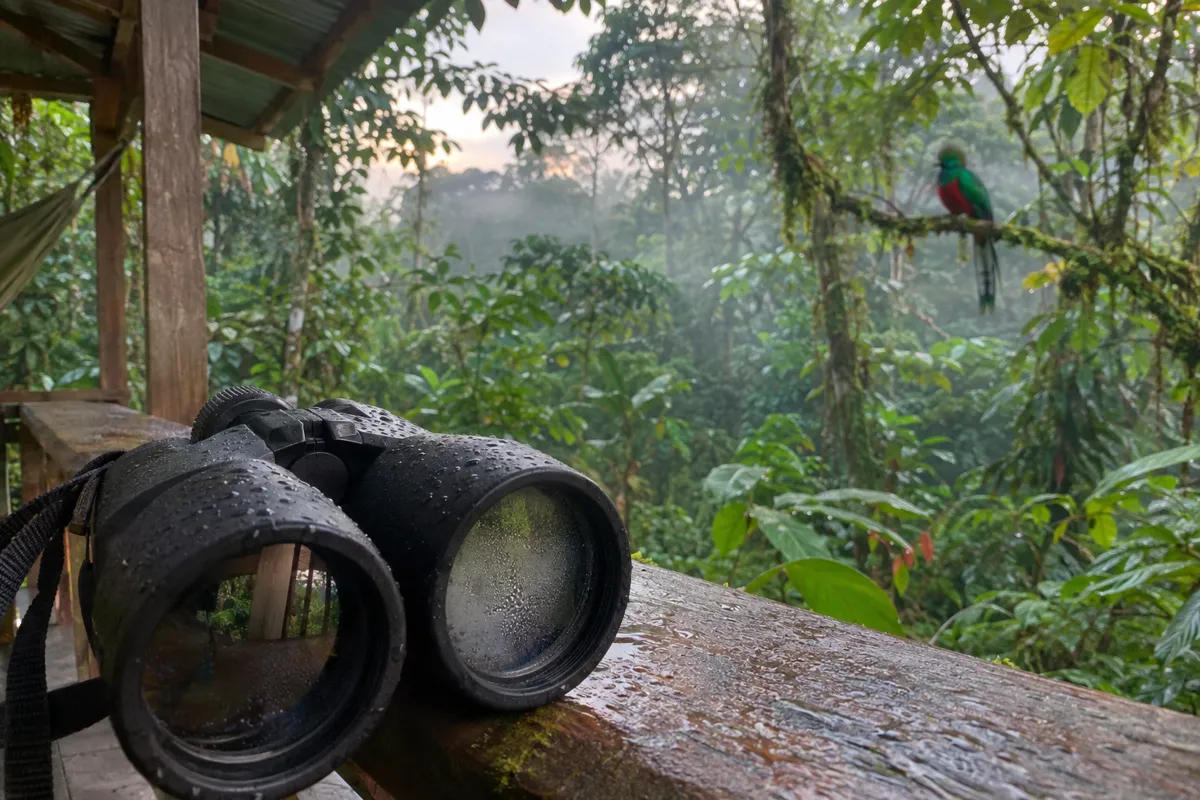
- Zoom binoculars (for example 10-30×50). Dim, narrow and shaky at the high end of the zoom.
- High-power pairs above 12x for handheld use. Use a spotting scope on a tripod instead.
- Tiny pocket binoculars such as 8×21 or 10×25 as your only pair. The small lenses make the view dark under trees.
- Unbranded “high power” binoculars with claims like “night vision” or huge magnification numbers. They rarely list a field of view or eye relief, and they are seldom gas purged.
- Porro-prism hunting binoculars at 7×50 or 10×50 as a first birding pair. They are bright but heavy, and most do not focus close.
Accessories for birding binoculars
A neck strap puts the full weight of the binoculars on the back of your neck. After a three-hour walk, that weight shows. A harness and a lens pen are the two accessories that make any pair easier to use.
For any pair
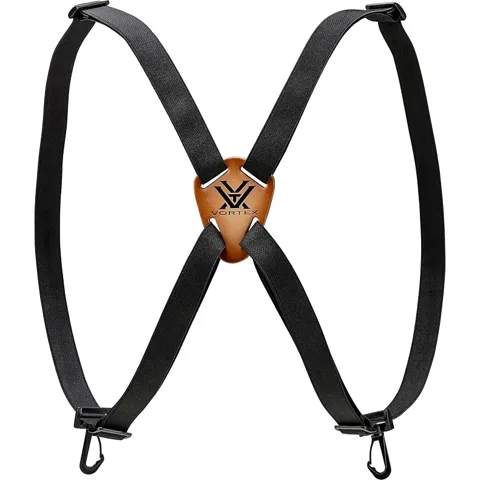
15. Vortex Binocular Harness Strap
The harness spreads the weight of the binoculars across both shoulders and holds them against your chest, so they do not swing when you bend down or climb. The elastic straps stretch, so the binoculars still come up to your eyes in one move.
It fits any binoculars with standard strap lugs. Buy it for the Celestron, Nikon and Athlon pairs above; the Diamondback HD 8×42 and Viper HD include a harness.
- Elastic nylon and Lycra straps
- One size, fully adjustable
- Fits binoculars, rangefinders and small cameras
Good: cheap and useful for every birder, with over 4,000 ratings. Not great: warm under a light shirt in summer.
Field cleaning
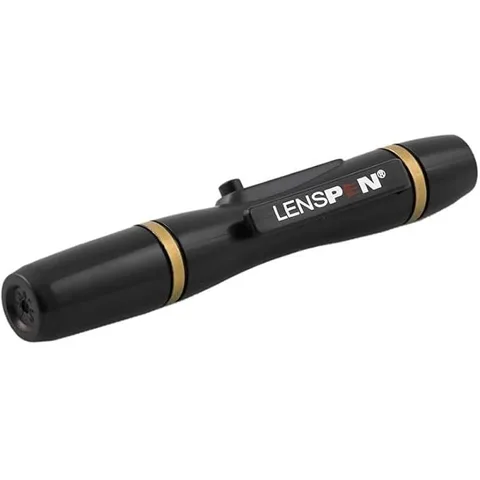
16. LensPen Lens Cleaning Pen
Birders clean their lenses with a shirt tail, a tissue or a sleeve, and all three scratch the coatings over time. The LensPen has a soft retractable brush for dust at one end and a carbon cleaning tip for fingerprints and smudges at the other, with no liquid to spill or freeze.
It fits in a binocular case or a jacket pocket and works on scopes, camera lenses and glasses too.
- Retractable brush plus carbon cleaning tip
- No fluids
- Pocket size
Good: the right way to clean coated lenses in the field. Not great: replace it once the tip stops cleaning well.
How to set up binoculars for birding
New binoculars need two minutes of setup, and most beginners skip it. Do this once and the image will be sharper for both eyes.
- Set the eyecups. Down for glasses, up without them.
- Set the width. Fold the barrels until you see one round image, not two circles.
- Set the diopter. Cover the right lens, focus on a sign or branch with the center wheel using your left eye. Then cover the left lens and turn the diopter ring near the right eyepiece until the image is sharp. Leave the center wheel alone during this step.
- Practice raising them. Keep your eyes on the bird and bring the binoculars up to your eyes without looking down. Practice on a feeder or a perched crow before you try a warbler.
For practice birds, start with the ones you can see from home. Our guides to red birds and yellow birds cover common backyard species, and the bird quiz tests your identification. If you are buying binoculars as a present, see our Christmas gifts for bird lovers for what to pair them with.
FAQ
What are the best binoculars for bird watching?
For most birders, the Vortex Diamondback HD 8×42 is the best choice: HD glass, a wide view, close focus, a harness in the box and an unconditional lifetime warranty. The Celestron Nature DX 8×42 is the best budget pair, the Nikon Monarch M7 8×42 is the best upgrade and the Swarovski EL 8.5×42 is the premium standard.
What magnification is best for bird watching?
8x is the best magnification for most bird watching. It is steady in the hand, shows a wide view that makes moving birds easy to find and is bright at dawn and dusk. 10x helps for shorebirds, waterfowl and hawks in open country.
Is 8×42 or 10×42 better for birding?
8×42 is better for all-round birding, especially in woods and backyards, because it is steadier, brighter and shows a wider view. 10×42 shows birds 25% larger and suits open water, marshes and hawk watching.
What do the numbers on binoculars mean?
The first number is the magnification and the second is the diameter of each front lens in millimeters. 8×42 binoculars magnify eight times and have 42 mm lenses. Divide the second number by the first to get the exit pupil: larger exit pupils give a brighter image in low light.
What binoculars does Reddit recommend for birding?
On r/birding the most recommended binoculars are the Vortex Diamondback HD, Nikon Monarch M5 and M7, Athlon Midas, Celestron Nature DX, Nikon Prostaff and Vortex Crossfire HD, almost always in 8×42. Commenters also suggest buying a used pair of a good brand if the budget is small.
What are the best binoculars for bird watching for beginners?
Beginners should buy a waterproof 8×42 roof-prism pair from a known brand, such as the Celestron Nature DX 8×42, Nikon Prostaff P3 8×42 or Vortex Crossfire HD 8×42. If the budget allows, the Vortex Diamondback HD 8×42 is the pair most beginners keep for years.
What are the best binoculars for bird watching for people who wear glasses?
Choose binoculars with at least 16 mm of eye relief and eyecups that twist all the way down. The Nikon Prostaff P3 8×42 (20.2 mm), Swarovski EL 8.5×42 (20 mm) and Nikon Monarch M5 8×42 (19.5 mm) have the longest eye relief in this guide.
Are compact binoculars good for birding?
Compact 8×32 and 8×30 binoculars are good for birding in daylight, travel and long hikes, and they suit kids and small hands. They are dimmer than 8×42 at dawn, dusk and in deep forest. Tiny 8×21 and 10×25 pocket pairs are too dark and narrow to be your only birding binoculars.
What binoculars do professional birders use?
Tour leaders, bird banders and researchers most often carry premium 8×42 or 8.5×42 binoculars from Swarovski, Zeiss and Leica, such as the Swarovski EL or NL Pure and the Zeiss Victory SF. Many also carry a spotting scope for distant birds.
How long do birding binoculars last?
Good birding binoculars last decades. Vortex and Athlon repair or replace their binoculars for life with no questions, and Nikon, Celestron, Zeiss and Swarovski repair defects under limited lifetime warranties. Keep them dry, use lens caps and clean the lenses with a brush and lens pen, not a shirt.
Sources
- National Audubon Society. The Audubon Guide to Binoculars.
- Cornell Lab of Ornithology. The Cornell Lab Review: Affordable Full-Size 8×42 Binoculars.
- Vortex Optics. VIP Warranty.
- r/birding. What binoculars do y’all use when you’re out birdwatching?
- r/birding. Binocular recommendations.
- r/birding. Binocular Recommendation?
- r/birding. Birding Binoculars.
- r/birding. Binocular purchase help: SO OVERWHELMED!!
- r/birding. Budget binoculars.
- r/birding. Binocular suggestion for beginner birding glass wearer.
- r/birding. Are “zoom” binoculars really as bad as I see some people say?
- r/birding. Pro tip: Do NOT try out the nicest pair of binoculars at the store.