Show the math
How much feed a chicken eats per day
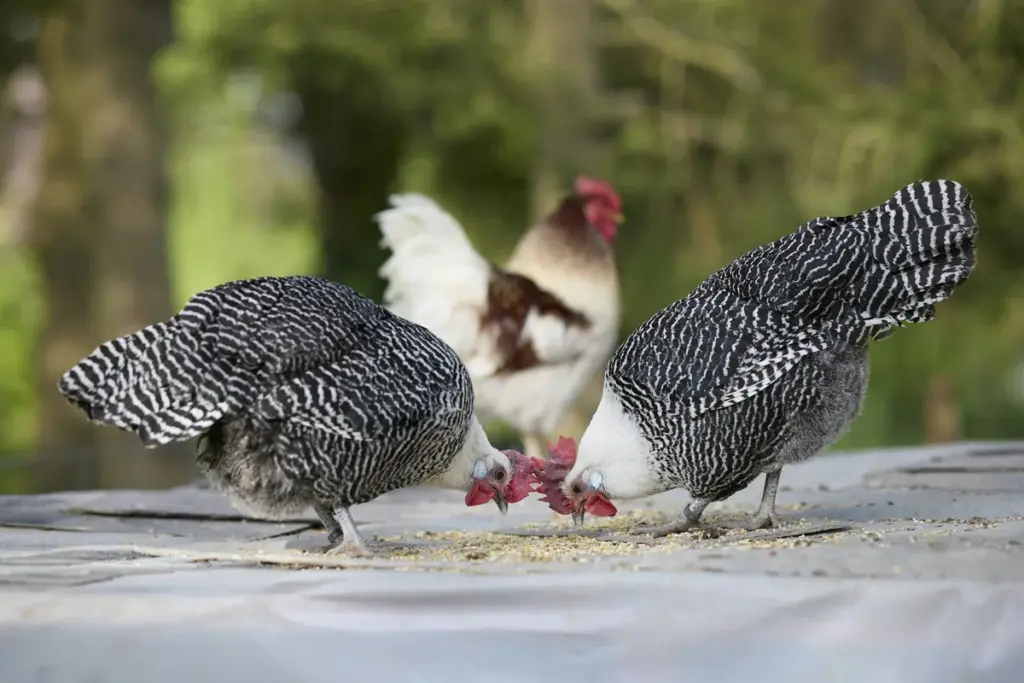
A standard laying hen eats 1/4 pound of feed a day, a little under a cup. That is the figure University of Kentucky and Alabama Extension both give, and it matches the numbers breeder guides publish for commercial laying hens. Size moves it up or down. A white Leghorn eats about 10% less than a standard hen and a large heritage hen about 12% more.
| Bird | Feed eaten per day | In grams |
|---|---|---|
| Light laying hen (Leghorn) | 0.23 lb | 102 g |
| Standard laying hen | 0.25 lb | 113 g |
| Large or heritage hen | 0.28 lb | 127 g |
| Bantam | 0.12 lb | 54 g |
| Laying duck (Pekin, Rouen or mixed) | 0.30 lb | 136 g |
| Quail | 0.055 lb | 25 g |
These are amounts eaten. A feeder always loses some feed to the ground, so the calculator adds 5% for a good feeder and 10% for an open dish or trough. A standard hen on a good feeder takes 0.26 lb a day from the bag. Light laying ducks such as Khaki Campbells eat closer to 0.25 lb a day.
Hens also drink about twice as much water by weight as they eat feed. A flock of 16 hens drinks roughly a gallon a day in mild weather.
How long a 50 lb bag of chicken feed lasts
Divide the bag weight by what the flock takes from the bag each day. For hens that is the number of hens times 0.25 lb times 1.05. Six hens take 1.58 lb a day, so a 50 lb bag lasts 32 days. The numbers below include the 5% spill.
| Hens | Feed per day | Days per 50 lb bag | Feed per month | Bags per month |
|---|---|---|---|---|
| 3 | 0.79 lb | 63 days | 24 lb | 0.5 |
| 6 | 1.58 lb | 32 days | 48 lb | 1 |
| 10 | 2.63 lb | 19 days | 80 lb | 1.6 |
| 20 | 5.25 lb | 10 days | 160 lb | 3.2 |
| 50 | 13.1 lb | 4 days | 399 lb | 8 |
A month is 30.4 days. Round bags up when you shop: a flock of 10 needs two bags a month, and a flock of 3 can buy a 25 lb bag and still not run out in 30 days. The calculator handles 40 lb and 25 lb bags and kilogram bags as well.
How much it costs to feed chickens
Layer feed in 50 lb bags sells for about $16 to $19 for store brands and $22 to $26 for premium brands. At $22 a bag, feed costs $0.44 a pound and each hen costs about $3.51 a month.
| Hens | Cost per month | Cost per year |
|---|---|---|
| 3 | $10.53 | $126 |
| 6 | $21.07 | $253 |
| 10 | $35.11 | $421 |
| 20 | $70.22 | $843 |
| 50 | $175.56 | $2,107 |
Feed cost per dozen eggs
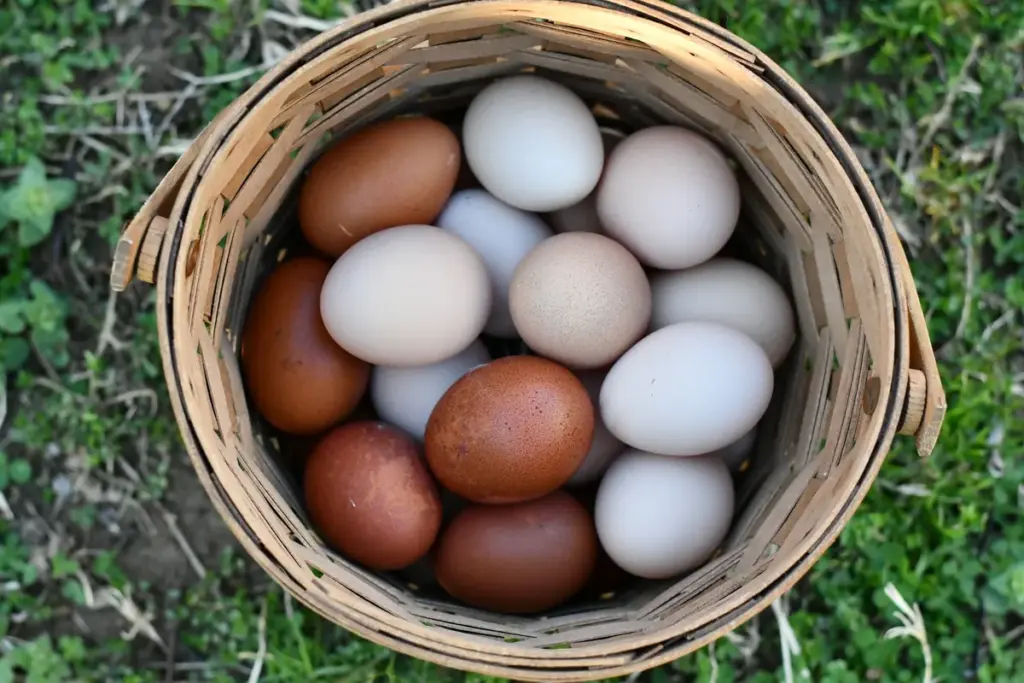
A hen that lays 5 eggs a week produces 1 dozen every 2.4 weeks, and over that time she eats 4.4 lb of feed. University of Maryland Extension puts a backyard flock at 4.5 lb of feed per dozen. At $22 a bag, that is $1.94 of feed in each dozen eggs.
| Price per 50 lb bag | Feed cost per dozen eggs |
|---|---|
| $16 | $1.41 |
| $19 | $1.68 |
| $22 | $1.94 |
| $26 | $2.29 |
The figure covers feed only. Raising a pullet to her first egg takes about 16 to 17 lb of feed, around $7 to $8 at $22 a bag, and bedding, grit and oyster shell add to the total. Feeding other animals follows the same method: the cat food cost calculator turns a cat’s weight into a monthly bill, and every tool on the site is listed on the calculators page.
How much feed chicks need, week by week
A chick eats 0.25 lb of feed in its first week and 2.4 lb by week 6. By week 17 a pullet has eaten 13.2 lb, and about 16 to 17 lb by week 20. The table shows the total eaten so far, before spill, for a brown egg-laying hybrid. Extension services quote 14 to 16 lb to the first egg for backyard flocks, so a commercial hybrid sits at the top of that range.
| Age | Total feed eaten so far | Feed to use |
|---|---|---|
| Week 1 | 0.25 lb | Starter, 18 to 20% protein |
| Week 2 | 0.53 lb | Starter |
| Week 3 | 0.86 lb | Starter |
| Week 4 | 1.27 lb | Starter |
| Week 5 | 1.77 lb | Starter |
| Week 6 | 2.37 lb | Switch to grower, about 16% protein |
| Week 8 | 3.84 lb | Grower |
| Week 10 | 5.60 lb | Grower |
| Week 12 | 7.58 lb | Grower |
| Week 14 | 9.71 lb | Grower |
| Week 16 | 11.98 lb | Grower |
| Week 17 | 13.20 lb | Grower |
| Week 20 | about 17 lb | Layer feed at the first egg |
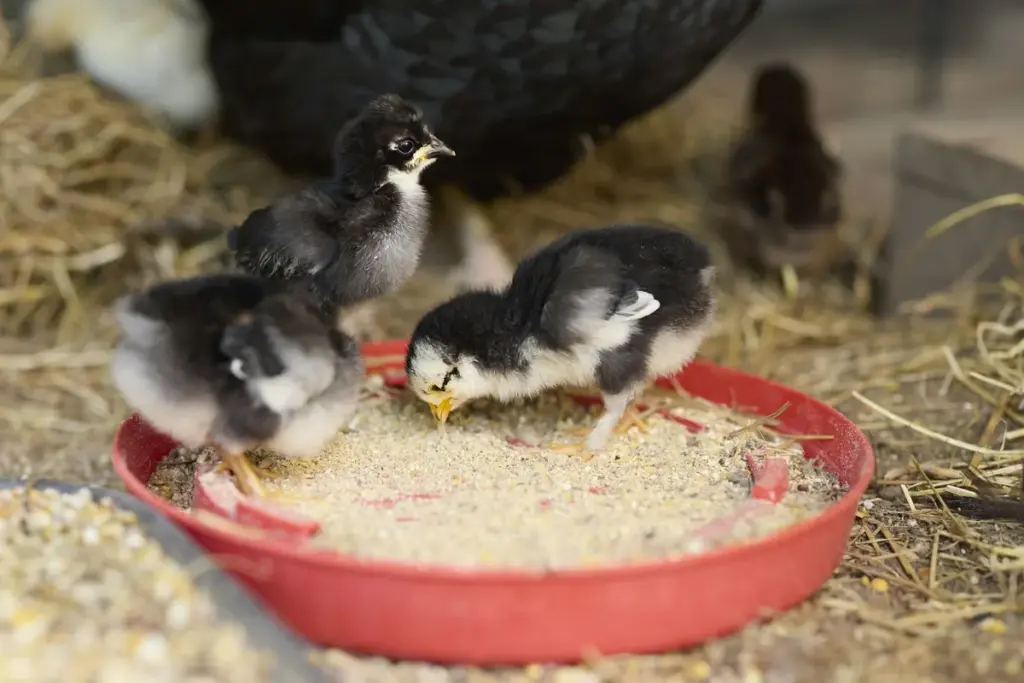
Production breeds start laying at 18 to 20 weeks. Heritage breeds can take until 25 weeks and eat about 10% more along the way.
Do not feed layer feed to chicks
Layer feed carries 2.5 to 4% calcium. Growing chickens need about 1.2%. Alabama Extension warns that laying mash fed to chicks or growing birds can cause growth problems, kidney damage and death. Keep chicks on starter, then grower, and offer oyster shell only after the flock moves to layer feed at the first egg. A complete grower feed already has the calcium a pullet needs, so do not add more.
Meat chickens: feed to butcher weight
A Cornish Cross meat chicken eats about 15.5 lb of feed to reach 8 lb live weight at 8 weeks. That is about 2 lb of feed for every pound of bird. The ratio worsens each week as growth slows, so butchering earlier saves feed.
| Week | Total feed eaten | Live weight | Feed per lb of bird |
|---|---|---|---|
| 1 | 0.34 lb | 0.40 lb | 0.85 lb |
| 2 | 1.08 lb | 1.01 lb | 1.07 lb |
| 3 | 2.34 lb | 1.90 lb | 1.23 lb |
| 4 | 4.15 lb | 3.01 lb | 1.38 lb |
| 5 | 6.43 lb | 4.27 lb | 1.51 lb |
| 6 | 9.18 lb | 5.57 lb | 1.65 lb |
| 7 | 12.23 lb | 6.84 lb | 1.79 lb |
| 8 | 15.54 lb | 8.01 lb | 1.94 lb |
These figures sit between the breeder company targets for Ross and Cobb birds, which are leaner, and the older university tables, which run higher. They match what Penn State reports for pastured Cornish Cross: about 5 1/4 lb live at 6 weeks and about 15 lb of feed by harvest.
For 100 broilers to 8 weeks, plan on 1,554 lb of feed eaten, or 1,632 lb with 5% spill. That is 33 bags of 50 lb, about $718 at $22 a bag. Butchering at 6 weeks takes 964 lb with spill, so 20 bags. Feed a 22% protein meat bird starter for the first 3 weeks, then a 19 to 20% grower. Egg-type chick starter slows meat birds.
Slow-growing meat breeds such as Freedom Rangers reach about 5 1/4 lb live in 8 to 9 weeks and eat about 16 lb of feed doing it, roughly 3 lb of feed per pound of bird.
Poultry feed for ducks, turkeys and quail
Ducks
A laying duck eats about 0.30 lb (136 g) of feed a day, a little more than a hen. Light laying breeds such as Khaki Campbells eat closer to 0.25 lb, and heavy breeds such as Pekin and Rouen can eat up to 0.40 lb. A Pekin raised for meat eats about 22 lb of feed to reach 6 1/2 lb at 8 weeks.
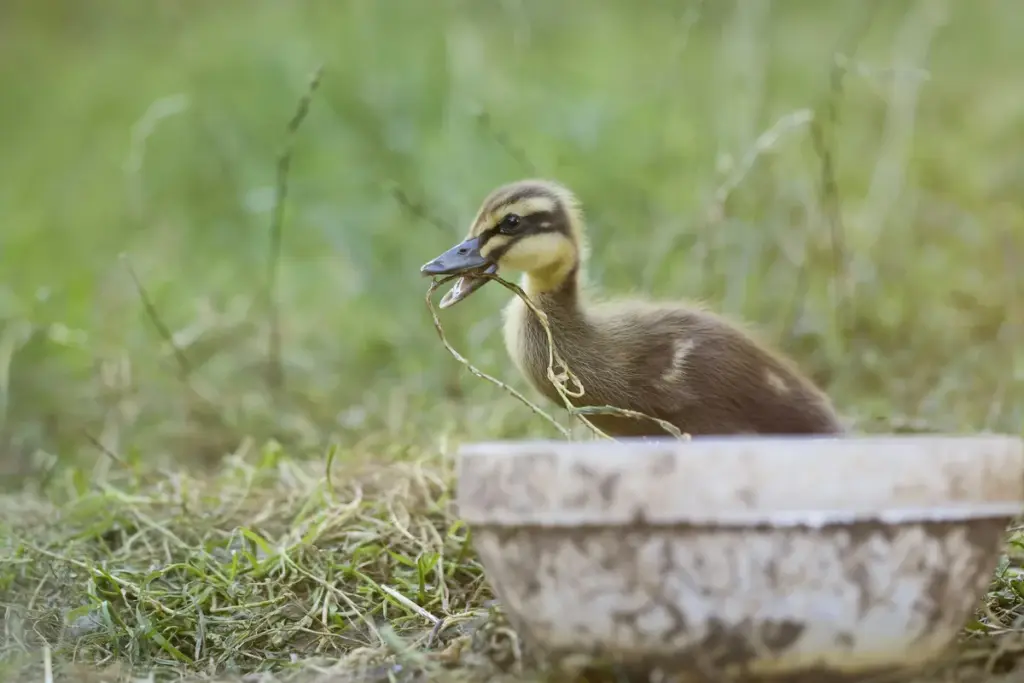
Ducklings need more niacin than chicks, so plain chick starter leaves them short. Use an unmedicated duck or waterfowl starter at 20% protein for the first 2 weeks, then a 16 to 18% grower. Medicated chick feed can poison waterfowl. The full list of safe foods, treats and what to avoid is in our guide to what to feed a baby duck.
Turkeys
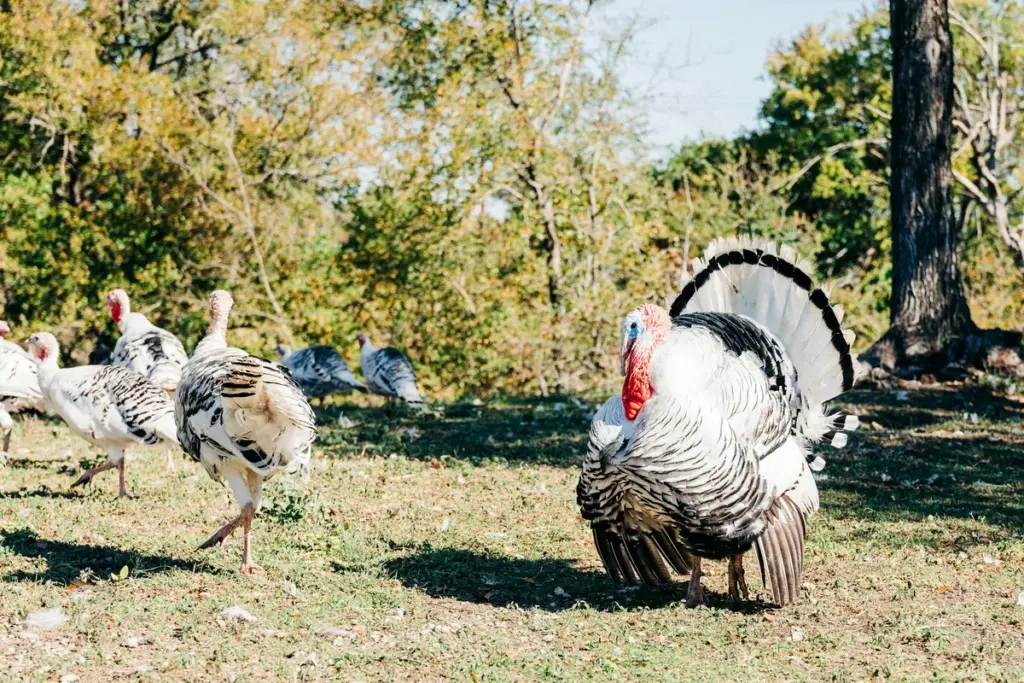
A broad-breasted turkey eats about 64 lb of feed as a hen and 100 lb as a tom by 20 weeks. The calculator averages the two at 82 lb. Turkey poults need 26 to 28% protein for the first 8 weeks, which is more than chicken starter holds. Use a turkey or game bird starter, then a 20 to 22% grower from week 8 to 16 and a 14 to 16% finisher after that.
Quail
An adult Japanese quail eats about 25 g (0.055 lb) a day. Feed a 24 to 26% game bird starter for the first 6 weeks, then a 20% layer or breeder feed with extra calcium for laying hens.
Looking for more animals that live on a farm? The complete list of farm animals A to Z covers poultry, livestock and working animals.
What changes how much chickens eat
Cold weather
Chickens eat more when it is cold because they burn feed to stay warm. Alabama Extension lists winter energy needs up to 31% above summer needs. The calculator’s cold winter setting adds 10% for adult birds.
Hot weather
Intake begins to fall above 68°F and drops faster above 86°F. Ontario’s agriculture ministry reports that hens held at a constant 95°F ate 52% less feed and laid at 56% instead of 87%. A daily swing between 75°F and 95°F cut feed by 24%. The calculator’s hot summer setting subtracts 15%. Water use climbs as feed use falls: hens drink twice their feed weight at 70°F and up to eight times at 100°F, so check waterers first on hot days.
Hen size
Bigger birds eat more. Hy-Line reports brown hybrids at about 0.24 to 0.26 lb a day against 0.22 lb for white Leghorns. The calculator offers light, standard and large settings.
Spill and feeder type
Feed on the ground is feed lost. Hang the feeder with its lip at the height of a hen’s back, and fill troughs no more than half full. Crumbles spill more than pellets. The calculator assumes an open dish wastes twice as much as a good feeder, so it adds 10% in place of 5%.
Free-ranging
Free-range chickens eat as much feed as confined chickens, and often more. Penn State states that pastured birds eat more feed than birds raised in houses, and Kentucky Extension says free-range chickens typically eat more because they are more active. Grass and clover make up less than 5% of the dry feed a pastured broiler eats. The calculator does not reduce the amount for free-ranging. Geese are the exception: Extension data show a 48% reduction in complete feed on pasture.
How the calculator works
The calculator multiplies the number of birds by the daily amount for that bird, adjusts for weather, hen size and spill, and then converts the result to bags and dollars. These are the numbers it uses.
- Adult feed per day: standard hen 0.25 lb, bantam 0.12 lb, duck 0.30 lb, quail 0.055 lb.
- Hen size: light 0.90, standard 1.00, large 1.12.
- Weather: mild 1.00, cold winter 1.10, hot summer 0.85, applied to adult birds only.
- Spill: good feeder 5%, open dish or trough 10%.
- Month: 30.4 days.
- Chicks: the weekly totals in the chick table, which follow Hy-Line Brown guide data, with starter to week 6, grower to week 18 and layer feed after.
- Meat chickens: the weekly totals in the meat chicken table. Meat ducks use 22 lb to week 8 and turkeys 82 lb to week 20.
- Water: twice the feed weight in mild weather and 1.5 times in hot weather, at 8.34 lb per gallon.
- Eggs: 5 per hen per week unless you change it, and the cost per dozen is the weekly feed cost of the flock divided by the dozens laid.
- Price: $22 per 50 lb bag unless you change it.
For growing birds, the day, week and month totals follow the feed curve forward from the age you enter.
Sources
- University of Kentucky Extension, How Much Will My Chickens Eat? (ASC-191) and Feeds for Small Egg Enterprises (ASC-233)
- Alabama Extension, Nutrition for Backyard Chicken Flocks (ANR-1317) and Feeding the Laying Hen (ANR-2913)
- Hy-Line International, Hy-Line Brown management guide, W-36 management guide and heat stress technical update
- Ontario Ministry of Agriculture, Heat stress in commercial layers
- Aviagen, Ross 308 broiler performance objectives (2022), and Cobb, Cobb 500 performance and nutrition supplement (2022)
- Penn State Extension, A Quick Guide to Raising Pastured Broilers
- Oregon State University Extension, Feeding Meat-type Chickens (PNW 658)
- University of Maryland Extension, Backyard Layer Flock Economics (FS-2025-0783)
- University of Kentucky and eXtension, Feeding Ducks, Feeding Ducks Intended for Consumption and Raising Geese
- North Carolina State Extension, Feeding Ducks
- NCAT, Pastured Turkey Production, and University of Alaska Fairbanks Extension, Raising Turkeys (LPM-00441)
- Mississippi State University Extension, Quail Feeding Programs