Spend 24 hours inside the body of a wild Bengal tiger and the first thing that breaks your image of “king of the jungle” is the boredom. A tiger sleeps for most of the day. It hunts at the edges of light, fails most of the time it tries, and goes to bed hungry far more often than full. The power is real — 600 pounds, four-inch canines, night vision built for the dark — but the life is mostly patience, hunger, and walking.
Here’s what a day in the life of a tiger actually looks like, hour by hour. We turned our short film on the same idea into a full POV experience — you can watch it below, then read the version with the facts spelled out.
Table of Contents
- The Body That Does the Work
- Dawn: A Tiger’s First Hunt
- Midday: Why Tigers Sleep Most of the Day
- A Kingdom of Scent, Claw, and Roar
- Dusk: The Hunt That Has to Land
- Nightfall: The Threat a Tiger Can’t Outfight
- A Day in the Life of a Tiger: Quick Answers
- The Takeaway
The Body That Does the Work
A Bengal tiger male weighs as much as three grown men and carries canine teeth that can reach four inches — longer than your fingers. The paw swipe behind those numbers lands with enough force to break a large prey animal’s spine. That’s the headline. The quieter equipment matters more for getting through a day.
A tiger sees roughly six times better than you do in low light, which turns a pitch-black forest into something closer to dusk. Its ears pivot independently to place a sound it can’t see yet. Its paws have thick, soft pads that kill the noise of a 600-pound animal moving through dry leaves, so it can close the distance on prey that never hears it coming.
And the stripes do more than camouflage. Every tiger’s pattern is unique, like a fingerprint, and it isn’t only in the fur — shave the coat and the skin underneath carries the same stripes. The orange-and-black breaks up the cat’s outline in tall grass and dappled light, which is exactly where it does its best work.
Dawn: A Tiger’s First Hunt
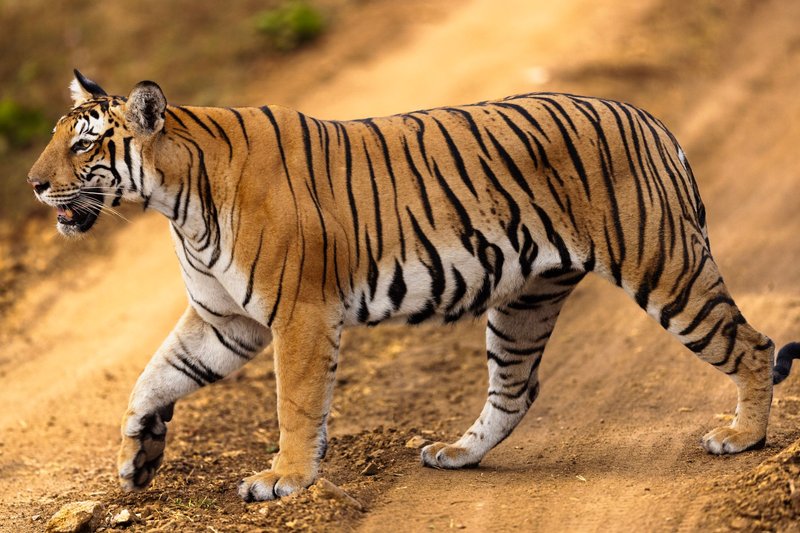
Tigers aren’t strictly nocturnal. They’re crepuscular, most active in the soft light of dawn and dusk, when deer come out to feed and can’t quite pick a striped shape out of the grass. So dawn is the first real chance of the day.
A hunt looks nothing like a chase scene. It’s mostly the stalk — belly low, one slow paw at a time, freezing every time a head lifts. A tiger will spend twenty minutes closing a hundred feet, trading patience for the few seconds when it’s near enough to commit. Then it explodes: close to 40 miles per hour out of a dead stop, covering the last stretch before the prey can react.
Most of the time, it doesn’t work. A tiger’s hunting success rate sits around one in ten attempts, and a deer that jukes left at the right instant leaves the cat grabbing nothing but air. That failure rate is the whole reason the rest of the day is built the way it is. Miss at dawn, and you’ve burned energy you didn’t have, with the sun climbing and the easy light gone.
Midday: Why Tigers Sleep Most of the Day
Here’s the part that surprises people most about a tiger’s daily routine: it spends somewhere between 16 and 20 hours a day resting or asleep. Not in one block — tigers nap on and off around the clock. The reason is simple math. Hunting is explosive, expensive, and usually unsuccessful, so a wild tiger conserves everything it can between attempts. Sleep is the strategy, not the laziness.
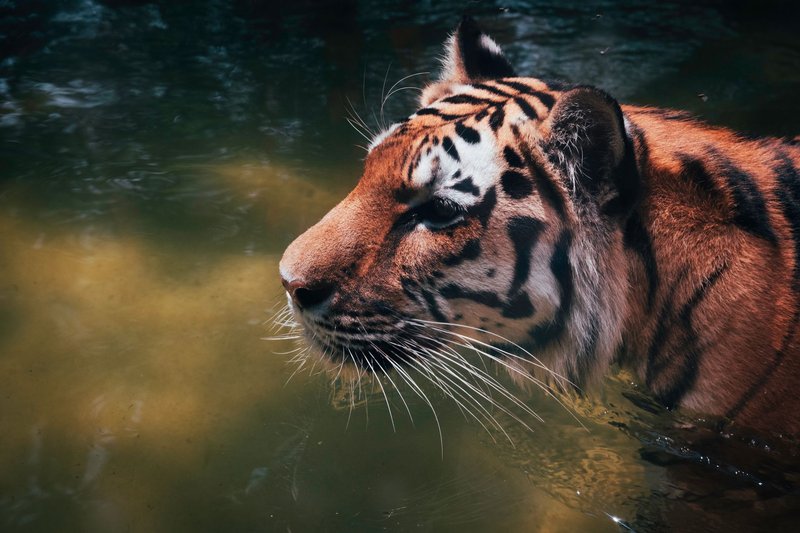
As the heat builds, a tiger looks for shade or water. And unlike most big cats, tigers genuinely like water. They’re strong swimmers that will wade into a stream to cool off and cross rivers without hesitation, sometimes covering several miles in the water in a single day. A tiger lying belly-up in a shallow jungle pool isn’t an odd sight — it’s a normal afternoon.
A Kingdom of Scent, Claw, and Roar
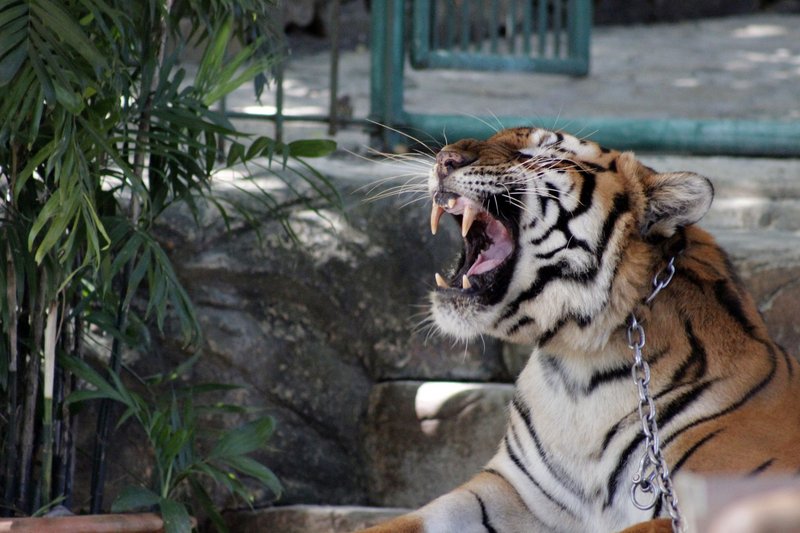
A resting tiger is still working. The patch of forest around it is a territory, and a single male’s range can stretch across 60 to 100 square kilometers, patrolled constantly — sometimes 20 miles in a night. Tigers are solitary and don’t share ground, so the borders have to be advertised.
A tiger marks its range with scent sprayed on trees, with claw rakes dragged down bark, and with sound. The scent marks can stay readable to other tigers for weeks, carrying a clear message: who lives here, how big they are, and that they should keep moving. The loudest message is the roar, which carries up to two miles through dense forest.
When a rival male crosses the line, the day takes a dangerous turn. A real fight between two 600-pound cats can leave deep, infected wounds and a torn paw — and an injured tiger can’t hunt, which means it starves. So most confrontations are theater first: ears pinned flat to flash the white false-eye spots on their backs, body swollen to look bigger, a low grinding roar held until one cat decides the fight isn’t worth it and melts back into the trees. Winning without a scratch is the goal. A standoff costs energy. A brawl can cost everything.
Dusk: The Hunt That Has to Land
By dusk, a tiger that missed at dawn is running on empty, and the second window of good hunting light is the last decent shot for a while. This is when it takes the bigger risk — a sambar deer, maybe 500 pounds, far more dangerous to bring down than a small chital, but worth far more meat.
The method is the same as the morning, run with more care: the drop, the creep, the silence, this time with the wind right and cover on its side. When the cat connects, it drags the prey down with its forelegs and clamps its jaws over the throat — not to tear, but to hold and close off the air. For large prey, that hold takes roughly 90 seconds. Quiet, and quick by the standards of the wild.
Then the tiger finally eats, and it does not ration. In a single sitting a tiger can put away up to 75 pounds of meat, gorging because it has no idea when the next meal comes. After a kill that size it may not need to hunt again for days, and it will drag the leftovers into thick brush, cover them, and return the next day. One good kill at dusk can carry a tiger through most of a week.
Nightfall: The Threat a Tiger Can’t Outfight
There’s one danger in the forest that night vision and four-inch fangs do nothing against. A century ago, roughly 100,000 wild tigers roamed Asia. Today there are around 5,500 left in the wild, scattered across a fraction of their old range.
Tigers have lost something close to 95% of the land their kind once used — cleared, farmed, fenced, and built over. The threats that actually decide a wild tiger’s future aren’t rival cats; they’re habitat loss, prey decline, and poaching driven by demand for skins and body parts. The cat that rules its 60 square kilometers is, on the larger map, one of the last of a vanishing animal — which is the part of the story that rarely makes the highlight reel.
Across Myanmar, habitat loss continues to threaten these apex predators.
A Day in the Life of a Tiger: Quick Answers
How many hours do tigers sleep?
Wild tigers rest or sleep roughly 16 to 20 hours a day, napping on and off rather than in one stretch, to conserve energy between demanding hunts.
Are tigers nocturnal?
Not exactly. Tigers are crepuscular — most active at dawn and dusk — though they also hunt and patrol through the night using their strong low-light vision.
Do tigers like water?
Yes. Unlike most cats, tigers swim well and willingly, cooling off in streams and crossing rivers, sometimes swimming several miles in a day.
How often do tigers eat?
Tigers usually make one large kill every week or so. After gorging on up to 75 pounds of meat at once, a tiger can go days before it needs to hunt again.
How successful are tigers at hunting?
Only about one hunt in ten ends in a kill. That low success rate is why tigers rest so much and target a few large, high-value prey animals.
The Takeaway
A day in the life of a tiger is less a power fantasy than a careful balance: explosive ability spent in short, expensive bursts, wrapped in long hours of rest and constant patrol. The animal is built to kill, but it survives by patience, by knowing its ground, and by making the rare successful hunt count. Powerful, solitary, hungry more often than not — and, on a shrinking map, running out of room. Watch the full POV film above to feel a day from the inside, then look up the tigers near you that still need that room to exist.