The Gambia is barely wider than the river it wraps around, but the flowers packed along that corridor punch well above the country’s size. You get coastal scrub fading into Sudano-Sahelian woodland, mangrove fringes, garden hibiscus spilling over compound walls in Banjul, and forest palms hauling up plumes of bloom you’d never expect from a dry-season country.
Most lists of Gambian flora are just taxonomic catalogs — Latin names stacked in a column with no photos and no sense of where you’d actually run into the plant. This is the opposite. Fifteen flowers you can realistically spot on a trip up the river or a walk through a coastal town, with the local names, when they bloom, and where to look.
Table of Contents
- When and where to see flowers in The Gambia
- The 15 flowers
- Chinese hibiscus
- Roselle (sorrel)
- Red frangipani
- Bougainvillea
- Devil’s backbone
- Flame tree / flamboyant
- Baobab flower
- African tulip tree
- Yellow oleander
- Raffia palm
- Allamanda
- Desert rose
- Ixora
- Periwinkle
- Senegal mahogany flower
- The national flower question
- A quick spotting table
When and where to see flowers in The Gambia
The Gambia runs on two seasons, and they decide almost everything about what’s flowering. The dry season runs roughly November to May; the rains come July through October.
Most of the cultivated showstoppers — hibiscus, bougainvillea, frangipani, allamanda — bloom hardest in the dry season, which is also the main tourist window. Walk any residential street in Bakau, Fajara, or Serrekunda from December onward and you’ll see them spilling over walls. The native trees and herbaceous wildflowers are the opposite: many wait for the rains, so a July visit to the bush around Abuko Nature Reserve or up-country near Janjanbureh shows you a completely different palette.
Best single spot for sheer flower density: the gardens and hotel grounds along the Atlantic coast strip. Best for native flora in context: Abuko Nature Reserve, the small but dense gallery forest reserve a short drive from the coast.
The 15 flowers
1. Chinese hibiscus (Hibiscus rosa-sinensis)
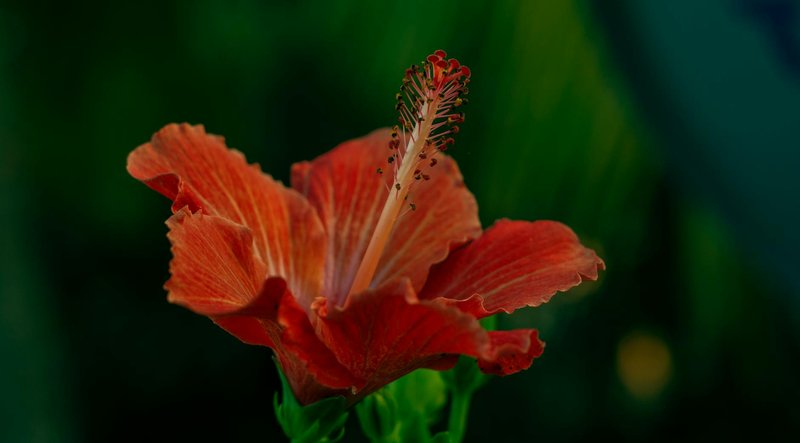
The hibiscus you picture when someone says “tropical flower.” Five overlapping petals, usually a deep cherry red, with a long staminal column poking straight out the middle like a tongue. In The Gambia it’s everywhere there’s a wall to plant it against — hotels, compounds, roadside hedges.
Locally you’ll hear it tied to the bissap family in conversation, though true bissap is the next plant on this list. The flowers last a single day, open at dawn and crumple by dusk, which is why a healthy bush always looks freshly bloomed: it’s a fresh set every morning. Dry season is peak. Look along garden walls in Bakau and Fajara.
2. Roselle / sorrel (Hibiscus sabdariffa)
This is the one that matters to Gambian kitchens. Bissap in Wolof, the same plant that makes the deep magenta drink sold cold in plastic bags across West Africa. The flower itself is pale yellow with a dark maroon center, modest compared to its showy cousin — but the prize is the fleshy red calyx left behind after the petal drops.
Those calyces get dried and steeped into the tart, cranberry-like bissap juice. Roselle grows through the rainy season and into the early dry months, harvested around November to January. You’ll see it in vegetable gardens and small farm plots rather than ornamental beds.
3. Red frangipani (Plumeria rubra)
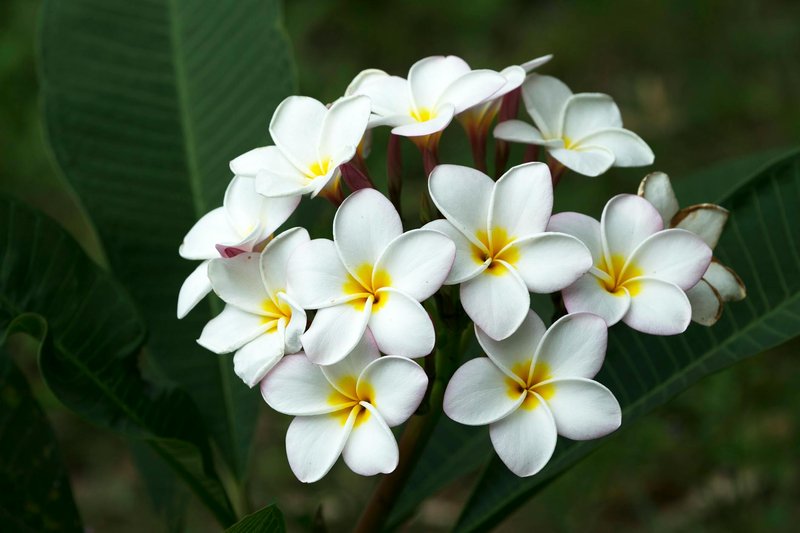
Frangipani is the scent of a Gambian dry-season evening. Small trees with thick, almost rubbery bare branches that look dead in the dry months, then erupt into clusters of five-petalled flowers — pink, white, or sunset-yellow at the throat — with a perfume that carries.
The bare-branch trick is the giveaway: a frangipani drops its leaves and blooms anyway, flowering on naked stems. Common in hotel grounds and older garden plantings along the coast. The flowers are a fixture of celebrations and get tucked behind ears across the tropics.
4. Bougainvillea (Bougainvillea glabra)
The waterfall of magenta, orange, or white you see cascading off walls and pergolas. Here’s the thing most people get wrong: those vivid “petals” aren’t petals at all. They’re modified leaves called bracts, and the actual flower is the tiny white tube tucked inside each cluster of three.
Bougainvillea is the workhorse of Gambian dry-season color. It’s drought-hardy, thorny, and unstoppable once established, which is why it drapes so many compound entrances. Peak bloom is the dry season, when the lack of rain actually intensifies the bract color.
5. Devil’s backbone (Euphorbia tithymaloides)
A strange one. The stems zigzag — they literally kink back and forth at each node, which is where the “backbone” name comes from. The flowers are small, bird-shaped, red-and-pink structures called cyathia, clustered at the stem tips.
It’s grown as an ornamental hedge and a folk-medicine plant; the milky sap is a skin irritant, so it doubles as a deterrent planting. You’ll find it in garden borders rather than the wild. Like other euphorbias, treat the sap with respect and keep it off your skin and eyes.
6. Flame tree / flamboyant (Delonix regia)
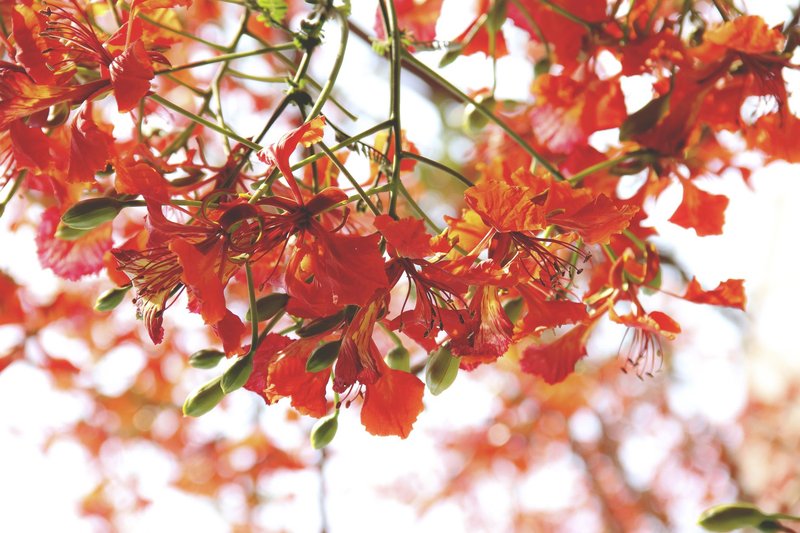
When a flamboyant goes off, the whole crown turns scarlet — a dome of red-orange flowers so dense you barely see green. Each flower has four spreading red petals and a fifth, upright “standard” petal streaked white and yellow. After blooming it drops long, woody seed pods up to two feet long that rattle in the wind.
Flamboyants line streets and shade public squares across the coastal towns. They flower at the start of the rains, roughly May to July, which makes them one of the few big-tree spectacles you’ll catch in the wet season.
7. Baobab flower (Adansonia digitata)
The baobab is The Gambia’s signature tree — the upside-down giant you see standing alone in the savanna. Its flower is easy to miss because it happens overnight and high up. Large, white, waxy, hanging on a long stalk, with a powderpuff of stamens, it opens at dusk and is pollinated by fruit bats before it browns and drops within a day.
The flowers give way to the velvety “monkey bread” fruit, whose tart pulp Gambians sweeten into a drink and a sherbet sold as bouy. Baobabs flower in the rainy season. To see the blooms you need to be looking up at dusk near a mature tree, common up-country and in village commons. The same savanna that holds these trees teems with pollinators after dark, part of the broader cast of African savanna insects that keep the bush ticking over.
8. African tulip tree (Spathodea campanulata)
Big, glossy, orange-red bell-shaped flowers grouped in tight crowns at the branch tips, each ringed with a frilly yellow edge. The unopened buds hold water and squirt when squeezed, which is how kids across West Africa know the tree.
It’s a fast-growing ornamental and shade tree planted along roads and in gardens. The flowers open in a ring around the outside of each cluster, so a single crown gives you a slow rotation of colour over days. Look in cultivated grounds along the coast and in larger town gardens.
9. Yellow oleander (Cascabela thevetia)
Funnel-shaped yellow-to-apricot flowers, slightly twisted like a pinwheel, on a shrub with narrow glossy leaves. Pretty, common as a hedge — and seriously poisonous in every part, especially the seeds, which contain cardiac glycosides. The IUCN and toxicology references both flag it as one of the more dangerous garden plants in the tropics.
It’s planted widely precisely because nothing eats it, which makes it a reliable, tidy hedge. Admire it, don’t taste it, and keep it in mind if you’re travelling with small children. Blooms much of the year, peaking in the dry season.
10. Raffia palm (Raphia vinifera)
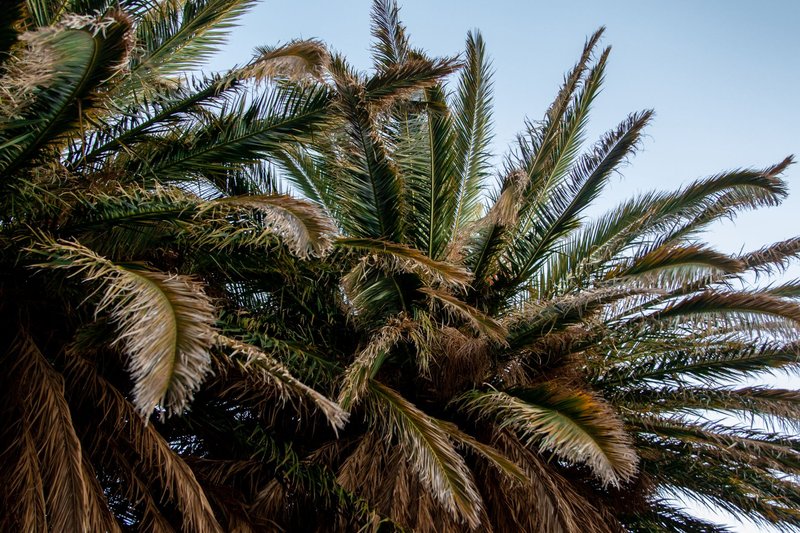
Not a flower most people would name, but the raffia palm produces one of the most dramatic inflorescences in Gambian wetlands: a massive branched flower stalk that emerges, fruits, and then — in the wine raffia — the plant dies after that single reproductive effort. The palm holds the record for the longest leaves of any plant, fronds that can stretch past 50 feet.
You’ll find raffia in swampy ground and along the freshwater reaches of the river. Beyond the flowers, it’s an economic plant: the leaf fibre is the raffia of weaving and tying, and the sap is tapped for palm wine, which is where vinifera comes from.
11. Allamanda (Allamanda cathartica)
Bright, buttery-yellow trumpets the size of your palm, on a scrambling vine with whorled glossy leaves. It’s one of the most common ornamental climbers along the coastal hotel strip, trained over fences and arches for a wall of yellow through the dry season.
The species name cathartica is a warning: the sap is a purgative and an irritant, so it’s another look-don’t-handle plant. Closely related to frangipani and oleander in the dogbane family, which is the running theme — a lot of The Gambia’s prettiest ornamentals carry a toxic streak.
12. Desert rose (Adenium obesum)
A swollen, bottle-shaped succulent trunk topped with clusters of deep-pink, five-petalled flowers that look a lot like a small frangipani — same family. The fat caudex stores water, which is exactly the adaptation you’d want in a Sudano-Sahelian dry season.
It’s prized as a potted ornamental and grows in the drier up-country reaches and in coastal gardens. Slow-growing and long-lived, an old specimen develops a gnarled, bonsai-like base that’s half the appeal. Flowers mainly in the dry months.
13. Ixora (Ixora coccinea)
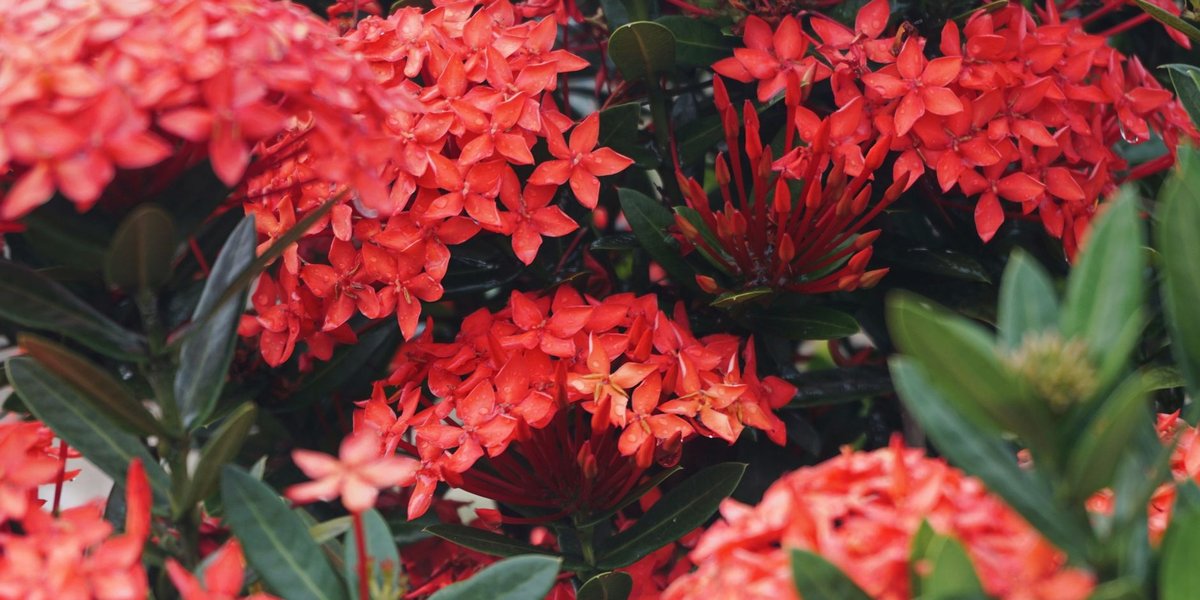
Dense, rounded clusters of small four-petalled flowers, usually fire-red or orange, sitting on a tidy evergreen shrub. The flower heads look like little bouquets, dozens of slim tubes opening into flat crosses. It’s a hedge and border staple in Gambian gardens because it blooms almost continuously and clips into neat shapes.
Each tiny flower holds a bead of nectar at the base of its tube — pull one out and there’s a genuine sweetness, which is why sunbirds work the bushes. Those nectar-feeding birds are just one corner of the wider community of animals of West Africa that lean on flowering plants for food.
14. Madagascar periwinkle (Catharanthus roseus)
A low, unfussy plant with flat five-petalled flowers in pink, mauve, or white, each with a contrasting eye at the centre. It self-seeds and turns up half-wild in waste ground and roadside edges as readily as in tended beds, so it’s one flower you’ll spot without trying.
It’s also one of the most medically important plants on this list: compounds first isolated from it became the chemotherapy drugs vinblastine and vincristine, used against leukemia and Hodgkin lymphoma. Research on those alkaloids is documented through PubMed and the broader oncology literature. Blooms year-round in The Gambia’s climate.
15. Senegal mahogany flower (Khaya senegalensis)
The dry-zone mahogany, a major shade and timber tree across the Sahel, including The Gambia. Its flowers are the understated kind — small, sweet-scented, white-to-cream, in loose sprays — easy to overlook beneath the big spreading crown that makes the tree so valued for shade.
The bark is a heavily used traditional medicine across West Africa, which has pushed the species onto conservation watchlists in parts of its range. You’ll find mature Khaya shading village meeting spots and lining older avenues. Flowering comes in the dry season, before the new leaves fully flush.
The national flower question
Here’s a fact that surprises people: The Gambia has no officially designated national flower. Plenty of sources online will confidently assign one, but there’s no government-recognized national bloom the way there is a national animal or a flag emblem. If you want a flower that feels national, the working answer most Gambians and visitors land on is the hibiscus — both the ornamental Chinese hibiscus draped over every wall and the roselle behind the country’s beloved bissap drink. That family is as close to a floral signature as the country has.
A quick spotting table
| Flower | Local / common name | Best season | Where to look |
|---|---|---|---|
| Chinese hibiscus | Hibiscus | Dry (Nov–May) | Garden walls, hotel grounds |
| Roselle | Bissap / sorrel | Late rains–early dry | Vegetable gardens, farm plots |
| Red frangipani | Frangipani | Dry season | Hotel grounds, older gardens |
| Bougainvillea | — | Dry season | Compound walls, pergolas |
| Devil’s backbone | — | Dry season | Ornamental hedges |
| Flame tree | Flamboyant | Early rains (May–Jul) | Streets, public squares |
| Baobab | Bouy (fruit) | Rainy season | Savanna, village commons, up-country |
| African tulip tree | — | Much of the year | Roadsides, town gardens |
| Yellow oleander | — | Dry season peak | Hedges (toxic) |
| Raffia palm | Raffia | Single mass-flowering | River swamps, wetlands |
| Allamanda | — | Dry season | Coastal hotel fences |
| Desert rose | — | Dry season | Pots, up-country gardens |
| Ixora | — | Year-round | Hedges, borders |
| Madagascar periwinkle | — | Year-round | Roadsides, waste ground |
| Senegal mahogany | Khaya | Dry season | Shade trees, old avenues |
Pack this list for a dry-season trip and you’ll tick off most of the ornamentals on a single walk through any coastal town. Want the native, rains-only flora instead — the baobab blooms, the flamboyants, the wildflowers of the bush? Come in July and head up the river. Two seasons, two completely different sets of flowers, and a country narrow enough to catch a lot of both in one visit.