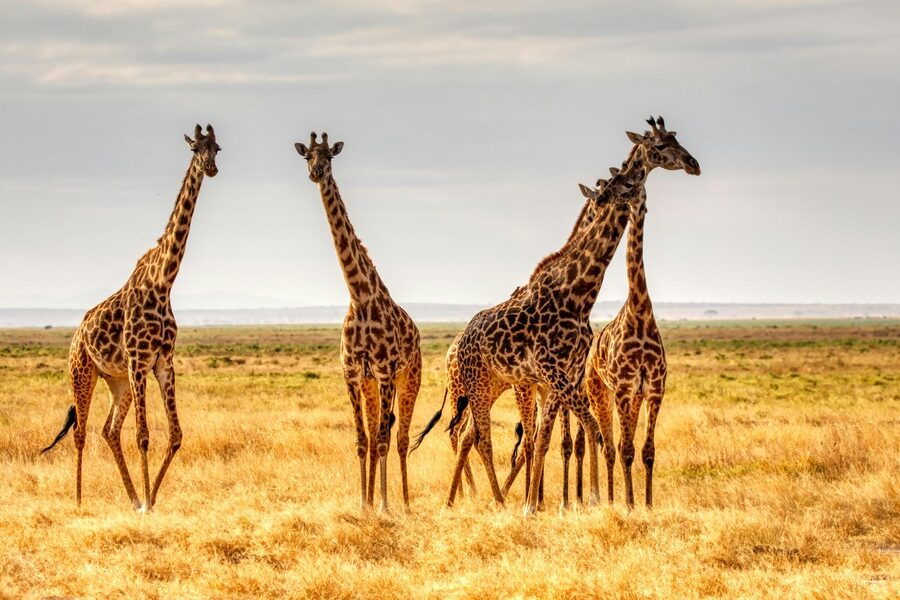
A giraffe is built around one problem: reaching leaves that grow up to 5.5 m (18 ft) off the ground. Its neck has the same seven vertebrae as yours, its heart pumps at about twice the pressure of a typical mammal’s, and its 50 cm tongue strips thorny acacia branches. The labeled diagram below shows every major body part from the side and the front.
Tap a part or its label to see what it does. Use + and - or pinch to zoom, drag to pan.
All parts and what they do
- Two skin-covered bony knobs on top of the skull, present in both sexes. They lie flat at birth and fuse to the skull by adulthood. Adult males use them as clubs in necking fights, which wears the tips bald.
- A bony bump in the middle of the forehead, a third ossicone, is larger in males. It grows bigger with age as bone is added to the skull.
- Giraffe ears are large and movable, so they can turn toward sounds without the head moving. From up high, a giraffe can hear and watch for lions and other predators.
- Giraffe eyes sit on the sides of the head and are larger than those of other hoofed mammals, about 65 cm3 in adults. Together with their height, they give a wide view over the savanna.
- The nostrils are narrow slits, possibly an adaptation to blowing sand. Giraffes smell and breathe through them while the tongue and lips do the leaf picking.
- The narrow muzzle lets a giraffe reach between thorns to pick single leaves. Thick saliva and tough bumps called papillae help protect the mouth from pricks.
- The upper lip is flexible and hairy. It works with the tongue to pluck leaves from between thorns, and thick papillae on the lips help shield them from pricks.
- A giraffe's tongue is about 45 to 50 cm long and can wrap around branches to strip leaves. Its dark color may help prevent sunburn, though that is still only a hypothesis.
- A short mane of stiff, upright hairs runs along the top of the neck, from the head to the withers. It is much shorter than a horse's mane.
- The neck can reach 2.4 m but has only 7 vertebrae, the same number as a human. Each is about 25 to 30 cm long and joined by flexible ball-and-socket-type joints.
- The hump at the shoulders is formed by long spines on the upper back vertebrae. They anchor the strong neck ligament and muscles that hold the heavy head and neck up.
- The back slopes downward from the shoulder hump to the rump, because the front legs are longer than the hind legs. This is why a giraffe's body tilts forward.
- The forelegs are longer than the hind legs and join the body at a raised shoulder. Males have proportionally longer forelegs than females.
- The chest holds a heart of about 11 kg. It is not unusually big for the body's size but has very thick walls, so it can push blood about 2 m up to the brain.
- The flank is the body side behind the ribs. Dark patches here sit over networks of blood vessels and sweat glands that may help release body heat. Each giraffe's pattern is unique.
- Giraffes are ruminants with a four-chambered stomach. They chew cud and eat up to about 34 kg of leaves and twigs a day, so the belly holds a large gut.
- The tail is 80 to 100 cm long and ends in a long tuft of dark hair. Giraffes swish it to drive off flies and other biting insects.
- The dark tuft at the end of the tail works as a fly swatter. Giraffes flick it to keep biting insects away from their flanks and legs.
- Forelegs are longer than the hind legs. To drink, a giraffe spreads its front legs wide or bends them, and it can run in short bursts at up to about 60 km/h.
- The joint that looks like a backward knee on the foreleg is the wrist (carpus). The real knee sits high up against the body and is mostly hidden by the skin of the belly.
- The joint halfway up the hind leg is the hock, which is the ankle (tarsus). Giraffes defend themselves mainly by kicking with their legs, and a kick can be lethal to a lion.
- The fetlock sits just above the hoof. Skin on the lower legs is thick and tight, which is thought to stop blood and fluid from pooling in the legs under the animal's weight.
- Giraffes walk on two toes per foot. A big male's hoof can reach about 31 cm long and 23 cm wide, which spreads the weight of an animal that can top a tonne.
How to use the giraffe diagram
- Switch views: the Side and Front tabs show the giraffe in profile and head-on.
- Zoom: use the + and − buttons, pinch on a phone, or hold Ctrl and scroll. Drag to move around when zoomed in.
- Labels: turn them off to quiz yourself, then turn them back on to check.
- Tap any part to highlight it and read what it does. The link in each card jumps to the matching section below.
Teachers and students can download the labeled diagram and a blank label-the-giraffe worksheet as PDFs in the printable section.
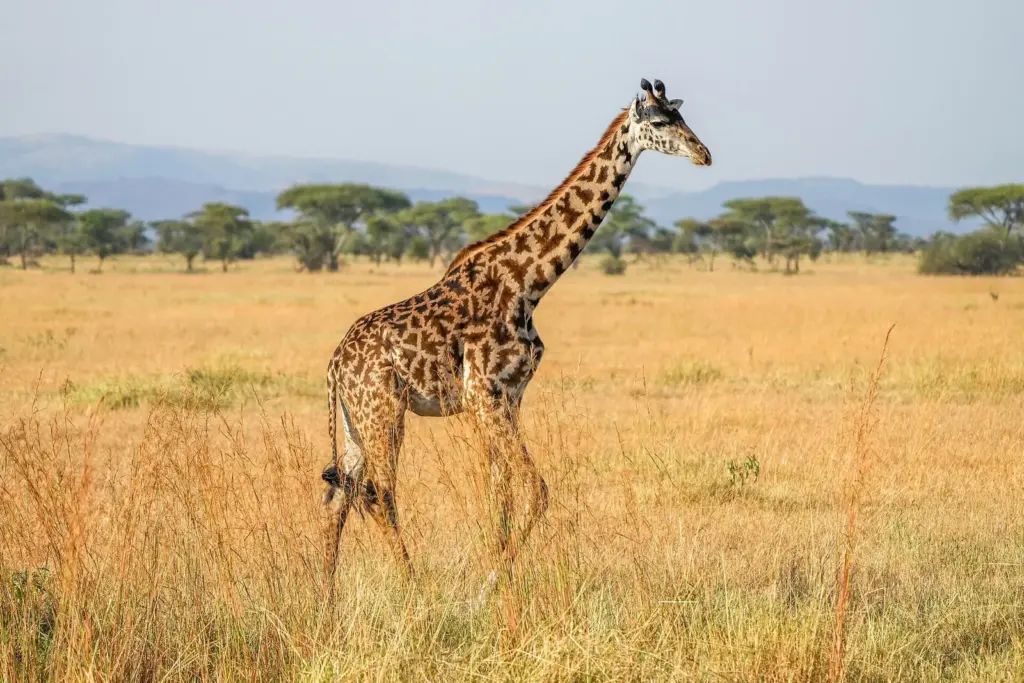
Giraffe body parts at a glance
| Body part | What it is | What it does |
|---|---|---|
| Ossicones | Two skin-covered bony knobs on the skull | Weapons in male necking fights |
| Median lump | A third bony bump on the forehead | Adds weight to a male’s head |
| Tongue | Prehensile, 45 to 50 cm long, dark blue-black | Wraps around branches and strips leaves |
| Lips and muzzle | Narrow, flexible, lined with tough papillae | Pick single leaves between thorns |
| Eyes | Large, set on the sides of the head | Wide view for spotting predators |
| Neck | Up to 2.4 m, 7 vertebrae | Reaches high leaves, used in fights |
| Withers | Shoulder hump of long vertebral spines | Anchors the ligament that holds up the neck |
| Chest | Holds an 11 kg heart | Pumps blood 2 m up to the brain |
| Belly | Four-chambered ruminant stomach | Ferments up to 34 kg of leaves a day |
| “Knee” (front leg) | The wrist, or carpus | Bends when the giraffe lies down or drinks |
| Hock | The ankle of the hind leg | Powers the kick that drives off lions |
| Hooves | Two toes, up to 31 cm long | Carry more than a tonne of body weight |
| Tail | 80 to 100 cm with a dark tuft | Swats flies |
The giraffe head: ossicones, eyes, ears and mouth
The head is small for the animal’s size, but it holds most of the tools a giraffe uses to feed and stay safe.
Ossicones
The two “horns” on top of a giraffe’s head are ossicones. They are not true horns, which have a keratin sheath like a cow’s, and they are not antlers, which deer shed every year. An ossicone is a bony core covered in skin and hair. The only other animal with ossicones is the okapi, the giraffe’s closest living relative.
Calves are born with their ossicones lying flat against the head. They stand upright within the first week, and the bony core fuses to the skull as the giraffe matures. Both males and females have them.
Median lump
Many giraffes have a third bump in the middle of the forehead, called the median lump or median ossicone. It is larger in males and keeps growing as bone builds up on the skull throughout a bull’s life. Northern and reticulated giraffes tend to have the most prominent lumps.
Eyes and ears
Giraffe eyes sit on the sides of the head, which gives a wide field of view. An adult giraffe’s eyeball is about 65 cm³, larger than the eyes of the other hoofed mammals compared in the same study. Combined with a viewpoint over 5 m up, this lets giraffes spot lions at a long distance.
The ears are long and move independently, so a giraffe can track a sound without turning its head.
Nostrils, lips and muzzle
The nostrils are narrow slits, which may help keep out blowing sand. The muzzle is long and narrow so it fits between thorns, and the upper lip is flexible enough to pick single leaves. Tough, finger-like bumps called papillae line the lips and mouth, and thick saliva coats anything sharp that gets swallowed.
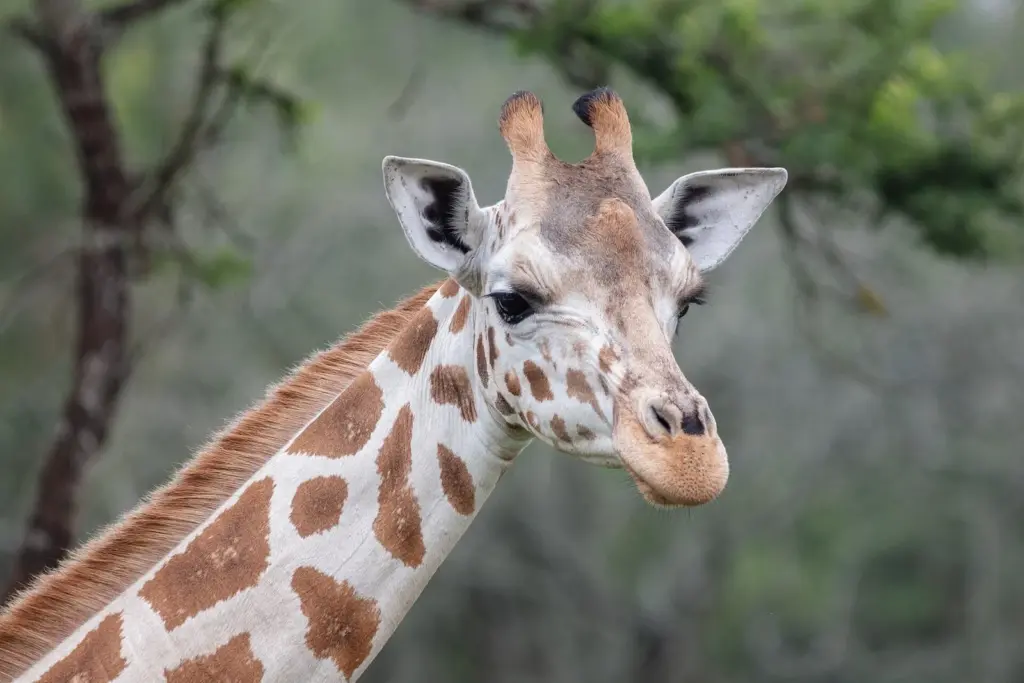
The giraffe tongue
A giraffe’s tongue is about 45 to 50 cm (18 to 20 in) long. It is prehensile, which means it can grip. A feeding giraffe wraps its tongue around a branch, pulls it into the mouth and strips the leaves off as it draws its head back, while the thorns slide past the papillae.
The front of the tongue is dark blue-black and the base is pink. The leading explanation is that the dark pigment protects the tongue from sunburn during hours of feeding in full sun. That idea is still a hypothesis. The okapi also has a dark tongue and lives in shaded rainforest.
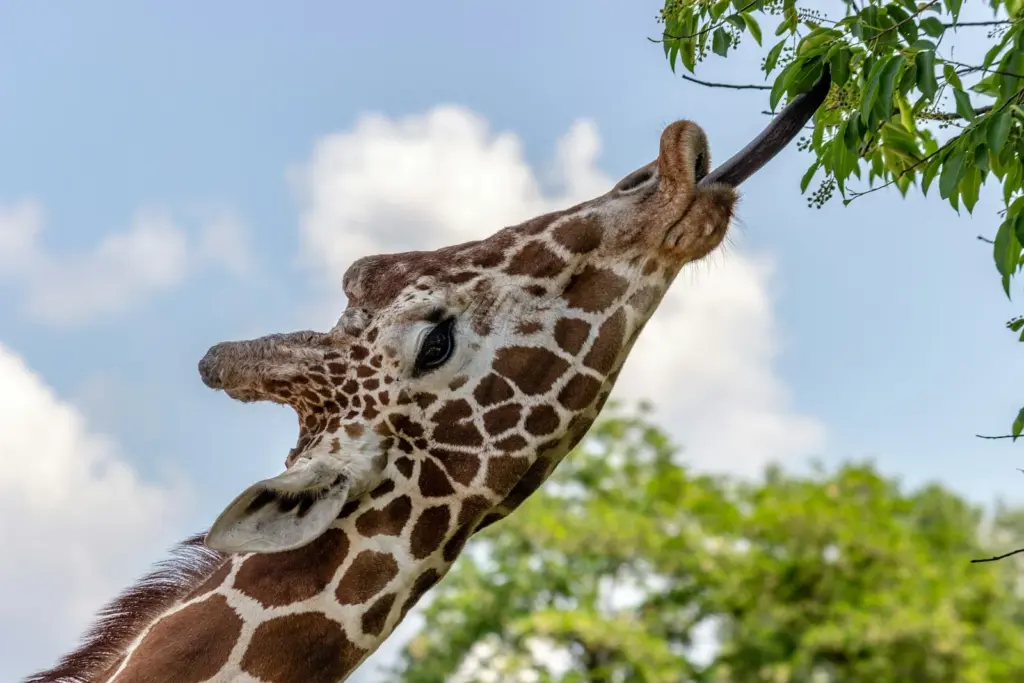
Giraffe skeleton and neck vertebrae
A giraffe’s neck can reach 2.4 m (8 ft) and makes up more than half the length of its spine. It still has only seven cervical vertebrae, the same number as a human, a mouse or a whale. The difference is size. Each of the middle neck vertebrae in an adult giraffe is about 25 to 30 cm (10 to 12 in) long.
The vertebrae meet at ball-and-socket-type joints: the front of each bone is rounded and fits into a cup on the back of the one before it. This gives the neck its range of motion, from reaching the treetops to bending down to drink and swinging sideways in a fight.
One researcher, Nikos Solounias, argued in 1999 that the first thoracic vertebra (T1) works like an eighth neck bone. Most anatomists still count seven, with T1 as a transitional bone that carries a rib.
The shoulder hump and sloping back
The hump at the shoulders, the withers, is made by tall spines on the first vertebrae of the back. These spines anchor the nuchal ligament and the neck muscles that hold up the head and neck. Behind the withers the back slopes steeply down to the rump, because the front legs are longer than the hind legs.
Giraffe heart and blood pressure
The giraffe heart weighs about 11 kg (25 lb) and is about 60 cm long. That sounds huge, but it is about 0.5% of the animal’s body weight, the same share as in other mammals. What sets it apart is the wall of the left ventricle. It is very thick and surrounds a small chamber, which lets the heart push blood about 2 m uphill to the brain.
To manage that, a giraffe’s blood pressure at the heart averages around 200 mmHg, roughly double that of a typical mammal. Two other features keep that pressure from causing harm:
- Jugular vein valves. Each jugular vein has about 6 to 7 one-way valves that stop blood from flowing backward toward the head. When a giraffe lowers its head to drink, blood pools in these veins and arterial pressure falls, which keeps the brain from being flooded. Researchers think the pooled blood returns to the heart when the head comes back up, helping the giraffe avoid a blackout.
- Tight leg skin. The skin on the lower legs is thick and tight. Scientists think it acts like a compression stocking that stops blood and fluid from pooling in the legs under such high pressure.
Giraffes also have a network of small arteries at the base of the brain called the carotid rete. Researchers still debate whether it helps control blood flow when the head swings down or mainly cools the blood heading to the brain.
Giraffe digestion
Giraffes are ruminants, like cows and antelope. They have a four-chambered stomach that ferments tough plant material, and they bring food back up to chew it again as cud, often while walking. A giraffe eats up to about 34 kg (75 lb) of leaves, shoots and twigs a day, with acacia as a favorite. The intestines are over 70 m long.
Because leaves are full of water, giraffes can go several days without drinking.
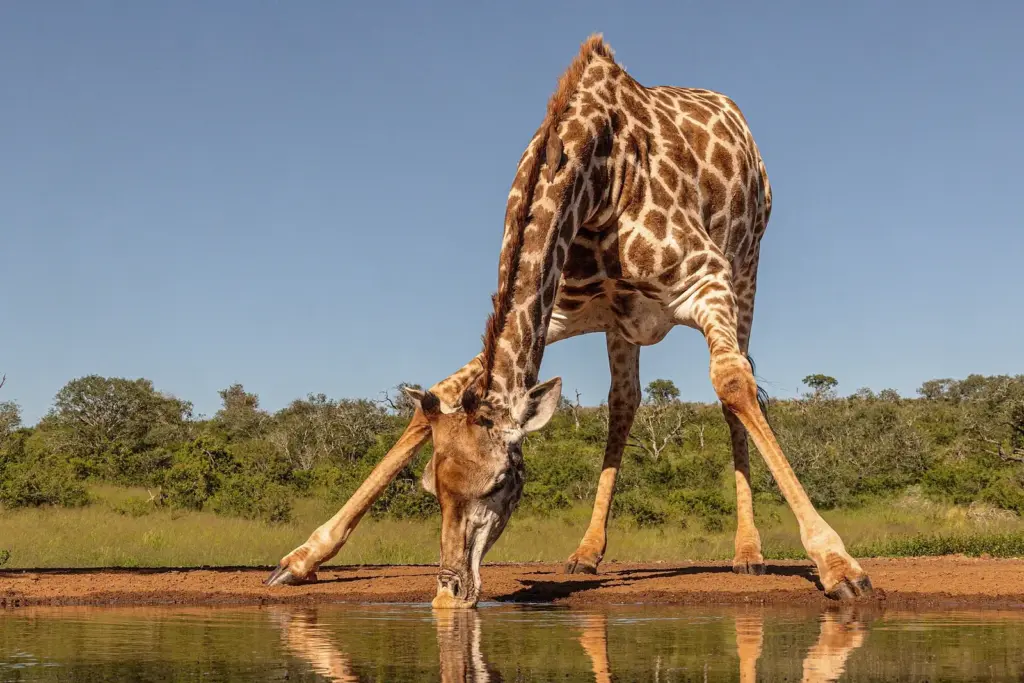
Giraffe legs, hooves and movement
The joint halfway down a giraffe’s front leg looks like a knee, but it is the wrist (carpus). On the hind leg, the backward-pointing joint is the hock, which is the ankle. The real knees sit high up, close to the body.
Each foot ends in a two-toed hoof that can be 31 cm (12 in) long on a large male. The hooves and long legs make a powerful weapon: a well-placed kick can kill a lion.
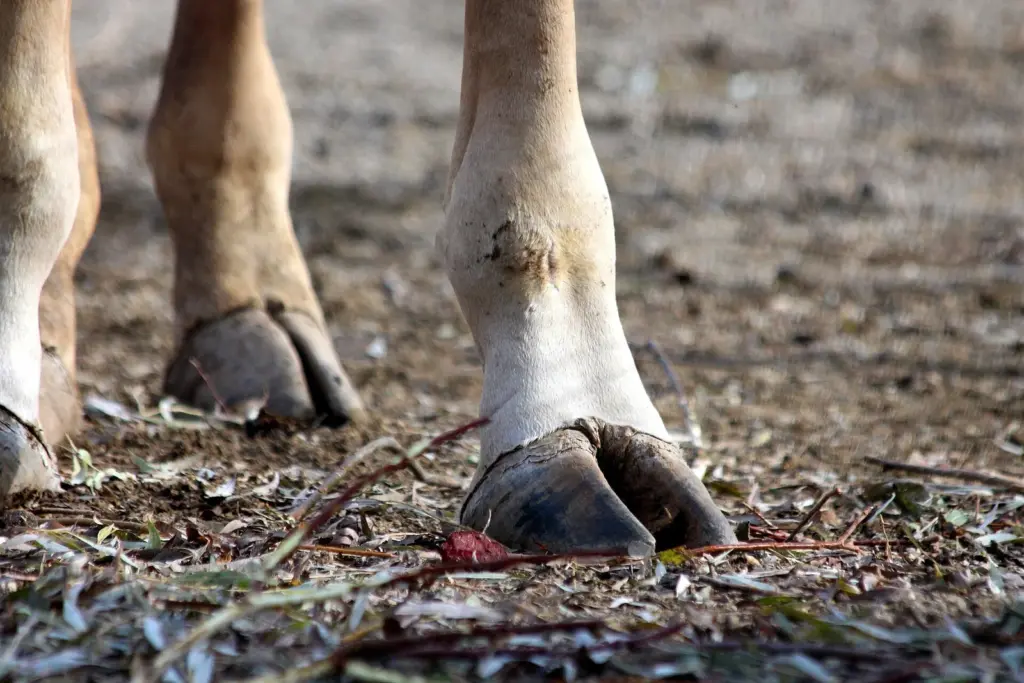
When a giraffe walks, the legs on one side of the body move forward together, followed by the legs on the other side. The neck swings back and forth to keep the animal balanced. In a gallop, giraffes reach about 55 to 60 km/h (35 mph) for short distances.
Drinking is the giraffe’s most awkward moment. It has to spread its front legs wide or bend them before its head can reach the water, which is why giraffes drink in short bursts and look up often.
Giraffe skin and coat pattern
Giraffe skin is up to about 2 cm thick in places and mostly made of collagen, which helps protect against thorns and bites. The coat pattern of dark patches separated by pale lines is unique to every giraffe and stays the same for life. Researchers identify individual giraffes from photos of their patterns, the same way fingerprints identify people.
The patches may do more than provide camouflage. Each dark patch sits over a dense network of blood vessels and larger sweat glands, and scientists think giraffes may use these areas to release body heat. The pattern is partly inherited: calves resemble their mothers in some spot traits but not all of them.
The patterns also differ between the four giraffe species. Reticulated giraffes have large, sharp-edged patches separated by thin white lines, while Masai giraffes have jagged, leaf-shaped patches.
Male vs female giraffe anatomy
| Feature | Male (bull) | Female (cow) |
|---|---|---|
| Height | About 5 m, up to 5.5 m (18 ft) | About 4.4 m (14 ft) |
| Weight | About 1,200 kg (2,600 lb) | About 830 kg (1,800 lb) |
| Ossicones | Thick, with bald, knobby tips | Thin, with tufts of hair on top |
| Median lump | Larger, grows with age | Small or faint |
| Skull | Heavy and lumpy from added bone | Lighter and smoother |
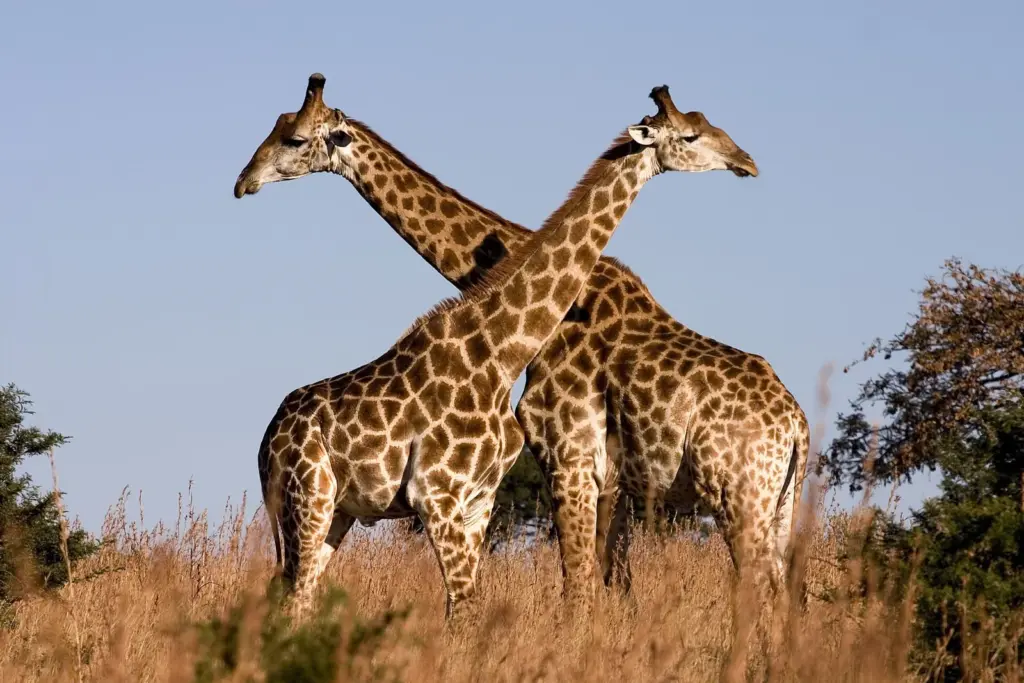
The bald ossicone tips come from necking, the fights in which bulls swing their heads at each other like clubs. A quick look at the top of the head is the easiest way to tell a male from a female in the field.
Giraffe anatomy and physiology facts
| Height | 4.3 to 5.7 m (14 to 19 ft) |
|---|---|
| Weight | 830 kg (female) to 1,200 kg (male) on average |
| Neck length | Up to 2.4 m (8 ft) |
| Neck vertebrae | 7, each up to about 30 cm |
| Tongue | 45 to 50 cm |
| Heart | About 11 kg, 60 cm long |
| Blood pressure at the heart | Around 200 mmHg, about twice a typical mammal’s |
| Stomach | 4 chambers (ruminant) |
| Food per day | Up to 34 kg |
| Top speed | About 55 to 60 km/h |
| Hoof size | Up to 31 x 23 cm |
| Tail | 80 to 100 cm |
| Calf at birth | About 1.8 m tall, 50 to 100 kg |
| Lifespan | About 25 years in the wild |
Printable giraffe diagram with labels
Download the diagram for class or homework. Each PDF fits on one page, and the worksheet has an answer key on page 2.
- Labeled giraffe diagram (US Letter PDF) · A4
- Label the giraffe worksheet with answer key (US Letter PDF) · A4
You are free to print and share these for classroom use.
Giraffe anatomy FAQ
How many neck bones does a giraffe have?
A giraffe has 7 neck vertebrae, the same number as a human. Each one is much longer, about 25 to 30 cm in an adult, which is how the neck reaches up to 2.4 m.
How long is a giraffe's tongue?
A giraffe's tongue is about 45 to 50 cm (18 to 20 in) long. It is prehensile, so the giraffe can wrap it around a branch and strip the leaves off.
Why is a giraffe's tongue dark?
The front of a giraffe's tongue is dark blue-black, which most likely protects it from sunburn during long hours of feeding in the sun. This is a hypothesis, and the okapi has a dark tongue despite living in shade.
How big is a giraffe's heart?
A giraffe's heart weighs about 11 kg (25 lb) and is about 60 cm long. That is about 0.5% of its body weight, the same share as in other mammals, but the left ventricle wall is extremely thick so it can pump blood 2 m up to the brain.
What are the horns on a giraffe called?
The horns on a giraffe are called ossicones. They are bony knobs covered in skin and hair that fuse to the skull. Both males and females have them, and males wear the tips bald in necking fights.
Do giraffes have knees?
Yes, but the joint that looks like a knee halfway down the front leg is the wrist (carpus). The true knees sit high up near the body. The backward-bending joint on the hind leg is the ankle, called the hock.
How many stomachs does a giraffe have?
A giraffe has one stomach with four chambers. It is a ruminant like a cow, so it ferments leaves in the stomach and chews them again as cud.
Why don't giraffes faint when they lower their heads?
When a giraffe lowers its head, one-way valves in the jugular veins stop blood from flowing back toward the brain, and arterial pressure falls as blood pools in those veins. Researchers think that pooled blood returns to the heart when the head comes back up, which helps the giraffe avoid a blackout.