Week-by-week plan (17 weeks)
| Week | Pig weight | Feed a day, each pig | Feed a day, all pigs | Feed |
|---|---|---|---|---|
| 1 | 60 lb | 2.8 lb | 5.7 lb | Grower |
| 2 | 69 lb | 3.2 lb | 6.3 lb | Grower |
| 3 | 80 lb | 3.5 lb | 7.0 lb | Grower |
| 4 | 90 lb | 3.8 lb | 7.6 lb | Grower |
| 5 | 101 lb | 4.1 lb | 8.2 lb | Grower |
| 6 | 112 lb | 4.4 lb | 8.8 lb | Grower |
| 7 | 124 lb | 4.7 lb | 9.4 lb | Grower |
| 8 | 136 lb | 4.9 lb | 9.8 lb | Finisher |
| 9 | 148 lb | 5.2 lb | 10.3 lb | Finisher |
| 10 | 160 lb | 5.4 lb | 10.7 lb | Finisher |
| 11 | 173 lb | 5.6 lb | 11.1 lb | Finisher |
| 12 | 185 lb | 5.7 lb | 11.5 lb | Finisher |
| 13 | 197 lb | 5.9 lb | 11.8 lb | Finisher |
| 14 | 209 lb | 6.0 lb | 12.0 lb | Finisher |
| 15 | 221 lb | 6.2 lb | 12.3 lb | Finisher |
| 16 | 232 lb | 6.3 lb | 12.5 lb | Finisher |
| 17 | 244 lb | 6.4 lb | 12.7 lb | Finisher |
How to use the pig feed calculator
Pick what you are feeding at the top. Each tab answers a different question.
- Pigs for meat: enter how many pigs you have, what they weigh now and the weight you want to butcher at. Pick fast-growing cross or heritage. You get the total feed in pounds and bags, how many weeks it takes, the feed cost and how much each pig should eat today. Open the week-by-week plan to print a feeding chart for the barn.
- Mix my feed: pick the stage, your grain and your protein feed. The calculator works out how many pounds of each go into a batch, using the Pearson square. It also checks lysine, the nutrient corn and soybean meal mixes run short on.
- Sows and boars: daily feed for a pregnant sow, a nursing sow, a boar or a gilt you are raising to breed.
- Mini pigs: daily food for a pot-bellied or mini pet pig, split into meals and cups.
Switch between pounds and kilograms with the toggle. Every result updates as you type, and the link in your browser bar reopens the same numbers.
How much feed does it take to raise a pig?
Most people buy feeder pigs at 40 to 60 lb, about 8 to 12 weeks old, and raise them to 250 to 280 lb. Here is the feed per pig for the common ranges:
| From | To | Fast-growing cross | Heritage or pasture |
|---|---|---|---|
| 40 lb | 250 lb | 620 lb feed, 19 weeks | 750 lb feed, 23 weeks |
| 50 lb | 250 lb | 600 lb feed, 18 weeks | 720 lb feed, 21 weeks |
| 60 lb | 250 lb | 580 lb feed, 17 weeks | 690 lb feed, 20 weeks |
| 50 lb | 280 lb | 720 lb feed, 20 weeks | 870 lb feed, 24 weeks |
| 50 lb | 300 lb | 810 lb feed, 22 weeks | 970 lb feed, 27 weeks |
That is 12 to 15 bags of 50 lb per pig for a fast-growing cross. Two pigs going from 50 to 250 lb need about 24 bags.
The last 30 lb cost the most. A pig gaining from 250 to 280 lb eats about 4 lb of feed per pound of gain, against about 2 lb per pound when it was under 100 lb. If you are raising for your own freezer, 250 lb is a good stopping point. Past that, a pig puts on more fat than meat for each bag you buy.
Fast-growing cross or heritage?
Most feeder pigs sold at farms and sale barns are crosses of Yorkshire, Duroc, Hampshire and Landrace. They convert feed well. In small groups they need about 3 lb of feed per pound of gain, according to Penn State Extension.
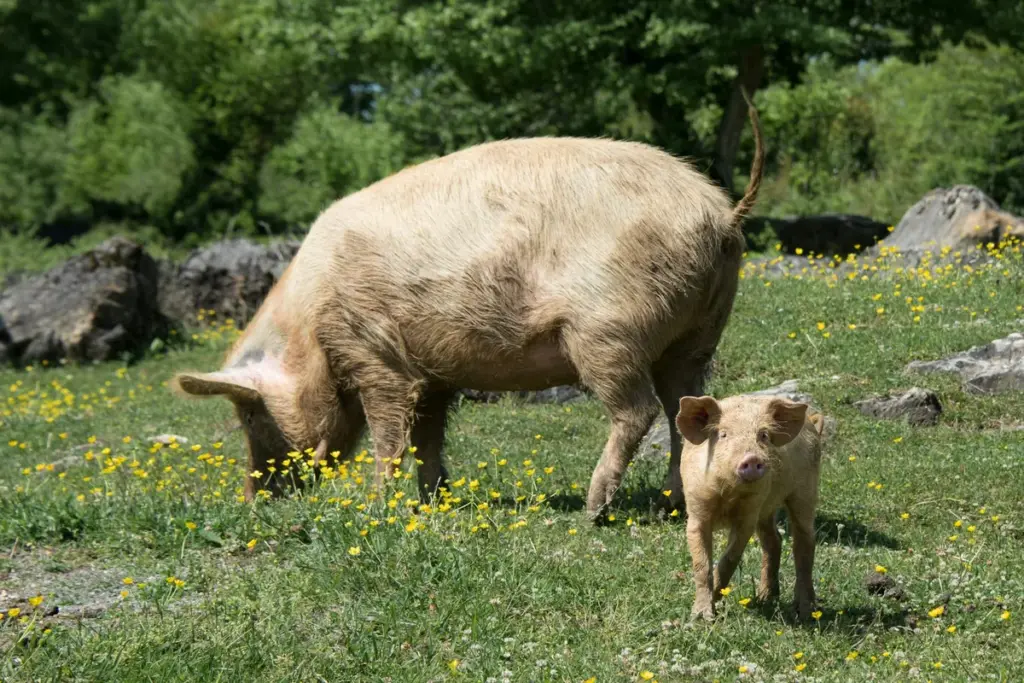
Heritage breeds such as Berkshire, Tamworth, Gloucestershire Old Spots and Red Wattle grow slower and lay on more fat. Pigs that spend their day foraging also burn more feed walking. No extension study gives a measured number for these pigs, so the calculator uses 3.6 lb of feed per pound of gain as an estimate. Your pigs may do better or worse. Weigh them every few weeks and adjust.
How much does a pig eat a day?
A growing pig eats about 5% of its body weight a day at 50 lb and about 2.5% at 250 lb. In pounds, that is about 2.5 lb a day at 50 lb, 4 lb at 100 lb, 6 lb at 200 lb and 6.5 lb at 250 lb. The table shows the amounts from the swine nutrition standard used by feed companies and universities, with 5% added for feed that ends up on the floor.
| Pig weight | Feed a day | % of body weight | Feed from 50 lb | Protein |
|---|---|---|---|---|
| 25 lb11 kg | 1.4 lb0.6 kg | 5.5% | – | 18% |
| 50 lb23 kg | 2.4 lb1.1 kg | 4.9% | – | 16% |
| 75 lb34 kg | 3.3 lb1.5 kg | 4.5% | 56 lb25 kg | 16% |
| 100 lb45 kg | 4.1 lb1.9 kg | 4.1% | 116 lb52 kg | 16% |
| 125 lb57 kg | 4.7 lb2.1 kg | 3.8% | 182 lb83 kg | 14% |
| 150 lb68 kg | 5.2 lb2.4 kg | 3.5% | 255 lb116 kg | 14% |
| 175 lb79 kg | 5.6 lb2.5 kg | 3.2% | 332 lb151 kg | 14% |
| 200 lb91 kg | 5.9 lb2.7 kg | 3.0% | 416 lb189 kg | 14% |
| 225 lb102 kg | 6.2 lb2.8 kg | 2.8% | 506 lb229 kg | 14% |
| 250 lb113 kg | 6.4 lb2.9 kg | 2.6% | 600 lb272 kg | 14% |
| 275 lb125 kg | 6.6 lb3.0 kg | 2.4% | 701 lb318 kg | 14% |
| 300 lb136 kg | 6.8 lb3.1 kg | 2.3% | 807 lb366 kg | 14% |
Feed growing pigs free choice from a self-feeder. Penn State Extension notes that feeding once or twice a day works less well than letting pigs eat when they want. Pigs eat more in cold weather to stay warm, so expect the daily amount to climb in winter.
Pig feed stages and protein
Pigs need less protein as they grow. Feed stores sell three feeds for the three stages:
| Stage | Pig weight | Protein in the feed | Feed per pig |
|---|---|---|---|
| Starter | Up to 40 lb | 18% or more | about 30 lb from 25 lb |
| Grower | 40 to 125 lb | 16% | about 200 lb |
| Finisher | 125 lb to butcher | 14% | about 420 lb to 250 lb |
Protein numbers come from Oklahoma State University’s ration guide. Many bagged feeds run a point or two higher. A “grower-finisher” feed at 16% works for the whole time from 40 lb to butcher weight if you only want to buy one feed. You spend a little more on protein the pigs don’t need at the end.
How to mix your own pig feed
Mixing your own feed from corn and soybean meal costs a fraction of bagged feed. In November 2026, USDA put corn at about $4.60 a bushel and soybean meal at about $340 a ton. Those prices make a 16% grower mix for about $195 a ton before the premix, against $820 to $1,080 a ton for the same feed in 50 lb bags. You need a place to store grain, a way to grind it and a swine vitamin and mineral premix.
The Pearson square
The Pearson square tells you how much grain and how much protein feed to mix to hit a target protein. Here is a 16% grower mix from corn (8.2% protein) and soybean meal (47.7% protein), with 3% of the batch saved for premix:
- Take the premix out first. The premix is 3% of the batch, so corn and soybean meal make up the other 97%. They have to carry all the protein: 16 ÷ 0.97 = 16.5%.
- Draw the square. Put corn (8.2) at the top left, soybean meal (47.7) at the bottom left and 16.5 in the middle.
- Subtract across the diagonals. 47.7 − 16.5 = 31.2 parts corn. 16.5 − 8.2 = 8.3 parts soybean meal. Ignore minus signs.
- Turn parts into shares. 31.2 + 8.3 = 39.5 parts. Corn is 31.2 ÷ 39.5 = 79% and soybean meal is 21% of the 97%.
- Scale to your batch. For a ton (2,000 lb): 1,534 lb corn, 406 lb soybean meal and 60 lb premix.
The calculator does these steps for any grain and batch size, and draws the square so you can check the math.
Protein is not the whole story
Pigs need lysine, an amino acid, more than they need protein as a number. Corn is low in lysine. A 16% corn and soybean meal mix has about 0.8% lysine, while a fast-growing 80 lb pig uses about 1.05%. Extension nutritionists balance pig feed on lysine for this reason. The calculator shows the lysine in your mix and the protein level that would cover it. Slower heritage pigs manage on less.
How much to feed a sow or boar
Breeding pigs are fed by the day, not free choice, because they get fat fast.
- Pregnant sow: 4 to 6 lb a day for most of the pregnancy. A 400 lb sow needs about 4.8 lb. Add 2 lb a day for the last two weeks before she farrows. K-State Research and Extension lists overfeeding pregnant sows as the most common feeding mistake in breeding herds. Don’t drop below 4 lb a day, or she can come up short on vitamins and minerals.
- Cold barns: add 1 lb a day for every 20°F below 60°F, according to the University of Minnesota.
- Nursing sow: let her eat all she wants. Build up to full feed over the first week after farrowing. Expect 9 to 15 lb a day; a sow nursing 10 or more piglets eats at the top of that range.
- Boar: about 6 lb a day of a sow feed once he passes 240 lb. A young boar still growing can eat all he wants of a 16% feed.
- Gilt for breeding: raise her on grower feed to 200 lb, then switch to about 5 lb a day of sow feed. Raise it to 6 to 8 lb a day for 2 to 3 weeks before breeding.
How much to feed a mini pig
A pot-bellied or mini pig should eat about 2% of its body weight a day, counting every treat and snack. A 100 lb mini pig gets about 2 lb of food a day, split into two or three meals. In volume, VCA Animal Hospitals puts it at roughly 1 cup of mini pig pellets per 50 lb of body weight, though brands differ, so check the feed bag.
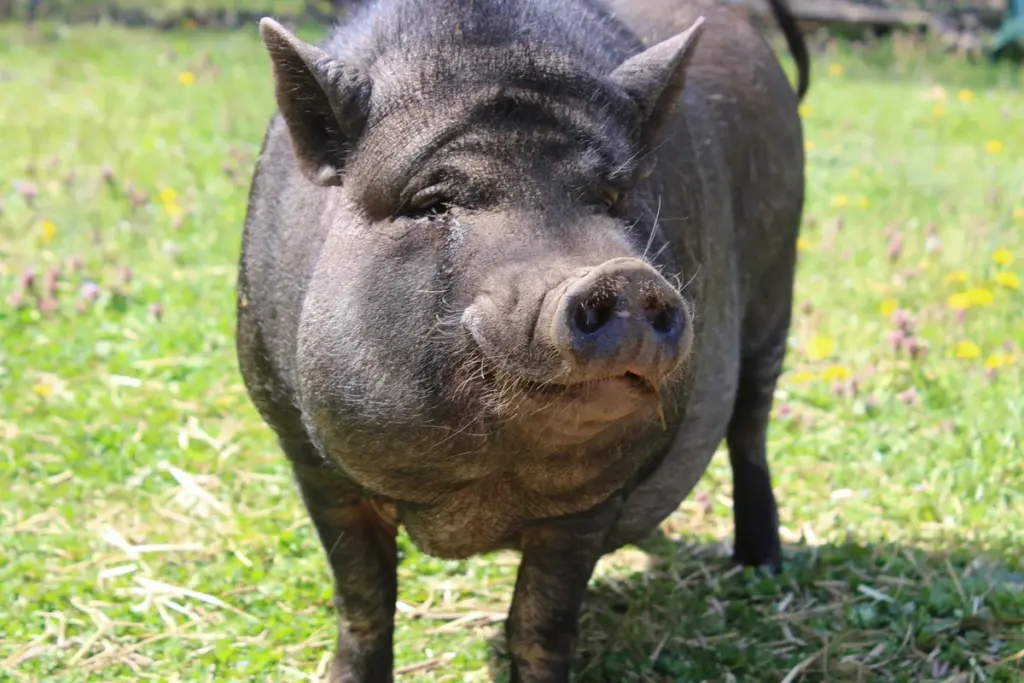
Most adult mini pigs weigh 100 to 150 lb, more than the name suggests, and keep growing until they are 2 to 3 years old. Don’t feed them on the meat-pig numbers in this calculator. Meat pigs are fed to grow as fast as possible, and a pet fed that way becomes obese. The Merck Veterinary Manual warns that mini pigs gain weight easily, so high-energy treats should stay small.
Signs a mini pig is overweight include fat over the eyes, a belly that nearly touches the ground and rolls of fat on the face and neck. Texas A&M vets recommend weight loss of no more than 0.5% to 1% of body weight a week. For a 150 lb pig, that is 0.75 to 1.5 lb a week.
How much water does a pig need?
A pig drinks about 2 to 3 lb of water for every pound of feed it eats. Plan to supply:
| Pig | Water a day |
|---|---|
| Under 60 lb | about 1 gallon |
| 60 to 100 lb | 2 to 3 gallons |
| 100 lb to butcher | 3 to 5 gallons |
| Pregnant sow | 3 to 6 gallons |
| Nursing sow | 5 to 8 gallons |
| Boar | 3 to 8 gallons |
| Pigs on pasture, hot days | 8 to 12 gallons |
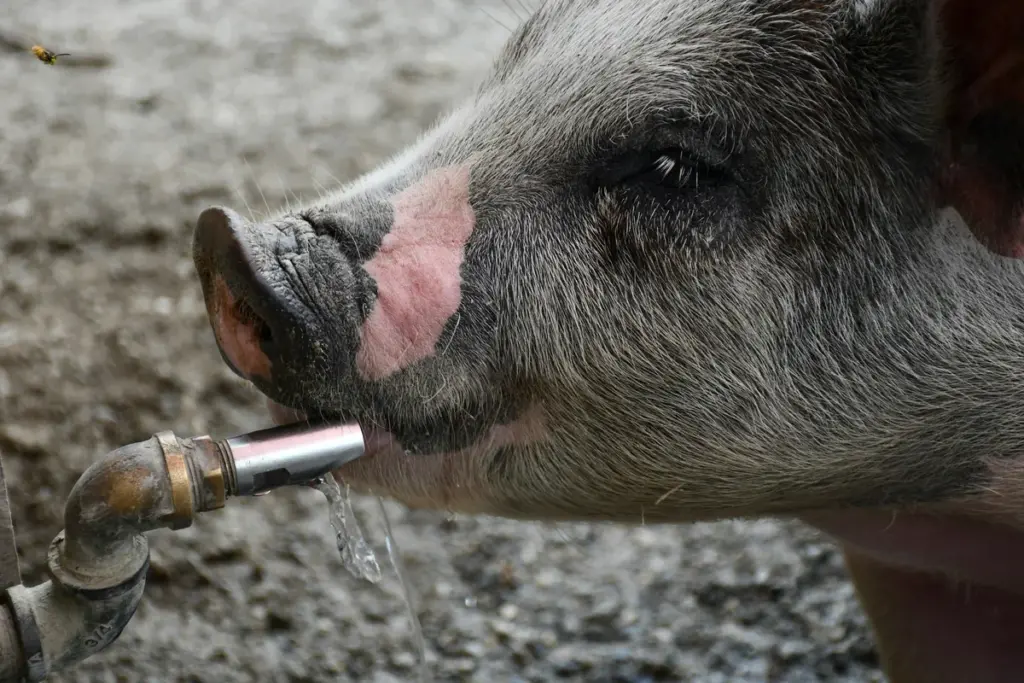
These numbers include water that spills from nipple drinkers and troughs. Pigs drink 25% to 50% more in heat. A pig without water for a day can get salt poisoning even on normal feed, so check waterers every day, and twice a day when it freezes.
What does it cost to feed a pig to butcher weight?
At $22 for a 50 lb bag, the 600 lb of feed a fast-growing pig eats from 50 to 250 lb costs about $264. Bagged grower feed ran about $20 to $27 a bag at farm stores in late 2026, so expect $240 to $325 per pig on bagged feed. A heritage pig that eats 720 lb costs about $317 at $22 a bag.
Feed is the largest cost of raising a pig. Add the price of the feeder pig, bedding, any vet visits and processing. Buying feed by the half ton or ton from a feed mill usually costs less per pound than bags. Enter your own price in the calculator; feed prices vary a lot by region.
Can pigs eat kitchen scraps?
Scraps can be a small part of the diet, but not the base of it. Any food that contains meat or has touched meat counts as “garbage” under the federal Swine Health Protection Act. Feeding it requires a license and cooking it at 212°F for 30 minutes. Meat scraps can carry African swine fever, foot-and-mouth disease and trichinosis.
Twenty-five states ban feeding food waste to pigs outright, including Iowa, Illinois, New York and Wisconsin. Federal law exempts scraps from your own kitchen fed to your own pigs on the same property, but state law can be stricter. Check with your state veterinarian before feeding scraps, especially if you plan to sell the meat.
Pig feeding mistakes to avoid
- Moldy feed. Mold can carry aflatoxin. The FDA limit is 20 ppb for pigs under 4 months and pet pigs, 100 ppb for breeding pigs and 200 ppb for finishing pigs over 100 lb. Throw out feed that smells musty or has clumps.
- Running out of water. See above. A frozen or broken waterer is the usual cause of salt poisoning.
- Grinding feed too fine. Grain ground finer than about 700 microns (flour-like) raises stomach ulcers in finishing pigs, according to the University of Minnesota.
- Using a premix made for another animal. A cattle mineral does not meet a pig’s needs.
- Overfeeding sows and mini pigs. Both put on fat fast. Feed them a measured amount.
For more on pigs, read about famous pigs and their names or browse our list of farm animals. Raising other livestock? Use our chicken feed calculator, goat feed calculator, sheep feed calculator and cattle feed calculator, or browse all our animal calculators.
How the calculator works
Total feed. The calculator uses Kansas State University’s standard feed budget, which gives the feed a pig eats from 10 lb up to 300 lb. The feed between two weights is the difference between the two points on that chart. The K-State chart assumes commercial pigs needing 2.8 lb of feed per pound of gain from 50 to 250 lb. The calculator scales it to 3.0 for fast-growing crosses in small groups (Penn State Extension) and to 3.6 for heritage and pasture pigs (an estimate).
Daily feed and time. Daily feed comes from the free-choice intake equation in the National Research Council’s Nutrient Requirements of Swine (2012), the standard reference for pig nutrition, with 5% added for spilled feed. The calculator walks the pig forward one pound at a time. For each pound it takes the feed from the budget and divides it by what a pig that size eats in a day. Adding up the days gives the time to butcher weight. From 50 to 250 lb this comes to about 124 days, close to Penn State’s planning figure of 118 days for 60 to 260 lb.
Feed mix. Pearson square on crude protein, as in Oklahoma State’s ration guide, with the premix share taken out first. Ingredient protein and lysine values come from the NRC feed tables. Lysine targets come from K-State’s example diets.
Sows, boars and mini pigs. Sow and boar amounts come from K-State, the University of Minnesota and the University of New Hampshire. Mini pig amounts come from VCA Animal Hospitals, the Merck Veterinary Manual and Texas A&M.
These are planning numbers. Real pigs vary with genetics, weather, health and feed quality. A weight tape or a scale every two to three weeks tells you whether yours are on track.
Frequently asked questions
How much feed does it take to raise a pig?
How much does a pig eat per day?
How long does it take to raise a pig to 250 lb?
How many pounds of feed does a pig need per pound of gain?
How much does it cost to feed a pig to butcher weight?
What protein feed do pigs need at each stage?
How do you mix pig feed with corn and soybean meal?
How much should I feed a mini pig?
How much water does a pig drink a day?
Can I feed my pigs kitchen scraps?
How many times a day should you feed a pig?
Sources
- National Research Council. Nutrient Requirements of Swine, 11th revised edition. National Academies Press, 2012.
- DeRouchey, J. et al. Growing-Finishing Pig Recommendations (MF2301). Kansas State University Research and Extension.
- Breeding Herd Recommendations for Swine (MF2302). Kansas State University Research and Extension.
- Luce, W.G. Formulating Swine Rations (ANSI-3501). Oklahoma State University Extension.
- Raising Small Groups of Pigs and Adjusting and Monitoring Meat Animal Growth Rate. Penn State Extension.
- Formulating Farm-Specific Swine Diets and Mixing Your Own Swine Feed. University of Minnesota Extension.
- Swine Nutrition. University of New Hampshire Cooperative Extension.
- Watering Tips for Swine (Bulletin #1122). University of Maine Cooperative Extension.
- Mini-Pigs: Feeding. VCA Animal Hospitals.
- Tynes, V. Feeding and Nutrition of Miniature Pet Pigs. Merck Veterinary Manual.
- Avoiding Pig Obesity. Texas A&M College of Veterinary Medicine.
- Human Food Waste and Swine. USDA APHIS, 2024.
- CPG Sec. 683.100 Action Levels for Aflatoxins in Animal Food. U.S. Food and Drug Administration.
- World Agricultural Supply and Demand Estimates. USDA, November 2026.