A 1-year-old rabbit is about 21 in human years, a 2-year-old is 27 to 31 and a 5-year-old is 47 for a dwarf rabbit and 67 for a giant one. After the first year each rabbit year adds 6 to 12 human years, depending on size. A well-cared-for pet rabbit lives about 6 to 10 years by size. The popular chart (20 at year 1, then 6 a year) and the times-8 rule both miss the pace of larger rabbits.
Choose a breed or a size class, enter your rabbit’s age and the rabbit years calculator returns the human-equivalent age, the life stage and the age your rabbit becomes a senior. It also works in reverse, from human years to rabbit years, and it shows how the result compares with the popular chart and the times-8 rule. This page also answers how long rabbits live. Bunny and rabbit are two words for the same animal, and every chart on the page comes from the same model.
How to use the rabbit years calculator
Pick a breed or size, enter an age and read the human equivalent. The calculator takes four steps.
- Pick a breed, or “Not sure of the breed”. The size class sets your rabbit’s typical lifespan, which sets how fast the scale runs. The classes are dwarf (under about 3.5 lb or 1.6 kg), small (3.5 to 6 lb), medium (6 to 9 lb), large (9 to 11 lb) and giant (over 11 lb or 5 kg). Choose “mixed or unknown size” for a rescue rabbit you cannot place.
- Enter your rabbit’s age. Use years and months. Months matter in the first year, when a rabbit gains 21 human years.
- Read the result. You get the human-equivalent age, the life stage and the age at which your rabbit reaches the senior stage.
- Switch to human to rabbit years to turn a person’s age into a rabbit age for the same size. The conversion is the exact inverse of the rabbit-to-human one.
A rabbit older than its size class’s typical lifespan is labeled “past the typical lifespan for a rabbit this size”. That describes where the rabbit sits on the scale. It is not a prognosis. The scale stops at 122 human years, the oldest verified human age.
The calculator covers domestic rabbits. For the difference between rabbits and hares, see hares vs rabbits. The dog years, cat years and horse years calculators use the same method, and every tool is listed on the calculators page.
How long do rabbits live?
A well-cared-for indoor pet rabbit lives 8 to 12 years, according to the House Rabbit Society, PetMD, Petplan, Omlet and Woodgreen. PDSA says 7 to 10. Studies that follow whole populations of pet rabbits report lower medians at death: 4.3 years in UK vet practices and 7 years at a Tokyo referral clinic. Pet bunnies and rabbits are the same animal, so these figures answer both questions.
Size changes the answer. Small rabbits live longer than large ones in every source that compares them. The measured figures and the care-organisation figures are different kinds of number, and the table sets them side by side.
| Measure | Figure | Source |
|---|---|---|
| Median age at death, UK pet rabbits under vet care (2013, 370 deaths) | 4.3 years (IQR 2.1-7.0, range 0.1-14.4) | O’Neill DG et al. Vet Rec 2020;186(14):451. doi:10.1136/vr.105592 |
| Same study, males vs females | 5.2 vs 3.7 years | O’Neill 2020 |
| Median age at death, one exotic-animal clinic in Tokyo (2006-2020, 898 rabbits) | 7 years; 18% lived past 9; oldest 15 | Shiga T, Nakata M, Miwa Y. J Exot Pet Med 2022;43:35-39 |
| Typical lifespan, indoor neutered rabbit (care organisations) | 8-12 years | House Rabbit Society; Petplan; PetMD; Woodgreen; Omlet (PDSA: 7-10) |
| Oldest rabbit on record | 18 years 10.75 months (Flopsy, Tasmania, wild-caught 1964) | Guinness World Records |
| Oldest living rabbit | 15 years 82 days on 10 Nov 2025 (Herbie, Lionhead, UK) | Guinness World Records |
Why the UK median is only 4.3 years
The UK figure of 4.3 years is the median age of rabbits that died, and it is not a life expectancy. O’Neill and colleagues (2020) followed 6,349 rabbits at 107 UK clinics in the VetCompass database in 2013. Of the 370 rabbits that died during the study, the median age at death was 4.3 years (interquartile range 2.1 to 7.0, range 0.1 to 14.4). Three things pull it down.
- It counts only deaths. Every young death is in the figure and the living rabbits are not.
- Many deaths were early and preventable. Median age at death was 1.7 years for myxomatosis, 2.0 for bite injuries, 3.0 for E. cuniculi and 5.4 for flystrike (myiasis).
- It covers only rabbits seen by vets. The authors cite PDSA data that 34% of UK rabbits are not registered with a vet, so the median may not reflect the wider UK rabbit population.
Some summaries call 4.3 the average lifespan. The paper reports a median age at death.
The Tokyo series (Shiga et al. 2022) covers 898 rabbits seen at one exotic-animal referral clinic from 2006 to 2020. The median age at death was 7 years, 18% lived past 9 and the oldest reached 15. Clinician’s Brief attributes the gap between Tokyo and England to housing (indoor or outdoor) or the type of clinic.
This calculator takes the typical lifespan to mean what a rabbit in good care can expect. It sits between the Tokyo median of 7 and the care-organisation range of 8 to 12, graded by size. It is not a median at death, and the calculator assumes good care.
How long rabbits live by size
Dwarf rabbits are given 10 years, small rabbits 9.5, medium rabbits 8.5, large rabbits 7 and giant rabbits 6. No study measures rabbit lifespan by size. The UK study could not analyse breed and the Tokyo series reports none, so every size claim comes from care organisations and breed sites. They agree on the direction. The Rabbit Welfare Association and Fund (RWAF) gives 12 to 13 years for small breeds such as the Netherland Dwarf and Polish, 9 to 10 for medium rabbits and 4 to 7 for large breeds such as the Continental Giant, French Lop, Belgian Hare and New Zealand White. Woodgreen gives 7 to 10 for the Netherland Dwarf, 7 to 9 for the Lionhead, 6 to 9 for the Dutch and 7 to 9 for smaller lops, and says giants live shorter lives.
Breed-site tables run lower, at 5 to 8 years for most medium and large breeds, and they contradict themselves: one gives the Polish 5 to 6 years, and RWAF names the Polish among its 12-to-13-year breeds. Treat breed figures as noise around a size trend.
| Size class | Adult weight | Typical lifespan used here | Senior from | Geriatric from | Reaches the 122 cap at |
|---|---|---|---|---|---|
| Dwarf | Under 3.5 lb (1.6 kg) | 10 years | 7 years | 8.5 years | 18.9 years |
| Small | 3.5 to 6 lb (1.6 to 2.7 kg) | 9.5 years | 6.7 years | 8.1 years | 17.9 years |
| Medium | 6 to 9 lb (2.7 to 4.1 kg) | 8.5 years | 5.9 years | 7.2 years | 15.9 years |
| Large | 9 to 11 lb (4.1 to 5 kg) | 7 years | 4.9 years | 6 years | 12.9 years |
| Giant | Over 11 lb (5 kg) | 6 years | 4.2 years | 5.1 years | 10.7 years |
| Mixed / unknown | Not known | 9 years | 6.3 years | 7.7 years | 16.9 years |
What shortens or lengthens a rabbit’s life
Housing, preventable disease and neutering are the factors the sources discuss. Only sex is measured in a cohort, and the care-organisation figures below are not trial results.
- Indoor housing. The House Rabbit Society puts indoor rabbits at 8 to 12 years, neutered indoor rabbits at around 10 and outdoor rabbits at 3 to 5, and says many reach 14 or 16.
- Preventable early deaths. In the UK data, flystrike, myxomatosis, bite injuries and E. cuniculi killed rabbits at median ages from 1.7 to 5.4 years.
- Neutering. PetMD, Petplan and the House Rabbit Society say neutered rabbits live longer, and no study has measured the size of the effect. The reason given is uterine cancer in unspayed does. Three published clinical series of rabbits with uterine disease found adenocarcinoma in 10 of 47, 29 of 59 and 27 of 50 animals, at a mean age of about 5 to 6 years. Those series show it is common in does with uterine disease. They cannot show how common it is across all does.
- Sex. In the UK data, males had a median age at death of 5.2 years and females 3.7 (P < 0.001). Neuter status was recorded for only 19.7% of rabbits, and the authors could not analyse breed or neuter effects, so the gap is not a clean male-versus-female lifespan.
- Disease by age. In the Tokyo series cancer caused 24.8% of deaths, gastrointestinal disease 15%, abscesses 10%, urinary disease 9.5%, trauma 4.9% and heart disease 3%. Gastrointestinal disease led among rabbits aged 4 and under, and cancer from age 5.
The oldest rabbit on record
The oldest rabbit on record is Flopsy, who lived 18 years 10.75 months. Guinness World Records says she was caught on 6 August 1964 and died 18 years 10.75 months later at the home of Mrs L. B. Walker of Longford, Tasmania. Flopsy was wild-caught, so her age at capture is unknown and 18.9 years is a minimum.
| Record | Animal | Age |
|---|---|---|
| Oldest rabbit ever | Flopsy, caught wild in Tasmania in 1964 | 18 years 10.75 months |
| Oldest living rabbit (10 November 2025) | Herbie, a Lionhead, Surrey, UK | 15 years 82 days |
| Oldest living rabbit in 2019 | Mick, Illinois | 16 years |
The cohort maxima are lower: 14.4 years in the UK data, 15 in the Tokyo series and 14 in Lennox’s practice. In this calculator the dwarf class reaches the 122 cap at 18.9 years, Flopsy’s age, and Herbie at 15.2 years is 104.1 in human years.
Rabbit years to human years chart
A 4-month-old rabbit is 12 in human years, a 1-year-old is 21 and a 5-year-old is 47 to 67, depending on size. The chart gives whole human years for rabbits from 1 month to 16 years, by size class. A value of 122 is the cap, first reached by a giant rabbit at 11 years.
| Rabbit age | Dwarf | Small | Medium | Large | Giant | Mixed / unknown |
|---|---|---|---|---|---|---|
| 1 month | 2 | 2 | 2 | 2 | 2 | 2 |
| 2 months | 5 | 5 | 5 | 5 | 4 | 5 |
| 3 months | 8 | 8 | 8 | 8 | 5 | 8 |
| 4 months | 12 | 12 | 12 | 12 | 7 | 12 |
| 6 months | 17 | 17 | 17 | 17 | 10 | 17 |
| 9 months | 19 | 19 | 19 | 19 | 14 | 19 |
| 1 year | 21 | 21 | 21 | 21 | 18 | 21 |
| 2 years | 27 | 28 | 29 | 31 | 30 | 28 |
| 3 years | 34 | 35 | 36 | 40 | 42 | 36 |
| 4 years | 40 | 41 | 44 | 50 | 55 | 43 |
| 5 years | 47 | 48 | 52 | 60 | 67 | 50 |
| 6 years | 53 | 55 | 60 | 69 | 79 | 57 |
| 7 years | 60 | 62 | 67 | 79 | 88 | 65 |
| 8 years | 66 | 69 | 75 | 86 | 97 | 72 |
| 9 years | 73 | 76 | 82 | 94 | 106 | 79 |
| 10 years | 79 | 82 | 88 | 101 | 116 | 84 |
| 11 years | 84 | 87 | 94 | 108 | 122 | 90 |
| 12 years | 89 | 92 | 99 | 115 | 122 | 95 |
| 13 years | 94 | 97 | 105 | 122 | 122 | 101 |
| 14 years | 98 | 102 | 111 | 122 | 122 | 106 |
| 15 years | 103 | 107 | 117 | 122 | 122 | 112 |
| 16 years | 108 | 112 | 122 | 122 | 122 | 117 |
Three things stand out. Every size is the same through the first year except giants: 12 at 4 months and 21 at 1 year, against 7 and 18 for a giant, whose growth runs later. After year 1 the sizes separate: at 5 years a dwarf rabbit is 47, a small rabbit 48, a medium rabbit 52, a large rabbit 60 and a giant rabbit 67. The reason is the scale. Each size’s typical lifespan lands on 79 human years, which a dwarf reaches at 10 years, a small rabbit at 9.5, a medium rabbit at 8.5, a large rabbit at 7 and a giant at 6.
The chart in short form: 1 rabbit year = 21 (giants 18), 2 = 27 to 31, 5 = 47 to 67, 8 = 66 to 97, 10 = 79 to 116.
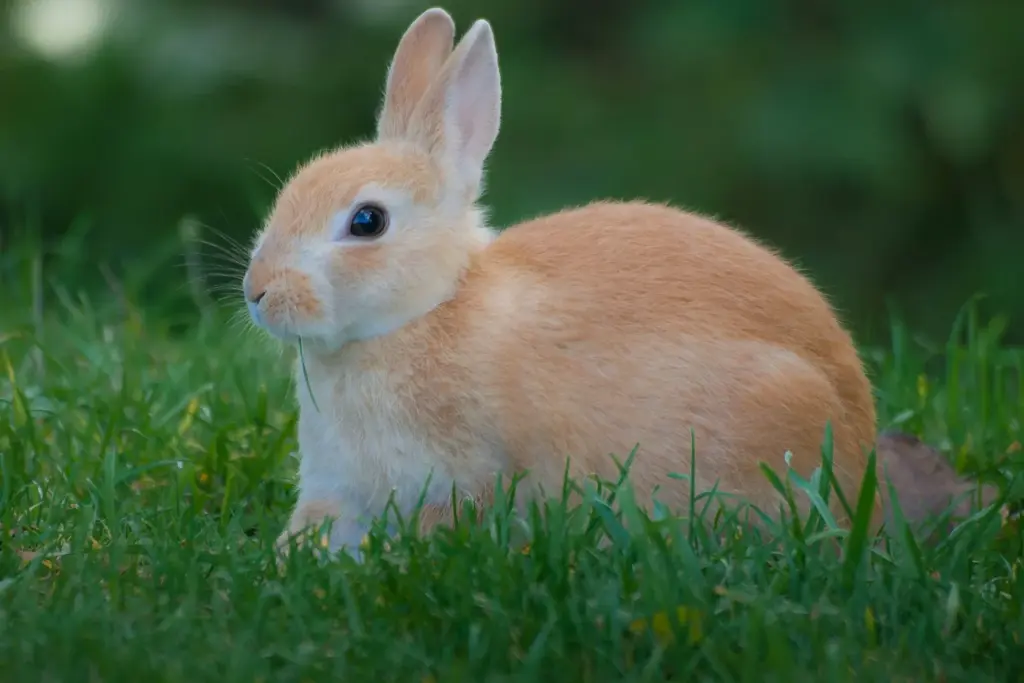
Human years to rabbit years chart
A 12-year-old child matches a rabbit of 4 months, an 18-year-old matches a rabbit of 7 months (a giant of 1 year) and a 50-year-old matches a small rabbit of 5 years 3 months. Find the human age in the first column. The cells give the rabbit’s age in years (y) and months (mo).
| Human age | Dwarf | Small | Medium | Large | Giant | Mixed / unknown |
|---|---|---|---|---|---|---|
| 3 | 2 mo | 2 mo | 2 mo | 2 mo | 2 mo | 2 mo |
| 6 | 2 mo | 2 mo | 2 mo | 2 mo | 4 mo | 2 mo |
| 9 | 3 mo | 3 mo | 3 mo | 3 mo | 6 mo | 3 mo |
| 12 | 4 mo | 4 mo | 4 mo | 4 mo | 8 mo | 4 mo |
| 15 | 5 mo | 5 mo | 5 mo | 5 mo | 10 mo | 5 mo |
| 18 | 7 mo | 7 mo | 7 mo | 7 mo | 1 y | 7 mo |
| 21 | 1 y | 1 y | 1 y | 1 y | 1 y 3 mo | 1 y |
| 25 | 1 y 7 mo | 1 y 7 mo | 1 y 6 mo | 1 y 5 mo | 1 y 7 mo | 1 y 7 mo |
| 30 | 2 y 5 mo | 2 y 4 mo | 2 y 2 mo | 1 y 11 mo | 2 y | 2 y 3 mo |
| 35 | 3 y 2 mo | 3 y 1 mo | 2 y 10 mo | 2 y 5 mo | 2 y 5 mo | 2 y 11 mo |
| 40 | 3 y 11 mo | 3 y 9 mo | 3 y 5 mo | 3 y | 2 y 10 mo | 3 y 7 mo |
| 45 | 4 y 9 mo | 4 y 6 mo | 4 y 1 mo | 3 y 6 mo | 3 y 3 mo | 4 y 4 mo |
| 50 | 5 y 6 mo | 5 y 3 mo | 4 y 9 mo | 4 y | 3 y 7 mo | 5 y |
| 55 | 6 y 3 mo | 6 y | 5 y 5 mo | 4 y 6 mo | 4 y | 5 y 8 mo |
| 60 | 7 y 1 mo | 6 y 9 mo | 6 y 1 mo | 5 y | 4 y 5 mo | 6 y 5 mo |
| 65 | 7 y 10 mo | 7 y 5 mo | 6 y 8 mo | 5 y 7 mo | 4 y 10 mo | 7 y 1 mo |
| 70 | 8 y 7 mo | 8 y 2 mo | 7 y 4 mo | 6 y 1 mo | 5 y 3 mo | 7 y 9 mo |
| 75 | 9 y 5 mo | 8 y 11 mo | 8 y | 6 y 7 mo | 5 y 8 mo | 8 y 5 mo |
| 80 | 10 y 2 mo | 9 y 8 mo | 8 y 8 mo | 7 y 2 mo | 6 y 1 mo | 9 y 2 mo |
| 85 | 11 y 3 mo | 10 y 8 mo | 9 y 6 mo | 7 y 10 mo | 6 y 8 mo | 10 y 1 mo |
| 90 | 12 y 3 mo | 11 y 8 mo | 10 y 5 mo | 8 y 6 mo | 7 y 2 mo | 11 y |
| 95 | 13 y 4 mo | 12 y 8 mo | 11 y 3 mo | 9 y 2 mo | 7 y 9 mo | 11 y 11 mo |
| 100 | 14 y 4 mo | 13 y 7 mo | 12 y 1 mo | 9 y 11 mo | 8 y 4 mo | 12 y 10 mo |
Up to age 21 every size agrees except giants, because the early anchors are shared. From age 30 the sizes diverge: a 30-year-old person matches a dwarf rabbit of 2 years 5 months, a small rabbit of 2 years 4 months and a large rabbit of 1 year 11 months. A 79-year-old person matches a rabbit at the end of its typical lifespan, which is 9.5 years for a small rabbit.
Rabbit years by breed
Breed changes the answer only through size. Each of the 49 breeds uses the typical lifespan of its size class, because no breed-level survival data exist. At 5 years a Netherland Dwarf is 47 in human years, a Mini Rex 48, a Rex 52, a New Zealand 60 and a Flemish Giant 67. The table lists the human-equivalent age at 2, 5 and 8 years for each breed, with the lifespan range that breed-care sites quote.
| Breed | Size class | Typical lifespan used (years) | Breed sites quote (years) | Senior from (years) | 2 y | 5 y | 8 y |
|---|---|---|---|---|---|---|---|
| American Fuzzy Lop | Dwarf | 10 | 5 to 8 | 7 | 27 | 47 | 66 |
| Britannia Petite | Dwarf | 10 | 6 to 10 | 7 | 27 | 47 | 66 |
| Dwarf Hotot | Dwarf | 10 | 7 to 10 | 7 | 27 | 47 | 66 |
| Himalayan | Dwarf | 10 | 5 to 8 | 7 | 27 | 47 | 66 |
| Holland Lop | Dwarf | 10 | 7 to 14 | 7 | 27 | 47 | 66 |
| Jersey Wooly | Dwarf | 10 | 7 to 10 | 7 | 27 | 47 | 66 |
| Lionhead | Dwarf | 10 | 7 to 10 | 7 | 27 | 47 | 66 |
| Netherland Dwarf | Dwarf | 10 | 7 to 12 | 7 | 27 | 47 | 66 |
| Polish | Dwarf | 10 | 5 to 6 | 7 | 27 | 47 | 66 |
| Dutch | Small | 9.5 | 5 to 9 | 6.7 | 28 | 48 | 69 |
| Florida White | Small | 9.5 | 5 to 8 | 6.7 | 28 | 48 | 69 |
| Havana | Small | 9.5 | 5 to 8 | 6.7 | 28 | 48 | 69 |
| Mini Lop | Small | 9.5 | 5 to 10 | 6.7 | 28 | 48 | 69 |
| Mini Rex | Small | 9.5 | 7 to 10 | 6.7 | 28 | 48 | 69 |
| Mini Satin | Small | 9.5 | 8 to 13 | 6.7 | 28 | 48 | 69 |
| Silver | Small | 9.5 | 7 to 10 | 6.7 | 28 | 48 | 69 |
| Tan | Small | 9.5 | 8 to 10 | 6.7 | 28 | 48 | 69 |
| Thrianta | Small | 9.5 | 8 to 13 | 6.7 | 28 | 48 | 69 |
| American Sable | Medium | 8.5 | 5 to 8 | 5.9 | 29 | 52 | 75 |
| Belgian Hare | Medium | 8.5 | 7 to 11 | 5.9 | 29 | 52 | 75 |
| English Angora | Medium | 8.5 | 7 to 12 | 5.9 | 29 | 52 | 75 |
| English Spot | Medium | 8.5 | 5 to 9 | 5.9 | 29 | 52 | 75 |
| French Angora | Medium | 8.5 | 7 to 12 | 5.9 | 29 | 52 | 75 |
| Harlequin | Medium | 8.5 | 5 to 8 | 5.9 | 29 | 52 | 75 |
| Lilac | Medium | 8.5 | 8 to 12 | 5.9 | 29 | 52 | 75 |
| Rex | Medium | 8.5 | 5 to 6 | 5.9 | 29 | 52 | 75 |
| Rhinelander | Medium | 8.5 | 5 to 8 | 5.9 | 29 | 52 | 75 |
| Satin Angora | Medium | 8.5 | 7 to 12 | 5.9 | 29 | 52 | 75 |
| Silver Marten | Medium | 8.5 | 8 to 12 | 5.9 | 29 | 52 | 75 |
| Standard Chinchilla | Medium | 8.5 | 5 to 8 | 5.9 | 29 | 52 | 75 |
| American | Large | 7 | 4 to 7 | 4.9 | 31 | 60 | 86 |
| American Chinchilla | Large | 7 | 5 to 8 | 4.9 | 31 | 60 | 86 |
| Beveren | Large | 7 | 5 to 10 | 4.9 | 31 | 60 | 86 |
| Blanc de Hotot | Large | 7 | 7 to 10 | 4.9 | 31 | 60 | 86 |
| Californian | Large | 7 | 5 to 10 | 4.9 | 31 | 60 | 86 |
| Champagne d’Argent | Large | 7 | 4 to 7 | 4.9 | 31 | 60 | 86 |
| Cinnamon | Large | 7 | 5 to 10 | 4.9 | 31 | 60 | 86 |
| Creme d’Argent | Large | 7 | 4 to 7 | 4.9 | 31 | 60 | 86 |
| English Lop | Large | 7 | 5 to 7 | 4.9 | 31 | 60 | 86 |
| Giant Angora | Large | 7 | 7 to 12 | 4.9 | 31 | 60 | 86 |
| New Zealand | Large | 7 | 5 to 8 | 4.9 | 31 | 60 | 86 |
| Palomino | Large | 7 | 4 to 7 | 4.9 | 31 | 60 | 86 |
| Satin | Large | 7 | 4 to 7 | 4.9 | 31 | 60 | 86 |
| Silver Fox | Large | 7 | 4 to 7 | 4.9 | 31 | 60 | 86 |
| Checkered Giant | Giant | 6 | 5 to 6 | 4.2 | 30 | 67 | 97 |
| Continental Giant | Giant | 6 | 4 to 7 | 4.2 | 30 | 67 | 97 |
| Flemish Giant | Giant | 6 | 5 to 8 | 4.2 | 30 | 67 | 97 |
| French Lop | Giant | 6 | 5 to 7 | 4.2 | 30 | 67 | 97 |
| Giant Chinchilla | Giant | 6 | 4 to 7 | 4.2 | 30 | 67 | 97 |
The table uses ARBA breed names, plus the British Rabbit Council’s Continental Giant. Two caveats apply:
- Eleven breeds quote a lower range than their class. The Dutch, Rex, Polish, Harlequin, American Fuzzy Lop, American Sable, Florida White, Havana, Himalayan, Rhinelander and Standard Chinchilla have a breed-site range whose top is below the class lifespan. All eleven come from one internally inconsistent breed-site table. The calculator keeps the class figure, which describes a well-cared-for rabbit, and shows the quoted range.
- UK and US lop names clash. The UK Mini Lop is close to Holland Lop size, and the UK Dwarf Lop is close to the ARBA Mini Lop.
Rabbit life stages, from kit to geriatric
A rabbit is a kit until 4 months (7.5 months for giants), an adolescent to 1 year, a young adult to 18 months and an adult after that. A small rabbit becomes a senior at 6.7 years and geriatric at 8.1. The calculator fixes the first four boundaries and places senior and geriatric at 70% and 85% of the size class’s typical lifespan.
| Stage starts at | Dwarf | Small | Medium | Large | Giant | Mixed / unknown |
|---|---|---|---|---|---|---|
| Kit | 0 (human 0) | 0 (human 0) | 0 (human 0) | 0 (human 0) | 0 (human 0) | 0 (human 0) |
| Adolescent | 4 mo (human 12) | 4 mo (human 12) | 4 mo (human 12) | 4 mo (human 12) | 7.5 mo (human 12) | 4 mo (human 12) |
| Young adult | 12 mo (human 21) | 12 mo (human 21) | 12 mo (human 21) | 12 mo (human 21) | 12 mo (human 18) | 12 mo (human 21) |
| Adult | 18 mo (human 24.2) | 18 mo (human 24.4) | 18 mo (human 24.9) | 18 mo (human 25.8) | 18 mo (human 24.1) | 18 mo (human 24.6) |
| Senior | 7 y (human 59.7) | 6.7 y (human 59.6) | 5.9 y (human 59.3) | 4.9 y (human 58.7) | 4.2 y (human 57) | 6.3 y (human 59.4) |
| Geriatric | 8.5 y (human 69.3) | 8.1 y (human 69.3) | 7.2 y (human 69.1) | 6 y (human 68.9) | 5.1 y (human 68) | 7.7 y (human 69.2) |
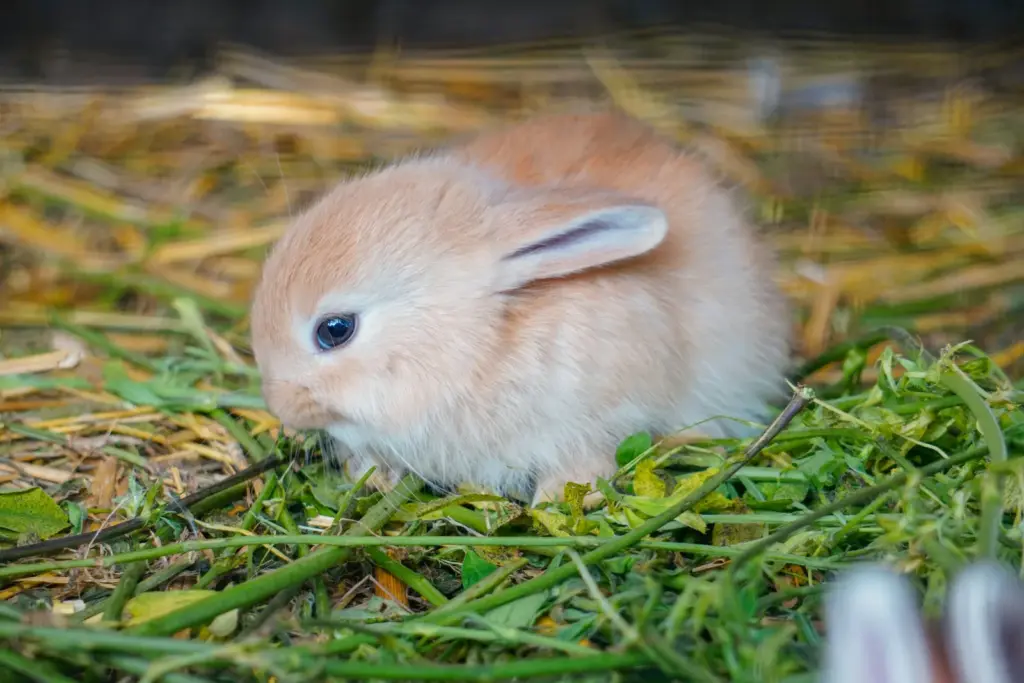
- Kit (birth to 4 months, human 0 to 12): nursing, then weaning at about 6 weeks, which the calculator sets at human age 3. The MSD Veterinary Manual says domestic kits are weaned at about 6 weeks, and commercial kits at 4 to 5.
- Adolescent (4 months to 1 year, human 12 to 21): the MSD manual puts sexual maturity at 3.5 to 4 months in small breeds, 4 to 4.5 in medium breeds and 6 to 9 in giant breeds. The House Rabbit Society says adolescence can begin as early as 3 months, especially in dwarf breeds, and that 5 to 6 months is more common.
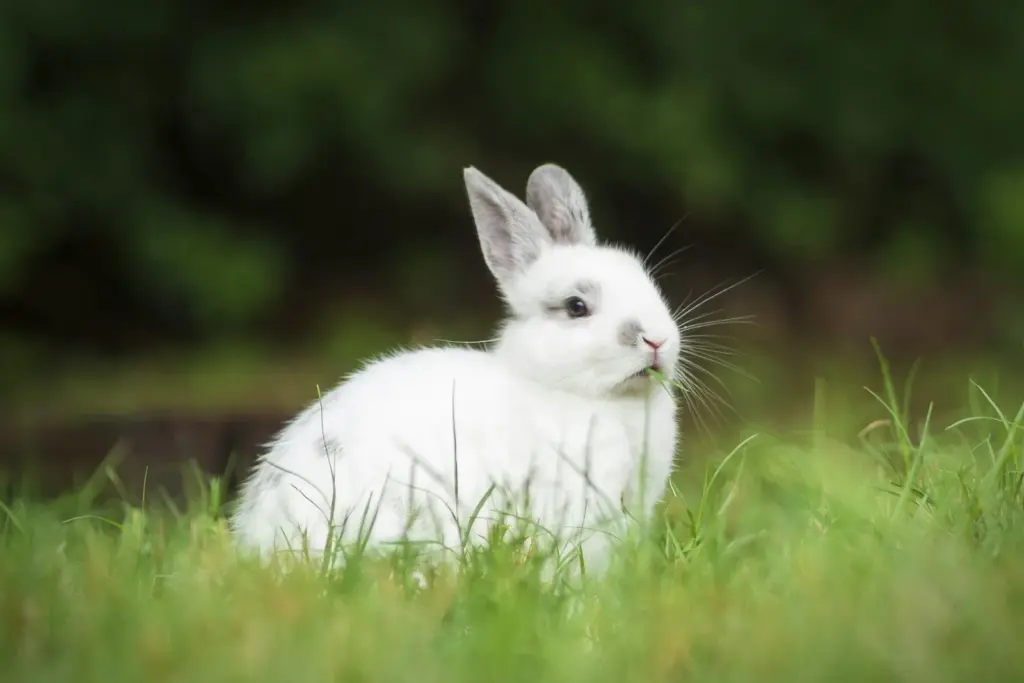
- Young adult (1 to 1.5 years, human 21 to about 25): the House Rabbit Society says rabbits generally move from adolescence to adulthood at about one year. Skeletal growth finishes earlier: in New Zealand Whites it was complete at 28 weeks, about 6.5 months, with the femur at 95% and the tibia at 94% of adult length by 16 weeks (Masoud et al. 1986).
- Adult (from 1.5 years, human 24 to 26): breed-care sources put full adult size at 14 to 18 months.
- Senior and geriatric: see the next section.
Giant breeds mature later. The MSD manual gives sexual maturity at 6 to 9 months for giants against 4 to 4.5 for medium breeds, and breed sites put full size near 18 months. The calculator uses a separate anchor set for them.
When is a rabbit a senior?
A rabbit is a senior from about 4 to 8 years, depending on size. RWAF and Petplan put small rabbits at 8 and over, medium rabbits at 6 and over and large and giant rabbits at 4 and over. The BSAVA client handout uses a single cut-off, calling any rabbit over 7 “older or geriatric”.
| Source | Small / dwarf | Medium | Large / giant |
|---|---|---|---|
| RWAF, Petplan | 8 and over | 6 and over | 4 and over |
| BSAVA client handout | Over 7 for every rabbit (“older or geriatric”) | ||
| This calculator (senior from) | 7.0 (dwarf), 6.7 (small) | 5.9 | 4.9 (large), 4.2 (giant) |
The calculator sets senior at 70% of the size class’s typical lifespan: 7.0 years for dwarf rabbits, 6.7 for small, 5.9 for medium, 4.9 for large and 4.2 for giant. That is about 1 year earlier than RWAF for dwarfs, matches medium and giant, and is about 1 year later for large breeds. No source separates senior from geriatric by age, so the geriatric boundary at 85% of the lifespan (8.5, 8.1, 7.2, 6.0 and 5.1 years) is the calculator’s own. In human terms senior begins between 57.0 and 59.7 for every size.
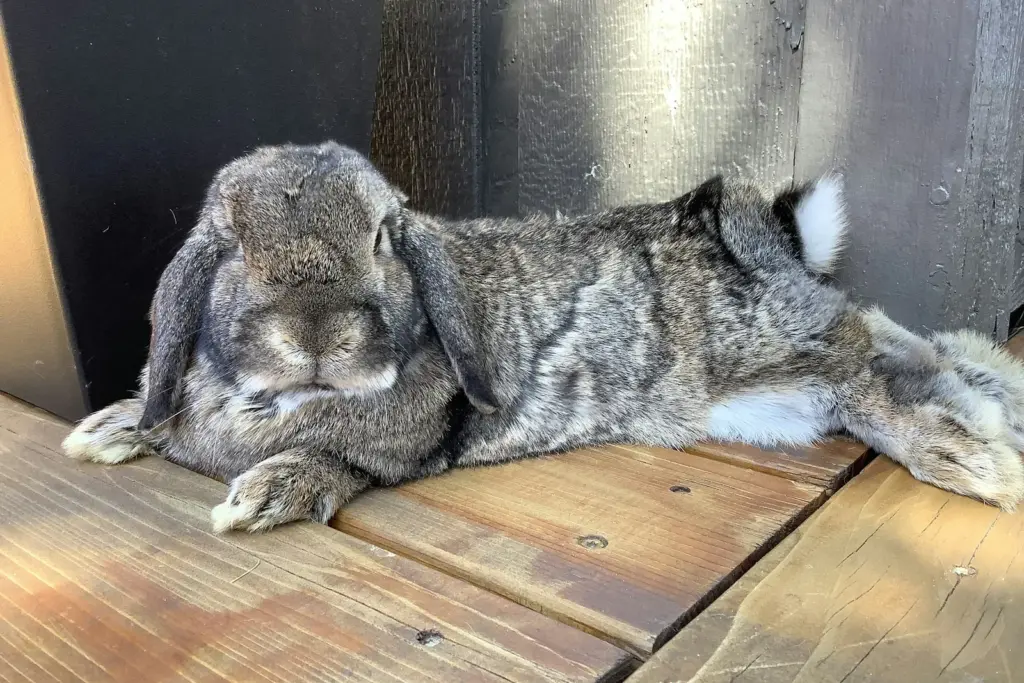
Lennox (2010) describes a screening age as well as a stage: twice-yearly examinations with bloodwork from age 5. Ask your vet when your rabbit should start senior check-ups. The senior age shown by the calculator is a prompt to book one.
Rabbit years vs the popular chart and “times 8”
One rabbit year is not 7 or 8 human years. At age 1 this calculator gives 21 for a small rabbit, the popular chart gives 20 and times 8 gives 8. The three agree on the first months and diverge from year 2.
| Rabbit age | This calculator (small rabbit) | Popular chart | Times 8 |
|---|---|---|---|
| 1 month | 2 | 3 | 0.7 |
| 3 months | 8 | 9 | 2 |
| 4 months | 12 | 12 | 2.7 |
| 6 months | 17 | 14 | 4 |
| 1 year | 21 | 20 | 8 |
| 2 years | 28 | 26 | 16 |
| 3 years | 35 | 32 | 24 |
| 5 years | 48 | 44 | 40 |
| 7 years | 62 | 56 | 56 |
| 10 years | 82 | 74 | 80 |
| 12 years | 92 | 86 | 96 |
The popular chart gives 3 human years for each rabbit month to 4 months (12 at 4 months), then 1 per month to 12 months (20 at 1 year), then 6 for every year after. The same table appears at The Bunny Lady (Amy Pratt) and Cottontail Club, and both say it has no scientific basis. No veterinary body publishes a rabbit age chart. The chart reaches 79 at about 10.8 years, close to the House Rabbit Society’s “around 10” for neutered indoor rabbits, which is why it became the default. The published table shows 66 at 9 years, a one-off break from its own rule, and the table above follows the stated rule.
This calculator is close to the chart in the first year: both give 12 at 4 months, and 21 against 20 at 1 year. After that the chart adds a flat 6 a year, and here the rate runs from 6.4 (dwarf) to 12.2 (giant) human years per rabbit year, because larger rabbits have shorter typical lifespans. A 10-year-old small rabbit is 81.6 here and 74 on the chart. A 5-year-old giant is 67 here and 44 on the chart.
Times 8 and times 7 are flat ratios. Times 8 appears on converter sites, and Calculator Academy gives times 7 and calls it an “entertainment convention”. Times 8 makes a 1-year-old rabbit 8 and a 2-year-old 16, when rabbits reach sexual maturity at 4 months. It overtakes this calculator for a small rabbit at 11 years (88 against 86.7) and reaches 96 at 12 years against 91.8.
How this calculator works
The calculator pairs four developmental milestones with human ages, then runs a straight line to the rabbit’s typical lifespan and slows down after it.
The model
- Fixed anchors. Birth is 0. At 1.5 months (weaning) a rabbit is 3 in human years. At 4 months, the sexual maturity of small and medium breeds, it is 12. At 6.5 months, when skeletal growth is complete in New Zealand Whites, it is 18, and at 12 months, the move from adolescence to adulthood, it is 21. Giant breeds use four anchors: 3 at 1.5 months, 12 at 7.5 months (the midpoint of 6 to 9) and 18 at 12 months. The rabbit ages come from sources. The human values are modelling choices.
- Linear to the typical lifespan. After the last anchor the scale is a straight line chosen so that the size class’s typical lifespan maps to 79, the 2024 US life expectancy at birth (CDC NCHS Data Brief 548). A dwarf rabbit gains 6.44 human years per rabbit year, a small rabbit 6.82, a medium rabbit 7.73, a large rabbit 9.67, a giant rabbit 12.20 and a mixed or unknown rabbit 7.25.
- A slower tail. Past the typical lifespan each rabbit year counts as 0.75 of an earlier one, which is 4.83 human years for a dwarf rabbit and 9.15 for a giant. The factor is a modelling choice, set so the dwarf class reaches the 122 cap at 18.9 years, the Guinness record. The cap ages are 18.9 (dwarf), 17.9 (small), 16.9 (mixed), 15.9 (medium), 12.9 (large) and 10.7 (giant).
- Size classes and breeds. A breed uses its size class’s typical lifespan: 10 years for dwarf, 9.5 for small, 8.5 for medium, 7 for large, 6 for giant and 9 for mixed or unknown. The mixed class sits between PDSA’s 7 to 10 and the House Rabbit Society’s 8 to 12, and the median adult weight of UK pet rabbits in the VetCompass data was 2.1 kg, a small rabbit.
The calculator does not use the UK median of 4.3 years as the lifespan. With it a 5-year-old rabbit would be about 85 in human years, and vet and charity sources call rabbits senior from 4 to 8 years.
Data
The anchors come from the MSD Veterinary Manual, Masoud et al. (1986) and the House Rabbit Society. The size classes follow the MSD weight classes with a dwarf split at 3.5 lb. The lifespans are a judgement between the cohort medians (UK 4.3 years, Tokyo 7) and the care-organisation figures (8 to 12 years, RWAF 12 to 13 for small, 9 to 10 for medium and 4 to 7 for large). For dwarf and small rabbits the calculator takes the care-organisation side over the breed-site tables. For large and giant rabbits both kinds of source agree, so the lifespan follows them. No source states 10, 9.5, 8.5, 7 or 6 as such.
Validation
- Human age never decreases as rabbit age rises. The check covered 102,013 pairs of profile and age, across the 6 size classes and all 49 breeds from 0 to 240 months in 0.1-month steps, with 0 violations.
- Converting a human age back to rabbit years returns the original age exactly. From a human age rounded to one decimal it returns it to within 0.0103 rabbit years.
- The dwarf cap age of 18.9 equals Flopsy’s age by construction, since the tail factor was set to match it. Herbie, a Lionhead, at 15.2 years reads 104.1.
- Senior ages sit 0.1 to 1.3 years from the RWAF and Petplan figures of 8, 6 and 4, and match BSAVA’s 7 for dwarf rabbits.
- A 10-year-old small rabbit is 81.6 here, 74 on the popular chart and 80 under times 8.
Limitations
- The typical lifespan is an estimate for a well-cared-for indoor, neutered rabbit, not a prognosis. The calculator describes how far along its expected life a rabbit is and does not predict how long an individual rabbit will live.
- No study measures lifespan by size, so the size gradient rests on care-organisation and breed-site statements. The gradient is steeper than the breed-site tables show and gentler than RWAF’s.
- The giant anchors (12 and 18 months) are not measured. No radiographic data exist for giant breeds.
- The pairings with human ages of 12, 21 and 18 are assumptions, and so is the geriatric boundary.
- The calculator does not take sex or neuter status as inputs, because no study measures the size of a neutering effect and the UK sex difference cannot be separated from early deaths.
- Unlike the dog years calculator, this one has no DNA-methylation comparison, because no formula for rabbits has been published.
- No measurement defines a rabbit’s “human age”. Every conversion, including this one, is a model.
Sources
- O’Neill DG, Craven HC, Brodbelt DC, Church DB, Hedley J (2020). Morbidity and mortality of domestic rabbits (Oryctolagus cuniculus) under primary veterinary care in England. Veterinary Record 186(14):451. doi:10.1136/vr.105592, PMC7279133
- Shiga T, Nakata M, Miwa Y (2022). Age at death and cause of death of pet rabbits seen at an exotic animal clinic in Tokyo, Japan: a retrospective study of 898 cases (2006-2020). Journal of Exotic Pet Medicine 43:35-39. Figures from the abstract and from Clinician’s Brief, Life expectancy of pet rabbits.
- Masoud I, Shapiro F, Kent R, Moses A (1986). A longitudinal study of the growth of the New Zealand white rabbit. Journal of Orthopaedic Research 4:221-231. doi:10.1002/jor.1100040211
- Lennox AM (2010). Care of the geriatric rabbit. Veterinary Clinics of North America: Exotic Animal Practice 13:123-133. doi:10.1016/j.cvex.2009.09.002
- MSD Veterinary Manual. Management of rabbits (weaning and sexual maturity) and Description and physical characteristics of rabbits (weight classes).
- House Rabbit Society. Rabbit lifespan and Espie A, Rebel with Paws (adolescence).
- Rabbit Welfare Association and Fund. Caring for senior rabbits.
- Petplan UK. How to care for an older rabbit. PetMD, How long do rabbits live? PDSA, How long do pets live? Woodgreen, How long do rabbits live? Omlet, Rabbit lifespans.
- BSAVA client handout on the older rabbit (Varga M, BSAVA Manual of Rabbit Medicine, 2013).
- The Bunny Lady. Rabbit years to human years, Rabbit life stages and Rabbit lifespan. Cottontail Club, rabbit age chart. Calculator Academy, Rabbit years to human years calculator.
- Guinness World Records. Oldest rabbit ever (Flopsy), Oldest living rabbit (Herbie) and Mick.
- ARBA. Recognized breeds (maximum weights).
- NCHS (2026). Mortality in the United States, 2024. Data Brief 548 (US life expectancy 79.0 years).
The size-class and breed lifespans, all conversions and the charts are florafaunafun.com calculations, and the original authors did not review or endorse them.
Frequently asked questions
How long do rabbits live?
A well-cared-for indoor pet rabbit lives 8 to 12 years, according to the House Rabbit Society, PetMD, Petplan, Omlet and Woodgreen, and PDSA says 7 to 10. Measured populations run lower: the median age at death is 4.3 years in UK vet practices and 7 years at a Tokyo referral clinic. Smaller rabbits live longer. This calculator uses 10 years for a dwarf rabbit and 6 for a giant breed.
How long do bunnies live indoors and outdoors?
A bunny kept indoors lives 8 to 12 years and a neutered indoor bunny lives around 10, according to the House Rabbit Society, which puts outdoor bunnies at 3 to 5 years. These are charity figures, not measured results, and the society says many bunnies reach 14 or 16. Clinician's Brief attributes the higher Tokyo median of 7 years, against England's 4.3, to housing or clinic type.
How old is a 1-year-old rabbit in human years?
A 1-year-old rabbit is about 21 in human years, and 18 for a giant breed. A 4-month-old is 12 and a 6-month-old is 16.8. Small and medium breeds reach sexual maturity at 3.5 to 4.5 months, which the calculator pairs with human age 12, and the move from adolescence to adulthood at about one year, which it pairs with 21.
How old is a 5-year-old or 10-year-old rabbit in human years?
A 5-year-old rabbit is 47 to 67 in human years and a 10-year-old is 79 to 116, depending on size. At 5 years a dwarf rabbit is 47, a small rabbit 48, a medium rabbit 52, a large rabbit 60 and a giant rabbit 67. At 10 years they are 79, 82, 88, 101 and 116. Each size's typical lifespan is set to 79 human years, so larger rabbits age faster per year.
Is 1 rabbit year 7 or 8 human years?
No. A 1-year-old rabbit is about 21 in human years, not 7 or 8. After year 1 each rabbit year adds 6.4 to 12.2 human years, depending on size. Times 8 gives 8 at 1 year and 16 at 2 years, where this calculator gives 27 to 31 at 2 years. For a small rabbit, times 8 catches up at 11 years, with 88 against 86.7.
When is a rabbit a senior?
A rabbit is a senior from about 4 to 8 years, depending on size. The Rabbit Welfare Association and Fund and Petplan put small rabbits at 8 and over, medium rabbits at 6 and over and large and giant rabbits at 4 and over, and BSAVA calls any rabbit over 7 "older or geriatric". The calculator uses 7.0 years for dwarf, 6.7 for small, 5.9 for medium, 4.9 for large and 4.2 for giant rabbits, about 57 to 60 in human years.
Why is the UK median age at death only 4.3 years?
Because 4.3 years is the median age of rabbits that died, not how long a cared-for rabbit lives. The VetCompass study of 6,349 rabbits counted the 370 that died in 2013, so every young death is in it and the living rabbits are not. Many deaths were early and preventable, with median ages of 1.7 years for myxomatosis, 2.0 for bite injuries and 5.4 for flystrike. About 34% of UK rabbits are not registered with a vet.
What is the oldest rabbit ever?
The oldest rabbit on record is Flopsy, who lived 18 years 10.75 months, according to Guinness World Records. She was caught wild in Tasmania on 6 August 1964, so her age at capture is unknown and 18.9 years is a minimum. The oldest living rabbit on 10 November 2025 was Herbie, a Lionhead in Surrey, at 15 years 82 days. Mick, in Illinois, was 16 in 2019.
Do small rabbits live longer than large ones?
Yes, according to every source that compares them, although no study has measured it. The Rabbit Welfare Association and Fund gives 12 to 13 years for small breeds, 9 to 10 for medium rabbits and 4 to 7 for large breeds, and Woodgreen says giants live shorter lives. This calculator uses 10 years for dwarf, 9.5 for small, 8.5 for medium, 7 for large and 6 for giant rabbits.
How accurate is a rabbit years calculator?
It is an estimate, because no one has measured a rabbit's human age. The early anchors come from sources: weaning at about 6 weeks, sexual maturity at 3.5 to 4.5 months in small and medium breeds, skeletal growth complete at 28 weeks in New Zealand Whites and adulthood at about one year. The later pace comes from a typical lifespan for a well-cared-for rabbit, a judgement between the Tokyo median of 7 years and the care-organisation range of 8 to 12. It is not a prognosis.