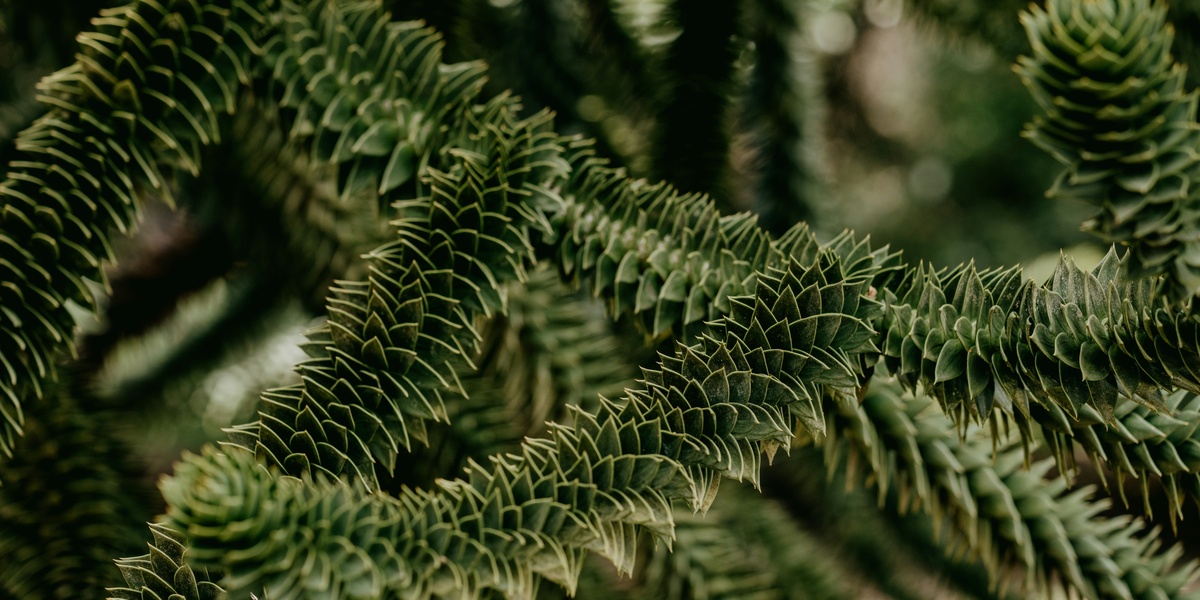
Chile’s varied landscape—from the Atacama in the north to the temperate forests of the south and the Andes in between—creates distinct habitats that support many tree species. Local climates, soil types and elevation shifts mean trees can look and behave very differently across short distances.
There are 30 Trees of Chile, ranging from Alerce to Ñire, chosen to illustrate that ecological range. For each species you’ll find below entries organized with Scientific name,Max height (m),Distribution (regions) — you’ll find below.
How are these species distributed across Chile’s regions?
Distribution reflects climate bands: northern species are adapted to aridity, central ones tolerate Mediterranean seasons, and southern species favor humid, cool forests; the table’s “Distribution (regions)” column shows where each tree typically occurs so you can see geographic patterns at a glance.
Are height and range enough to identify a tree in the field?
Height and distribution narrow possibilities but aren’t definitive; leaf shape, bark, fruit, and seasonal traits are often required for reliable ID, so use the table as a starting point and consult local field guides or experts for confirmation.
Trees of Chile
| Common name | Scientific name | Max height (m) | Distribution (regions) |
|---|---|---|---|
| Pehuén (Monkey puzzle) | Araucaria araucana | 40 | Central-southern Andes; Araucanía, Biobío |
| Alerce | Fitzroya cupressoides | 40 | Los Lagos to Aysén (temperate rainforests) |
| Ciprés de las Guaitecas | Pilgerodendron uviferum | 15 | Los Lagos to Magallanes coastal forests |
| Mañío | Saxegothaea conspicua | 20 | Los Ríos to Aysén (Valdivian forests) |
| Coihue | Nothofagus dombeyi | 50 | Valdivian forests, Los Ríos to Aysén |
| Roble | Nothofagus obliqua | 40 | Central-southern Chile, Maule to Los Ríos |
| Raulí | Nothofagus alpina | 45 | Maule to Los Ríos (moist forests) |
| Lenga | Nothofagus pumilio | 25 | Andes, Ñuble to Magallanes (treeline) |
| Ñire | Nothofagus antarctica | 10 | Patagonian steppe to Magallanes |
| Evergreen southern beech | Nothofagus betuloides | 20 | Chiloé to Magallanes (southern forests) |
| Ulmo | Eucryphia cordifolia | 30 | Los Ríos to Los Lagos (Valdivian forests) |
| Laurel | Laurelia sempervirens | 40 | Maule to Los Lagos (coastal, Valdivian forests) |
| Tepa | Laureliopsis philippiana | 25 | Los Ríos to Los Lagos (Valdivian mixed forests) |
| Olivillo | Aextoxicon punctatum | 20 | Coastal Valdivian forests, central-southern Chile |
| Arrayán | Luma apiculata | 15 | Riversides in Valdivian forests, Los Ríos to Los Lagos |
| Notro | Embothrium coccineum | 10 | Valdivian forests, central-southern Chile |
| Boldo | Peumus boldus | 10 | Coquimbo to Araucanía (central Chile) |
| Quillay | Quillaja saponaria | 20 | Coquimbo to Maule (central Chile) |
| Peumo | Cryptocarya alba | 15 | Coquimbo to O’Higgins (central Chile) |
| Chilean hazelnut | Gevuina avellana | 20 | Los Ríos to Los Lagos (Valdivian forests) |
| Chilean wine palm | Jubaea chilensis | 20 | Central Chile, relict populations (Coquimbo to O’Higgins) |
| Algarrobo | Prosopis chilensis | 12 | Semi-arid north-central to central Chile |
| Tamarugo | Prosopis tamarugo | 12 | Pampa del Tamarugal, Tarapacá (northern Atacama) |
| Maitén | Maytenus boaria | 15 | Coquimbo to Los Lagos (central-southern Chile) |
| Espino | Acacia caven | 6 | Central Chile dry valleys and shrublands |
| Molle | Schinus molle | 15 | Naturalized widely in central Chile, disturbed sites |
| Humboldt’s willow | Salix humboldtiana | 20 | Riparian zones throughout Chile |
| White poplar | Populus alba | 25 | Riparian and disturbed sites, central Chile (naturalized) |
| Blue gum eucalyptus | Eucalyptus globulus | 40 | Widespread plantations central-southern Chile (naturalized) |
| Monterey pine | Pinus radiata | 30 | Extensive plantations in central Chile (introduced) |
Images and Descriptions
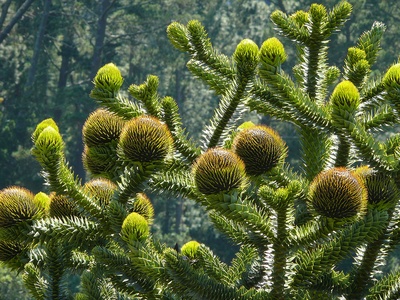
Pehuén (Monkey puzzle)
Iconic evergreen pehuén (monkey puzzle), endemic tree reaching around 40 m. Found on dry slopes of central-southern Andes in Araucanía and Biobío. Slow-growing with spiky, scale-like leaves; culturally sacred to Mapuche. Vulnerable due to logging and limited range.

Alerce
Alerce is a long-lived, endemic conifer that can reach massive sizes, typically around 40 m. Grows in temperate rainforests of Los Lagos to Aysén. Valued for durable timber; critically endangered from historical overharvest and slow recovery.
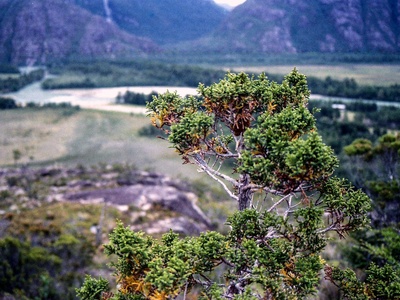
Ciprés de las Guaitecas
Ciprés de las Guaitecas, a slow-growing native cypress up to about 15 m, occupies peatlands and cold coastal forests from Los Lagos to Magallanes. Aromatic, rot-resistant wood was heavily logged; populations are protected but fragmented.
Mañío
Mañío is a slow-growing endemic conifer reaching about 20 m in cool, humid Valdivian forests from Los Ríos to Aysén. Notable for dark, glossy foliage and dense wood; locally rare and often part of old-growth stands.
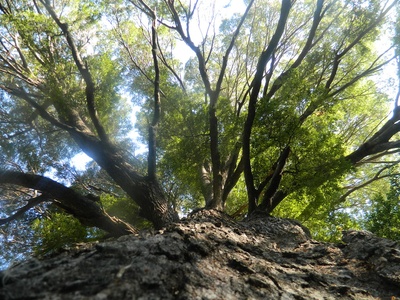
Coihue
Coihue is a large native beech often reaching 50 m in productive Valdivian forests from Los Ríos to Aysén. Fast-growing and important for timber, it forms dense canopy and supports diverse understory; not currently endangered.
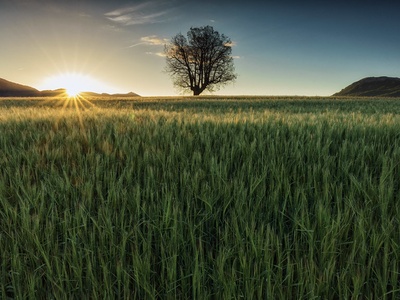
Roble
Roble or roble pellín is a deciduous native beech reaching about 40 m in central-southern Chilean forests. Valued timber species that tolerates drier sites than some beeches; fragmented by logging but still common in protected areas.
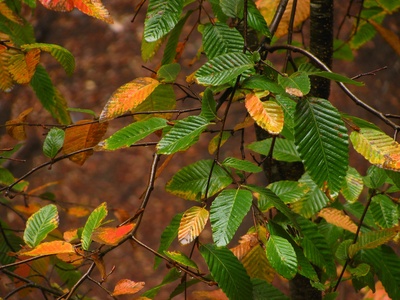
Raulí
Raulí is a tall native beech up to about 45 m, found in moist central-southern forests from Maule to Los Ríos. Known for straight trunks and quality timber; conservation concerns arise from past heavy logging.
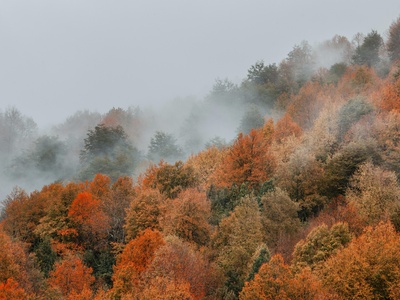
Lenga
Lenga is a cold-tolerant deciduous beech reaching around 25 m near the treeline in the Andes from Ñuble to Magallanes. Forms windswept forests at high elevations; important for soil protection and wildlife habitat.
Ñire
Ñire is a small, hardy deciduous beech usually under 10 m, common in Patagonian steppe and Magellanic shrublands. It tolerates cold and dry conditions and often forms krummholz near treeline; valuable for local firewood.
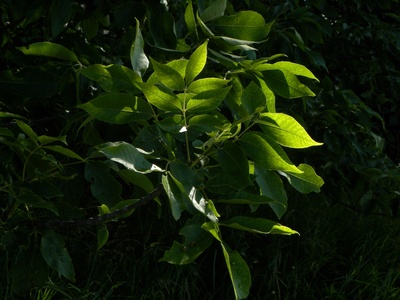
Evergreen southern beech
Evergreen southern beech is a coastal, evergreen Nothofagus up to about 20 m in southern forests from Chiloé to Magallanes. Glossy leaves and twisted trunks mark old individuals; important in subpolar rainforest ecosystems.
Ulmo
Ulmo is an attractive evergreen tree to about 30 m native to Valdivian rainforests. Its fragrant white flowers feed bees and produce prized ulmo honey; populations face local pressure from logging and land conversion.
Laurel
Laurel is a tall, aromatic native tree up to about 40 m in moist coastal and Valdivian forests. It has oily leaves and was overharvested for timber; surviving stands are protected and often in reserves.
Tepa
Tepa is a medium to tall native tree around 25 m, typical of Valdivian mixed forests. Its soft, aromatic wood and glossy leaves are notable; habitat loss has reduced some populations locally.
Olivillo
Olivillo is a distinctive evergreen native tree to about 20 m in coastal Valdivian forests. It has thick leaves and dense wood, often forming pure stands; conservation is stable in many protected areas.
Arrayán
Arrayán is a striking evergreen with cinnamon-colored peeling bark, usually reaching about 15 m along rivers in Valdivian forests. Native to southern Chile and Argentina, it forms scenic groves valued for beauty and local cultural uses.
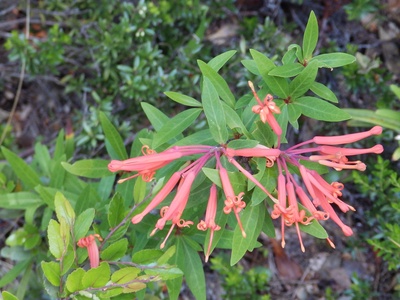
Notro
Notro is a colorful native shrub-tree to about 10 m with vibrant red flowers, common in Valdivian and Andean forests. Its blooms attract birds and insects; locally cultivated for ornament and valued in native ecosystems.
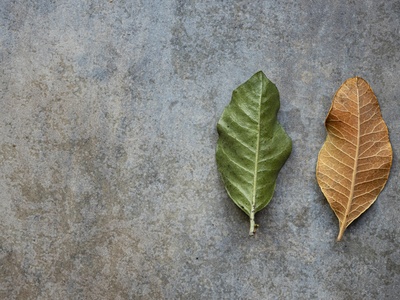
Boldo
Boldo is a small evergreen native tree to about 10 m in central Chile, known for aromatic leaves used medicinally. It grows on dry slopes and valley edges; wild populations persist though local harvesting occurs.
Quillay
Quillay is a hardy evergreen tree to about 20 m native to central Chile’s sclerophyllous forests. Its bark yields saponins used in medicine and industry; populations are resilient but face local pressure from overharvest and land clearing.
Peumo
Peumo is a broadleaf evergreen native to central Chile, reaching about 15 m in Mediterranean-type forests. Aromatic leaves and fleshy fruit support wildlife and traditional uses; populations are reduced by habitat loss but common in remnants.
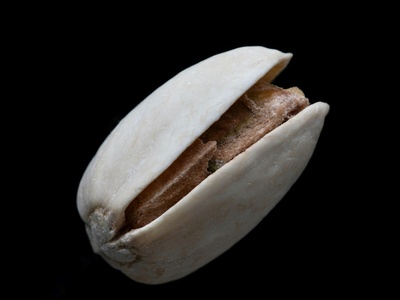
Chilean hazelnut
Chilean hazelnut is an evergreen native tree to about 20 m in Valdivian forests. It bears edible, oil-rich nuts and attractive flowers; historically harvested by people, it survives better in protected forests but faces pressure from land-use change.
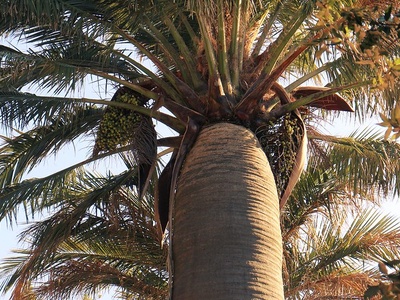
Chilean wine palm
Chilean wine palm is a slow-growing palm tree up to about 20 m, native to central Chile. It has massive trunk and edible seeds; historical exploitation and habitat loss have reduced wild populations to scattered, protected groves.
Algarrobo
Algarrobo is a hardy native leguminous tree to about 12 m common in semi-arid valleys and drylands of north‑central Chile. It fixes nitrogen, produces edible pods used as animal feed and traditional food; desertification and land use affect some populations.
Tamarugo
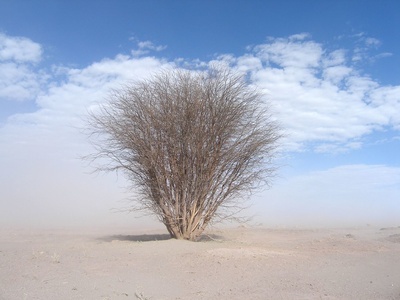
Tamarugo is a tree of the Atacama Desert reaching about 12 m, endemic to Pampa del Tamarugal in Tarapacá. Deep roots tap groundwater; heavily impacted by groundwater extraction and grazing, it is of conservation concern.
Maitén
Maitén is a hardy evergreen native tree to about 15 m in central and southern Chile, often on rocky slopes. Smooth bark and dense canopy; used ornamentally and for charcoal, with stable wild populations.
Espino
Espino is a thorny native small tree up to about 6 m common in dry central valleys. It has fragrant yellow flowers and pods eaten by livestock; important for soil stabilization but declining in some areas from land conversion.
Molle
Molle is an introduced Peruvian pepper tree reaching about 15 m, now naturalized in central Chile. It has feathery foliage and berry-like drupes used as spice; can form dense stands and is considered invasive locally.
Humboldt’s willow
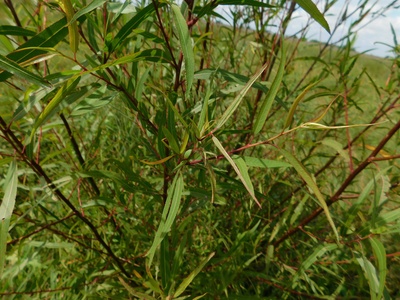
Humboldt’s willow is a widespread native willow up to 20 m along riversides throughout Chile. Rapid-growing, it stabilizes banks and is used for shade and wood; tolerant of flooding and commonly forms riparian forests from north to south.
White poplar
White poplar is an introduced poplar reaching about 25 m, naturalized along rivers and disturbed sites in central Chile. Fast-growing and widely planted for shelter belts; can spread from plantations and alter riparian plant communities.
Blue gum eucalyptus
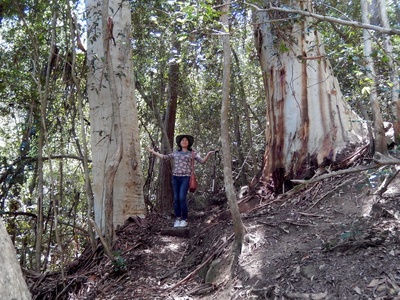
Blue gum eucalyptus is a tall introduced tree commonly planted for timber and pulp, reaching about 40 m in Chile. Widespread plantations dominate parts of central-southern landscapes and can reduce native biodiversity where they replace native forest.
Monterey pine
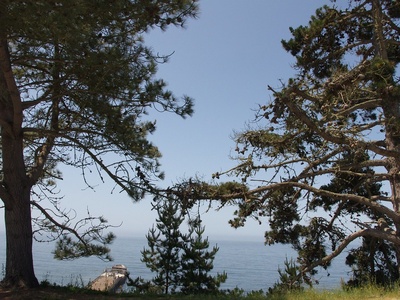
Monterey pine is an introduced commercial tree reaching around 30 m, extensively planted in central Chile for timber. It supports a large forestry industry but can naturalize and compete with native vegetation in some areas.