Mali doesn’t touch an ocean. Not even close — it’s a landlocked country where the nearest saltwater is a thousand kilometers away. So every fish here is a freshwater fish, and almost all of them owe their existence to one thing: the Niger River, which loops up through the country in a giant arc before bending back south.
That single river feeds a fishery that supplies roughly 60% of the animal protein Malians eat. So these aren’t obscure aquarium curiosities. They’re dinner, livelihood, and in one famous case, a fish that can knock you off your feet with an electric shock.
Here are 14 fish that actually live in Mali’s waters, what makes each one worth knowing, and which ones are quietly disappearing.
Table of Contents
- The quick list
- 1. Mali Electric Catfish
- 2. Nile Perch (the “Capitaine”)
- 3. Nile Tilapia
- 4. North African Catfish
- 5. African Arowana
- 6. African Bonytongue’s cousin: the Heterotis
- 7. Tigerfish
- 8. Elephantnose Fish
- 9. Nile Bichir
- 10. Vundu Catfish
- 11. African Knifefish
- 12. Niger Barb
- 13. Redbelly Tilapia
- 14. African Lungfish
- Fish as food and the pressure on the Niger
The quick list
If you only remember a handful: the Mali electric catfish (Malapterurus minjiriya) is the headline act — it delivers a genuine electric jolt. The Nile perch (“capitaine”) is the giant everyone fishes for. Nile tilapia and the North African catfish are the protein workhorses that feed the country. And the African arowana is the prehistoric-looking surface hunter that aquarists travel for.
Below, all 14 in detail.
1. Mali Electric Catfish (Malapterurus minjiriya)
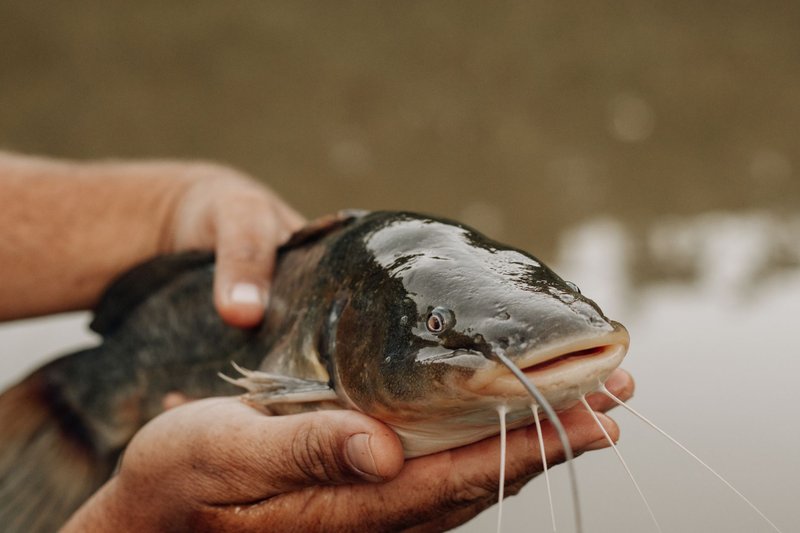
Start with the one that bites back. The electric catfish generates a charge from specialized muscle tissue that runs nearly the length of its body, and it uses that charge twice: to stun the small fish it eats and to discourage anything that tries to eat it. A jolt from a large individual can reach a few hundred volts — enough to make a fisherman drop the net and reconsider his life choices.
It’s a thick, sausage-shaped fish with tiny eyes, no dorsal fin to speak of, and a sluggish, nocturnal habit. During the day it tucks into hollows and undercut banks along the Niger. It’s not a fish you target on purpose; it’s the surprise at the bottom of the haul. Among the electric catfishes of West Africa, the Niger basin species is the one most associated with Mali’s stretch of river.
2. Nile Perch — the “Capitaine” (Lates niloticus)
The capitaine is the prize. It’s the largest fish you’ll pull from the Niger — individuals can exceed 100 kg and 1.8 meters, though the monsters are rarer now than they used to be. It’s a silvery, deep-bodied predator with a protruding lower jaw and a distinctive black-rimmed eye, and it eats whatever fits in its mouth, including its own kind.
In Mali’s markets, “capitaine” fillets command a premium. The flesh is white, firm, and nearly boneless — the reason it gets exported and the reason it’s been fished hard. The same species, introduced to Lake Victoria decades ago, became a notorious invader that collapsed native cichlid populations there. In its actual home range, the Niger included, it’s simply the apex of the river.
3. Nile Tilapia (Oreochromis niloticus)
This is the fish that feeds people. Nile tilapia is the backbone of both wild catch and the small but growing aquaculture sector in Mali, and you’ll see it grilled whole at roadside stalls across the country. It’s a hardy, fast-growing cichlid that tolerates warm, low-oxygen, even slightly murky water — exactly the conditions a seasonal river delivers.
Adults are olive-grey with faint vertical bars and a fondness for shallow, vegetated margins where they mouth-brood their young. The same toughness that makes them perfect for farming also makes them a survivor in a river system that swings hard between flood and dry season. The Food and Agriculture Organization tracks Nile tilapia as one of the most farmed finfish on the planet, and West Africa is squarely inside its native range.
4. North African Catfish (Clarias gariepinus)
The sharptooth, or North African catfish, is the other great protein staple — and one of the most absurdly tough fish alive. It has an accessory air-breathing organ that lets it gulp atmospheric oxygen, so it survives in puddles, mud, and water that would suffocate almost anything else. When the dry season shrinks the Niger’s backwaters, Clarias is often the last fish standing.
It’s a long, flattened-headed catfish with long barbels, and it’ll eat nearly anything: insects, smaller fish, plant matter, scraps. That omnivory plus the air-breathing makes it a dream for fish farmers, who raise it in ponds across the Sahel. In the wild it’s been recorded crossing wet ground between pools, which is exactly as unsettling as it sounds.
5. African Arowana (Heterotis niloticus)
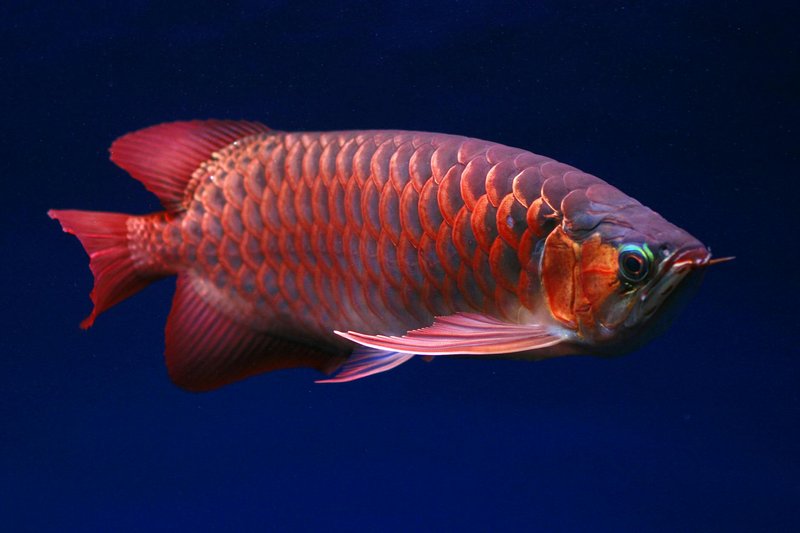
The African arowana looks like it swam in from the dinosaur era — long, scaled body, upturned mouth, and an elongated profile built for cruising just under the surface. Despite the predatory looks, it’s mostly a filter-feeder, straining plankton and small invertebrates through a specialized organ in its throat. It builds a circular floating nest in the floodplain and guards the fry, which is unusual behavior for a fish this size.
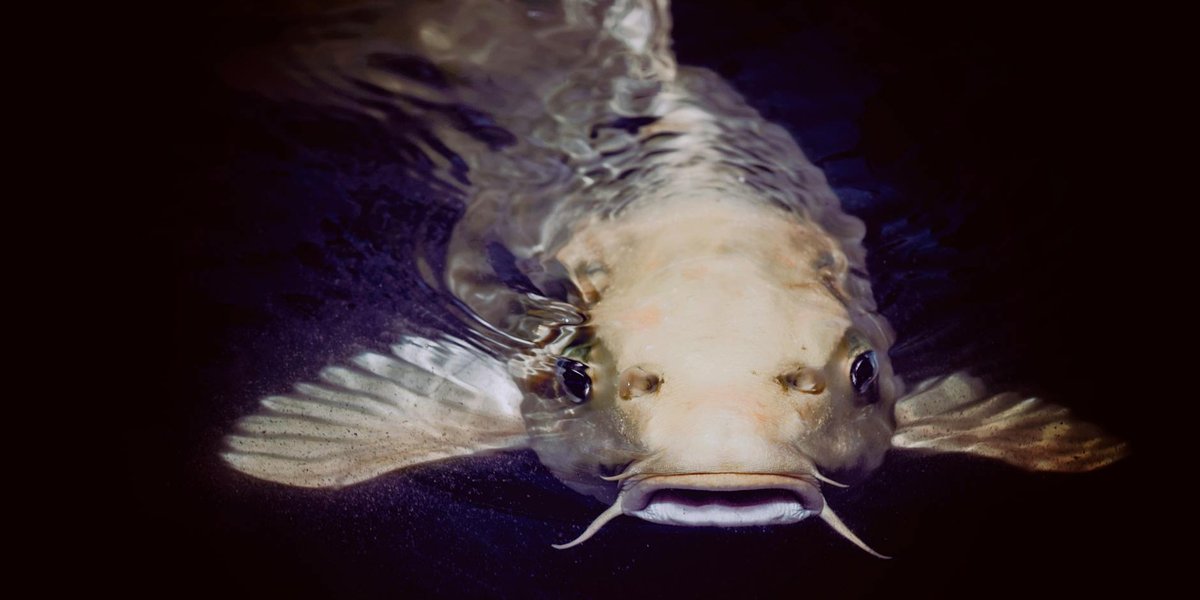
It’s prized both as food and, in the aquarium trade, as a striking Niger-biotope centerpiece. Anyone building a West African tank tends to put this fish near the top of the wishlist, the same way pond keepers obsess over the color, pattern, and body traits that define a prize koi.
6. African Bonytongue (Gymnarchus niloticus)
Not to be confused with the arowana, the African bonytongue — locally part of the “knifefish” group — is an eel-like predator that swims forward and backward with equal ease using a single long fin running down its back. It generates a weak electric field to navigate and hunt in murky water, the same sensory trick the elephantnose uses.
It can reach over a meter and a half, and in the Niger’s turbid channels it’s an effective ambush hunter. It’s also a fish that builds large floating nests, making it one of the more conspicuous breeders in the floodplain.
7. Tigerfish (Hydrocynus species)
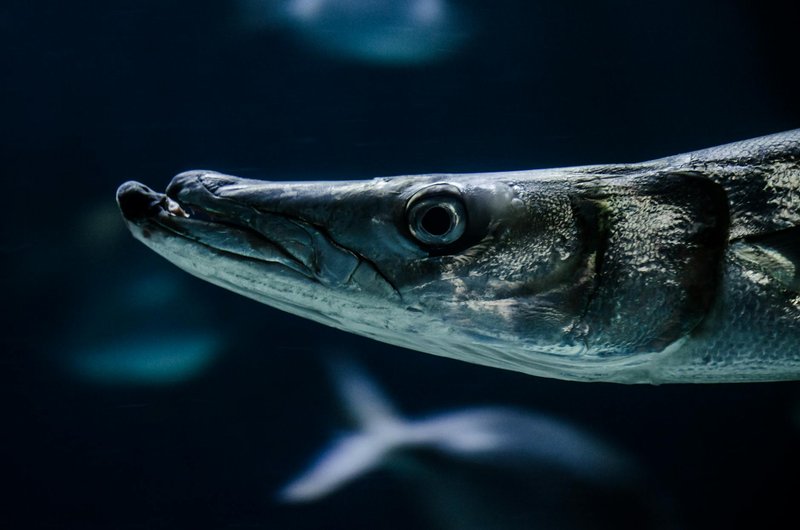
The tigerfish earns its name with a mouthful of interlocking, dagger-like teeth that close like a bear trap — the kind of specialized dentition that shows up again and again in the defining traits of dedicated meat-eaters. It’s a fast, silver, torpedo-shaped predator that hunts in the open channels of the Niger, and the larger Hydrocynus species are among the most aggressive freshwater fish in Africa. Anglers chase them for the strike alone.
Several tigerfish species occur across West African river systems, and the Niger basin hosts them at the smaller-to-mid end of the genus. Where they’re present, they’re the streamlined terror of the bait-fish schools.
8. Elephantnose Fish (Mormyrus and relatives)
The elephantnose is the oddball of the bunch — a fish with a trunk-like extension of its lower jaw that it uses to probe the muddy bottom for insect larvae. Like the bonytongue, it generates and reads weak electric fields, and it has one of the largest brain-to-body ratios of any fish, much of it devoted to processing those electrical signals.
The mormyrid family is well represented in the Niger, and these fish are a favorite in the aquarium hobby for their alien looks and genuinely curious behavior. They need clean, well-oxygenated water, which makes them a decent indicator of river health.
9. Nile Bichir (Polypterus bichir)
The bichir is a living fossil — an armored, snake-bodied fish with a row of individual finlets along its back and a pair of lungs that let it breathe air. The lineage goes back hundreds of millions of years, and looking at one, you believe it. It hunts at night along the bottom, taking smaller fish and invertebrates.
In Mali’s waters it sticks to slow, vegetated margins. In the aquarium trade it’s a sought-after oddity precisely because it looks like something that should have gone extinct with the trilobites.
10. Vundu Catfish (Heterobranchus species)
The vundu is the heavyweight catfish of the Niger — a relative of the North African catfish that grows even larger, sometimes exceeding 30 kg. It shares the air-breathing trick, which lets it dominate the deeper, low-oxygen pools that other big fish avoid. It’s a nocturnal predator and scavenger that takes fish, frogs, and anything organic it finds.
For Malian fishers, a vundu is a serious haul. For the river, it’s one of the larger native predators still hanging on in the deeper channels.
11. African Knifefish (Xenomystus nigri)
The African knifefish is a slim, dark, bottom-dwelling fish with a long anal fin that runs the underside of its body — the “knife” it’s named for. It moves in graceful, undulating waves and can produce sounds, gulping air at the surface to make a faint bark. It’s nocturnal and shy, sheltering among roots and submerged wood during the day.
It’s modest in size compared to the giants on this list, but it’s a fixture of the quieter, vegetated stretches of West African rivers and a staple of Niger-biotope aquariums.
12. Niger Barb (Labeo and Barbus relatives)
Not every Mali fish is a giant or a predator. The barbs and Labeo species are the mid-sized, schooling grazers that fill the middle of the food web — feeding on algae, detritus, and small invertebrates, and in turn feeding the perch and tigerfish above them. They’re the unglamorous engine of the river’s ecology.
In the markets they show up as smaller, smoke-dried catch, an important and cheap protein source in inland communities far from the main fishing centers.
13. Redbelly Tilapia (Coptodon zillii)
A second tilapia worth its own entry. The redbelly is more of a vegetarian than the Nile tilapia — it grazes hard on aquatic plants and algae, to the point that it’s been used elsewhere for weed control. It’s smaller, scrappier, and tolerant of a wide range of conditions, which is why it shows up throughout the Niger’s shallows and floodplain pools.
It’s a common catch and a common sight, the kind of everyday fish that doesn’t make headlines but quietly makes up a chunk of the daily haul.
14. West African Lungfish (Protopterus annectens)
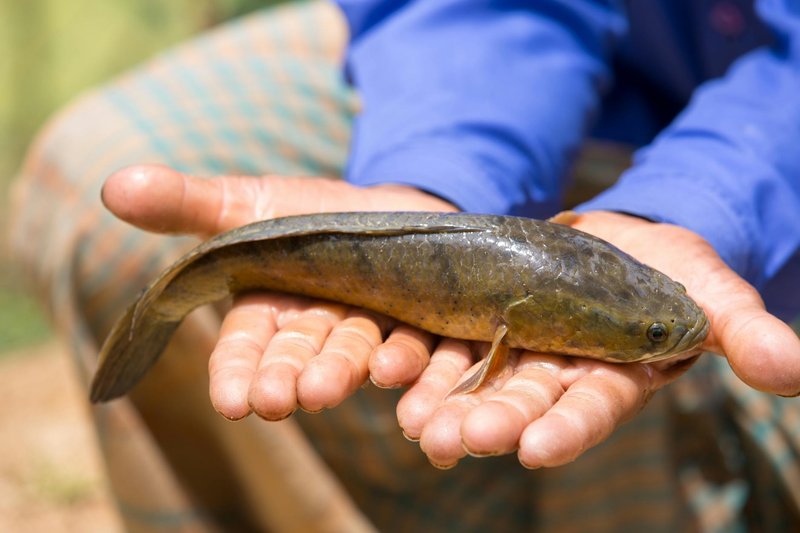
End with the survivor. The West African lungfish has true lungs and can survive when its pool dries up completely — it burrows into the mud, secretes a mucus cocoon, and goes dormant for months, sometimes years, breathing air through a small breathing hole until the rains return. Dig one up in the dry season and it’ll be there, waiting.
It’s eel-like, with thread-thin paired fins, and it’s an obligate air-breather as an adult — it will actually drown if denied access to the surface. In the seasonal floodplains of the Niger, that adaptation is the difference between life and a dry grave. It’s hard to think of a fish more perfectly built for a country where the water vanishes for half the year.
Fish as food and the pressure on the Niger
Strip away the curiosities and one fact remains: fish is how Mali eats. Inland fisheries supply the bulk of the country’s animal protein, and the Inner Niger Delta — the vast seasonal floodplain in central Mali — is one of West Africa’s most productive fishing grounds, supporting hundreds of thousands of people.
That productivity is under strain. Overfishing has thinned out the big capitaine and vundu, the kind of large, slow-growing fish that vanish first under pressure. Upstream dams and irrigation reduce the flood pulse that the whole system depends on — many of these species spawn on the rising water, so a weaker flood means fewer fish. And the Sahel is warming and drying, shrinking the very floodplains that the lungfish, catfish, and tilapia rely on. The IUCN tracks the status of West African freshwater fish, and the trend lines for the larger species are not reassuring.
The fish on this list aren’t just a biodiversity inventory. They’re a working river — one that feeds a nation, hides an electric ambush predator in its hollows, and shelters a lungfish that can sleep through a drought. Knowing them is the first step to noticing when they start to disappear.