Drop your face into the water off almost any Caribbean reef and within thirty seconds something blue and yellow will swim past you like it owns the place. That’s probably a blue tang, and you’ll see hundreds of them. The trick to enjoying a reef isn’t memorizing 450 species — it’s recognizing the dozen you’ll actually meet, plus knowing the two or three you should keep your hands off.
This guide organizes Caribbean fish the way your eyes sort them underwater: by shape, color, and movement, not by taxonomy. No one floating above a reef thinks “ah, family Pomacanthidae.” They think “big flat oval, electric blue lines.” So that’s how we’ll do it.
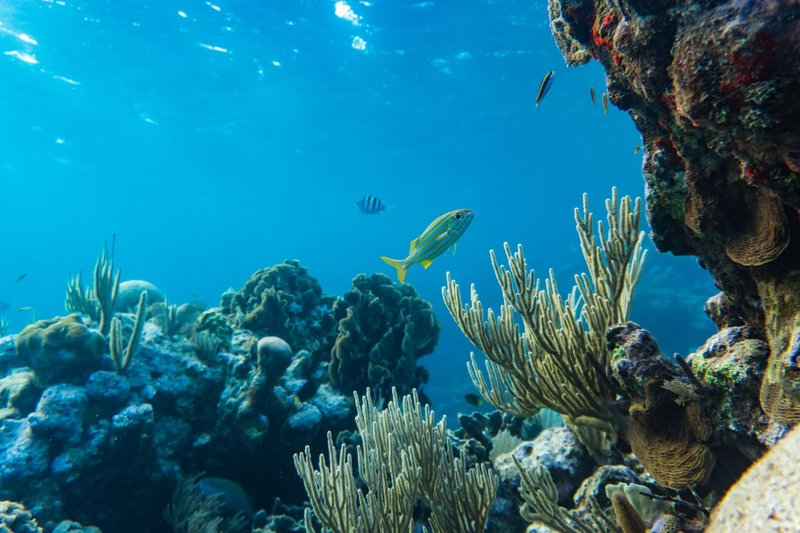
Table of Contents
- The fish you’ll definitely see
- Oval and disk-shaped reef fish
- The silvery schoolers
- Eels and bottom dwellers
- Sharks and rays
- The oddballs
- Dangerous fish: what to never touch
- Snorkeling vs. diving: what changes
- Best islands for reef fish
The fish you’ll definitely see
Short on time? If you snorkel a healthy Caribbean reef for twenty minutes, these five show up on nearly every trip. Learn them first and you’ll already feel fluent.
- Blue tang — flat blue oval, often in roaming herds that graze algae together
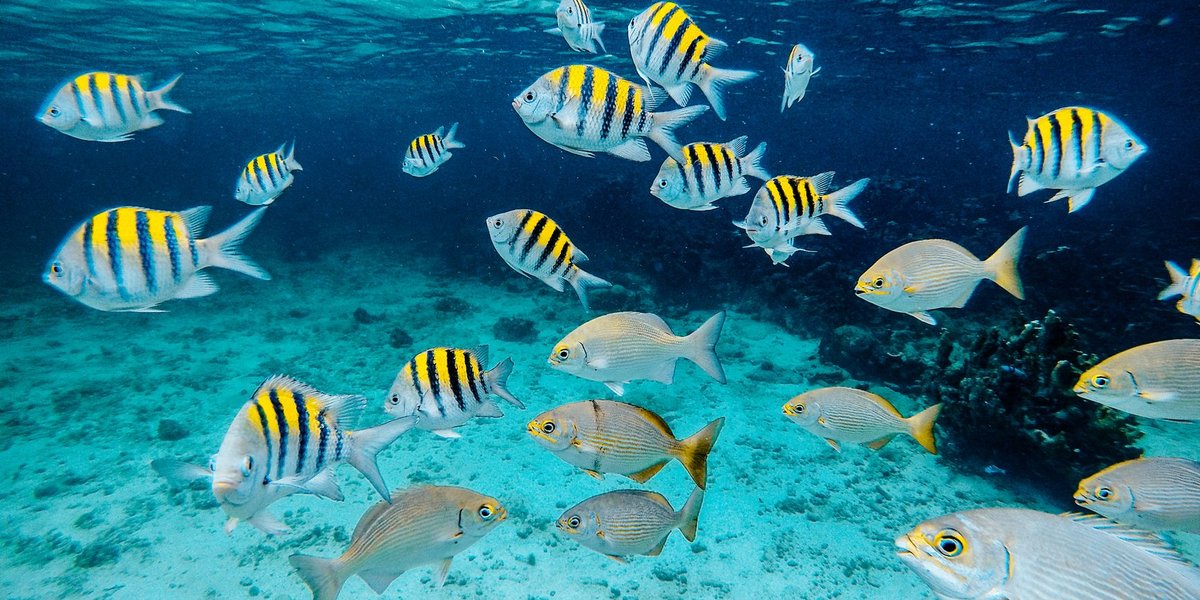
- Sergeant major — silver-yellow with five bold black bars, the bossy little fish that follows you
- Stoplight parrotfish — green-and-pink, crunching coral loud enough to hear
- French grunt — yellow with blue horizontal stripes, hanging motionless under ledges by the hundreds
- Yellowtail snapper — silver torpedo with a bright yellow stripe and forked yellow tail, cruising mid-water
Everything else in this guide is a bonus sighting. These five are the reef’s regulars.
Oval and disk-shaped reef fish
These are the classic reef fish — tall, flat from the side, built to turn on a dime in tight coral. This is where the Caribbean shows off its color.
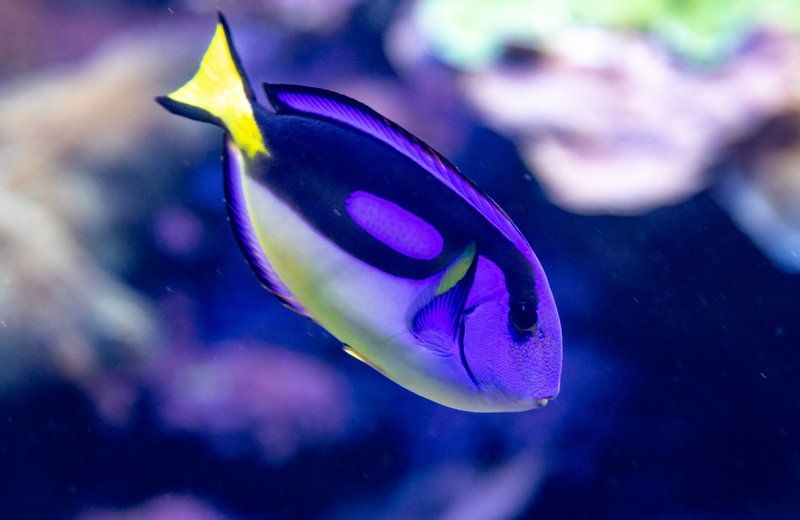
Blue tang (Acanthurus coeruleus) — Up to about 15 inches. Deep royal blue with fine wavy lines and a yellow scalpel-like spine near the tail (which is exactly why you don’t grab one). Juveniles are bright yellow, which throws people off — same fish, completely different paint job.
Queen angelfish (Holacanthus ciliaris) — Around 14 inches and unmistakable: electric blue and yellow with a dark blue “crown” spot ringed in bright blue on the forehead. Shy, usually solo or in pairs, ducking around coral heads. Spotting one feels like the reef gave you a gift.
French angelfish (Pomacanthus paru) — Roughly 15 inches, black body with every scale rimmed in bright yellow, so it looks scaled in gold flecks. Often swims in bonded pairs that stay close for life. Curious and not especially shy — they’ll sometimes approach divers.
Foureye butterflyfish (Chaetodon capistratus) — Small, about 6 inches, pale with a big dark eyespot near the tail. The fake eye is the whole strategy: a predator strikes at the wrong end, the fish darts the other way. You’ll usually see them paired up.
Stoplight parrotfish (Sparisoma viride) — Up to 24 inches. The terminal-phase male is the show-stopper: green body, pink and orange streaks around the face, a yellow spot at the tail base. Parrotfish are coral’s lawnmowers, scraping algae and biting coral with a beak. One parrotfish can produce hundreds of pounds of fine white sand a year — that postcard beach is partly fish digestion, and once you know it you can’t unknow it.
The silvery schoolers
These move in numbers. Individually plain, collectively mesmerizing — a wall of silver that opens around you and closes behind you.
Blue-striped grunt (Haemulon sciurus) — About 12 inches, yellow body with blue horizontal stripes. Named for the grunting sound they make by grinding their throat teeth, amplified by the swim bladder. They hover in huge stationary clouds under ledges during the day and spread out to feed at night.
Yellowtail snapper (Ocyurus chrysurus) — Up to 30 inches but usually smaller on the reef. Silver-blue body, a bright yellow midline stripe, and that signature forked yellow tail. They cruise higher in the water column than most reef fish, so they’re often the first thing you notice.
Bermuda chub (Kyphosus sectatrix) — Around 12 inches, plain gray-silver oval. Easy to overlook, but they roll through in fast loose schools and will sometimes circle a snorkeler out of curiosity.
Atlantic spadefish (Chaetodipterus faber) — Up to 3 feet, tall and disk-shaped, silver with vertical black bars that fade as they age. They form tight, slow-rotating schools that look almost choreographed.
Eels and bottom dwellers
Look down and into holes — this crowd hides in plain sight.
Green moray eel (Gymnothorax funebris) — Up to 8 feet, though 4 to 6 is typical. Often poking out of a crevice with its mouth opening and closing, which looks menacing but is just how it breathes — it’s pushing water over its gills, not threatening you. The skin is actually brown; the green comes from a yellow mucus coating. They only bite when cornered or hand-fed, so don’t reach into holes.
Spotted moray (Gymnothorax moringa) — Smaller, around 2 to 3 feet, cream-colored with dense dark speckling. Same rule: admire, don’t touch.
Yellowhead jawfish (Opistognathus aurifrons) — A 4-inch oddity that hovers vertically above a burrow it built grain by grain, and vanishes tail-first the instant you get close. Males brood eggs in their mouths. Worth slowing down for over sandy patches.
Peacock flounder (Bothus lunatus) — A flatfish, up to 18 inches, lying on the sand with both eyes on top of its head. It changes color and pattern to match the bottom in seconds. You’ll often spot one only when it moves — then it melts back into the sand and disappears.
Sharks and rays
The big stuff. Almost everything you’ll encounter here is harmless to a respectful swimmer.
Nurse shark (Ginglymostoma cirrostomum) — Up to 10 feet, brownish, with two barbels by its mouth like a catfish. They spend the day resting motionless under ledges and are about as aggressive as a sleeping dog — until someone grabs a tail. Per the Florida Museum’s International Shark Attack File, nurse sharks account for a small number of bites, nearly all provoked. Look, don’t poke.
Southern stingray (Hypanus americanus) — A wide diamond up to 5 feet across, gliding over sand or half-buried with just its eyes showing. The barbed spine at the tail base is purely defensive. The shuffle-your-feet advice in shallow sand is real — it nudges a buried ray awake so it swims off instead of getting stepped on.
Spotted eagle ray (Aetobatus narinari) — Up to 10 feet across, dark with white spots and a long whip tail, often “flying” in open water near reef edges. One of the genuine highlights of any Caribbean dive. They keep their distance, so just hover and watch.
Caribbean reef shark (Carcharhinus perezi) — The classic gray shark of the region, up to 10 feet, usually seen on deeper dives at sites like the walls of the Bahamas or Roatán. Generally indifferent to divers. Encounters are calm unless food is in the water. The same wall-and-deep-water profile shapes the cast in nearby waters too — Dominica’s reef, river, and offshore species skew toward the same big-blue setting, since its coast drops off almost immediately into the deep.
The oddballs
The reef’s weirdos — the fish that don’t fit any neat category and are usually the most fun to find.
Smooth trunkfish (Lactophrys triqueter) — A 12-inch fish shaped like a boxy little tank, dark with white spots, rigid because its body is fused into a bony shell. It swims with frantic fin-flapping that looks comically inefficient. Blows jets of water at the sand to expose buried prey.
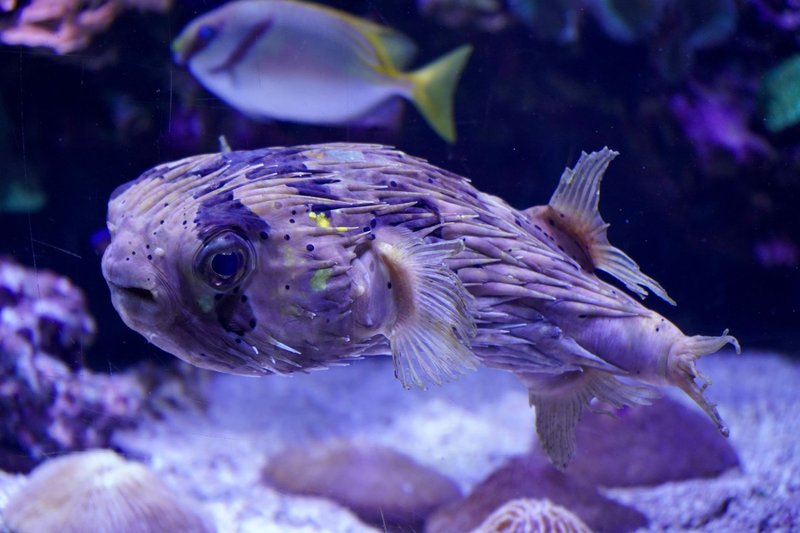
Porcupinefish (Diodon hystrix) — Up to 3 feet, big-eyed and goofy, covered in spines that lie flat until it inflates into a spiked balloon. Don’t ever provoke that response — inflating stresses the fish badly. Just appreciate the resting form, which already looks like a cartoon.
Trumpetfish (Aulostomus maculatus) — A long thin tube up to 3 feet, which hangs motionless head-down among sea rods and gorgonians, pretending to be one of them. It’ll even shadow a larger fish to sneak up on prey. Spotting one is a small victory because they’re built to be missed.
Flamingo tongue snail — Not a fish, but you’ll ask. It’s a small snail on sea fans with a vivid leopard-spotted mantle. The spots are soft tissue it can retract, leaving a plain white shell. People pocket the shells and are always disappointed — the color was never in the shell.
Dangerous fish: what to never touch
Most of what scares snorkelers is harmless, and a few harmless-looking things can actually hurt you. Here’s the honest list.
Lionfish (Pterois volitans) — The one that genuinely doesn’t belong. Striking red-and-white striped fins fanned out like a feather headdress, up to about 15 inches. It’s an invasive species in the Caribbean with venomous spines that deliver a sting comparable to a bad wasp — painful, rarely dangerous, but a hospital trip if you’re allergic. They hover calmly and don’t flee, which tempts people to get close. Don’t. According to NOAA, lionfish have spread across the entire region with no natural predators, which is why so many dive operations now run culling programs. They’re far from the only newcomer reshaping island ecosystems either — the invasive species cataloged in Saint Lucia show how widely the same problem reaches across the region, on land and in the water.
Scorpionfish — Venomous spines and master camouflage, sitting on the bottom looking exactly like a lumpy rock. The danger is stepping or leaning on one you never saw. Keep your hands and knees off the reef and you’ll never have a problem.
Barracuda (Sphyraena barracuda) — Up to 6 feet, silver with a mouthful of teeth, often hanging motionless and staring. Looks intimidating, basically isn’t — they’re curious, not aggressive, and bites are vanishingly rare and usually tied to shiny jewelry that flashes like a baitfish. Leave the dangly silver bracelet on the boat.
Moray eels — Covered above. The bite risk is entirely about hands in holes. Keep them out.
The real takeaway: nothing on a Caribbean reef wants to hurt you. Injuries come from touching, grabbing, feeding, or stepping. Float, keep your hands to yourself, and the reef stays harmless.
Snorkeling vs. diving: what changes
From the surface with a mask, you’ll see the whole shallow cast: tangs, parrotfish, grunts, sergeant majors, the occasional ray over sand. Reef tops in 5 to 20 feet of water are dense with life and brilliantly lit, so snorkeling is far from a consolation prize.
Diving buys you depth and the timid stuff. Eels deep in crevices, larger groupers, reef sharks cruising walls, and the cleaner color that comes from being close instead of looking down through ten feet of water. Anything past about 30 feet is dive territory. But for sheer fish count per minute, a sunny shallow reef at midday is hard to beat either way.
Best islands for reef fish
A few standouts for putting this guide to use:
- Bonaire — A protected marine park with shore diving you can walk into; arguably the most fish-dense easy access in the Caribbean.
- Cozumel, Mexico — Drift dives along healthy reefs, big on eagle rays, splendid toadfish (found nowhere else), and parrotfish.
- Roatán, Honduras — Part of the second-largest reef system on earth, with steep walls and reliable reef sharks. The Mesoamerican Reef it belongs to is profiled by National Geographic as one of the most biodiverse marine regions in the hemisphere.
- Grand Cayman — Stingray City, where southern stingrays gather in waist-deep sand, plus excellent wall diving.
- The Bahamas — Shark and ray encounters on the bank edges, clear water, easy shallow reefs for snorkelers. On a no-dive day, the islands reward a look upward too — the native plants of the Bahamas are as distinctive above the waterline as the reefs are below it.
Pick any of them, learn the five fish from the top of this guide, and you’ll spend less time wondering what you’re looking at and more time just watching. That’s the whole point — the reef gets better the more of it you can name.