Most “forest animals” lists give you the same cast: deer, bear, fox, owl, repeat. Useful if you’re six. Less useful if you already know a raccoon when you see one.
This list goes after the strange ones — the animals doing something genuinely odd to survive under the trees. A monkey loud enough to hear three miles off. A frog you can read a newspaper through. A weasel that hunts one of the few animals covered in spikes, and wins. And it spans real forest types, not just the rainforest everyone defaults to. Tropical canopy, temperate woodland, the frozen boreal taiga up north — each one breeds its own weird specialists.
Scientific names, where you’d actually see them, and the one adaptation that makes each one worth knowing.
Table of Contents
- Quick comparison table
- Rainforest standouts
- Temperate forest animals
- Boreal forest and taiga animals
- How forest animals adapt to the layers
- FAQ
Quick Comparison Table
| Animal | Forest Type | Standout Trait |
|---|---|---|
| Okapi | Tropical (Congo) | Striped legs, giraffe relative |
| Three-toed sloth | Tropical | Two-week digestion |
| Glass frog | Tropical | See-through belly |
| Howler monkey | Tropical | Loudest land animal |
| Tarsier | Tropical | Eyes bigger than its brain |
| Sunda colugo | Tropical | Glides 200+ feet |
| Fossa | Tropical (Madagascar) | Madagascar’s top predator |
| Fisher | Temperate | Hunts porcupines |
| Flying squirrel | Temperate | Glows pink under UV |
| Pine marten | Temperate | Eats fruit, climbs like a cat |
| Hoary bat | Temperate | Migrates like a bird |
| Wolverine | Boreal | Smells carrion under snow |
| Lynx | Boreal | Built around one prey animal |
| Pine grosbeak | Boreal | Survives -40°F winters |
| Sable | Boreal | Coat that started a fur trade |
Rainforest Standouts
The tropical forest packs more species into a single hectare than entire countries hold elsewhere. These are the ones worth pulling out of the crowd.
Okapi (Okapia johnstoni)
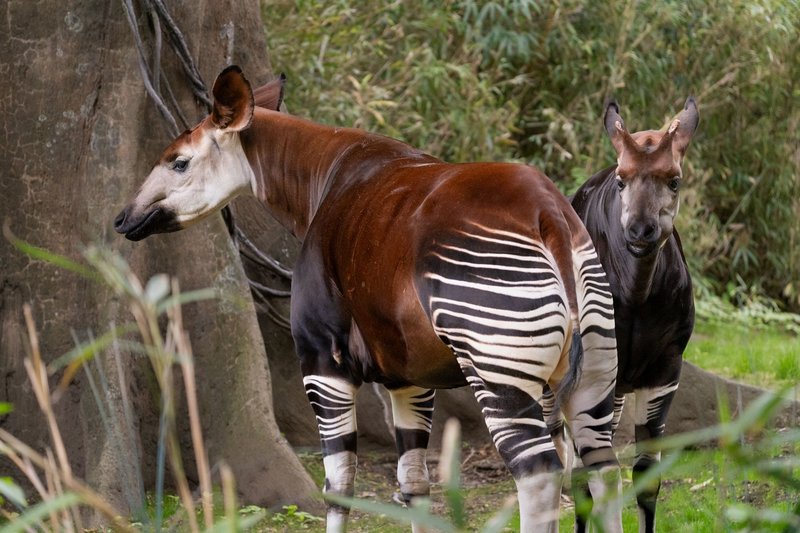
It looks like someone built a horse out of zebra and giraffe parts, and that second guess is closer than it sounds — the okapi is the giraffe’s only living relative. Those white leg stripes break up its outline in the dappled light of the Congo’s Ituri Forest, which is the only place on Earth it lives wild.
It stayed hidden from Western science until 1901, which is absurd for an animal the size of a horse. Locals knew it the whole time. Its tongue is long enough — about 18 inches — to wash its own eyelids and ears. Where you’d see it: dense lowland rainforest in the Democratic Republic of the Congo. The IUCN lists it as Endangered, with fewer than 25,000 left.
Three-Toed Sloth (Bradypus)
The famous slowness isn’t laziness — it’s a strategy. A sloth’s stomach can take up to two weeks to digest a single batch of leaves, because leaves are nutritionally close to worthless and the animal runs on a metabolic budget most mammals couldn’t survive on.
It’s so still that algae grows in its fur, tinting it green, which doubles as camouflage. A whole micro-ecosystem of moths lives in there too. Sloths come down from the canopy to defecate about once a week — the single most dangerous thing they do, and nobody’s fully sure why they bother climbing down for it. Where you’d see it: Central and South American rainforest canopy.
Glass Frog (Centrolenidae)
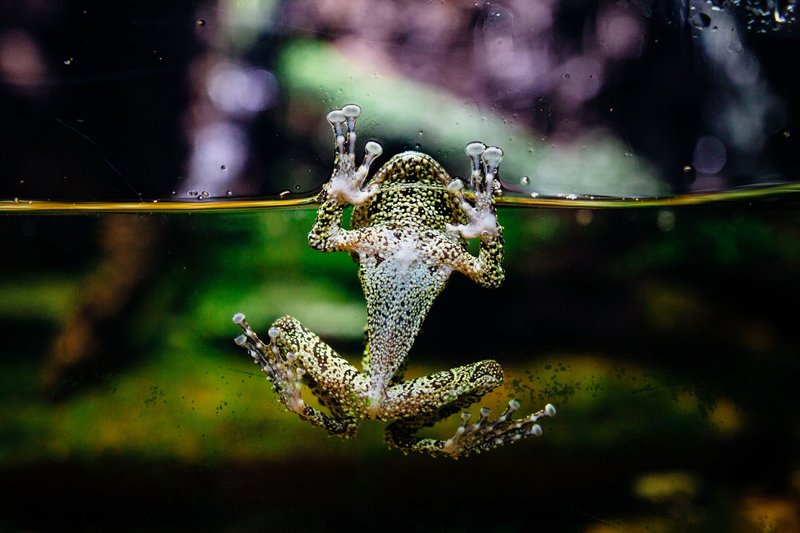
Flip one over and you can watch its heart beat. The skin on a glass frog’s underside is translucent — you can see the heart, liver, and looping intestines right through it. Some species push the trick further: while sleeping, they pull red blood cells out of circulation and hide them in the liver, making themselves up to 60% more transparent so predators looking up from below see straight through them.
Males guard the eggs, which they stick to leaves hanging over streams so the tadpoles drop straight into water when they hatch. Where you’d see it: Central and South American cloud forests, on leaves above running water.
Howler Monkey (Alouatta)
You’ll hear it before you have any hope of seeing it. The howler’s call carries up to three miles through dense forest, which makes it one of the loudest land animals alive. The sound comes from an enlarged hyoid bone in the throat that works like a resonating chamber.
There’s a catch biologists love: the males with the biggest, loudest call-boxes tend to have the smallest testes. Loud or fertile — evolution made them pick. The roar isn’t aggression, mostly. It’s real estate, broadcasting “this patch is taken” so troops avoid wasting energy on fights. Its place in the Amazon’s tangled web of who eats who is more as broadcaster than prey, since few canopy hunters can reach a full-grown troop. Where you’d see it: treetops across Central and South America.
Tarsier (Tarsius)
Each eyeball is bigger than its brain. The tarsier is a tiny nocturnal primate with eyes so large it can’t rotate them in their sockets — so it evolved a neck that swivels nearly 180 degrees in each direction, owl-style, to look around.
It’s the only entirely carnivorous primate, eating insects, lizards, and the occasional bird, snatched mid-leap. It communicates partly in ultrasound, above the range of human hearing, which went unnoticed until 2012. Where you’d see it: rainforests of the Philippines, Borneo, and Sulawesi.
Sunda Colugo (Galeopterus variegatus)
Often called a “flying lemur,” it neither flies nor is a lemur. It glides — and it’s exceptional at it, covering distances over 200 feet between trees while barely losing altitude, thanks to a membrane that stretches from its neck to its fingertips to its tail. Even the spaces between its toes are webbed.
On the ground it’s nearly helpless, which is why it almost never lands. Mothers carry infants slung against the belly, gliding with the baby attached. Where you’d see it: Southeast Asian rainforests, gliding between trunks at dusk.
Fossa (Cryptoprocta ferox)
Madagascar’s largest predator looks like a cat crossed with a mongoose, which is roughly what it is — it’s most closely related to the mongoose family and evolved in isolation on the island. It’s the top hunter there, and lemurs make up the bulk of its diet — including frugivorous species like the crowned lemur, whose fruit-heavy diet keeps it in exactly the canopy zones the fossa hunts.
It has semi-retractable claws and flexible ankles that rotate, letting it run down tree trunks head-first like a squirrel. Where you’d see it: forests across Madagascar, increasingly rare as the island’s woodland shrinks.
Temperate Forest Animals
The temperate forest — oak, maple, pine, the kind that turns color in autumn — gets skipped on most lists because it feels familiar. It shouldn’t. Some of its residents are stranger than anything in the tropics.
Fisher (Pekania pennanti)
The fisher doesn’t fish. It’s a large weasel, and its claim to fame is being one of the few predators that reliably kills and eats porcupines. It does this by attacking the face — the one spot without quills — circling and biting until the porcupine is too injured to defend itself, then flipping it to get at the unprotected belly.
Fishers nearly vanished from the northeastern US to the fur trade and have quietly recolonized forests in recent decades, sometimes turning up in suburbs. They’re in good company among the continent’s odder residents — plenty of strange and endangered animals in Canada share these same conifer forests. Where you’d see it: dense conifer and mixed forests across Canada and the northern US.
Northern Flying Squirrel (Glaucomys sabrinus)
It glides on a membrane between its limbs, steering with its flat tail like a rudder, covering 150 feet or more in a single launch. That part’s been known for a century. The surprise came in 2019: under ultraviolet light, flying squirrels glow bright pink. Nobody’s certain why — possibly camouflage against UV-reflecting snow, possibly signaling.
They’re nocturnal and far more common than people realize; you’ve almost certainly slept near one without knowing. Where you’d see it: mature forests across North America, active only after dark.
Pine Marten (Martes martes)
A pine marten moves through the canopy like the branches are a floor — it has rotating wrist joints that let it climb down trees head-first, and it’s quick enough to catch squirrels in a flat-out chase through the treetops. Then it’ll turn around and spend autumn eating berries, with rowan fruit a particular favorite.
In Britain, the marten’s comeback is reshaping the forest: where martens return, invasive grey squirrels collapse and the native red squirrel recovers, because reds evolved alongside the predator and greys didn’t. Where you’d see it: woodlands across Europe and into Asia.
Hoary Bat (Lasiurus cinereus)
Most temperate bats hibernate in caves. The hoary bat migrates instead — flying hundreds of miles south for winter like a bird, one of the few bats that does. It roosts alone in tree foliage, wrapped in its own frost-tipped fur, which is where the “hoary” name comes from.
It’s a strong, fast flyer and one of the most widespread bats in the Americas, yet almost nobody sees one, because it hunts high and late. Where you’d see it: forested areas across North and South America, usually as a silhouette at dusk.
Boreal Forest and Taiga Animals
The boreal forest — the taiga — is the largest land biome on Earth, a band of spruce and fir wrapping the top of the planet. Winter runs eight months and bottoms out past -40 degrees. The animals here aren’t strange-looking so much as ruthlessly engineered for cold.
Wolverine (Gulo gulo)
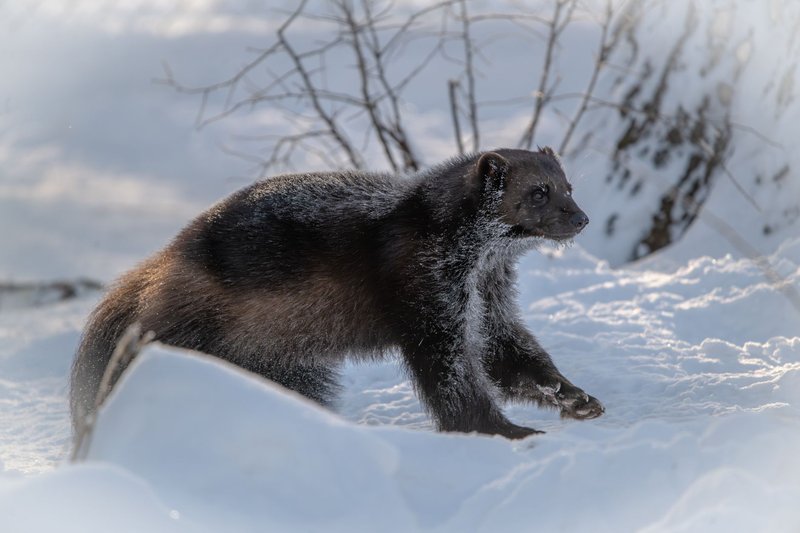
Pound for pound the strongest mammal predator going, the wolverine is a 30-pound weasel that will drive bears and wolves off a kill. It can smell a carcass buried under 20 feet of snow and dig down to it. Its molars are rotated 90 degrees inward, built to tear frozen meat and crush bone that’s solid as wood.
It travels enormous distances — a single wolverine’s home range can top 240 square miles — and needs deep spring snowpack to den, which is why a warming climate threatens it directly. Where you’d see it: remote boreal and tundra-edge forest across the far north. Realistically, you won’t — that’s the point.
Canada Lynx (Lynx canadensis)
The lynx is a cat built around one meal: the snowshoe hare. Its oversized, fur-padded paws work like snowshoes, spreading its weight so it floats over powder that a hare’s predators would sink into. So tightly are the two animals linked that lynx populations rise and crash on a roughly 10-year cycle, tracking the hare’s boom-and-bust almost exactly.
When hares are scarce, lynx numbers fall within a year or two. It’s one of the cleanest predator-prey cycles in nature, plotted in textbooks for a century. Where you’d see it: snowy boreal forest across Canada and Alaska.
Pine Grosbeak (Pinicola enucleator)
A plump, raspberry-red finch that treats -40°F as a normal Tuesday. The pine grosbeak doesn’t flee south when the taiga freezes — it stays, living off conifer seeds, buds, and frozen berries it plucks straight off the branch. It fluffs its dense plumage into an insulating shell and lowers its metabolism overnight to ride out the cold.
It’s so unbothered by humans that birders nickname it the “tame” finch; you can often walk right up to one. Where you’d see it: boreal conifer forests across the Northern Hemisphere.
Sable (Martes zibellina)
The sable is another marten, and its fur is the reason Siberia was colonized — the pelts were valuable enough to drive a centuries-long fur rush across Russia. That fur is the adaptation: dense, silky, and uniquely able to lie smooth in any direction, which is what let the animal survive a climate that kills most things its size.
It hunts on the ground and in trees, caching food for winter, and has a scent-marking gland it drags along its territory. At the southern edge of its range it shares the mountain forests with browsers like the Japanese serow, which gets through winter on conifer foliage when little else is on offer. Where you’d see it: taiga forests across Russia and into Mongolia and northern Japan.
How Forest Animals Adapt to the Layers
A forest isn’t one habitat — it’s stacked. Most of these animals are specialists in a single vertical band, and reading the layers tells you a lot about how a creature lives.
- Forest floor: Low light, deep leaf litter, the domain of ground hunters and rooters. The okapi and fossa work here, navigating by smell and hearing more than sight.
- Understory: The shrubby middle, dim and humid. Glass frogs and tarsiers thrive in this band, hidden from the predators above and below.
- Canopy: The dense leafy roof where most rainforest life actually happens. Sloths, howler monkeys, and colugos rarely leave it. This is where the food is, so this is where the competition is fiercest — hence the loud calls and the gliding.
- Emergent layer: The few giant trees that punch above the canopy, exposed to full sun and wind. Mostly the province of large birds and gliding mammals making long crossings.
The same logic scales down to temperate and boreal forests, where the canopy is thinner and more life happens at ground level — which is exactly why the fisher, lynx, and wolverine are floor-and-trunk hunters rather than treetop acrobats.
FAQ
What is the most interesting forest animal? The okapi is a strong pick — a striped, giraffe-related mammal that stayed unknown to Western science until 1901 despite being horse-sized. For sheer strangeness, the glass frog’s see-through belly and the wolverine’s ability to smell carrion under 20 feet of snow are hard to beat.
What animals live in temperate forests? Beyond the familiar deer and foxes, temperate forests host genuinely odd specialists: the fisher (a weasel that hunts porcupines), the pine marten, flying squirrels that glow pink under UV light, and migrating hoary bats.
What animals live in the boreal forest or taiga? The taiga is home to cold-adapted survivors like the wolverine, Canada lynx, sable, and pine grosbeak — animals built for eight-month winters and temperatures below -40°F.
Why are howler monkeys so loud? An enlarged hyoid bone in the throat acts as a resonating chamber, letting their calls carry up to three miles. The calls mark territory so troops can avoid each other without fighting.
What forest animal has the strangest adaptation? Hard to top the glass frog, which hides red blood cells in its liver while sleeping to become up to 60% more transparent, or the three-toed sloth, whose stomach can take two weeks to digest a single batch of leaves.