TLDR
Longman’s beaked whales eat mostly squid, plus some deep-sea fish, hunted in near-total darkness more than 1,000 meters down. They don’t chew or bite — they suck their prey in whole. And here’s the honest part: almost everything we know about their diet comes from the stomachs of two or three dead, stranded whales. This is one of the least-observed large mammals on Earth.
Table of Contents
- The quick answer: squid, mostly
- Why we barely know anything
- A whale with (almost) no teeth catches food how?
- The dive: over half a mile down, in the dark
- How Longman’s stacks up against other beaked whales
- Why this whale stays a mystery
The quick answer: squid, mostly
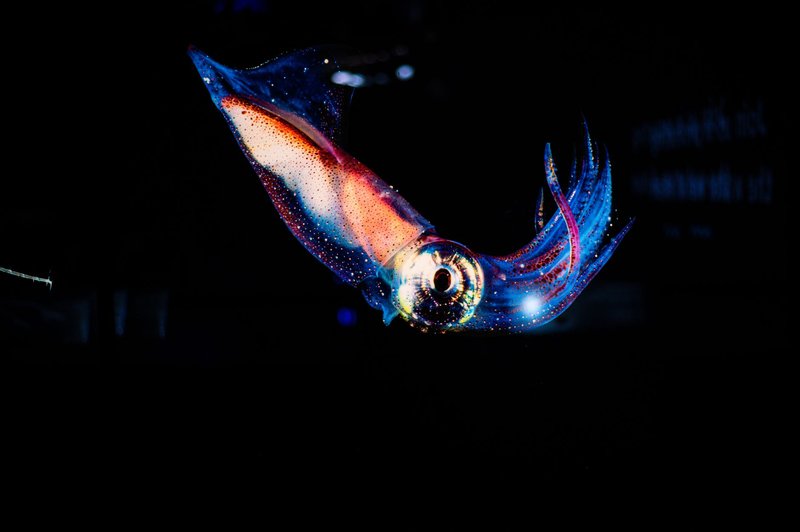
Cut through the taxonomy and the answer is short: cephalopods. Mostly squid, occasionally fish, and probably the odd octopus when one’s available.
The best data point we have is a whale that stranded on the coast of Kyushu, Japan, and got a full necropsy. Researchers pulled 99 upper beaks and 69 lower beaks — the hard, indigestible parts of a squid — out of its stomach. Five species showed up, and one of them, a deep-water squid called Taonius pavo, made up 84% of everything found, according to the necropsy published in Aquatic Mammals. A separate set of strandings in the Philippines turned up the same story: squid beaks, squid eye lenses, and a scattering of fish eye lenses, and nothing else.
So when a factsheet tells you Longman’s beaked whale “eats squid and fish,” that single sentence is standing on the stomach contents of maybe two or three animals, total. Which brings up the more interesting question.
Why we barely know anything
Most whales you can watch feed. Orcas hunt in daylight near the surface. Humpbacks lunge through bait balls you can film from a boat. Longman’s beaked whale does neither. It’s a deep-ocean specialist that surfaces briefly, dives for the better part of an hour, and rarely comes anywhere near a research vessel on purpose.
Nobody has ever directly observed one eating. Every scrap of diet data comes from necropsies on stranded carcasses, and stranded Longman’s beaked whales are rare events — NOAA Fisheries lists it among the least-known of all cetacean species, described almost entirely from bones and a handful of beach strandings since it was first identified in 1926. For decades after that, scientists weren’t even sure what a living one looked like; illustrations were often guesses.
That’s a genuinely different situation from “we don’t have time to research this.” It’s closer to a cold case: the evidence exists, but there’s so little of it that every new stranding rewrites part of the story.
A whale with (almost) no teeth catches food how?
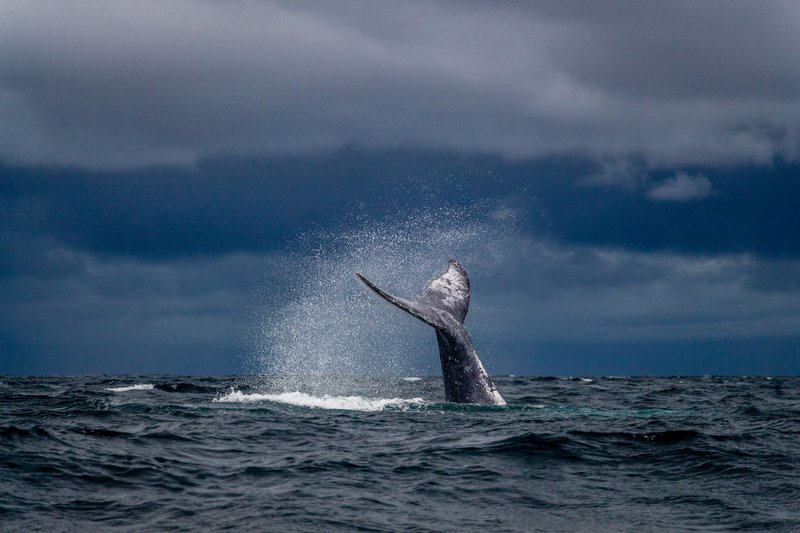
Here’s the detail that makes the feeding story make sense. Adult male Longman’s beaked whales have exactly two teeth, small and set near the tip of the lower jaw. Females have none that ever erupt through the gum. Neither sex has a set of grasping or chewing teeth anywhere in the mouth.
You can’t bite prey with that setup. So beaked whales don’t bite — they suck. The whale opens its mouth, drops its tongue like a piston, and creates a pressure drop that pulls the squid straight in, whole, faster than the animal can react. It’s the same basic mechanism used across the beaked whale family, where, as researchers studying the group note, females of most species stay functionally toothless their entire lives because teeth were never the tool being used for feeding in the first place — the male’s exposed tusk is for jousting other males, not hunting.
Once the squid is inside, there’s nothing left to identify it by except the beak, which is chitin and doesn’t digest. That’s the only reason we know what these whales eat at all: the one part of the meal that survives.
The dive: over half a mile down, in the dark
Longman’s beaked whales feed in the epipelagic to mesopelagic zone — roughly 200 to 1,000 meters down, based on where its confirmed prey species are known to live. Dives in the 15-to-33-minute range have been documented, though the whale’s deep-diving cousins push those numbers much further: satellite-tagged Cuvier’s beaked whales have logged dives to nearly 3,000 meters lasting over three and a half hours, the deepest and longest dives ever recorded for a mammal.
At those depths, there’s no light to hunt by. Beaked whales solve that with echolocation, clicking and listening for the return echo off a squid’s body — but they only switch the clicks on once they’ve reached the bottom third of the dive, saving the behavior for the actual hunt rather than running it the whole way down, according to acoustic tag data described by NOAA Fisheries. Picture a whale falling silently through black water for ten minutes, then flipping on sonar only once it’s close enough to start finding dinner.
How Longman’s stacks up against other beaked whales
Longman’s isn’t unusual within its family — it’s actually a fairly typical example of how beaked whales feed, which is part of why comparing it to relatives fills in gaps the direct evidence can’t.
Cuvier’s beaked whale, the deep-diving record holder, eats a broader mix of squid and some fish, hunting at similar or greater depths. The various Mesoplodont species — a genus of more than a dozen beaked whales, most about as poorly studied as Longman’s — show the same pattern in every stomach content study ever published: overwhelmingly cephalopods, caught by suction, in deep water, mostly out of sight of anyone. The family resemblance is strong enough that scientists lean on Cuvier’s and Blainville’s beaked whale dive-tag data, which is far more abundant, to make reasonable inferences about how Longman’s behaves, since directly tagging one has happened only a handful of times.
The one place Longman’s stands apart: its listed conservation status. The IUCN Red List classifies it as Data Deficient — not because it’s confirmed rare, but because there isn’t enough population data to say either way. It may not be unusually rare at all; it may just be unusually good at not being seen.
Why this whale stays a mystery
Every piece of this story loops back to the same root cause: you can’t easily study an animal that lives its life a kilometer underwater and only shows itself, briefly, when it’s already dead. The diet answer — squid, some fish, taken by suction, in the dark — is solid as far as it goes. What’s missing is scale: how much variation exists between individuals, whether populations in different oceans eat differently, whether climate-driven shifts in deep-sea squid populations will affect a whale nobody can currently track well enough to notice.
For now, the honest version of the story is the more interesting one anyway. A whale that’s barely been seen alive, built to feed in total darkness on prey most people will never lay eyes on, known to science almost entirely through what it left behind in its own stomach.