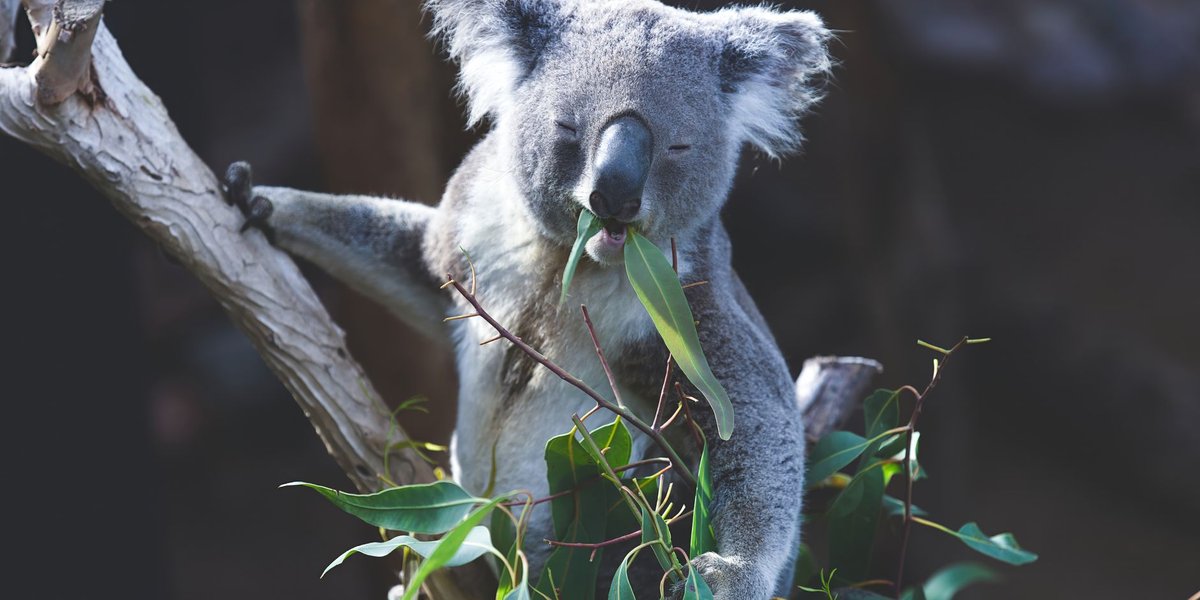
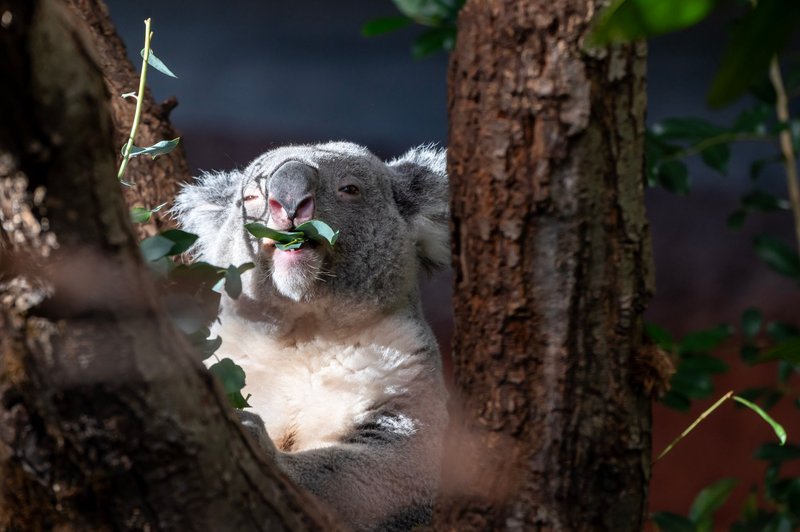
A koala eats eucalyptus leaves — nothing else, almost all day, every day. An adult gets through 200 to 500 grams of leaf a day, chewed down to a paste with teeth built for exactly that job. That’s the one-line answer. The interesting part is how an animal survives on a food most mammals can’t touch.
Quick Facts
- Diet: Almost exclusively eucalyptus leaves (occasionally a few other native leaves in small amounts)
- Daily intake: 200–500 grams of leaf per day, depending on body size and leaf quality
- Species eaten: Only 1–3 of Australia’s 600+ eucalypt species, chosen by region
- Water: Gets nearly all moisture from leaves; rarely drinks standing water
- Digestion: A caecum roughly 2 meters long ferments tough plant fiber
- First food: Joeys transition onto leaves by eating their mother’s pap, a specialized soft feces
Why Eucalyptus, and Only Eucalyptus
Eucalyptus leaves are a strange thing to build a diet around. They’re low in protein, packed with indigestible fiber, and loaded with phenolic and terpene compounds that are actively toxic to most animals. Koalas are among a select group of animals that can eat poisonous plants without dying, managing it with a liver that runs an unusually aggressive detoxification system, breaking down those compounds before they build up to dangerous levels.
That specialization is also a trap. A koala’s gut is colonized by a specific set of bacteria, inherited early in life, that’s tuned to process the toxins in the eucalypt species local to its home range. Move a koala to a new region with different eucalypt species and it can struggle to eat, because its gut microbes haven’t been trained on that particular chemical cocktail. This is a documented reason wildlife rescuers are careful about where they release koalas after rehabilitation — an animal from the Otways doesn’t necessarily do well eating trees from the Adelaide Hills.
Within its own territory, a koala is picky in a way that looks almost neurotic. Australia has more than 600 eucalypt species, and a given population will typically rely on just one to three of them, based on which species grow locally and which have the leaf chemistry that population’s gut bacteria can handle. According to the NSW Government’s koala habitat data, preferred food trees vary sharply by region — a koala in the Southern Highlands and a koala on the Central Coast may not eat the same tree at all, even though both are unmistakably “koalas eating eucalyptus.”
| Region | Commonly Preferred Eucalypts |
|---|---|
| Northern NSW / SE Queensland | Tallowwood, Forest Red Gum |
| Southern NSW / ACT | Ribbon Gum, Manna Gum |
| Victoria (French Island, Otways) | Manna Gum, Swamp Gum |
| South Australia (reintroduced populations) | River Red Gum, Blue Gum |
How Much a Koala Eats Each Day
An adult koala eats roughly 200 to 500 grams of eucalyptus leaf daily — the range depends on body size, sex, and how nutrient-rich the available leaves are that season. That’s not a small amount of chewing for an animal that spends up to 20 hours a day asleep or resting. The math works out because koalas are efficient rather than active: low metabolic rate, minimal movement, and a digestive system built to extract every available calorie from a food source that most animals would starve trying to live on.
Leaf quality shifts with rainfall, soil, and season, and koalas can tell the difference. Foliage surveys have shown koalas selectively feeding on younger, less fibrous leaves and avoiding trees with higher concentrations of defensive toxins — they’re not just eating “eucalyptus,” they’re grading it.
The Digestive System Behind It: Liver, Gut Bacteria, and the Caecum
Three systems do the heavy lifting.
The liver processes the toxic compounds — mostly terpenes and phenolics — that eucalyptus produces specifically to deter browsers. A koala’s liver enzymes break these down at a rate well beyond what a typical mammal liver handles, which is a large part of why almost nothing else eats eucalyptus in any quantity.
Gut bacteria, inherited from the mother early in life, help finish detoxifying compounds the liver doesn’t fully clear and assist in breaking down fibrous plant matter the koala’s own enzymes can’t touch alone.
The caecum, a pouch at the junction of the small and large intestine, is where the real fermentation happens. A koala’s caecum can run around 2 meters long — extraordinarily long relative to body size — and functions like a fermentation vat, giving gut microbes time to break down cellulose and extract nutrients from what is, by any normal standard, a poor food source.
Do Koalas Drink Water?
Rarely, and that’s not a myth softened for a fact sheet — it’s close to literal. Koalas get nearly all the moisture they need directly from eucalyptus leaves, which is reflected in the word itself: “koala” is often said to derive from an Aboriginal word meaning “no water” or “no drink.” Drinking is occasionally observed, more often during extreme heat, drought, or illness, but it isn’t a regular part of koala life the way it is for most mammals.
Myth: Are Koalas High or Drunk from Eucalyptus Oil?
No. The idea that koalas are stoned or drunk on eucalyptus compounds is a persistent piece of folklore, but their lethargy has a simpler explanation: eucalyptus leaf is so low in calories and nutrients, and so metabolically expensive to detoxify, that koalas conserve energy by doing almost nothing. Sleeping 18 to 20 hours a day isn’t intoxication — it’s a survival strategy for an animal running on a starvation-adjacent food source. Even the World Wildlife Fund’s koala fact page frames the sleep pattern as an energy-conservation adaptation, not a chemical side effect.
What Do Baby Koalas (Joeys) Eat?
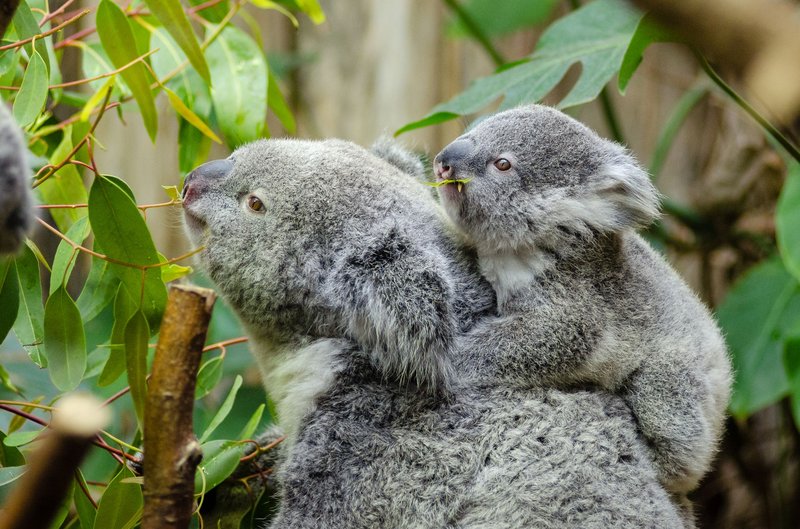
A joey can’t process eucalyptus leaves straight out of the pouch — its gut isn’t yet colonized with the bacteria needed to detoxify and digest them. Around six to seven months old, it starts eating a specialized transitional substance called pap: a soft, nutrient-dense form of the mother’s feces, distinct from her regular waste, that carries the exact gut bacteria the joey needs to eventually handle eucalyptus. The joey eats pap directly from the mother for a period of weeks before graduating to actual leaf material. It’s an unglamorous detail that most consumer-facing koala pages skip entirely, but it’s the actual mechanism that makes the entire adult diet possible.
Wild Diet vs. Captive Diet
Wild koalas are locked into whatever eucalypt species grow in their home range, which is part of why habitat loss hits them so hard — losing the right trees isn’t a minor inconvenience, it can mean starvation even in a landscape that still has plenty of other vegetation. Zoos and wildlife parks, including facilities like the Adelaide Koala and Wildlife Centre, work around this by cultivating multiple eucalypt species on-site and rotating fresh browse daily, since cut leaves lose nutritional value and palatability within a day or two. Captive diets are otherwise the same principle as wild ones — eucalyptus, selected by species, refreshed constantly — just with more species available at once than any single wild home range would offer.
FAQ
How much do koalas eat per day? Roughly 200 to 500 grams of eucalyptus leaf daily, depending on the koala’s size and the nutritional quality of the leaves available.
Why do koalas only eat eucalyptus? Their liver and gut bacteria are specifically adapted to detoxify and digest eucalyptus’s toxic compounds, a specialization that took over as a niche few other animals compete for — but it also means they can’t easily switch to other plants.
Do koalas drink water? Rarely. They get nearly all their hydration from the moisture in eucalyptus leaves and only drink directly during heatwaves, drought, or illness.
What do baby koalas eat? Joeys start on their mother’s milk, then transition to pap — a soft, specialized form of maternal feces containing the gut bacteria needed to digest eucalyptus — before moving on to leaves themselves.
Can koalas eat any eucalyptus species? No. Of Australia’s 600-plus eucalypt species, a given koala population typically eats only one to three, based on regional availability and what its inherited gut bacteria can process.
Are koalas drunk or high from eucalyptus? No. Their near-constant sleeping comes from conserving energy on a low-calorie, high-fiber diet, not from any intoxicating effect of eucalyptus oil.