Table of Contents
- The Honest Answer First
- Fast Facts: What Herbert’s Rock-Wallabies Probably Eat
- Feeding Behavior: Why They Leave the Rocks at Dusk
- Herbert’s vs. Brush-Tailed: How the Diets Likely Compare
- What Do They Eat in Captivity?
- The Other Six Queensland Rock-Wallabies
TLDR
Nobody has ever run a dedicated study on what Herbert’s rock-wallaby (Petrogale herberti) actually eats. What we know comes from its close Queensland cousins and general Petrogale biology: forbs, browse from shrubs and trees, grasses, and seasonal fruit, seeds, and flowers, with insect larvae showing up in tropical populations. They’re crepuscular foragers — sheltering in rocky outcrops by day, dropping down into the surrounding forest and woodland at dusk to feed, then climbing back up before anything with teeth notices.
The Honest Answer First
Herbert’s rock-wallaby diet has never been the subject of a dedicated field study. That’s not a knowledge gap researchers overlooked — it’s a reflection of how this species gets treated in the literature generally. It’s one of seven closely related rock-wallabies packed into northeastern Queensland, and the well-funded research attention tends to go to its more threatened or more accessible relatives, like the brush-tailed rock-wallaby further south.
So when you search “what do Herbert’s rock-wallabies eat,” you get either a thin taxonomic stub or content about a different species entirely. That’s genuinely the state of the science. What follows is the best available picture, built from what’s documented about Petrogale as a genus and what’s been confirmed for Herbert’s rock-wallaby’s closest relatives.
Fast Facts: What Herbert’s Rock-Wallabies Probably Eat
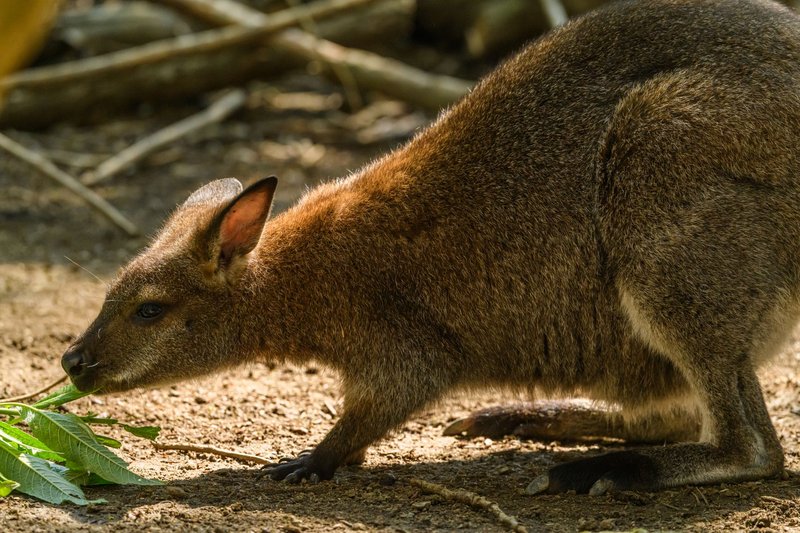
Rock-wallabies in the Petrogale genus are opportunistic, generalist feeders. Based on that baseline, here’s what almost certainly makes up a Herbert’s rock-wallaby’s diet:
- Forbs — soft-stemmed, broad-leaved plants, likely the dietary backbone
- Browse — leaves and shoots pulled from shrubs and trees
- Grasses — eaten, but as a secondary component rather than the main event
- Seasonal fruit and seeds — opportunistic, tied to what’s fruiting nearby
- Flowers — taken when available, same opportunistic pattern
- Insect larvae — recorded in tropical Petrogale populations, an unusual addition for a marsupial otherwise built for plant material
That last point is worth sitting with. Most rock-wallaby diet summaries stop at plants, but tropical populations of these animals will eat larvae when the opportunity presents itself. It’s a small detail, and it’s the kind of thing that gets dropped from shorter write-ups because it complicates a tidy “herbivore” label.
Feeding Behavior: Why They Leave the Rocks at Dusk
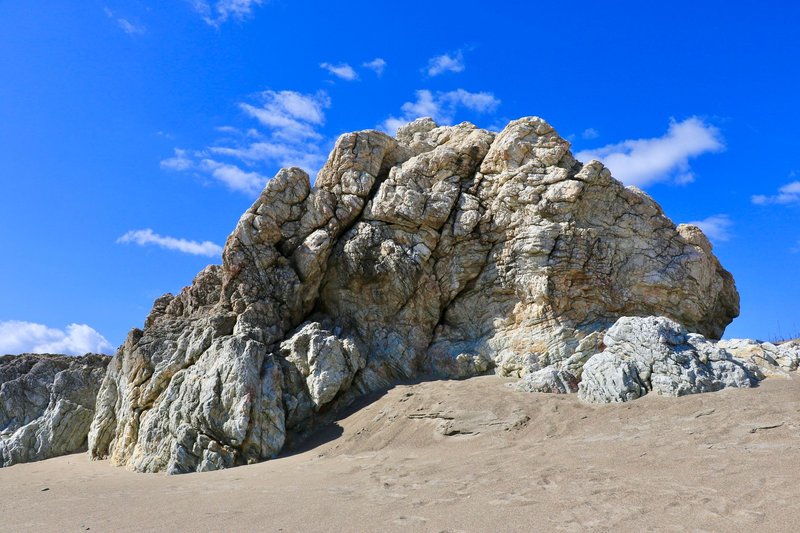
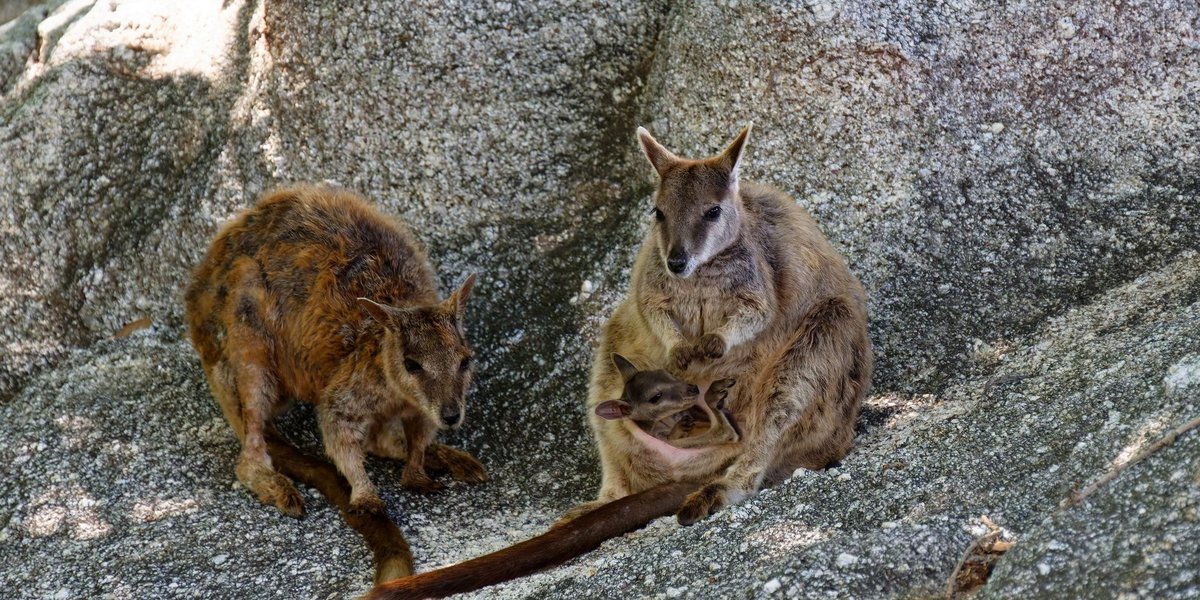
Diet and behavior are tangled together here, so the feeding pattern matters as much as the food list. Herbert’s rock-wallabies spend daylight hours tucked into rocky outcrops, boulder piles, and gorge country — terrain that’s nearly impossible for a dingo or a fox to follow them into at speed. As afternoon fades into dusk, they descend from the rocks and move into the adjacent forest and woodland to forage.
That timing isn’t random. It’s a trade-off: the rocks offer almost nothing to eat, but they offer safety. The forest floor and understorey have the food, but they’re where the predators are. Dusk splits the difference — enough light left to navigate, enough dark starting to cover the trip. Depending on the season, activity shifts toward fully nocturnal in summer heat and more crepuscular or even partly daytime the rest of the year.
This is a meaningfully different strategy from macropods that graze in open country full-time, like larger kangaroos. Herbert’s rock-wallaby treats foraging as a commute — out at dusk, back before full light, home base always within a hop of vertical rock.
Herbert’s vs. Brush-Tailed: How the Diets Likely Compare
The brush-tailed rock-wallaby (Petrogale penicillata) is the best-studied member of the genus, and its documented diet is the closest useful proxy for Herbert’s rock-wallaby. Here’s how they line up:
| Diet Component | Herbert’s Rock-Wallaby (inferred) | Brush-Tailed Rock-Wallaby (documented) |
|---|---|---|
| Grasses | Secondary component | Major component; forages in preferred short-grass patches |
| Forbs & browse | Likely primary forage | Eaten regularly, alongside grass |
| Fungi | Not recorded | Hypogeal (underground) fungi eaten opportunistically |
| Fruit, seeds, flowers | Seasonal, opportunistic | Acacia flowers, fruit, and bark taken opportunistically |
| Insect larvae | Recorded in tropical populations | Not typically noted |
| Water dependence | Unknown | Historically thought non-essential, now considered more important as droughts intensify |
| Foraging range | Unstudied | Small — averaging 2–3 hectares per animal |
The brush-tailed rock-wallaby’s national recovery plan even flags invasive lantana as a specific threat, since it crowds out the native forbs and grasses the species relies on. Nobody’s documented whether the same pressure hits Herbert’s rock-wallaby, but the two species share enough habitat overlap that it’s a reasonable open question for anyone studying the genus.
One caution: these are closely related species sharing a genus, not interchangeable animals. Herbert’s rock-wallaby is the largest and most widespread of the seven-species Queensland group, which suggests its diet may lean more heavily on browse than the brush-tailed rock-wallaby’s more grass-dominant intake. That’s an inference, not a finding.
What Do They Eat in Captivity?
This is one of the clearest content gaps in the existing coverage — nobody publishes anything about captive diets for this species. Herbert’s rock-wallaby doesn’t have the zoo presence of larger, more charismatic macropods, so there’s no public feeding-program documentation to draw from. Facilities that do hold Petrogale species typically feed a mix of native browse, grass hay, and commercial macropod pellets supplemented with fresh produce, but nothing specific has been published for Herbert’s rock-wallaby by name. If you’re researching for a zoo visit or an academic project, this is worth flagging directly to the institution rather than assuming a generic macropod diet applies.
The Other Six Queensland Rock-Wallabies
Herbert’s rock-wallaby is one of seven closely related species clustered in northeastern Queensland, alongside the brush-tailed, Godman’s, Mareeba, Cape York, Mount Claro, and allied rock-wallabies. They split from a common ancestor recently enough, in evolutionary terms, that their diets almost certainly overlap heavily — same genus-level feeding strategy, same rock-and-forage lifestyle, minor variation by local vegetation. Conservation-wise, Herbert’s rock-wallaby is currently listed as Least Concern, having held on even in areas cleared for cattle grazing — a resilience that its more threatened cousins, like the brush-tailed rock-wallaby in its southern range, haven’t managed to match.
The Australian Museum’s profile on the brush-tailed rock-wallaby notes it’s agile enough to climb trees and will actively defend its rock shelter — behavior that likely holds across the genus, Herbert’s rock-wallaby included, even without a dedicated study to confirm it.
Until someone runs that study, the honest answer stays the honest answer: educated inference from close relatives, not a documented fact about this specific animal. That’s not a failure of the research — it’s just where the science currently sits for one of Australia’s more overlooked rock-wallabies.