Equatorial Guinea has almost no readable flower guides. What exists is mostly plant databases and multi-volume botanical floras. This is the plain-language version: twelve flowers you can actually picture, what they look like, and which part of the country they belong to.
The country splits into three very different settings. Río Muni, the mainland, is mostly lowland rainforest cut by rivers. Bioko is a volcanic island with cloud forest on its upper slopes, and it sits closer to Cameroon than to the rest of the country. Annobón is a small, remote volcanic island far out in the Gulf of Guinea. The flowers below are spread across all of it, with most of the showy species in the forest and along its edges.
Table of Contents
Why the flora here is so varied
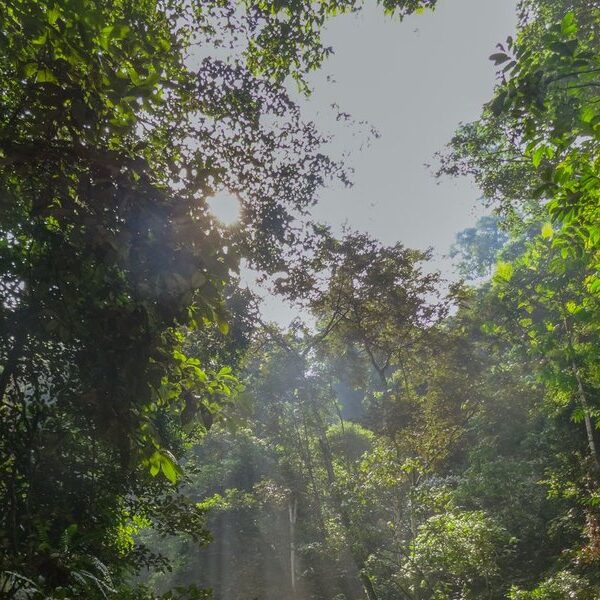
Equatorial Guinea sits on the equator, with rain nearly year-round in the forest and a short drier spell in the early part of the year. That climate keeps something in bloom most months, but not everything at once. Many forest flowers open for days, sometimes hours, and many bloom high in the canopy where nobody sees them.
Bioko adds altitude. Pico Basilé rises to about 3,000 meters, so a single day’s climb takes you from lowland forest through cloud forest to open montane vegetation. Each band has its own plants. The Gulf of Guinea forests also hold many species found nowhere else, which is why botanists still publish new finds from the region. You can browse the accepted names and distributions for yourself in Kew’s Plants of the World Online.
12 flowers worth knowing
1. Calabash nutmeg (Monodora myristica)
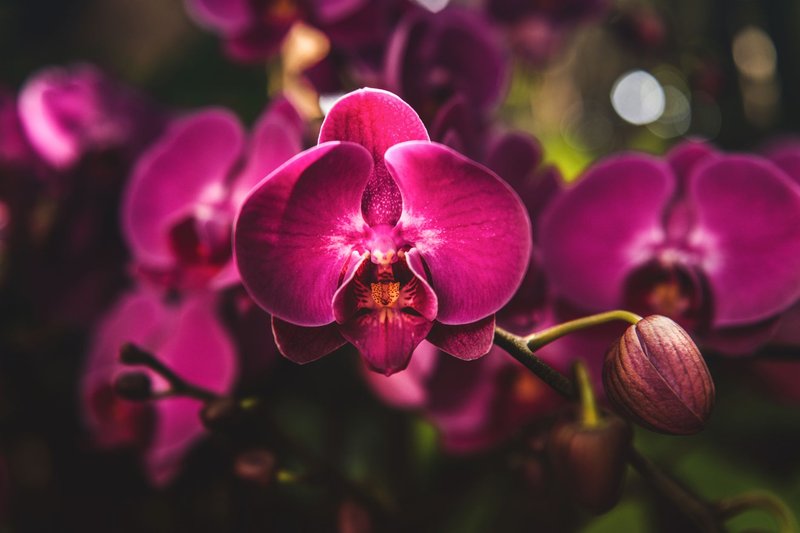
The flower looks like an orchid and isn’t one. Calabash nutmeg belongs to the custard apple family, and its blooms hang on long stalks with ruffled, curling petals in pale yellow and green, splashed with maroon. The tree grows in lowland rainforest across West and Central Africa, including Río Muni. The seeds are ground as a spice, which is the “nutmeg” in the name.
2. African tulip tree (Spathodea campanulata)
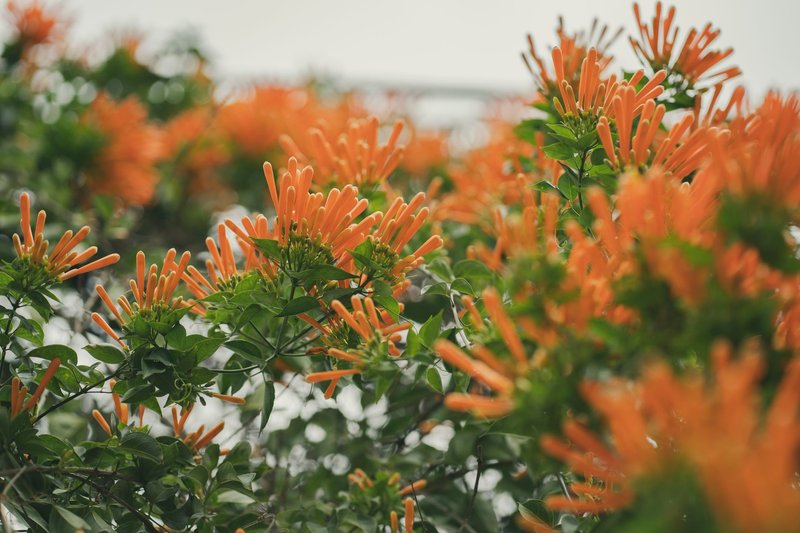
Impossible to miss. Clusters of orange-red, cup-shaped flowers sit at the tips of the branches, and the buds hold water that children are known to squirt at each other. It is native to tropical Africa and is now planted in towns and along roads, so it’s one of the easiest flowers to see without leaving the city. Look for the red crowns over streets in Malabo and Bata.
3. Bulbophyllum orchids
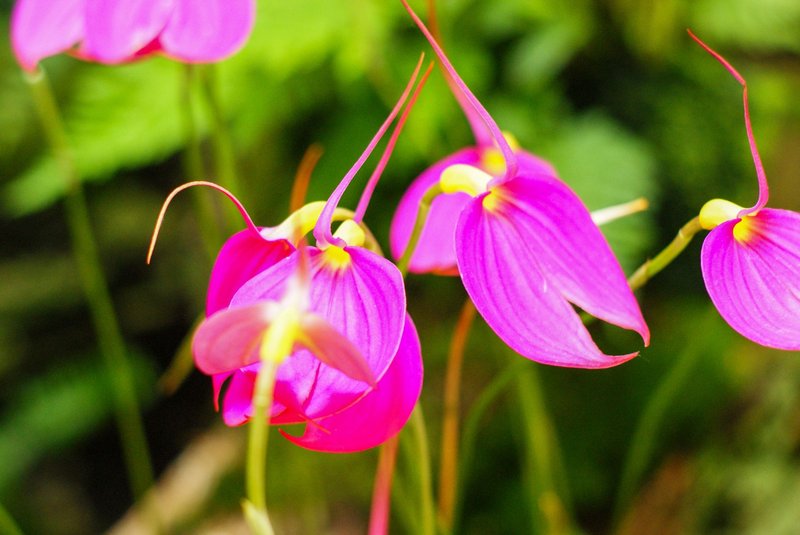
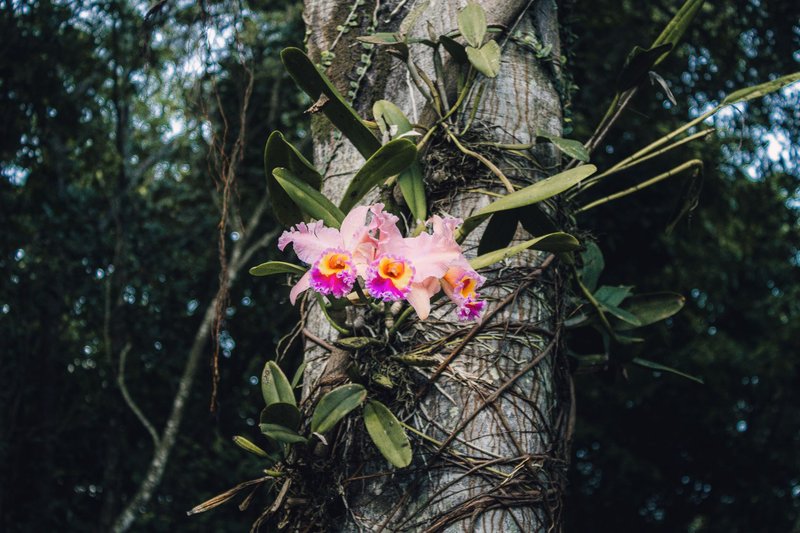
Bulbophyllum is one of the largest orchid genera on earth, and Africa’s forests hold a good share of it. The flowers are small, often smaller than a fingernail, and strange: fringed lips, hairy edges, colors that range from cream to dark red. Many grow attached to tree trunks and branches in humid forest, including on Bioko. Bring a macro lens or a magnifying glass. Without one you’ll walk straight past.
4. Ginger lily (Costus afer)
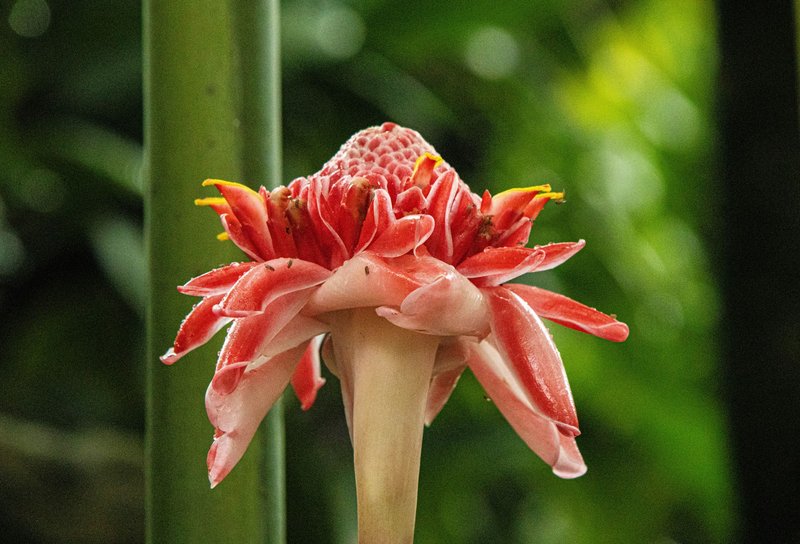
Costus afer is a tall forest-edge plant with a spiral of leaves along the stem and a cone-shaped head of red bracts. White to cream flowers with a crumpled lip emerge from the cone one at a time. It’s a relative of ginger, and you’ll find it in clearings, riverbanks and disturbed forest on the mainland. Look near water, where the light is better.
5. Rothmannia
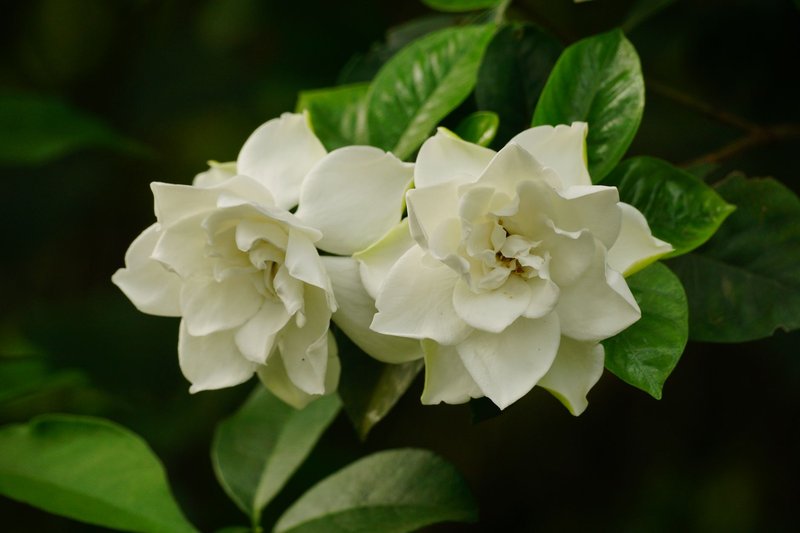
Rothmannia is a close cousin of the gardenia, and the flowers show it: bell-shaped, waxy, often cream-white with a spotted or streaked throat and a strong evening scent. Several species grow in African forest understory, including in the Guinea-Congo region. The flowers drop quickly, so a tree that was covered in blooms on Monday may be bare by Thursday.
6. Congo cockatoo (Impatiens niamniamensis)
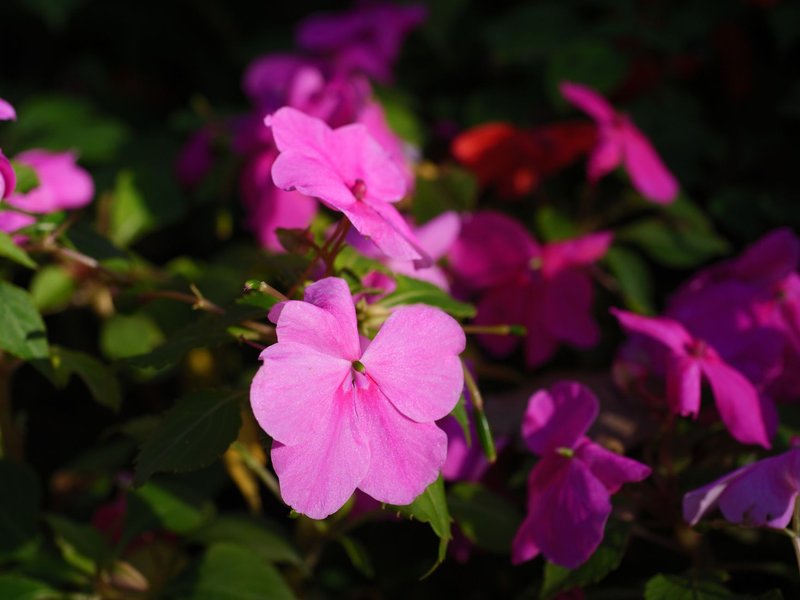
Common name says it all. The flower is a swollen red tube with a yellow-green tip, and from the side it looks like a small parrot’s head. It comes from the forests of tropical West and Central Africa and thrives in shade and constant moisture. It’s one of the few species on this list that’s a popular houseplant elsewhere, which means plenty of people have seen it without knowing where it comes from.
7. Mussaenda
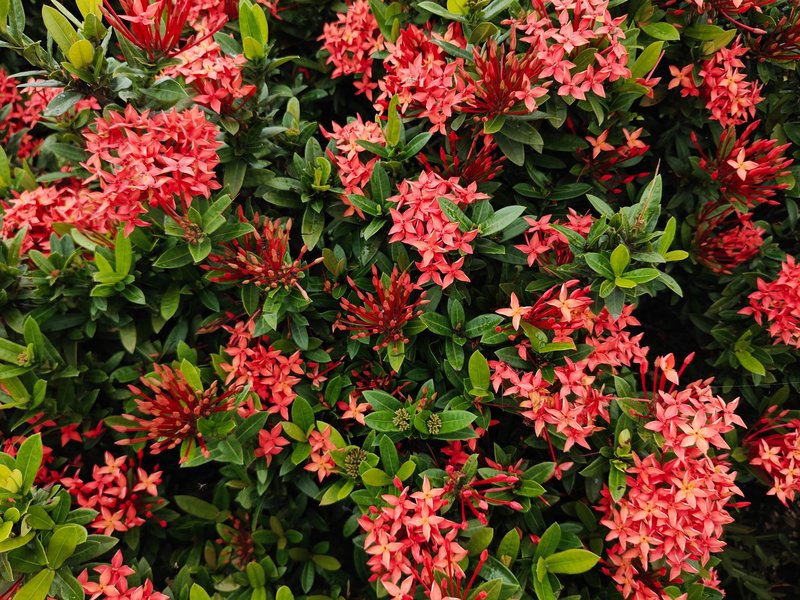
The tiny yellow flowers aren’t the point. Each cluster is surrounded by one or two enlarged, brightly colored leaves, red or orange or white, that do the work of petals for pollinators. Mussaenda species grow as shrubs and climbers in forest edges and secondary growth across tropical West Africa. In flower, a single shrub can light up a trail verge.
8. Bleeding-heart vine (Clerodendrum thomsoniae)
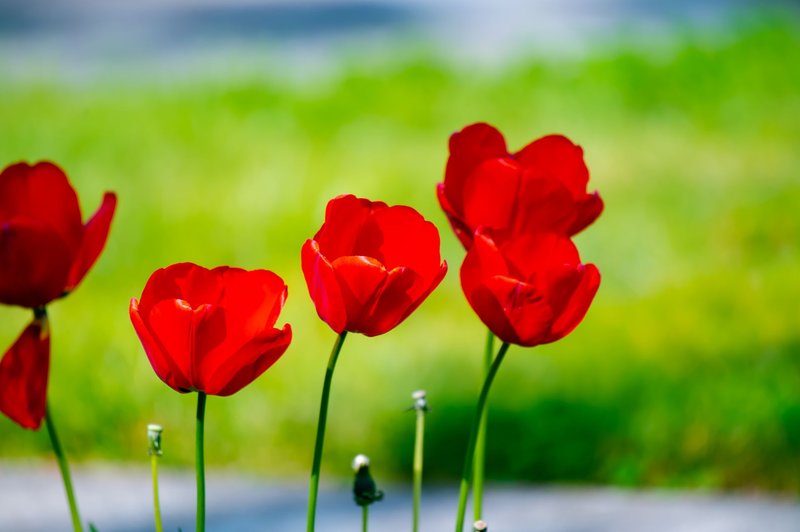
A white, balloon-like calyx holds a tiny crimson flower that pokes out from the bottom, which is where the name comes from. This is a climber native to West and Central Africa, and it scrambles over shrubs and fences at the forest edge. It’s also grown in gardens worldwide, so you may know it already. Seeing it in its native range is different.
9. Flame lily (Gloriosa superba)
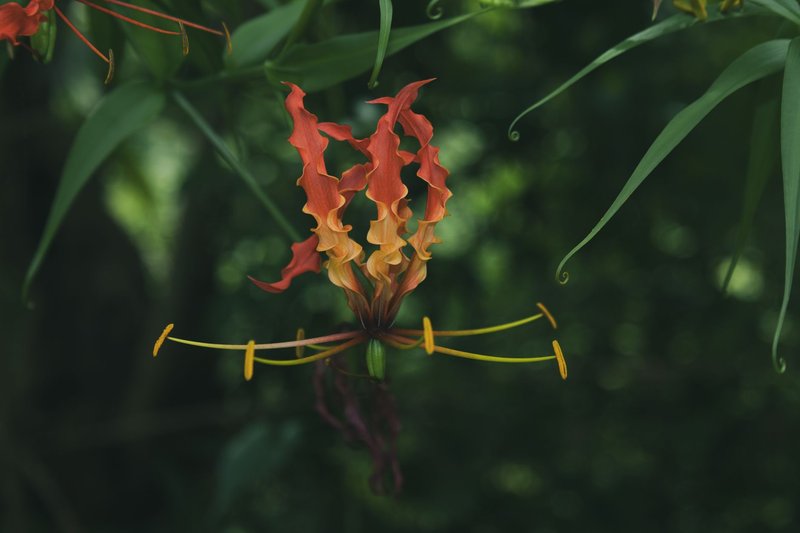
The petals curl backward and are red with yellow edges, so the flower looks like it’s on fire. It climbs by tendrils at the tips of its leaves and grows in thickets and open forest across tropical Africa and Asia. Be careful with it: every part of the plant is poisonous. Look, photograph, don’t touch.
10. Wild begonias (Begonia spp.)
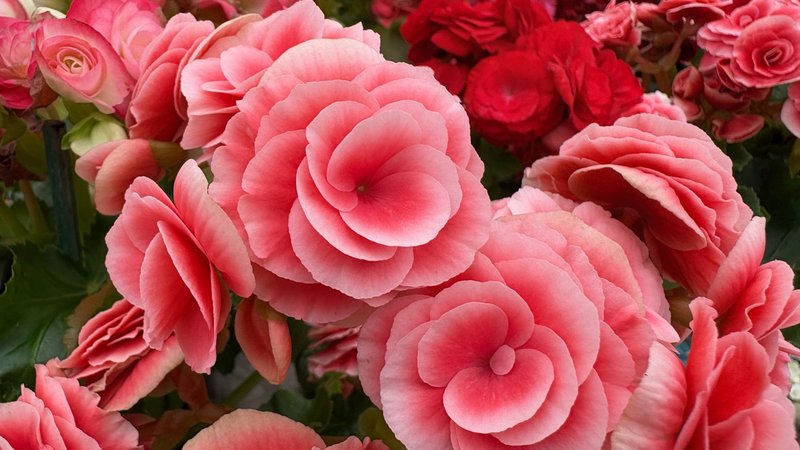
Africa has hundreds of wild begonias, and the Gulf of Guinea forests are especially rich in them. They grow on wet rocks, stream banks and shaded forest floors, with lopsided pink or white flowers above asymmetrical leaves that are often patterned or metallic. Because many species are restricted to tiny areas, a begonia you find on one stream may not occur on the next valley over.
11. Burning bush (Combretum paniculatum)
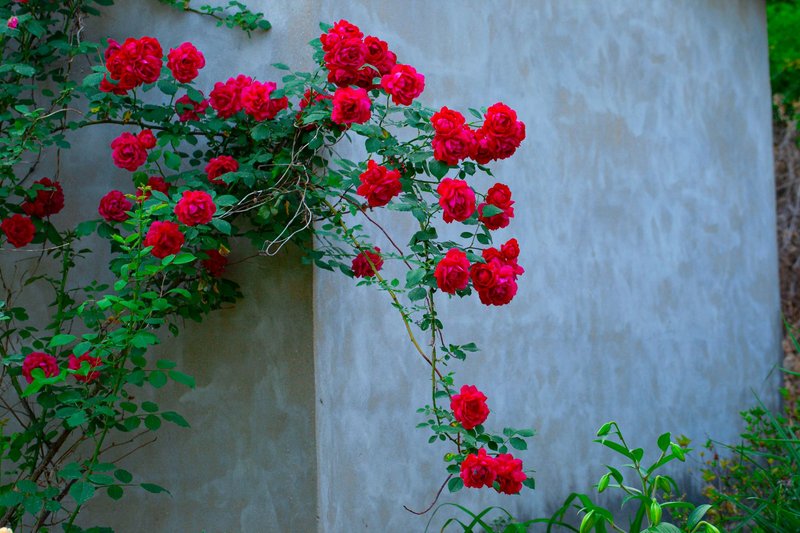
This climbing shrub covers itself in sprays of scarlet, brush-like flowers, usually at the forest edge where it gets sun. Sunbirds visit the blooms for nectar, which makes it a good spot for birdwatchers who also like plants. It’s native to tropical Africa and common in secondary growth.
12. Angraecum orchids
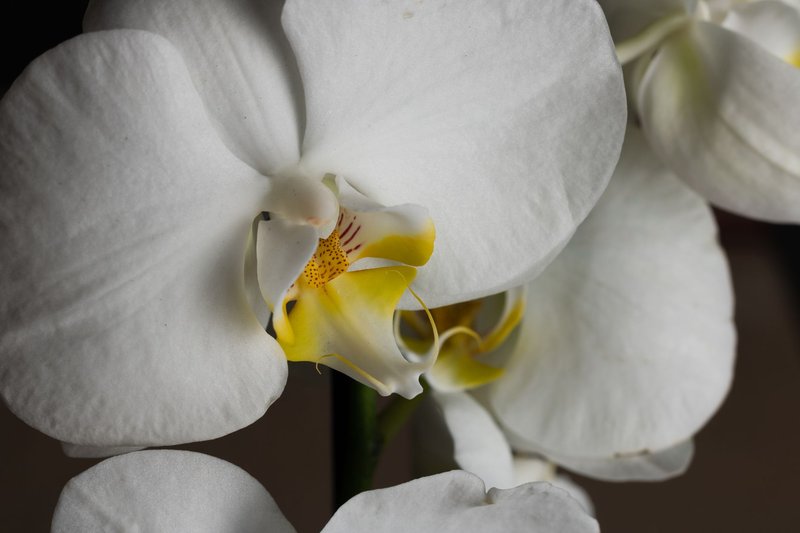
Angraecum is the second orchid group on this list, and the opposite of Bulbophyllum in style: white, star-shaped flowers, usually fragrant at night, with a long spur at the back that holds nectar. Africa and Madagascar are the center of the genus. Species grow on tree trunks in humid forest, and the pale flowers are pollinated by night-flying moths.
Where and when to see them
Pico Basilé (Bioko). The best place for montane plants. The road and trail climb through lowland forest, then cloud forest, where orchids, begonias and impatiens grow on mossy trunks and wet banks. Go early, before the cloud closes in.
Caldera de Luba (Bioko). A volcanic crater in the south of the island with dense, wet forest and very little human disturbance. It’s remote, so plan for a guide and a long day.
Monte Alén National Park (Río Muni). The country’s largest protected area and the main mainland draw. Lowland rainforest here is where you look for Costus, Rothmannia, calabash nutmeg and the forest-floor begonias.
Towns and roadsides. Malabo, Bata and the roads between them are the easiest place to find African tulip trees, bleeding-heart vine and Mussaenda in flower, because many are planted.
For timing, the drier months at the start of the year make travel easier, and trails are less slippery. Flowers don’t follow a single calendar, though. Treat any month as possible, and plan around access first. Check the conservation status of any species you want to look for in the IUCN Red List; some Gulf of Guinea plants are threatened by logging, land clearing, and invasive species.
FAQ
What is the national flower of Equatorial Guinea? There is no widely cited official national flower. The best-known plant symbol is the silk-cotton (kapok) tree on the national coat of arms.
When do flowers bloom in Equatorial Guinea? Something is in flower most of the year because the climate is warm and wet. Individual species have their own peaks, and many open for only a few days.
Can visitors pick or buy flowers? Picking wild flowers is a bad idea, especially inside protected areas like Monte Alén National Park, and some plants, such as the flame lily, are toxic. Photograph them instead. Garden and ornamental flowers are sold in local markets in the main towns.
Are any of these flowers endemic? Several of the genera here, including wild begonias and Bulbophyllum, contain species restricted to small areas of the Gulf of Guinea forests. Check Plants of the World Online for the distribution of a specific species before you assume it’s local or widespread.