Table of Contents
- TLDR: the key characteristics
- Body size and build
- The tail: a fifth limb
- Hook hands and missing thumbs
- Coat and face
- Life in the canopy
- Troop life: why the group keeps splitting
- Spider monkey vs howler vs capuchin
- Spider monkey species at a glance
- Are spider monkeys endangered?
- FAQ
TLDR: the key characteristics
The main characteristics of a spider monkey are a slender body, very long arms and legs, a prehensile tail that works like a fifth limb, hook-shaped hands with a reduced or missing thumb, and a life spent almost entirely in the treetops. They live in Central and South American forests, eat mostly ripe fruit, and travel in troops of roughly 15 to 25 that split into smaller foraging parties.
Every one of those traits traces back to one problem: reaching fruit that grows on thin branches, high up, scattered across a huge forest.
Body size and build
Spider monkeys are big for New World monkeys, but light for their length. Adults weigh roughly 6 to 11 kg (13 to 24 lb) with a body of about 35 to 66 cm, and the tail adds another 60 to 90 cm or so, usually longer than the body itself. Females run slightly larger than males in some species, which is unusual among primates.
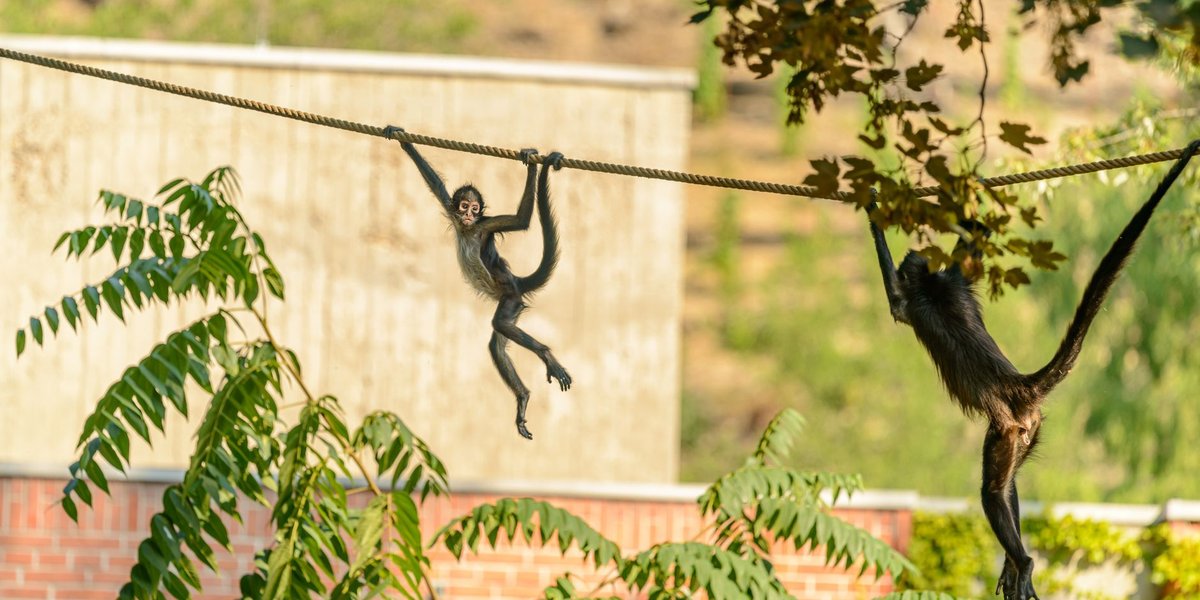
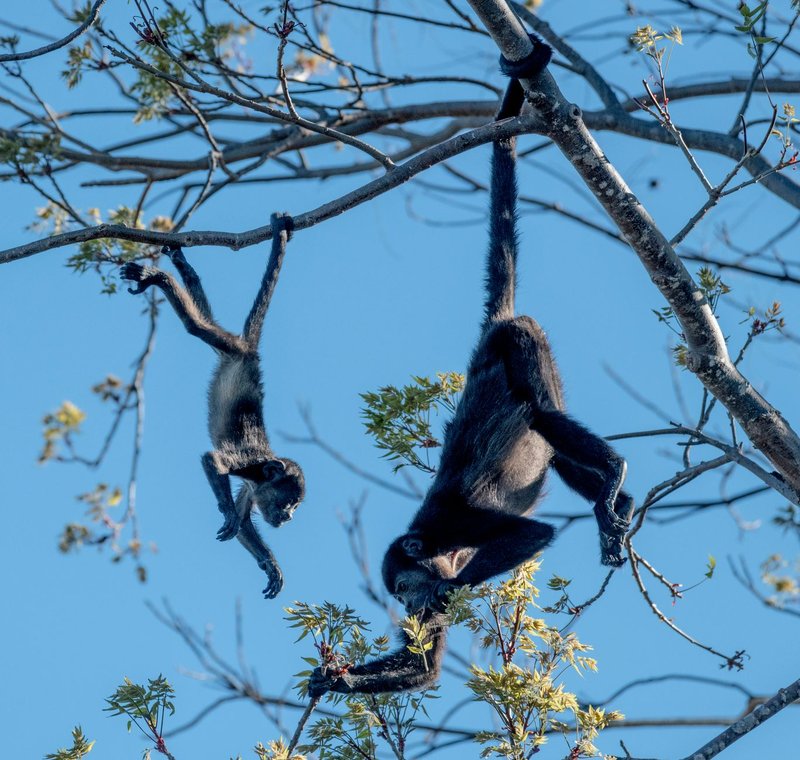
The frame is the name. Arms and legs are long and thin relative to a narrow trunk, and from below, a monkey hanging by its limbs and tail looks like a spider on a thread. The arms are longer than the legs, which helps with swinging and reaching. A small head sits on a pot-bellied torso, a shape that suits a fruit-heavy diet that takes time to process.
The tail: a fifth limb
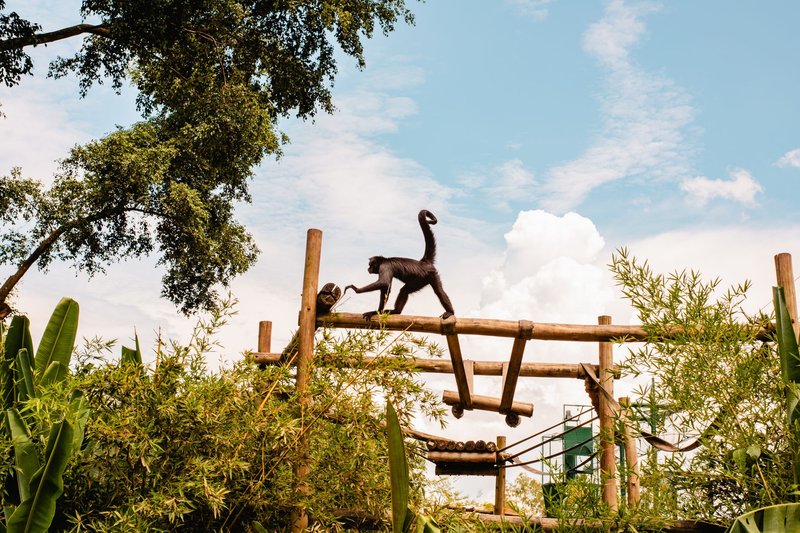
The prehensile tail is the single most useful thing a spider monkey owns. It can hold the animal’s entire body weight, so a monkey can hang by the tail alone and use all four limbs to pick fruit. It can also pick up small objects and wrap around a branch in a second.
The trick is at the tip. The underside of the last stretch of the tail is bare skin with ridged grooves, like fingerprints, which add grip and let the tail sense what it’s touching. The tail is also muscular along its whole length, and it works as both a safety line and a balance bar while the monkey crosses gaps.
Compare that with a monkey that has a non-prehensile tail, which serves as a balance aid at best. A spider monkey’s tail does the job of a hand.
Hook hands and missing thumbs
Spider monkey hands are long, narrow and hooked. The thumb is either tiny or absent, depending on the species, which is the opposite of how most primates grip. This looks like a flaw until you watch them move.
Without a thumb in the way, the four long fingers form a clean hook that can latch onto a branch and release it instantly while the body swings past. It’s the same logic as a gymnast’s grip on a bar. The monkey is semi-brachiating: it travels hand over hand, under branches, using its arm length and tail to swing rather than walk.
The cost is fine manipulation. Spider monkeys handle food with their lips and teeth more than with precise finger grips, and the tail often helps hold fruit steady.
Coat and face
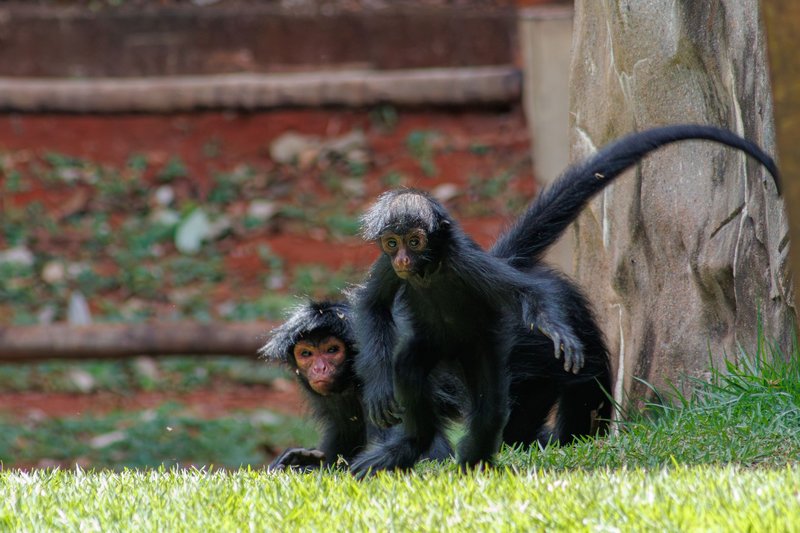
The coat is coarse hair, usually black, brown, or a mix, with paler patches depending on the species. Many have a lighter belly or a pale face mask. The fur sheds the heavy rain of tropical forests quickly, and the hair on the face is sparse enough to show skin that can be pink, black, or mottled.
Coat color is the easiest way to tell species apart in the field, which is why guides sort them by color rather than size. The face also carries expression: spider monkeys use a wide range of calls, postures, and facial movements to communicate across the canopy.
Life in the canopy
Spider monkeys are arboreal to an extreme. They spend most of their lives in the high canopy and rarely come to the ground, because their body is built for limbs in the air, not for walking. They range from southern Mexico through Central America into northern South America, with populations in the Amazon basin.
Their diet follows the same logic. Ripe fruit makes up the bulk of what they eat, and they supplement it with leaves, flowers, seeds, and some insects. Because ripe fruit is patchy and seasonal, a spider monkey has to cover a lot of ground, and a lot of that happens by swinging between trees.
This also makes them forest gardeners. They swallow seeds whole and drop them far from the parent tree, which helps rainforests regrow.
Females usually give birth to a single infant after about seven months of gestation, and the baby clings to its mother’s belly, then her back, for months. Mothers may raise only one young every two to four years, which is one reason populations recover slowly.
Troop life: why the group keeps splitting
A spider monkey troop is usually somewhere between 15 and 25 animals, but you almost never see all of them in one place. Their social system is called fission-fusion: the big group breaks into smaller parties that forage separately, then rejoins later.
The reason is food. When ripe fruit is abundant, parties get larger. When it’s scarce, a big group would strip the few trees available, so the troop fragments into small foraging parties of a few individuals. Compare that with a monkey that eats leaves, which are everywhere and can sustain a group that moves together all day.
Males typically stay in the group they were born into and cooperate to defend the territory, while young females leave to join other groups. Researchers at the Wisconsin National Primate Research Center’s Primate Info Net describe the same pattern for the black spider monkey: a loose, flexible society built around the food supply.
Spider monkey vs howler vs capuchin
Spider monkeys, howler monkeys, and capuchins share the same forests, so they get mixed up. The differences are easy to spot once you know where to look.
| Trait | Spider monkey | Howler monkey | Capuchin |
|---|---|---|---|
| Build | Slender, very long limbs | Stocky, heavy | Compact, medium |
| Tail | Fully prehensile, bare grip pad | Fully prehensile | Partly prehensile, used for support |
| Thumb | Reduced or absent | Present | Present, opposable |
| Main diet | Ripe fruit | Leaves | Fruit, insects, small animals |
| Movement | Swinging and climbing | Slow, careful climbing | Quick running and leaping |
| Signature trait | Fifth-limb tail | Loud roar | Tool use |
The diet explains the rest. Howlers eat leaves, which are low in energy, so they move slowly and rest a lot. Capuchins eat almost anything and use their hands for tools and tricky foods. Spider monkeys chase fruit, so they need reach and speed.
Spider monkey species at a glance
Sources disagree on how many spider monkey species exist. The IUCN-based count is seven in the genus Ateles, while some older references list fewer and treat several as subspecies. The table follows the seven-species count.
| Species | Coloring | Range | Conservation status |
|---|---|---|---|
| Red-faced (black) spider monkey, A. paniscus | Black coat, bare pink face | Northern Amazon (Guianas, Brazil) | Vulnerable |
| Black-faced (black-handed) spider monkey, A. chamek | Black coat, dark face | Western Amazon (Peru, Bolivia, Brazil) | Endangered |
| White-bellied spider monkey, A. belzebuth | Dark back, pale belly and face patch | Northern South America | Endangered |
| Geoffroy’s spider monkey, A. geoffroyi | Brown to black, paler underside | Mexico to Panama | Endangered |
| Brown spider monkey, A. hybridus | Brown coat, pale forehead | Colombia and Venezuela | Critically Endangered |
| Brown-headed spider monkey, A. fusciceps | Dark body, brown head | Panama to Ecuador | Critically Endangered |
| White-whiskered spider monkey, A. marginatus | Black coat, white face ring | Southern Amazon (Brazil) | Endangered |
Are spider monkeys endangered?
Yes. Every spider monkey species is listed as threatened on the IUCN Red List, and most are Endangered or Critically Endangered. Deforestation is the main driver, since these animals depend on large, continuous stretches of mature forest to find enough fruit. Hunting and the pet trade add to the pressure.
Their slow reproduction makes recovery hard. A female with one infant every few years can’t replace losses quickly, and their need for big ranges means that forest fragments can’t support a viable troop.
FAQ
Do spider monkeys have thumbs? Mostly no. The thumb is either vestigial or missing, depending on the species. The hand works as a hook instead.
How strong is a spider monkey’s tail? Strong enough to carry its whole body weight. The grooved, bare tip grips and senses like a fingertip.
How big are spider monkeys? Adults weigh about 6 to 11 kg and have bodies roughly 35 to 66 cm long, with a tail that is longer than the body.
What do spider monkeys eat? Mostly ripe fruit, plus leaves, flowers, seeds, and insects.
Where do spider monkeys live? In tropical forests from southern Mexico through Central America into northern and central South America.
How many spider monkeys live in a troop? Around 15 to 25, though the troop usually splits into smaller parties during the day.