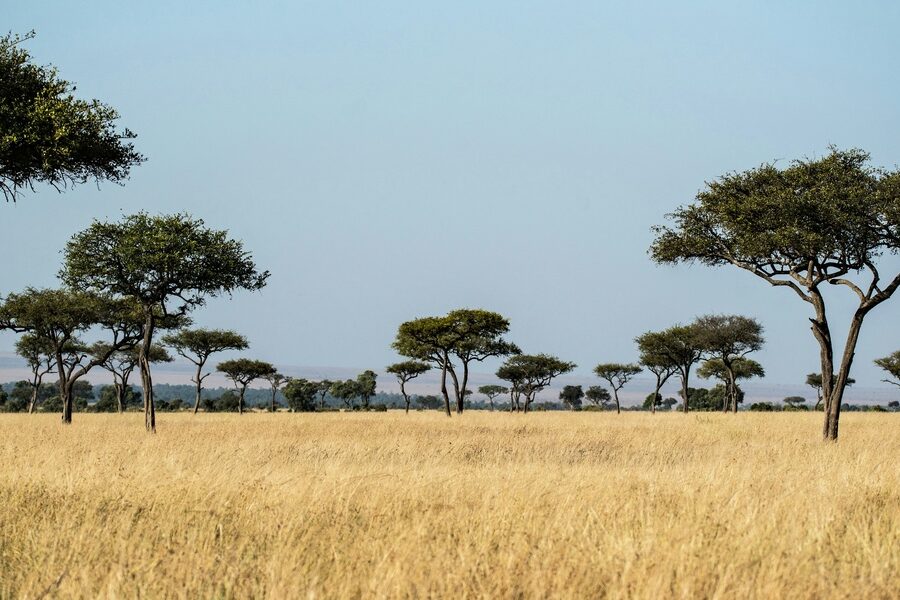
African savanna flora is built around one odd arrangement: a continuous layer of grass with scattered trees standing in it. Rain falls in one season, fire sweeps through in another, and every plant here is a solution to that cycle. Forest needs steady water. Desert has too little to carry a grass carpet. Savanna sits in between, and the plants that live there have worked out how to wait.
Contents
- What Defines Savanna Vegetation
- The Trees
- The Grasses
- Shrubs and Understory Plants
- How Savanna Plants Survive Fire and Drought
- Savanna Flora by Region
- Plants and Animals: A Two-Way Fight
- Quick Reference Table
- Summary
What Defines Savanna Vegetation
Savanna is a grassland with trees, not a forest with gaps. Grass forms the continuous ground layer, and trees cover only part of the canopy, often well under half. Add more trees and you get woodland. Remove them and you have open grassland.
Two forces hold that balance. The first is a long dry season, usually several months with almost no rain. The second is fire, which burns through dry grass every year or two in many regions. Trees that can’t survive a burn as seedlings never get tall enough to shade out the grass, and the grass keeps its ground.
Savannas cover roughly half of Africa’s land surface, from the Sahel’s southern edge to the plains of Tanzania and the woodlands of southern Africa. Researchers studying the continent’s vegetation have mapped them into distinct regional groups. A Utrecht University study of savanna floristic clusters identified eight, based on 298 samples, which tells you how much the flora changes from one region to the next.
The Trees
Savanna trees are short, wide and flat-topped for a reason. Most are spread to catch light across the open ground rather than race upward through a canopy. Four species do most of the work in the popular picture of the savanna.
Umbrella Thorn Acacia (Vachellia tortilis)
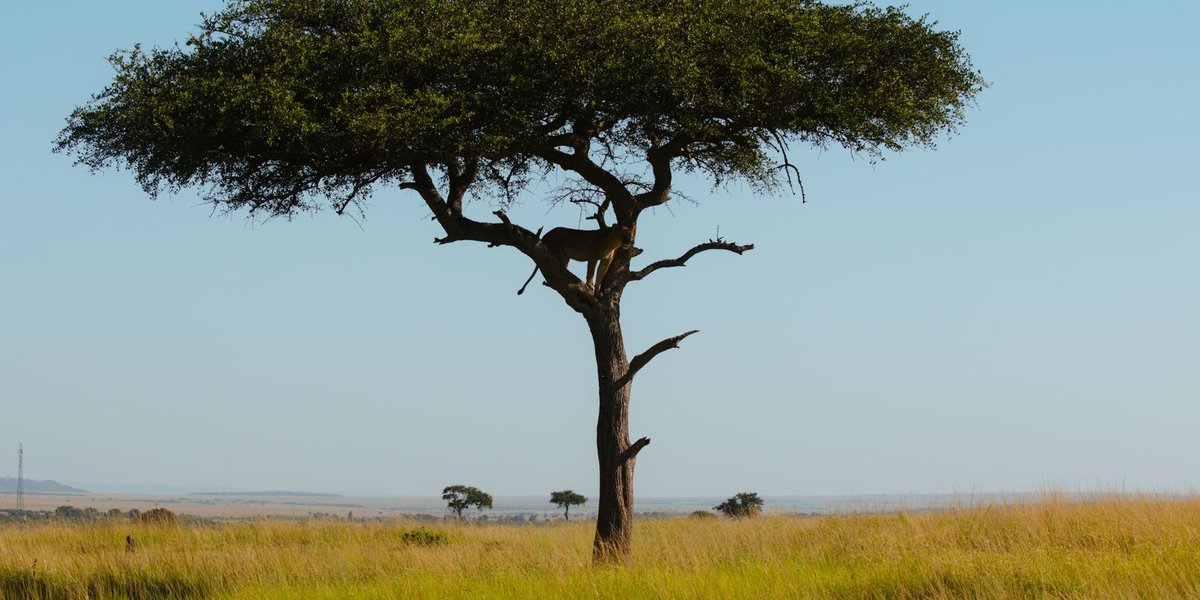
This is the flat-topped tree on every safari postcard. The crown spreads like an open umbrella, with paired thorns along the branches and tiny feathery leaflets that lose little water. Botanists moved most African acacias into the genus Vachellia (and Senegalia), so you’ll see both names in field guides.
Its trick is timing. It drops leaves in the dry season and flushes new growth when rain returns, and its roots reach deep for water that grasses can’t get to. Giraffes browse it anyway, working their long tongues between the thorns.
Baobab (Adansonia digitata)
You can identify a baobab from a kilometer away: a swollen, bottle-shaped trunk topped with stubby branches that look like roots, which is why people call it the upside-down tree. The trunk stores water in soft, fibrous wood. Large old trees can hold many thousands of liters, which carries them through months without rain.
Like the acacia, it is leafless for much of the dry season. The thick, fire-resistant bark protects the stored water, and elephants will sometimes strip the bark and chew the wood for moisture.
Marula (Sclerocarya birrea)
A broad, spreading tree with mottled grey bark, common in southern and eastern savannas. Its yellow, plum-sized fruit ripens in the wet season and is a favorite of elephants, along with baboons, monkeys and people. People press the fruit for drinks and oil, and the kernel is edible. Marula is dioecious, meaning individual trees are male or female, and only the females fruit.
Mopane (Colophospermum mopane)
Mopane’s leaves are paired and shaped like a butterfly’s wings, an easy ID. It dominates large stretches of hot, low-lying southern Africa, often forming dense stands in clay-heavy soil where little else thrives. Its leaves feed the mopane worm, the caterpillar of an emperor moth, which is a significant food source for rural communities in the region.
The Grasses
Grass is the foundation of the whole system. It feeds the herds, carries the fire and holds the soil.
Red Oat Grass (Themeda triandra)
One of the most widespread grasses across Africa, found from the continent’s south through the east and beyond. It grows in tufts topped with reddish-brown seed heads, and it handles both grazing and burning well. Grazers prefer it when young, and it recovers quickly after a burn.
Elephant Grass (Pennisetum purpureum)
The giant of the group. Elephant grass can reach three to four meters, tall enough to hide an adult human, and it grows in thick clumps where moisture is reliable, such as river margins and wetter savanna edges. It is also grown as livestock fodder across tropical Africa.
Other Grasses That Matter
Several other genera, including Hyparrhenia (thatching grass) and Aristida (three-awn grasses), dominate in different rainfall zones. As a rule, tall, coarse grasses grow where it’s wetter and short, fine ones where it’s drier. That difference shapes which animals live there, because tall coarse grass is less nutritious than short grazing lawns.
Shrubs and Understory Plants
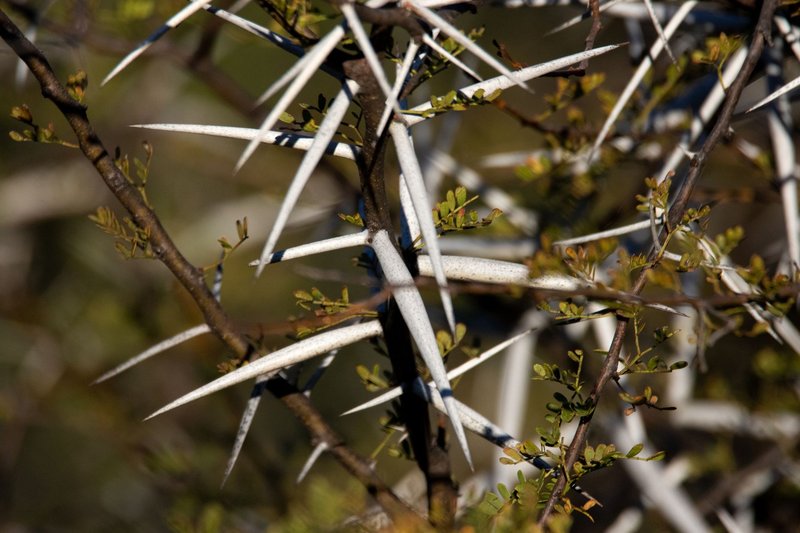
Shrubs fill the space between tall trees and ground-level grass, and many of the most interesting defenses show up here.
The whistling thorn (Vachellia drepanolobium) is the best-known example. It grows swollen thorn bases that ants hollow out as nests. The ants defend the tree against browsers, and in return the tree feeds them with nectar. The “whistling” is wind blowing across the holes the ants leave behind.
Many other low shrubs resprout from the base after a fire or heavy browsing, which lets them re-establish even when the above-ground growth is destroyed. Add in herbs and bulbs that pop up with the first rains, and the wet season turns what looked like a dead landscape into a green one within weeks.
How Savanna Plants Survive Fire and Drought
Every successful savanna plant has solved at least one of three problems: not enough water, regular fire, and hungry herbivores.
Water. Deep taproots, seasonal leaf drop and water-storing trunks (the baobab) all keep plants alive through the dry months. Small, divided leaves, as on acacias, cut evaporation.
Fire. Grasses grow from points at or below the soil surface, so when the top burns off, the growing tissue survives and sprouts again. Many trees have thick bark that insulates the living layer underneath. Others resprout from roots. Seedlings that survive repeated fires eventually grow past the flame height and escape it.
Herbivores. Thorns, tannins and hidden ant guards discourage browsing. Some acacias respond to being eaten by raising the tannin content in their leaves, which makes them taste worse the longer an animal feeds.
None of these solutions work forever. Fire and drought kill individual plants every year. The system stays stable because enough survive to rebuild it.
Savanna Flora by Region
The word “savanna” covers very different vegetation depending on where you are. Four regional groupings from the research literature are useful for anyone who wants to link plant names to places.
- Guinean savanna: the wetter belt along West Africa’s forest edge. Tall grasses and denser woodland, a transition zone between rainforest and drier savanna.
- Sudanian savanna: a band running across the continent south of the Sahel, from Senegal toward Sudan. Drier, with open woodland and acacia species adapted to a long dry season.
- Zambezian savanna: miombo and mopane woodlands across Zambia, Zimbabwe, Mozambique, Malawi and neighboring countries. Mopane is a defining species here, and Victoria Falls and Kafue National Park sit within this region.
- South African savanna: the Lowveld and Kalahari fringe, including the region around Kruger National Park, where marula, umbrella thorn and red oat grass are all common. For a wider view of the region’s plant life, see the Plants of South Africa field guide, which covers the country’s plants biome by biome.
East Africa’s Serengeti-Mara plains belong to another pattern, with open grassland interspersed with whistling thorn and umbrella thorn acacias, but the same logic applies: rainfall and fire decide the mix.
Plants and Animals: A Two-Way Fight
Savanna plants don’t just endure herbivores. They are shaped by them, and in turn they shape the animals.
Elephants are the heavy engineers. They push over trees, strip bark and break branches, which opens woodland into grassland. Without elephants, tree cover can thicken. With too many elephants, large trees vanish. Northern Ghana’s savanna around Mole National Park shows a similar balance, with elephants, buffalo and antelope sharing the grass; the Animals of Ghana guide covers the species in detail. Giraffes work the other way, browsing the upper canopy, trimming acacias into a flat-bottomed shape sometimes called a browse line.
Grazing herds such as wildebeest and zebra keep grasses short, which both reduces the fuel for fire and stimulates fresh, nutritious regrowth. Their dung returns nutrients to the soil. Seed dispersal follows the same logic: elephants eating marula fruit carry the seeds far from the parent tree.
For a broader look at how these systems work, National Geographic’s savanna overview covers the biome globally. The IUCN Red List is the place to check the conservation status of individual species, which matters because savanna habitat is being converted to farmland across the continent.
Quick Reference Table
| Species | Type | Region | Key adaptation |
|---|---|---|---|
| Umbrella thorn acacia (Vachellia tortilis) | Tree | Sudanian, East and South Africa | Deep roots, small leaflets, dry-season leaf drop |
| Baobab (Adansonia digitata) | Tree | Sudanian, Zambezian, South Africa | Water stored in trunk, fire-resistant bark |
| Marula (Sclerocarya birrea) | Tree | Zambezian, South Africa, East Africa | Drought tolerance, fruit that spreads seed via animals |
| Mopane (Colophospermum mopane) | Tree | Zambezian, South Africa | Thrives in hot, clay-heavy soils |
| Red oat grass (Themeda triandra) | Grass | Widespread | Regrows quickly after fire and grazing |
| Elephant grass (Pennisetum purpureum) | Grass | Guinean, wetter savanna | Fast growth to 3-4 m where water is available |
| Whistling thorn (Vachellia drepanolobium) | Shrub/tree | East Africa | Swollen thorns housing defender ants |
Summary
African savanna flora comes down to a handful of strategies repeated across hundreds of species: store or find water, survive the burn, and discourage the animals that eat you. Baobabs bank water in their trunks, acacias drop leaves and arm themselves with thorns, and grasses keep their growing points safely underground. The mix changes from the Guinean belt to the Zambezian woodlands, but the underlying rule is the same everywhere. The savanna is a system maintained by rain, fire and herbivores, and its plants are the proof that all three are working.