TLDR
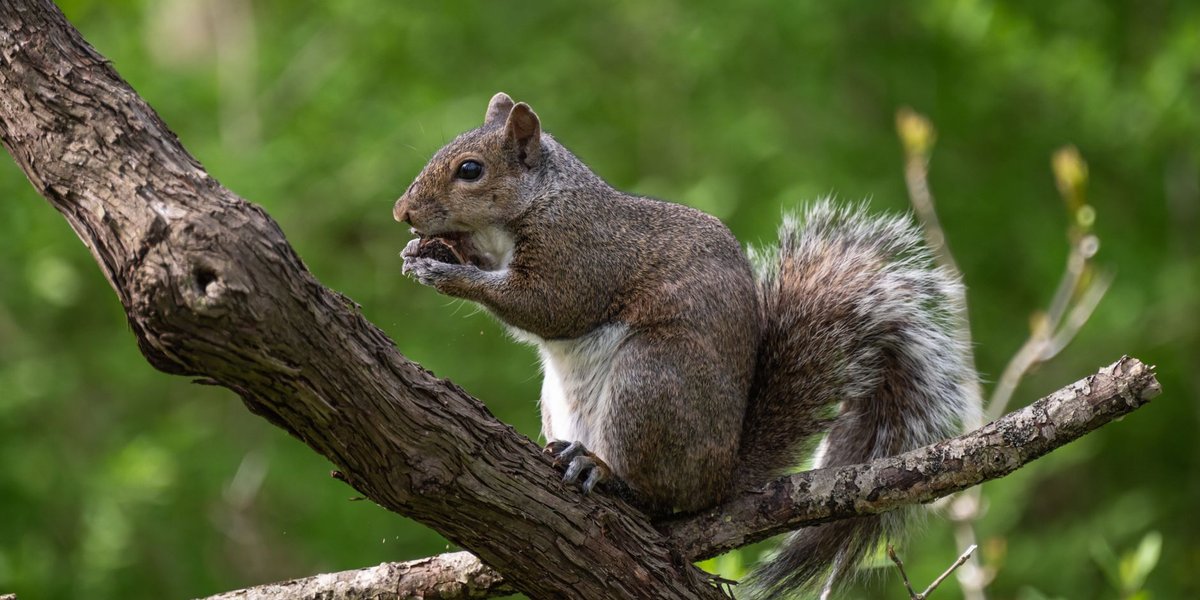
Douglas squirrels (chickarees) eat mostly conifer seeds, which they harvest by cutting green cones off the tree. The rest of the diet is fungi, especially truffles and mushrooms, plus buds, berries, nuts, tree sap, insects and now and then a bird egg or nestling. They store cones and dried mushrooms for winter, so the menu shifts with the season but the base stays the same: whatever the nearest conifer is producing.
Table of Contents
- Cone seeds: the core of the Douglas squirrel diet
- Do Douglas squirrels eat mushrooms?
- Berries, nuts, buds and sap
- Animal foods: insects, eggs and nestlings
- What Douglas squirrels eat by season
- Middens: how they store food
- Douglas squirrel vs. red squirrel diet
- What to feed Douglas squirrels at a feeder
Cone seeds: the core of the Douglas squirrel diet
Ask what a Douglas squirrel eats and the answer is cones. The park service lists Douglas-fir and Sitka spruce seeds among the main foods in Olympic National Park, and the same pattern holds across the squirrel’s range along the Pacific coast, from British Columbia down into California. Where the forest has hemlock, true firs, pines or cedars, those seeds go on the menu too.
The technique is what makes this squirrel different. Instead of waiting for cones to ripen and drop, a Douglas squirrel climbs out onto a branch, clips the green cone at its base and lets it fall. Then it goes down, picks it up and works it like an ear of corn: it strips the scales one at a time and pulls out the seed under each. A pile of shredded cone cores and scales at the base of a tree means a squirrel has been at work.
Cutting cones early is a strategy, not impatience. A ripe cone opens and scatters its seeds on the wind. A green one is still shut, and the squirrel gets the whole crop before the tree releases it.
Do Douglas squirrels eat mushrooms?
Yes, and fungi are a bigger part of the diet than most people expect. Douglas squirrels dig up truffles, the underground fruiting bodies of fungi that grow on tree roots, and they eat surface mushrooms too. Fecal-pellet studies in Washington’s conifer forests found fungal spores in the droppings of the squirrels they sampled, which is how researchers confirmed how much of the diet comes from fungi rather than seeds.
The squirrels are good at this for a reason. Truffles give off a strong smell that a squirrel’s nose can follow through the leaf litter. In return, the squirrel spreads the spores in its droppings, which helps the fungi spread to new tree roots. It’s a trade the forest depends on.
In late summer and fall, the squirrels also pick mushrooms and wedge them into tree forks and branch crotches to dry. Dried mushrooms keep far better than fresh ones. You can find them there weeks later, like laundry on a line.
Berries, nuts, buds and sap
Seeds and fungi make up the bulk, but the squirrel eats what’s in season:
- Berries and fruit: wild berries in summer, including those that grow in forest clearings. The park service lists berries alongside acorns in the Olympic diet.
- Nuts: acorns and hazelnuts where oaks and hazel grow, and the winged seeds of bigleaf maple.
- Buds and shoots: the male cones and new buds of conifers in spring, when little else is available.
- Sap: squirrels gnaw into maple bark and lick the sap that seeps out.
None of these replace cones. They fill gaps in the calendar, which matters because a squirrel that doesn’t hibernate has to eat every month of the year.
Animal foods: insects, eggs and nestlings
Douglas squirrels are mostly vegetarian, but not strictly. They eat insects when they come across them, and they raid nests for eggs and nestlings. Animal Diversity Web notes that they will eat animal foods as well as plant foods. This is opportunistic. A squirrel doesn’t hunt the way a weasel does; it takes what it finds in a nest or under a log. It’s a small share of the total, but a squirrel with a nest to raid in spring is getting protein it can’t get from cones.
What Douglas squirrels eat by season
| Season | Main foods | What’s going on |
|---|---|---|
| Spring | Conifer buds, male cones, sap, cached seeds and cones | Stored food runs low; fresh buds and sap fill the gap. Eggs and nestlings appear. |
| Summer | Truffles and mushrooms, berries, insects, early green cones | The squirrel starts cutting cones and picking mushrooms to dry. |
| Fall | Green cones, nuts, mushrooms | Peak harvest. Cones go into storage, mushrooms into tree forks. |
| Winter | Stored cones and seeds, dried mushrooms, truffles dug from under snow | The squirrel lives off its midden and stays active. |
The exact timing shifts with elevation and with the cone crop. Conifers don’t produce the same number of cones every year, so a poor year pushes squirrels toward more fungi and other backup foods.
Middens: how they store food
A midden is a Douglas squirrel’s pantry. It forms where the squirrel returns again and again to eat cones, usually at a stump, log or tree base, so the discarded scales and cores stack up year after year. Old middens can grow into mounds as wide as a car and a foot or more deep.
The pile has a second job. Squirrels bury whole green cones in the damp middens, and the cool, moist ground keeps the cones closed so the seeds stay inside and stay fresh. That is why a squirrel can eat seeds in February from cones it cut in September. Some middens are used by successive squirrels for decades.
Mushrooms are stored differently, up in the branches where they dry. So a Douglas squirrel runs two storage systems: wet for cones, dry for fungi.
Douglas squirrel vs. red squirrel diet
The eastern and boreal red squirrel (Tamiasciurus hudsonicus) is the Douglas squirrel’s closest relative, and the two share the same basic lifestyle: cut cones, cache them, eat fungi. The differences come from what grows where they live.
- Range and trees: red squirrels feed on spruce, pine and fir across much of Canada and the northern and eastern US. Douglas squirrels feed on the Pacific coast conifers, with Douglas-fir and Sitka spruce at the center of their diet.
- Size and looks: Douglas squirrels are smaller, and their bellies are orange-buff rather than white.
- Nuts: Douglas squirrels have access to bigleaf maple seeds and Pacific hazelnuts, which red squirrels in the east don’t.
If you’re trying to work out which squirrel is in your yard, location answers it. West of the Cascade crest in Washington and Oregon, it’s almost certainly a Douglas squirrel.
What to feed Douglas squirrels at a feeder
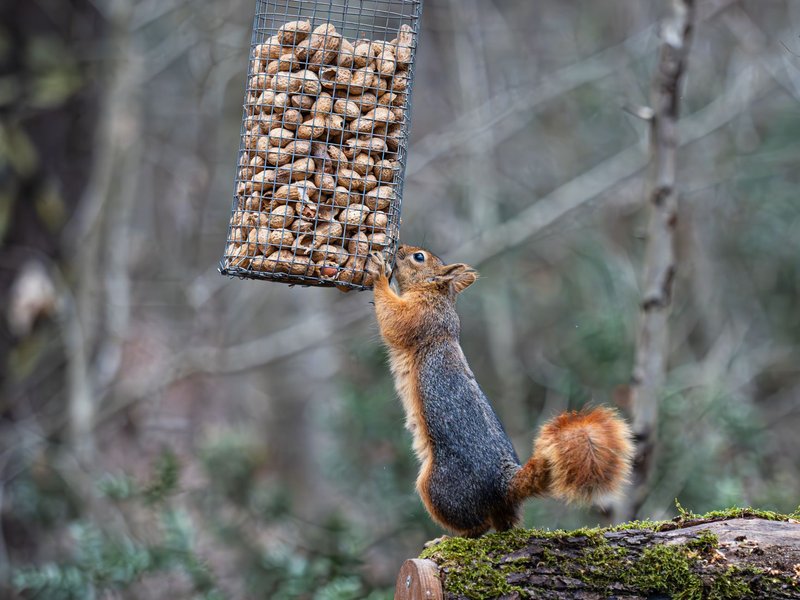
Wildlife agencies generally discourage feeding wild animals, and feeding conifer squirrels isn’t necessary, since they have a pantry of their own. If you still put something out, keep it simple and natural.
Good choices
- Unsalted nuts in the shell: hazelnuts, walnuts, unsalted peanuts
- Black oil sunflower seeds
- Whole cones from local conifers, if you have them
Avoid
- Salted or flavored nuts
- Bread, crackers, chips and sweets
- Corn-only mixes, which are low in nutrition
- Anything moldy
Put out a small handful, not a pile. Spread it out so one squirrel can’t claim the whole thing, and stop if it starts attracting rats or mice. A feeder that makes squirrels depend on you does them no favors. They are built to find truffles under a log in January, and that’s a skill worth keeping.
Now you know what a chickaree eats. The next time you find a pile of cone scales at the foot of a stump, you’ll know who ate there.