Most “animals of Europe” guides treat the continent as one giant block, running you through polar bears’ Arctic cousins and Balkan brown bears in the same breath as a hedgehog in an English garden. That’s not wrong, exactly. It’s just not useful if you’re actually trying to picture what lives between the Alps and the Atlantic.
Western Europe — France, Germany, the Benelux countries, the British Isles, the Alps, Iberia — has its own cast. Fewer big predators than the east, more recovery stories than you’d expect, and a surprising number of species you can go stand near this weekend if you know where to look. Here are 20 of them, grouped by the habitat you’d actually find them in, with a note on how each is doing and where to see it for yourself.
Table of Contents
- Alpine High Country
- Forest and Woodland
- Coastal and Marine
- Wetlands and Wading Birds
- Farmland and Hedgerow
- How Western Europe’s Wildlife Differs from the East and North
- Final Thoughts
Alpine High Country
The mountains strip the animal list down to specialists: creatures that can handle thin air, scree slopes, and winters that last half the year.
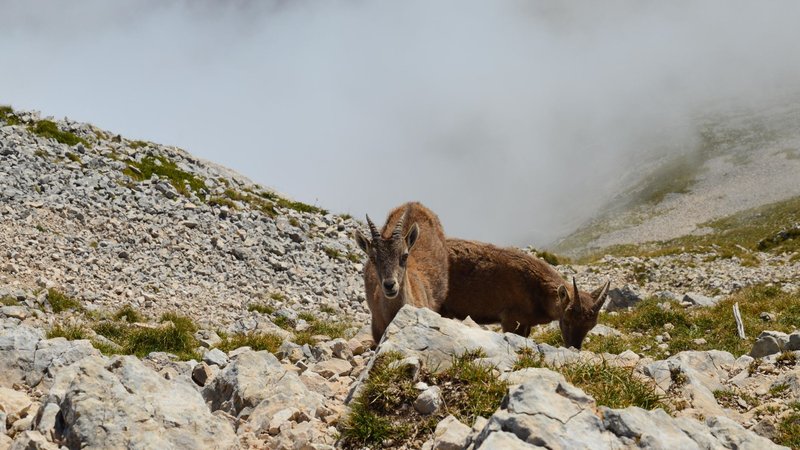
Alpine ibex. A wild goat with backward-curving horns that can hit a meter long on an old male, the ibex spends its life on cliff faces most animals wouldn’t attempt. It was hunted down to a single population in Italy’s Gran Paradiso massif by the early 1800s — every ibex alive today descends from those survivors. Reintroduction programs rebuilt the population across the Alps through the 20th century, and National Geographic has documented how close that bottleneck came to wiping the species out entirely. Conservation status: Least Concern. Where to see it: Gran Paradiso National Park in Italy, or the Swiss trails above Zermatt in early morning, when herds come down to graze before the heat pushes them back up.
Alpine marmot. The whistle you hear on a high trail and can’t place — that’s a marmot sentry warning its colony. They live in extended family burrows, hibernate for up to six months, and spend the rest of the year building up fat reserves by grazing alpine meadows in the cool hours. Least Concern, common across the range. Where to see it: the meadows around Chamonix or any well-trodden Alpine pass above the treeline; they’ve gotten used enough to hikers that you can often watch one for a full minute before it dives.
Chamois. A goat-antelope built for speed rather than raw climbing power, the chamois can outrun a wolf on a slope that would kill most predators to attempt. It’s smaller and warier than the ibex, with hook-shaped horns and a habit of freezing mid-stride when it senses movement. Least Concern. Where to see it: the Pyrenees and the Vosges as well as the Alps proper — it has a wider range than the ibex and turns up in more accessible national parks.
Bearded vulture. Also called the lammergeier, this is the bird that eats bone. It swallows fragments whole or drops larger bones from height onto rock slabs to crack them open for the marrow — a feeding behavior almost no other bird uses. It was shot and poisoned to extinction across the Alps by the 1910s. The International Bearded Vulture Reintroduction Project has been releasing captive-bred birds back into the range since 1986, and the population has climbed slowly ever since, a recovery tracked by the IUCN Red List. Globally Near Threatened, and still rare enough regionally that a sighting is worth marking down. Where to see it: the Hohe Tauern in Austria’s eastern Alps, or the French side near Haute-Savoie.
Forest and Woodland
Western Europe’s forests lost their apex predators generations before Eastern Europe’s did — but some are coming back.
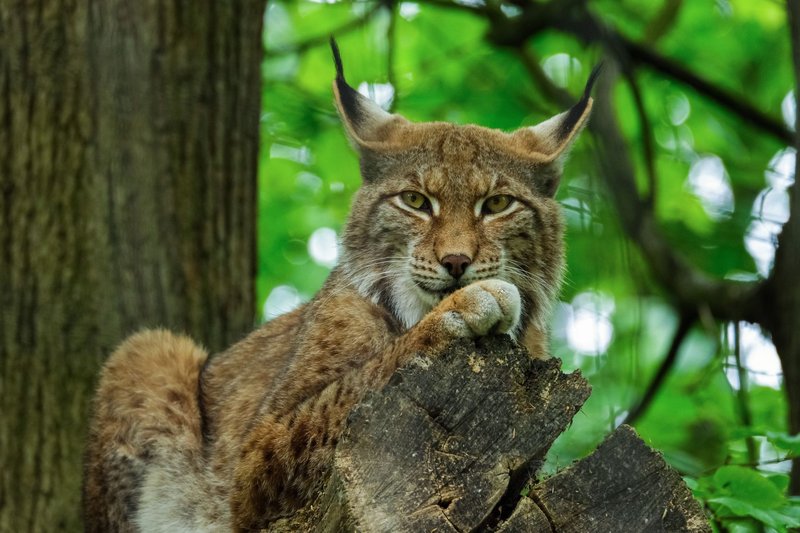
Eurasian lynx. The largest wild cat on the continent, built with tufted ears, a stub tail, and paws wide enough to work as snowshoes. It hunts alone, mostly at dawn and dusk, and a lynx can go days between kills on a single roe deer carcass. Extinct across most of Western Europe by the 1900s, it’s been reintroduced to the Jura mountains on the French-Swiss border, the Vosges, and Germany’s Harz Mountains, with BBC coverage tracking the slow, contested spread of these populations. Globally Least Concern but regionally endangered in reintroduced pockets. Where to see it: you won’t, most likely — lynx avoid people — but the Harz National Park runs an enclosure where you can see individuals up close, and wild sightings do get reported in the Jura.
Red deer. The largest deer species in Western Europe, with stags that can weigh over 200 kilograms and antlers that get more elaborate each year until the animal peaks around age seven or eight. The autumn rut, when stags roar and clash antlers over harems of hinds, is one of the most dramatic wildlife spectacles the region offers and doesn’t require any luck to witness. Least Concern. Where to see it: the Scottish Highlands, where free-roaming herds number in the tens of thousands, or England’s New Forest, where the rut draws crowds every September.
Wild boar. Populations have exploded across France and Germany in the past two decades — fewer natural predators, milder winters, and crops that make ideal forage have pushed numbers into the millions in France alone, enough to make boar a genuine agricultural problem rather than just a woodland curiosity. They’re intelligent, mostly nocturnal, and a sow with piglets will charge if she feels cornered. Least Concern, trending upward. Where to see it: forest edges near farmland at dusk almost anywhere in rural France or Germany, particularly the Ardennes.
Pine marten. A slim, tree-climbing member of the weasel family that was hunted nearly to extinction in Britain by the early 1900s for its fur. It’s recovering now, helped along by an odd side effect: pine martens prey on grey squirrels — an invasive species — far more readily than on native red squirrels, and areas where martens have returned have seen red squirrel numbers rebound as a result. Least Concern, recovering regionally. Where to see it: the Caledonian pine forests of Scotland, particularly around the Cairngorms, where hide-based watching sites have sprung up around the recovery.
Coastal and Marine
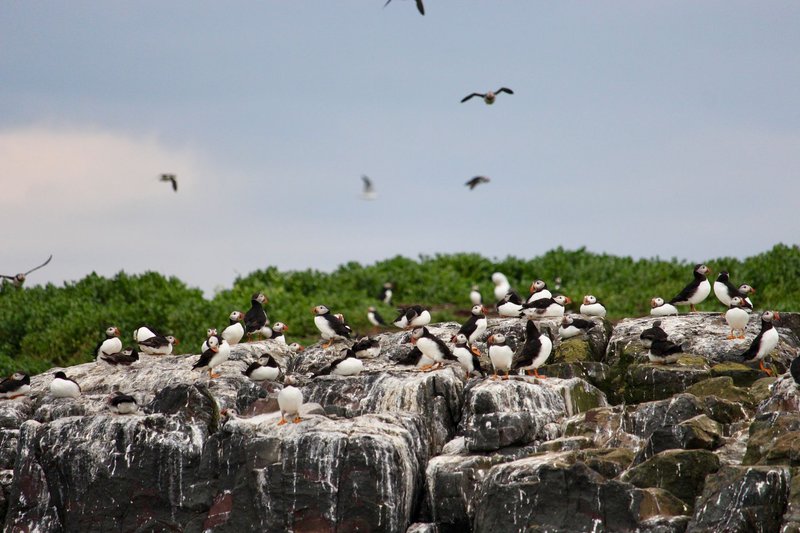
The Atlantic coastline, from the Wadden Sea to the Bay of Biscay, supports some of Europe’s largest wildlife concentrations — you just have to look at cliffs and water instead of trees.
Atlantic grey seal. One of the rarest seal species worldwide by global population, but concentrated enough along this coastline that Western Europe holds a meaningful share of it. Colonies haul out to breed on beaches in autumn and early winter, when thousands of pups are born within a few weeks of each other. Least Concern regionally, though populations are closely monitored. Where to see it: Blakeney Point in Norfolk, England, hosts one of the largest pupping colonies in the world every winter, and Germany’s Wadden Sea has its own well-established haul-out sites.
Atlantic puffin. The clown-faced seabird that spends most of the year alone on open ocean and only comes to land to breed, nesting in burrows on grassy clifftops. Chicks fledge at night and head straight out to sea without a parent escort — a fact that still surprises people who assume all birds are taught to fly. Globally Vulnerable, according to the RSPB, which runs several of the UK’s major puffin colonies. Where to see it: Skomer Island off the Welsh coast in early summer, when tens of thousands of pairs pack the cliffs.
Harbor porpoise. The smallest cetacean found in European waters, rarely more than 1.5 meters long and easy to miss — it surfaces quietly, without the showy breaches of dolphins, and disappears again in seconds. It’s the most commonly sighted whale-family species in the English Channel and southern North Sea. Globally Least Concern, though the Baltic subpopulation is separately classified as critically endangered. Where to see it: ferry crossings of the English Channel or Bay of Biscay give reasonable odds on a calm day, no boat tour required.
Common guillemot. A cliff-nesting seabird that packs onto ledges so densely the colonies look like crowded stadium seating, laying a single pear-shaped egg directly on bare rock — the shape keeps it from rolling off. Least Concern. Where to see it: Bempton Cliffs in Yorkshire or the Farne Islands off Northumberland, both accessible by short boat trips in the breeding season.
Wetlands and Wading Birds
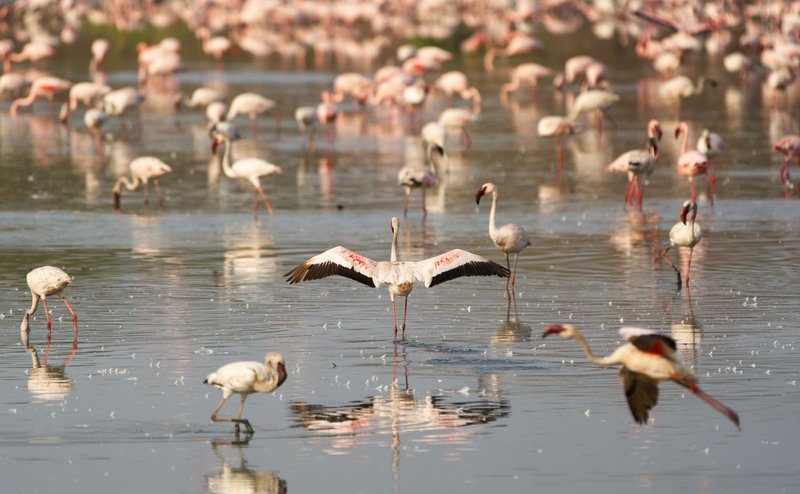
Western Europe’s wetlands are its most underrated wildlife habitat — the Camargue alone rivals anywhere in Europe for sheer density of birdlife.
Greater flamingo. France’s Camargue delta hosts the largest flamingo colony in Europe, with breeding numbers running into the thousands of pairs in a good year, feeding in shallow saline lagoons where they filter brine shrimp that tint their feathers pink. Least Concern. Where to see it: the Camargue Regional Nature Park, where boardwalks put you within easy view without disturbing the colony, or the marshes of southern Spain’s Coto Doñana.
White stork. A conservation comeback story: populations crashed across Western Europe through the mid-20th century as pesticides and wetland drainage cut off both food and nesting habitat, and the bird disappeared from entire regions. Targeted protection, artificial nest platforms, and pesticide bans brought it back, and storks now nest on rooftops and chimney stacks across Alsace and rural Germany every spring before migrating to sub-Saharan Africa for winter. Least Concern, recovering. Where to see it: village rooftops throughout Alsace in France, where nesting pairs are actively encouraged and monitored.
Eurasian otter. Nearly wiped out across Britain by the 1970s from organochlorine pesticide runoff that built up in the food chain, the otter has staged one of the country’s clearest wildlife recoveries — a national survey found the species present in every English county by 2011, after decades of near-total absence from large parts of the country. Least Concern. Where to see it: the rivers of Devon and the Scottish lochs, best at dawn when they’re most active and the water is still enough to spot a wake.
Common crane. Tall, gray, and unmistakable in flight with legs and neck fully extended, cranes breed in the lake districts of northern Germany and stage in massive numbers at Lac du Der in France during migration, before wintering on the acorn-rich oak woodlands of Extremadura in Spain. Least Concern. Where to see it: Lac du Der in autumn, when tens of thousands pass through on a single migration wave — one of the loudest, most visible bird spectacles in Western Europe.
Farmland and Hedgerow
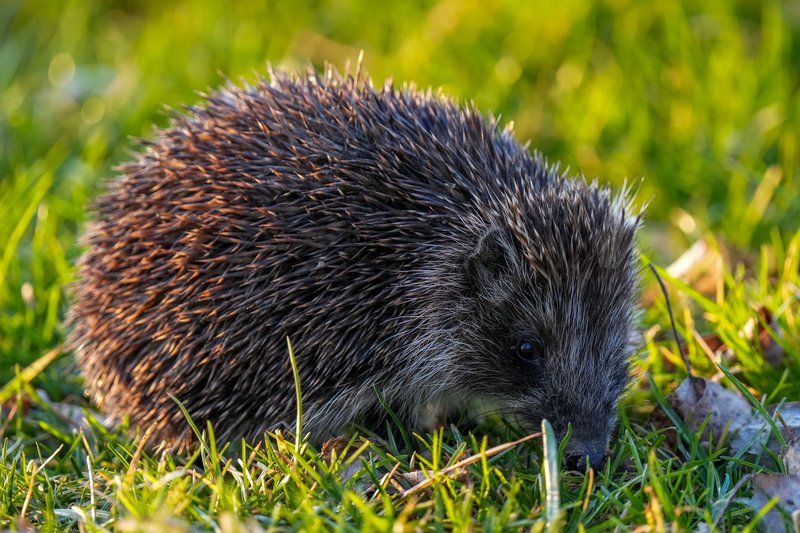
The animals most people in Western Europe actually live alongside — and, in several cases, the ones in the most quiet trouble.
European hedgehog. A garden regular that’s become a genuine conservation concern: hedgerow loss, more impermeable garden fencing, and busier roads have driven steep declines across the UK in particular over the past few decades. Regionally Near Threatened. Where to see it: gardens and parks at dusk almost anywhere in Britain, France, or Germany — leaving a gap under a garden fence is one of the simplest things a homeowner can do to help one move between territories.
Barn owl. A near-silent hunter, with wing feathers structured to muffle the sound of air moving over them, that patrols farmland edges and rough grassland for voles. Modern farming’s loss of the tussocky field margins barn owls hunt over drove serious declines through the 20th century, partly offset since by targeted nest box schemes. Least Concern, stabilizing where habitat is actively managed. Where to see it: farmland edges at dusk in rural England, where nest box programs have made sightings more predictable than they were a generation ago.
Brown hare. Introduced to Britain by the Romans and now naturalized across the region, the brown hare is famous for the “boxing” matches seen in early spring — usually a female fending off an overeager male rather than two males competing, which is the common misconception. Least Concern but declining across parts of its range. Where to see it: open arable farmland in eastern England or northern France, best in March and April during the boxing season.
Red fox. The most widespread carnivore in Western Europe by a wide margin, equally at home in remote farmland and city center — Europe’s urban fox populations, especially in Britain, have adapted to bin-raiding and garden visits so thoroughly they barely resemble their rural, more wary counterparts. Least Concern. Where to see it: literally anywhere, urban gardens included, most often around dawn or dusk.
How Western Europe’s Wildlife Differs from the East and North {#how-western-europes-wildlife-differs}
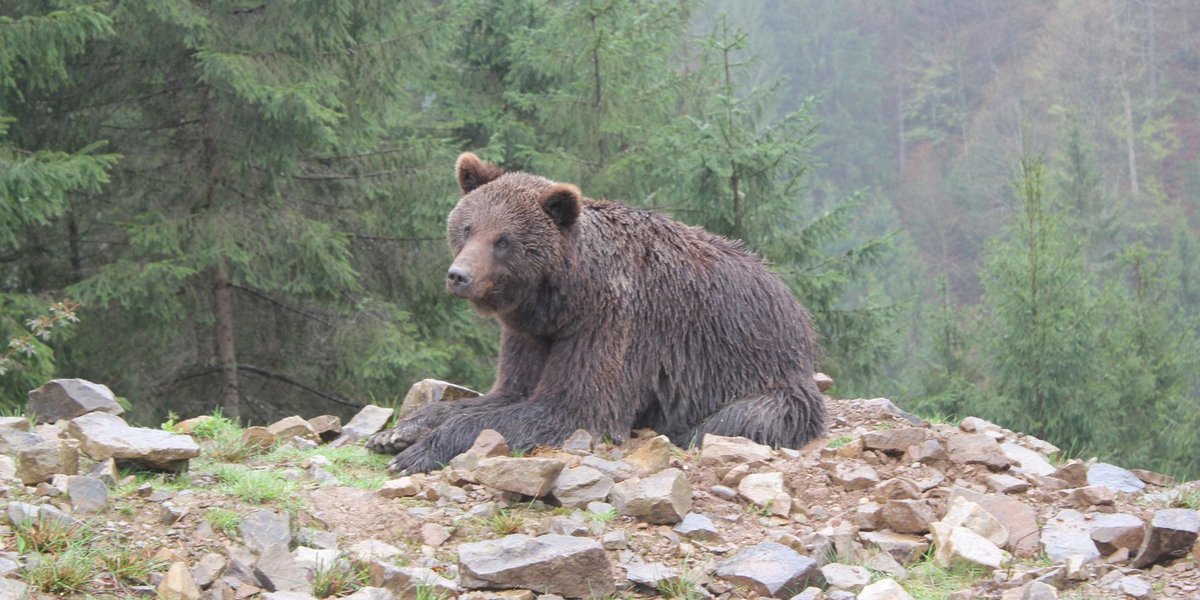
Cross into Poland, Romania, or the Balkans and the animal list changes fast. Brown bears and grey wolves are established, working populations there rather than reintroduction projects, and Poland’s Białowieża Forest still holds free-ranging European bison — an animal that vanished from the wild across the rest of the continent by the early 1900s. Go north into Scandinavia instead and you pick up reindeer, moose, wolverine, and Arctic fox: species built for a climate and a land area Western Europe simply doesn’t have.
The reason for the gap is mostly historical rather than ecological. Western Europe industrialized and farmed intensively earlier and more densely than the east, which pushed large predators out centuries before similar pressure reached Eastern Europe’s forests. Wolves are now working their way back into France and Germany on their own, dispersing westward from established Eastern European populations rather than through reintroduction — which is part of why a Western European wolf sighting still makes regional news in a way a Romanian one wouldn’t.
Final Thoughts {#final-thoughts}
None of these 20 species require a safari budget or a guide. A ferry crossing, a farmland walk at dusk, a weekend in the Camargue or the Cairngorms covers most of this list without much planning. The bigger pattern worth noticing: several of these are comeback stories — the stork, the otter, the pine marten, the ibex — species that were gone from large parts of the region within living memory and came back because someone decided the loss wasn’t acceptable. That’s arguably the more interesting story than the wildlife-spotting checklist itself.