Ask a biologist how many amphibian species are truly blue and you’ll get a shrug, not a number. Blue is one of the rarest colors in the animal kingdom to begin with, and amphibians make it harder still — most of what reads as green on a frog is actually a blue base with a yellow filter laid over it. Strip that filter away and the real list gets short fast: a handful of poison frogs, two tree frogs, one salamander with an unusual reproductive setup, and a pair of European frogs that turn electric blue for about three days a year and then quietly fade back to brown.
Table of Contents
- The Quick Answer
- Why Blue Is So Rare in Amphibians
- The Poison Dart Frogs That Are Genuinely Blue
- Are Blue Frogs Poisonous?
- The Non-Toxic Blue Tree Frogs
- The Frogs That Turn Blue Just to Mate
- The Only Blue Salamander Worth Knowing
- What About Blue Caecilians?
- Rarity and Safety, Side by Side
The Quick Answer
- Permanent, genuine blue in amphibians is concentrated almost entirely in the poison dart frog family, plus two tree frogs and one salamander.
- The brightest blue frogs are toxic in the wild, but captive-bred individuals raised without their native ant-and-mite diet lose most of that toxicity within a generation.
- Two European frog species turn blue only for a handful of nights during breeding season, then revert to brown.
- There’s exactly one blue salamander worth discussing, and its reproduction is stranger than its color.
- No confirmed caecilian species is blue. There’s a straightforward reason for that, covered near the end.
Why Blue Is So Rare in Amphibians
Amphibian skin gets its color from three stacked layers of cells. Xanthophores sit on top and hold yellow and red pigment. Melanophores sit at the bottom and hold dark melanin. In between sit iridophores, which don’t carry pigment at all — they’re made of stacked, light-reflecting crystal platelets that bounce back blue wavelengths through pure physics, the same trick that makes a soap bubble shimmer.
Most “green” frogs are really blue iridophores showing through a yellow xanthophore filter. Pull that yellow layer out — through a genetic condition called axanthism, or through natural variation in a population — and the frog underneath is blue. That’s the mechanism behind almost every entry on this list, and it’s also why you’ll occasionally see photos online of an all-blue bullfrog or green tree frog: it’s the same species, just missing its yellow filter.
The reasons a species keeps that blue once it shows up differ by group. In poison frogs, blue functions as a warning sign to predators — a phenomenon called aposematism, pairing a toxic body with a color that’s hard to miss. In salamanders, scattered blue flecking works more like disruptive camouflage, breaking up the animal’s outline in leaf litter. And in a couple of temperate frogs, blue shows up for only a few days a year as a mating signal, then disappears.
The Poison Dart Frogs That Are Genuinely Blue
If you want reliably, permanently blue amphibians, this is the family to look at. Four species stand out.
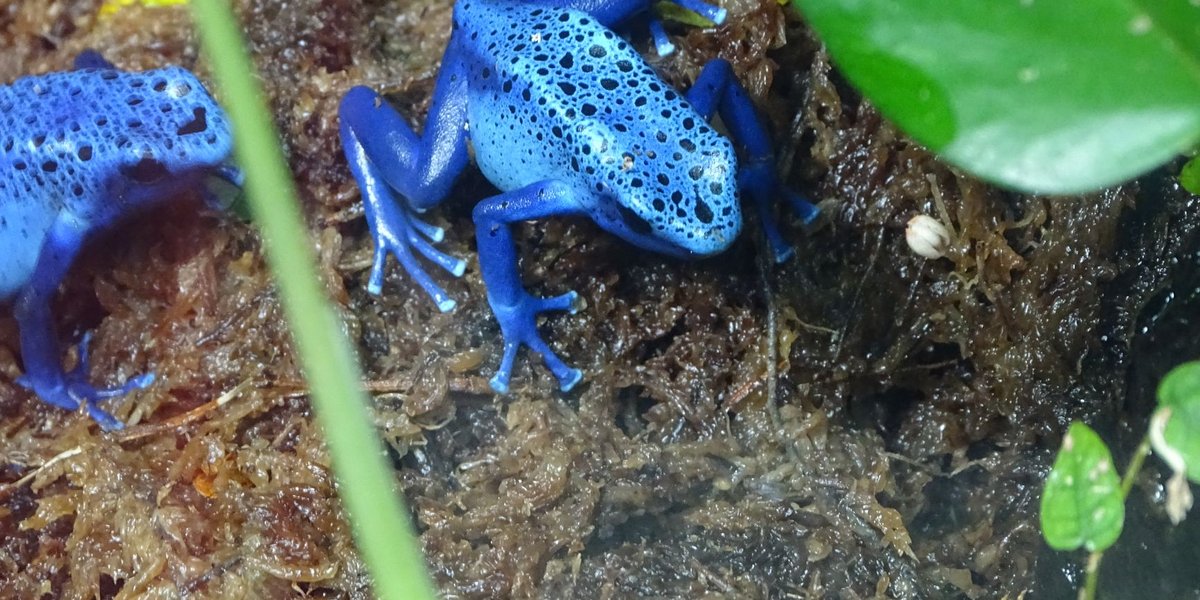
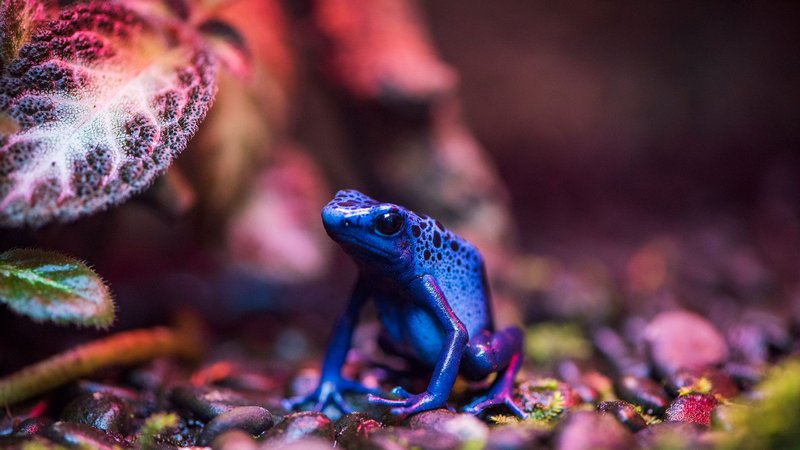
Blue poison dart frog (Dendrobates tinctorius “azureus”) lives only on a scatter of forest islands surrounded by the Sipaliwini savanna in southern Suriname — nowhere else on Earth. Locally it’s called okopipi. For decades it was classified as its own species, D. azureus, but DNA analysis showed it’s genetically identical to the much more widespread D. tinctorius, just a striking color morph rather than a separate lineage. The taxonomy got folded back together; the frog is still the bluest thing in the Guiana Shield.
Blue jeans poison frog (Oophaga pumilio) is the one most people have actually seen a photo of without knowing its name: red body, cobalt-to-black legs, native to Costa Rica and Panama. The Bocas del Toro archipelago off Panama’s Caribbean coast is the real draw for biologists — different islands have evolved wildly different color combinations in isolation, including populations that are blue or green rather than red.
Zimmerman’s poison frog (Ranitomeya variabilis) runs bright yellow with deep blue limbs and black spotting, found along the eastern Andean foothills of Peru and Ecuador. It comes in two distinct forms depending on elevation — striped in the lowlands, spotted in the highlands — which for years led researchers to mistake it for two separate species.
Sky-blue poison frog (Hyloxalus azureiventris) is the most geographically restricted of the four, known only from Peru’s San Martín region on the eastern slope of the Andes, between roughly 200 and 1,200 meters — a level of restriction that places it among South America’s most endangered species. Unlike most dart frogs, which stick to leaf litter, this one favors caves and rock piles — an odd habitat choice for a frog that relies on being seen to survive.
Are Blue Frogs Poisonous?
In the wild, yes — but the frogs don’t make the toxin themselves. Dart frogs pick up alkaloid compounds from the ants, mites, and other small invertebrates they eat, then concentrate those compounds in their skin. It’s diet, not biology, that makes them dangerous.
That’s why captive-bred blue poison frogs, raised on fruit flies and crickets instead of their native diet, lose most of their toxicity within one generation. A pet-store azureus or blue jeans frog is essentially harmless to handle, though you should still wash your hands before and after — human skin oils, lotion, and soap residue can hurt the frog even when the frog can’t hurt you. Wild-caught individuals are a different story and shouldn’t be handled bare-handed at all.
The Non-Toxic Blue Tree Frogs
Not every blue amphibian is a poison frog. Two tree-dwelling species get their color from the same structural mechanism without any toxin attached.
Blue-spotted tree frog (Leptomantis cyanopunctatus) turns up across Indonesia, Malaysia, Singapore, Thailand, Vietnam, and possibly Myanmar, in primary and secondary rainforest near streams up to about 600 meters elevation. Males call from perches roughly 2.5 meters above the water. Its range is wide enough that it’s currently rated least concern for extinction, though ongoing deforestation is worth watching.
Blue-sided leaf frog (Agalychnis annae), also called the golden-eyed tree frog, lives in and around Costa Rica’s Central Valley. By day it’s mostly green with an orange eye; when it leaps, the blue on its flanks and inner thighs flashes into view and then vanishes again as it lands — a flicker meant to confuse a predator’s aim rather than warn it off. Urban sprawl around San José has fragmented its habitat badly enough that the IUCN lists it as vulnerable, though a citizen-science survey found populations persisting in suburban parks and gardens, not just protected forest.
The Frogs That Turn Blue Just to Mate
This is the strangest entry on the list, because the frogs involved aren’t blue most of the year. The moor frog (Rana arvalis) and its close relatives, spread across mainland Europe and parts of Scandinavia like Finland, spend most of the year in ordinary brown. For a handful of nights during peak spawning — typically a narrow window between March and June depending on latitude — males turn a vivid blue or purple while females stay brown. Researchers studying the Balkan population found that mating success tracked with how blue a male got, especially among smaller males competing against larger rivals. Once the breeding frenzy ends, the color fades and the frogs go back to looking like every other brown frog in the pond until next spring.
The Only Blue Salamander Worth Knowing
Salamanders don’t do blue the way frogs do. The one real exception is the blue-spotted salamander (Ambystoma laterale), black-bodied with pale blue flecking, ranging across the Great Lakes region, New England, the Atlantic provinces, and as far north as James Bay, Ontario.
Its color is the least interesting thing about it. In parts of its range, blue-spotted salamanders form all-female hybrid lineages with related species like the Jefferson salamander, reproducing through a process called kleptogenesis: the hybrid females use sperm from males of a related species just to trigger egg development, then typically discard that male’s genetic contribution and develop the eggs asexually. It’s one of the more unusual reproductive strategies in North American vertebrates, blue spots aside.
What About Blue Caecilians?
No confirmed blue caecilian species exists, and the gap makes sense once you know what caecilians are. They’re limbless, burrowing amphibians that spend nearly their entire lives underground or in leaf litter, and most species have reduced or nonexistent eyesight. Their coloring runs to gray, pink, black, and the occasional yellow band — colors that show up in soil-dwelling animals generally, since there’s no predator or mate to signal to in total darkness. Blue, in every amphibian on this list, exists to be seen. A caecilian has no reason to grow a color nobody’s looking at.
Rarity and Safety, Side by Side
| Species | Range | Toxic in the Wild? | Conservation Status | Keep as a Pet? |
|---|---|---|---|---|
| Blue poison dart frog (azureus) | Suriname (Sipaliwini savanna only) | Yes — not in captive-bred stock | Least concern | Captive-bred only |
| Blue jeans poison frog | Costa Rica, Panama | Yes — not in captive-bred stock | Least concern | Captive-bred only |
| Zimmerman’s poison frog | Peru, Ecuador | Yes — not in captive-bred stock | Least concern overall; some populations pressured by habitat loss | Captive-bred, experienced keepers |
| Sky-blue poison frog | Peru (San Martín region only) | Yes | Limited range, rarely assessed | Rarely available; not recommended |
| Blue-spotted tree frog | Southeast Asia | No | Least concern | Uncommon in the pet trade |
| Blue-sided leaf frog | Costa Rica | No | Vulnerable, declining | No — avoid wild-collected animals |
| Moor frog (breeding-season blue) | Continental Europe, Scandinavia | No | Least concern | No — color is temporary and seasonal |
| Blue-spotted salamander | Northeastern North America | No | Least concern | No — protected in parts of its range |
If you’re chasing rarity, the blue-sided leaf frog and the sky-blue poison frog are your two candidates — one because its habitat keeps shrinking, the other because it was never found in more than one river valley to start with. Everything else on this list is stable enough that the bigger threat to seeing one isn’t extinction. It’s just knowing where to look.