A 1-year-old dog is about 15 in human years and a 2-year-old is about 24. After that the rate depends on the breed: a Labrador gains about 5 human years for each dog year, a French Bulldog about 7. The old rule of 7 human years per dog year fits neither the first years nor the last.
Enter your dog’s breed and age above and the dog years calculator returns the human-equivalent age, the life stage and the age your dog becomes a senior. It also works in reverse, from human years to dog years, and it shows how the answer compares with the AVMA chart, the DNA-methylation formula and the multiply-by-7 rule. Everything on this page, including the charts, comes from the same model.
How to use the dog years calculator
- Pick a breed or “Mixed / not sure”. The breed sets your dog’s expected lifespan. For a mixed-breed dog, enter its adult weight in pounds or kilograms and the calculator estimates the lifespan from size.
- Enter your dog’s age. Use years and months, or a birth date. Months matter in the first two years, when a dog ages fastest.
- Read the result. You get the human-equivalent age, the life stage and the age at which your dog reaches the senior stage.
- Switch to human to dog to turn a human age into a dog age for the same breed. The conversion is the exact inverse of the dog-to-human one.
Ages past a breed’s typical lifespan are labeled “past the typical lifespan for the breed”. That describes where the dog sits on the breed’s survival curve. It is not a prognosis, and many dogs live well beyond the median.
New puppy? The puppy weight calculator estimates adult size, which also feeds the mixed-breed option here. To convert a cat’s age, use the cat years calculator. The full set of tools is on the calculators page. Also own a horse? Our horse years calculator does the same for horses, ponies, donkeys and mules.
Dog years to human years chart
This chart shows the human-equivalent age for dogs aged 1 to 20, by size. The size columns use a typical mixed-breed dog of the stated weight, so a breed with a known lifespan may differ. Look your breed up in the breed table below.
| Dog age | Small (15 lb) | Medium (35 lb) | Large (70 lb) | Giant (120 lb) |
|---|---|---|---|---|
| 1 | 15 | 15 | 15 | 13 |
| 2 | 24 | 24 | 24 | 21 |
| 3 | 29 | 29 | 30 | 28 |
| 4 | 34 | 34 | 35 | 35 |
| 5 | 39 | 39 | 41 | 42 |
| 6 | 43 | 44 | 46 | 49 |
| 7 | 48 | 49 | 52 | 56 |
| 8 | 53 | 55 | 58 | 62 |
| 9 | 58 | 60 | 63 | 69 |
| 10 | 63 | 65 | 69 | 76 |
| 11 | 68 | 70 | 75 | 81 |
| 12 | 73 | 75 | 80 | 85 |
| 13 | 78 | 80 | 83 | 88 |
| 14 | 81 | 82 | 85 | 92 |
| 15 | 83 | 85 | 88 | 96 |
| 16 | 86 | 87 | 91 | 99 |
| 17 | 88 | 90 | 94 | 103 |
| 18 | 91 | 93 | 97 | 106 |
| 19 | 93 | 95 | 100 | 110 |
| 20 | 96 | 98 | 103 | 113 |
Three things stand out. Every size reaches 15 at year 1, except giant dogs, which mature later and sit at 13. Between years 3 and 10 the sizes spread apart: a 7-year-old is 48 in human terms if small and 56 if giant. After about year 12 or 13 the lines flatten, because the oldest dogs of every size age more slowly per year than middle-aged dogs. The next sections explain why.
The chart in a short form: 1 dog year = 15, 2 = 24, 5 = 39 to 42, 10 = 63 to 76, 15 = 83 to 96.

Human years to dog years chart
To convert the other way, find the human age in the first column. The cells give the dog’s age in years (y) and months (mo). A 15-year-old human matches a 1-year-old dog, and a 30-year-old human matches a dog of about 3 years.
| Human age | Small dog | Medium dog | Large dog | Giant dog |
|---|---|---|---|---|
| 10 | 6 mo | 6 mo | 6 mo | 7 mo |
| 15 | 1 y | 1 y | 1 y | 1 y 2 mo |
| 18 | 1 y 4 mo | 1 y 4 mo | 1 y 4 mo | 1 y 7 mo |
| 21 | 1 y 8 mo | 1 y 8 mo | 1 y 8 mo | 2 y |
| 25 | 2 y 2 mo | 2 y 2 mo | 2 y 2 mo | 2 y 7 mo |
| 30 | 3 y 3 mo | 3 y 2 mo | 3 y 1 mo | 3 y 4 mo |
| 40 | 5 y 3 mo | 5 y 2 mo | 4 y 10 mo | 4 y 9 mo |
| 50 | 7 y 4 mo | 7 y 1 mo | 6 y 8 mo | 6 y 2 mo |
| 60 | 9 y 5 mo | 9 y 1 mo | 8 y 5 mo | 7 y 8 mo |
| 70 | 11 y 5 mo | 11 y | 10 y 2 mo | 9 y 1 mo |
| 80 | 13 y 8 mo | 13 y 2 mo | 12 y 2 mo | 10 y 8 mo |
| 90 | 17 y 8 mo | 16 y 11 mo | 15 y 7 mo | 13 y 6 mo |
| 100 | 21 y 7 mo | 20 y 9 mo | 19 y | 16 y 3 mo |
Dogs and humans do not age at a constant ratio, so there is no single multiplier that works in both directions. The chart is the same model as the first one, read in reverse.
Dog years by breed
Breed changes the answer because breeds have different lifespans. The table lists the human-equivalent age at seven dog ages for the 25 most popular breeds in the AKC’s 2025 ranking, along with each breed’s median lifespan. Ages past a breed’s median describe the minority of dogs that live that long.

| Breed | Median lifespan | 1 y | 3 y | 5 y | 8 y | 10 y | 12 y | 15 y |
|---|---|---|---|---|---|---|---|---|
| French Bulldog | 9.8 | 15 | 31 | 45 | 66 | 80 | 87 | 98 |
| Labrador Retriever | 13.1 | 15 | 29 | 39 | 54 | 64 | 74 | 84 |
| Golden Retriever | 13.2 | 15 | 29 | 39 | 53 | 63 | 73 | 84 |
| German Shepherd Dog | 11.3 | 15 | 30 | 42 | 59 | 71 | 81 | 90 |
| Dachshund | 13.2 | 15 | 29 | 39 | 53 | 63 | 73 | 84 |
| Poodle (Standard) | 14.0 | 15 | 29 | 38 | 52 | 61 | 70 | 81 |
| Beagle | 12.5 | 15 | 29 | 40 | 55 | 66 | 76 | 86 |
| Rottweiler | 10.6 | 13 | 28 | 41 | 61 | 75 | 84 | 94 |
| German Shorthaired Pointer | 13.4 | 15 | 29 | 38 | 53 | 63 | 72 | 83 |
| Bulldog (English) | 9.8 | 15 | 31 | 45 | 66 | 80 | 87 | 98 |
| Cane Corso | 8.1 | 13 | 31 | 50 | 78 | 88 | 98 | 113 |
| Cavalier King Charles Spaniel | 11.8 | 15 | 30 | 41 | 58 | 69 | 80 | 88 |
| Yorkshire Terrier | 13.3 | 15 | 29 | 39 | 53 | 63 | 73 | 83 |
| Australian Shepherd | 13.7 | 15 | 29 | 38 | 52 | 62 | 71 | 82 |
| Doberman Pinscher | 11.2 | 15 | 30 | 42 | 60 | 72 | 81 | 91 |
| Pembroke Welsh Corgi | 13.2 | 15 | 29 | 39 | 53 | 63 | 73 | 84 |
| Miniature Schnauzer | 13.3 | 15 | 29 | 39 | 53 | 63 | 73 | 83 |
| Boxer | 11.3 | 15 | 30 | 42 | 59 | 71 | 81 | 90 |
| Pomeranian | 12.2 | 15 | 29 | 40 | 56 | 67 | 78 | 87 |
| Bernese Mountain Dog | 10.1 | 15 | 31 | 44 | 65 | 78 | 86 | 96 |
| Shih Tzu | 12.8 | 15 | 29 | 39 | 55 | 65 | 75 | 85 |
| Great Dane | 10.6 | 13 | 28 | 41 | 61 | 75 | 84 | 94 |
| Boston Terrier | 11.8 | 15 | 30 | 41 | 58 | 69 | 80 | 88 |
| Chihuahua | 11.8 | 15 | 30 | 41 | 58 | 69 | 80 | 88 |
| Havanese | 14.5 | 15 | 28 | 37 | 50 | 59 | 68 | 80 |
Size does not decide everything. A Chihuahua’s median lifespan is 11.8 years, shorter than the Labrador’s 13.1, so a 10-year-old Chihuahua is 69 in human terms and a 10-year-old Labrador is 64. A French Bulldog, a medium-sized breed, has a median of 9.8 years and reaches 80 by age 10, which is older than a 10-year-old Great Dane at 75. The Great Dane’s median is 10.6 years.
The Havanese has the longest median in the table at 14.5 years and the Cane Corso the shortest at 8.1. The Cane Corso figure rests on fewer dogs and has a wide 95% range of 6.5 to 9.5 years. Not sure which breed fits your family? The dog breed quiz narrows it down, and the healthy dog breeds guide covers health and longevity.
Notes on breed rows: the source reports one Poodle median for Toy, Miniature and Standard Poodles together, so the Poodle row uses that pooled figure with the Standard size class. The Dachshund row pools the standard coats, and the Beagle row pools both Beagle sizes.
Why “multiply by 7” is wrong
A dog’s age times 7 gives a human age that is too low in the first years and too high in the last. A 1-year-old dog is not 7 in human terms. Dogs reach puberty at around 6 months, so 15 and 24 at years 1 and 2 are much closer to the physical picture.
At the other end, 7 times 16 is 112. A 16-year-old Labrador is 86.5 in this model and 75 by the DNA-methylation formula in the next section.
Nobody has documented where the rule came from, according to Smithsonian Magazine. A common account traces it to the 1950s and divides a human life expectancy of about 70 years by a dog’s of about 10. That explains the ratio as an average lifespan comparison, which is a different thing from a year-by-year age equivalent.

The AVMA chart
The AVMA’s chart replaced the flat multiplier with a stepped one. The first dog year equals 15 human years, the second adds 9 for a total of 24, and each year after that adds about 5 for a medium dog. Its client brochure implies about 4 for small dogs and about 7 for very large ones. This page uses about 4, 5, 6 and 7 for small, medium, large and giant dogs. The rate of about 6 for large dogs is interpolated, not an AVMA figure.
The calculator uses the same two anchors and stays within 5 years of the chart through age 7 for small dogs, age 15 for medium, age 12 for large and age 10 for giant. It diverges from the chart for large and giant dogs at old ages. At 16, the AVMA rule puts a large dog at 108 and a giant at 122, the age of the oldest human on record. This model says 91 and 99. That is a 17 to 23 year gap.
The gap is deliberate. Survival data show the oldest dogs’ last years are compressed: after a breed’s median lifespan, each additional year is a smaller step along the dog’s remaining survival curve. A rule that keeps adding 6 or 7 years per dog year past the median produces human ages no person has reached. The calculator counts each dog year past the median as 0.52 of an earlier one. The method section shows how that figure was derived.
What the DNA clock study found
In 2020 a research team published a formula for dog age from DNA methylation, a chemical tag pattern on DNA that changes with age in both species. They sampled 104 Labrador Retrievers aged from about one month to 16 years, matched the dogs’ methylation pattern to human ones, and fitted the formula human age = 16 × ln(dog age) + 31 (Wang et al. 2020, Cell Systems).
Applied to a Labrador, the formula gives 31 for a 1-year-old, 42 for a 2-year-old, 68 for a 10-year-old and 75 for a 16-year-old. The curve rises steeply in the first two years and then flattens. That is a sharp early rise followed by a slower climb, the same general shape as this calculator’s curve with a steeper start.
Use the formula with three cautions. It was fitted on Labradors only, so it may not carry over to other breeds. It is not valid under one year of age, because the logarithm of a number below 1 is negative. And a methylation age measures biological change in the DNA, which is a different quantity from the maturity milestones, such as puberty and social maturity, that anchor the first two years here. The calculator shows the formula as a comparison line for dogs 1 year and older.
Dog life stages, from puppy to senior
The American Animal Hospital Association (AAHA) divides a dog’s life into puppy, young adult, mature adult and senior stages (2019 AAHA Canine Life Stage Guidelines). The stages follow growth and the share of lifespan used, not a fixed age.
- Puppy: birth to the end of rapid growth, at 6 to 9 months depending on size. The calculator uses 6 months for small dogs, 7 for medium, 8 for large and 9 for giant.
- Young adult: until physical and social maturity, at 3 to 4 years. The calculator uses 3 years for small and medium dogs and 4 for large and giant.
- Mature adult: from then until the last quarter of the expected lifespan. The calculator splits this into “adult” and “mature” at half the breed’s median lifespan. That split is this site’s choice, not AAHA’s.
- Senior: the last 25% of the expected lifespan.
The AAHA places the end-of-life stage by a dog’s medical condition and not by age. The calculator therefore stops at “senior” and labels dogs older than the breed’s median lifespan as past the typical lifespan.
When does a dog become a senior?
It depends on the breed’s lifespan, because senior is the last 25% of it. By that rule a Chihuahua (median 11.8 years) becomes a senior at 8.9 years, a Labrador (13.1) at 9.8 and a Great Dane (10.6) at 8.0. The AVMA gives size ranges: 8 to 11 years for small dogs (under 20 lb), 8 to 10 for medium (20 to 50 lb), 8 to 9 for large (50 to 90 lb) and 6 to 7 for giant dogs (over 90 lb).
In human terms, seniors of every breed in this model start at about 60 to 63. A small dog reaches that age later in calendar time and a giant dog sooner.
How long do dogs live?
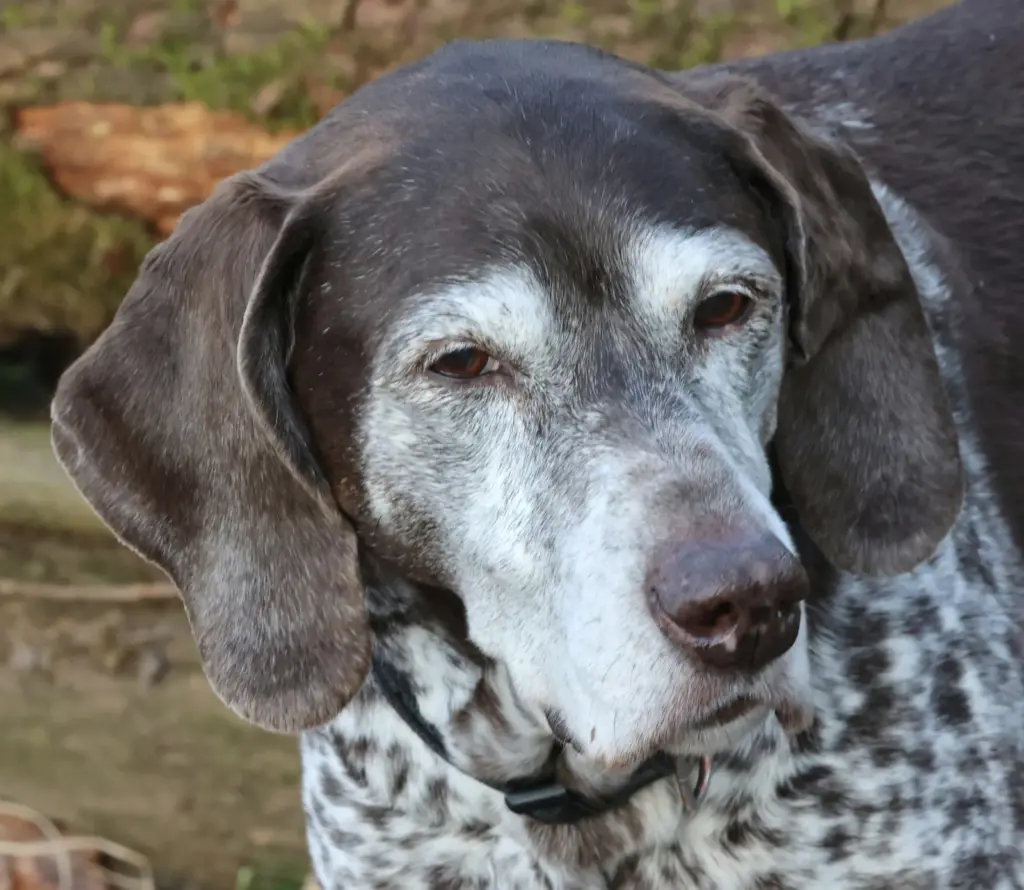
In McMillan et al. (2024), crossbred dogs have a median lifespan of 12.0 years, and the median for individual breeds ranges from 5.4 years for the Caucasian Shepherd and 7.7 for the Presa Canario to 15.2 for the Tibetan Spaniel and 15.4 for the Lancashire Heeler. The study covers 584,734 UK dogs, and “median” means half the dogs of that breed lived longer.
| Breed | Median lifespan (years) | 95% range |
|---|---|---|
| French Bulldog | 9.8 | 9.4-10.1 |
| Labrador Retriever | 13.1 | 13.0-13.1 |
| Golden Retriever | 13.2 | 13.1-13.2 |
| German Shepherd Dog | 11.3 | 11.3-11.4 |
| Dachshund | 13.2 | 13.0-13.5 |
| Poodle (Standard) | 14.0 | 13.8-14.1 |
| Beagle | 12.5 | 12.3-12.7 |
| Rottweiler | 10.6 | 10.4-10.7 |
| German Shorthaired Pointer | 13.4 | 13.3-13.6 |
| Bulldog (English) | 9.8 | 9.7-10.0 |
| Cane Corso | 8.1 | 6.5-9.5 |
| Cavalier King Charles Spaniel | 11.8 | 11.7-11.9 |
| Yorkshire Terrier | 13.3 | 13.3-13.4 |
| Australian Shepherd | 13.7 | 12.8-14.6 |
| Doberman Pinscher | 11.2 | 11.0-11.5 |
| Pembroke Welsh Corgi | 13.2 | 12.7-13.6 |
| Miniature Schnauzer | 13.3 | 13.2-13.5 |
| Boxer | 11.3 | 11.3-11.5 |
| Pomeranian | 12.2 | 12.0-12.5 |
| Bernese Mountain Dog | 10.1 | 9.8-10.4 |
| Shih Tzu | 12.8 | 12.6-12.9 |
| Great Dane | 10.6 | 10.4-11.0 |
| Boston Terrier | 11.8 | 11.0-12.2 |
| Chihuahua | 11.8 | 11.5-11.9 |
| Havanese | 14.5 | 14.1-n/a |
| Border Collie | 13.1 | 13.0-13.2 |
| English Springer Spaniel | 13.5 | 13.4-13.6 |
| Shetland Sheepdog | 13.4 | 13.1-13.6 |
| Siberian Husky | 11.9 | 11.7-12.0 |
Size matters on average. In US clinical data on 13.3 million dogs (Montoya et al. 2023), life expectancy at birth was 13.4 years for toy dogs, 13.5 for small, 12.7 for medium, 11.5 for large and 9.5 for giant dogs. In the UK data, each additional 10 kg of adult weight goes with a lifespan about 0.6 years shorter. But weight explains only about half of the differences between breeds (R2 of 0.47), and face shape accounts for part of the rest: leaving out the 18 flat-faced breeds improves the fit.
Signs your dog is getting older, and when to see a vet
Dogs usually show age gradually, and the first changes are easy to miss. Common early signs include:
- slowing down on walks, or stiffness after rest, especially on stairs and when getting up
- grey hair around the muzzle and eyes
- changes in weight, appetite or thirst
- cloudy eyes, or less response to sounds
- bad breath, drooling or reluctance to chew
- sleeping more, restlessness at night, or confusion in familiar places
Do not write these off as “just age”. Many are signs of treatable conditions such as arthritis or dental disease. Book a check-up when the changes begin, and ask your vet how often your dog needs senior check-ups. The AVMA’s senior pet guidance covers care in this stage.
The calculator’s senior age marks the start of the last quarter of expected lifespan, the AAHA’s definition of senior. It is a good time to raise these changes with your vet.
How this calculator works
The model
- Two fixed anchors. A dog is 15 in human years at 12 months and 24 at 24 months. Earlier anchors are 2.5 at 2 months and 10 at 6 months. Giant breeds mature later, so their anchors stretch by 1.2 (13.3 at 12 months, 21 at 24 months). The 1.2 comes from the growth data in the puppy weight calculator: giants reach 99% of adult weight at 83 weeks and 16-20 kg dogs at 70.
- Linear to the breed median. From age 2 the scale is a straight line chosen so that the breed’s median lifespan maps to 79, the 2024 US life expectancy at birth (CDC NCHS Data Brief 548). A Labrador gains about 5.0 human years per dog year, a Chihuahua 5.6 and a French Bulldog 7.1.
- The slower tail. Past the median, each dog year counts as 0.52 of a pre-median dog year. The factor comes from matching the point at which 25%, 10% and 5% of dogs are still alive to the same points in the 2024 US life table (fitted ratio 0.52; the crossbred curve gives 0.44). The result is capped at 122, the age of the oldest verified person.
- Mixed breeds. Lifespan comes from adult weight with a regression fitted to 120 breeds: median lifespan = 13.74 – 0.0604 × weight in kg. It has an R2 of 0.47 and a leave-one-out error of 0.80 years.
Data
Breed medians come from McMillan KM et al. (2024), Kaplan-Meier medians for 584,734 UK dogs, licensed CC BY 4.0. The calculator covers 218 breeds: 148 have a published median, 37 are crosses estimated as the average of parent breeds and 33 use the size regression and are flagged as estimated. The weights come from the puppy weight calculator’s breed table.
Validation
- The calculator’s output for a medium mixed-breed dog is within 1 year of the AVMA rule from age 1 to 13, and within 5 years through age 15. For small dogs it runs ahead of the AVMA chart by up to 9.5 years, and for large and giant dogs it runs behind by up to 17 and 23 years at age 16.
- Converting a human age back to dog years returns the original age to within 0.02 dog years, even after the human age is rounded to one decimal.
- Cross-checks against other lifespan studies line up in order: the regression predicts 13.6, 13.3, 12.7, 11.7 and 10.3 years for toy through giant dogs, against 13.4, 13.5, 12.7, 11.5 and 9.5 in the US Banfield data (a mean at birth, which runs lower than a median). VetCompass life tables (Teng et al. 2022) give lower values for breeds whose UK numbers grew quickly, such as French Bulldogs, because they count only dogs that died in a four-year window.
Limitations
- The breed medians describe UK dogs. US dogs may differ in health care, diet and breeding lines, and no US breed-level source was used.
- Where the source pools varieties, the calculator uses the pooled median for all of them. This applies to Poodle sizes, Dachshund coats and Beagle sizes.
- The American Pit Bull Terrier is not in the UK data because the breed is restricted there. Its lifespan is estimated from weight (12.5 years), and the American Staffordshire Terrier (12.5) and Staffordshire Bull Terrier (12.0) are listed for reference.
- No measurement defines a dog’s “human age”. Every conversion, including this one, is a model. The calculator estimates how far along its expected life your dog is and does not predict how long an individual dog will live.
- Moving from large to giant switches the anchor set. A 90 lb and a 91 lb dog can differ by up to 3 human years.
Sources
- McMillan KM, Bielby J, Williams CL, Upjohn MM, Casey RA, Christley RM (2024). Longevity of companion dog breeds: those at risk from early death. Scientific Reports 14:531. doi:10.1038/s41598-023-50458-w
- Teng KT, Brodbelt DC, Pegram C, Church DB, O’Neill DG (2022). Life tables of annual life expectancy and mortality for companion dogs in the United Kingdom. Scientific Reports 12:6415. doi:10.1038/s41598-022-10341-6
- Montoya M et al. (2023). Life expectancy tables for dogs and cats derived from clinical data. Frontiers in Veterinary Science 10:1082102. doi:10.3389/fvets.2023.1082102
- Wang T, Ma J, Hogan AN et al. (2020). Quantitative translation of dog-to-human aging by conserved remodeling of the DNA methylome. Cell Systems 11(2):176-185. doi:10.1016/j.cels.2020.06.006
- Creevy KE et al. (2019). 2019 AAHA canine life stage guidelines. JAAHA 55(6):267-290. AAHA life stage definitions
- AVMA. Caring for senior cats and dogs (senior ages by size).
- AKC. How to calculate dog years to human years (AVMA rule of 15, 9 and about 5 per year) and most popular dog breeds of 2025.
- NCHS (2026). Mortality in the United States, 2024. Data Brief 548 (US life expectancy 79.0 years).
- Salt C et al. (2017). Growth standard charts for monitoring bodyweight in dogs of different sizes. PLoS ONE 12(9):e0182064. doi:10.1371/journal.pone.0182064
The breed lifespans are reused as published under CC BY 4.0. The size estimates, parent averages and all conversions are florafaunafun.com calculations, and the original authors did not review or endorse them.
Is 1 dog year 7 human years?
No. One dog year is not 7 human years at any age. A 1-year-old dog is about 15 in human terms and a 2-year-old about 24. After that the rate depends on breed and size, from about 5 human years per dog year for a Labrador to about 7 for a French Bulldog. The multiply-by-7 rule has no documented origin.
How old is a 1-year-old dog in human years?
About 15. A medium-sized dog of 1 year is 15 in human years; a giant breed, which matures later, is about 13. By 2 years a dog is about 24, or 21 for a giant breed. These first-two-year values are fixed in the calculator and do not depend on the breed's lifespan.
How old is a 5-year-old dog in human years?
About 39 for a medium dog (35 lb, median lifespan 12.8 years). A small dog is 39, a large dog 41 and a giant dog 42. The spread between sizes is small at 5 years and widens afterwards. Pick your breed in the calculator for a breed-specific figure.
How old is a 10-year-old dog in human years?
About 65 for a medium dog (35 lb). A small dog is 63, a large dog 69 and a giant dog 76. Breed matters too: a 10-year-old Labrador is 64, a Chihuahua 69 and a French Bulldog 80, because the calculator scales each dog to its breed's median lifespan.
How old is a 15-year-old dog in human years?
About 85 for a medium dog (35 lb). A small dog is 83, a large dog 88 and a giant dog 96. Past the breed's median lifespan the calculator counts each dog year as roughly half a normal one, so a 15-year-old dog does not map to the 105 that multiplying by 7 gives.
Do small dogs age slower than large dogs?
On average, yes: smaller dogs usually live longer, so each of their years is a smaller share of life. It is not a rule for every breed. In the UK data the Chihuahua's median lifespan is 11.8 years, less than the Labrador's 13.1, and the French Bulldog, a medium-sized breed, lives 9.8 years, shorter than the Great Dane's 10.6.
How do I calculate dog years for a mixed-breed dog?
Choose "Mixed / not sure" and enter the dog's adult weight. The calculator estimates a lifespan from weight (about 13.7 years minus 0.6 years for every 10 kg) and converts the age from there. The estimate has an average error of 0.8 years, so treat it as a close guess rather than an exact value.
When is a dog a senior?
A dog is a senior in the last 25% of its expected lifespan, which is about 8 to 10 years for most dogs. The AVMA gives 8 to 11 years for small dogs, 8 to 10 for medium, 8 to 9 for large and 6 to 7 for giant dogs. In this calculator a Labrador becomes a senior at 9.8 years and a Great Dane at 8.0.
How do I calculate dog years by hand?
Use the AVMA rule: count the first dog year as 15, the second as 9 more for 24, then add about 5 for each further year for a medium dog (4 for small, about 6 for large, 7 for giant). An 8-year-old medium dog is 24 + 6 × 5 = 54. The calculator gives 55 and corrects for old age and breed.
How do I convert human years to dog years?
Subtract 24, divide by 5 for a medium dog (4 small, about 6 large, 7 giant) and add 2. A 54-year-old human matches (54 – 24) / 5 + 2 = 8 dog years. Under 24, human 15 matches dog 1. The calculator's human-to-dog mode does this exactly for each breed and also shows the chart values.
What is the oldest dog ever?
Bluey, an Australian cattle dog who lived 29 years 5 months and died in 1939, holds the Guinness World Records title. Bobi, a Portuguese dog, was listed as the oldest in 2023, but Guinness suspended the title in January 2024 after vets questioned his age and later withdrew it. Bluey's age is far beyond any breed median in the UK data.
Does breed affect how long a dog lives?
Yes, a lot. In a study of 584,734 UK dogs (McMillan et al. 2024), median lifespan ranged from 5.4 years for the Caucasian Shepherd to 15.4 years for the Lancashire Heeler. Crossbred dogs had a median of 12.0 years. Size explains about half of the difference between breeds, and the rest depends on breed-specific health and conformation.
How accurate is a dog years calculator?
It is an estimate, because no test measures a dog's human age directly. This calculator is built on breed lifespans from 584,734 UK dogs, and for mixed breeds the lifespan estimate has an average error of 0.8 years. For medium dogs it stays within 5 years of the AVMA chart through age 15. It differs from the chart for large and giant dogs at old ages.