Hummingbird nectar is 1 part plain white sugar to 4 parts water: 1/4 cup of sugar dissolved in 1 cup of water (50 g in 237 mL). Add nothing else, not dye, honey or vitamins.
The calculator below sets the hummingbird nectar ratio for your feeder size and number of feeders, switches between US and metric units, tells you how often to change the nectar at today’s temperature and plans a refrigerator batch for up to a week. The rest of this guide covers how to make hummingbird food, why the ratio is 4:1, what to keep out of the feeder and how to keep it clean.
Hummingbird Nectar Calculator
Pick your feeder size, or the sugar or water you already have, and get the exact amounts to mix.
- Heat the water until it is warm or just coming to a boil.
- Stir in plain white table sugar until the liquid is completely clear.
- Let the nectar cool to room temperature before you fill the feeder.
- Fill the feeder. Store the rest covered in the fridge for up to 7 days.
- Honey
- Brown, raw, turbinado or organic sugar
- Powdered sugar
- Red dye
- Artificial sweeteners
| Daytime high | Feeder in shade | Feeder in sun |
|---|---|---|
| Up to 59°F (15°C) | every 7 days | every 3 days |
| 60–70°F (16–21°C) | every 5 days | every 2 days |
| 71–80°F (22–26°C) | every 3 days | every day |
| 81–90°F (27–32°C) | every 2 days | every day |
| 91°F and up (33°C and up) | every day | every day |
Sugar and water for common feeder sizes
Standard 4:1 nectar: 4 parts water to 1 part plain white sugar, measured by volume.
| Feeder size | Sugar | Water | Sugar in grams |
|---|---|---|---|
| 4 oz | 1 tbsp + 2 1/2 tsp | 1/4 cup + 3 tbsp | 22 g |
| 8 oz | 3 tbsp + 2 tsp | 3/4 cup + 2 tbsp | 44 g |
| 10 oz | 1/4 cup + 1/2 tbsp | 1 cup + 1 1/2 tbsp | 55 g |
| 12 oz | 1/3 cup | 1 1/3 cups | 66 g |
| 16 oz | 1/4 cup + 3 tbsp | 1 3/4 cups | 88 g |
| 20 oz | 1/2 cup + 1 tbsp | 2 1/4 cups | 111 g |
| 24 oz | 2/3 cup | 2 2/3 cups | 133 g |
| 32 oz | 3/4 cup + 2 tbsp | 3 1/2 cups | 177 g |
| 48 oz | 1 1/3 cups | 5 1/3 cups | 265 g |
| 64 oz | 1 3/4 cups | 7 cups | 354 g |
Metric sizes
| Feeder size | Sugar | Water |
|---|---|---|
| 250 ml | 47 g | 220 ml |
| 500 ml | 93 g | 440 ml |
| 750 ml | 140 g | 665 ml |
| 1,000 ml | 187 g | 885 ml |
| 2,000 ml | 374 g | 1,770 ml |
How to Make Hummingbird Food
A hummingbird food recipe needs two ingredients: plain white granulated sugar and water. A quart batch uses:
- 1 cup (200 g) white granulated sugar
- 4 cups (946 mL) water
For one small feeder, scale down to 1/4 cup (50 g) of sugar and 1 cup (237 mL) of water.
- Measure 1 part sugar to 4 parts water by volume. Tap water works; both the Smithsonian’s National Zoo and Audubon say so. The Hummingbird Society advises against distilled water and gives no reason.
- Stir the sugar into hot water until no grains remain.
- Let the mixture cool to room temperature. NWF, Penn State Extension, Clemson and Audubon all say to fill the feeder only after it has cooled.
- Fill a clean feeder and refrigerate the extra in a sealed container.
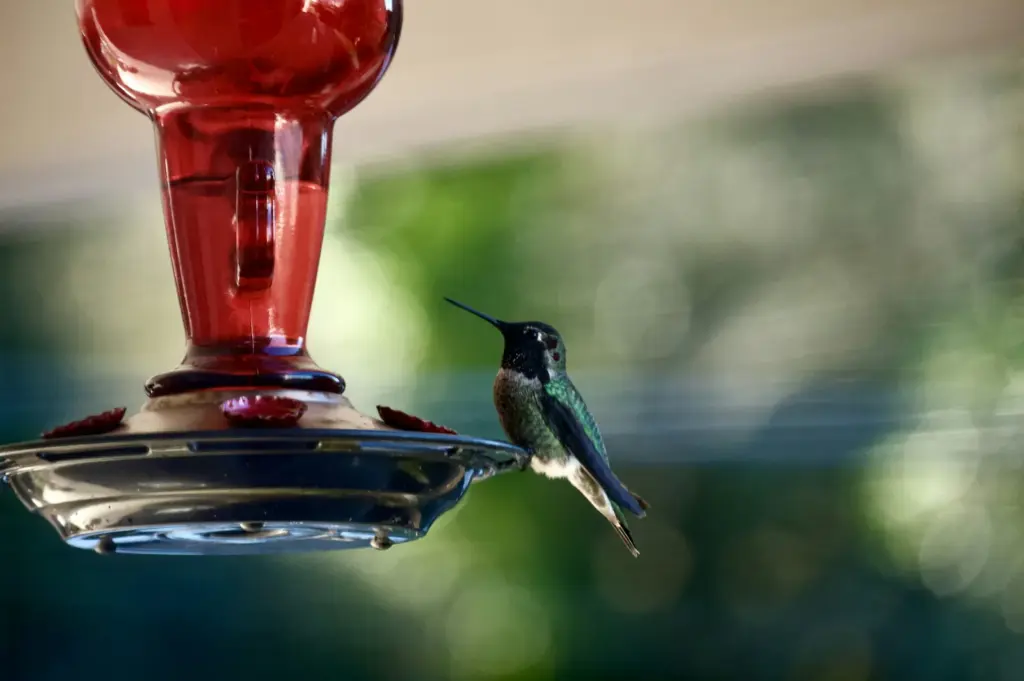
Do you need to boil hummingbird nectar?
Sources disagree. Audubon says to boil for one to two minutes to sterilize the mixture. The Smithsonian’s National Zoo, Clemson and Cornell’s FeederWatch BirdNotes say boiling is unnecessary. Cornell’s All About Birds and the Hummingbird Society split the difference: skip it for a feeder-sized batch you will use within a day or two, and boil when you are making extra to store.
No source shows that boiling makes nectar last longer once it is in the feeder. Cornell’s BirdNotes explains why: a hummingbird’s bill and tongue introduce microorganisms every time it drinks, so the nectar spoils whether or not it was boiled. The practical call is hot tap water for what you will use in a few days, and a boil of one to two minutes for a refrigerator batch. Do not boil longer, because evaporation strengthens the mix.
How long does nectar keep in the refrigerator?
Seven days. The Smithsonian’s National Zoo, NWF and the Hummingbird Society all give one week. Clemson says 7 to 10 days, and older Cornell and NWF material says two weeks; the newer sources are the shorter ones. Throw out any batch that shows mold, and bring chilled nectar to room temperature before filling a feeder.
Why the Hummingbird Nectar Ratio Is 4:1
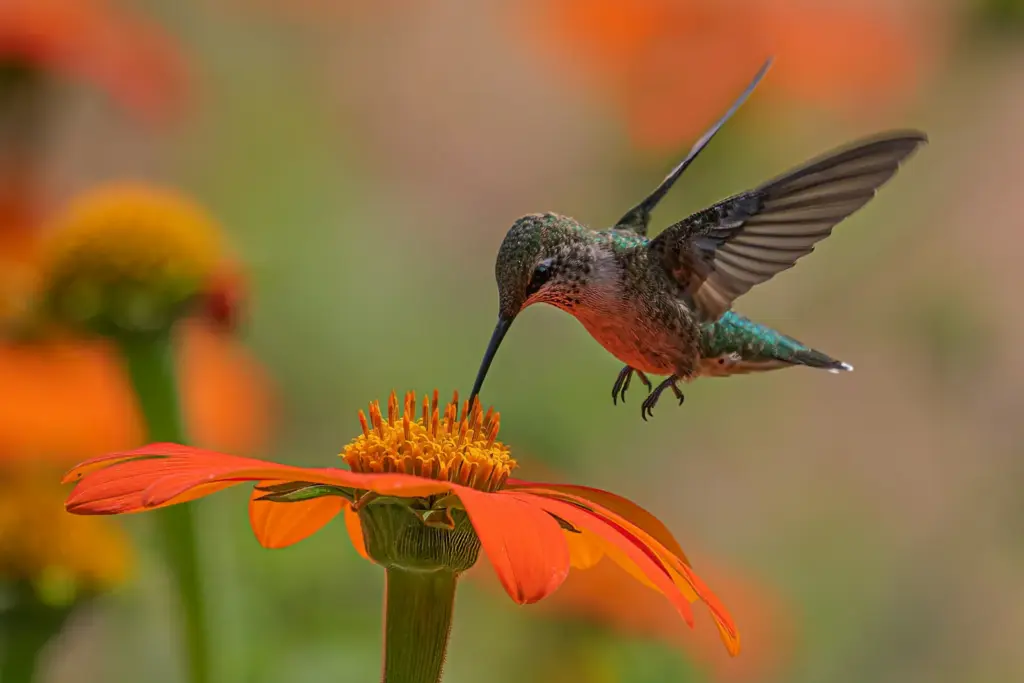
The same mix is written 4:1 (water to sugar) or 1:4 (sugar to water). It copies flower nectar. Flowers that hummingbirds pollinate produce nectar at roughly 15 to 25 percent sugar by weight (Johnson and Nicolson, 2008), and the average across hummingbird flowers sits at 20 to 25 percent (Roberts, 1995). NWF and the Hummingbird Society both describe 1:4 as the closest match. The match is not exact. Flower nectar is a blend of sucrose, glucose and fructose, while feeder nectar is all sucrose. See plant and pollinator interactions for how that relationship works, or browse the orange flowers that hummingbirds visit.
17 percent or 20 percent?
You will see the 4:1 mix described as a 20 percent solution. That is correct by weight: 100 g of sugar in 400 g of water is exactly 20 percent. Recipes are written in cups, though, and a cup of sugar weighs about 200 g (USDA) while a cup of water weighs about 237 g. Mixed by cup, 4:1 comes out at 17.5 percent sugar by weight. Both sit inside the natural range.
Why not make it stronger?
Thicker syrup is harder to drink. In Heyneman’s 1983 analysis, pure sucrose solutions deliver the most energy per second at about 22 percent, and higher concentrations “yield lower energy intake rates” because the viscosity cuts the amount a bird takes per lick. Hummingbirds choose syrups above 45 percent in choice tests (Roberts, 1995), but preferring a strong syrup does not make it a good one. Penn State Extension says stronger solutions “may be harmful,” and Cornell says to go no stronger than 1/4 cup of sugar per cup of water in hot, dry weather, when birds risk dehydration. No authoritative source recommends 2:1.
When 3:1 is fine
Cornell allows up to 1/3 cup of sugar per cup of water (3:1, about 22 percent) during cold, rainy or foggy weather, and says it “won’t hurt your birds and may help them.” The Hummingbird Society agrees for winter. Audubon, the Smithsonian and NWF publish only 4:1 and do not address colder mixes. Nobody says 3:1 is required in fall. Use 4:1 as the default and 3:1 as a cold-weather option.
Why not weaker?
Cornell’s BirdNotes suggests 1/5 cup of sugar per cup of water (about 14.5 percent) when insects are a problem, since it “may discourage the insects without losing the hummingbirds’ interest.” Penn State Extension notes that weaker solutions are less attractive to hummingbirds, so 1:5 is the floor.
What Never Goes in a Hummingbird Feeder
- Honey. It ferments and grows fungus faster than sugar water. The USGS National Wildlife Health Center says yeast infections of the mouth in hummingbirds are widely attributed to contaminated feeders or nectar made with honey. The danger is spoilage, not the honey itself.
- Brown, raw, turbinado and organic sugar. The Hummingbird Society warns these may keep traces of molasses, which is rich in iron and, in its words, a toxin to hummingbirds in all but the tiniest amounts. The Smithsonian says never to use raw, unprocessed sugars. USDA data shows the gap: granulated sugar has 0.05 mg of iron per 100 g, turbinado 0.37 mg and brown sugar 0.71 mg, about 14 times more than granulated. No one has measured iron toxicity in hummingbirds, so this is a reasoned warning, not a test result. Organic white sugar is unresolved: only the Hummingbird Society addresses it, and it says no. Plain refined white sugar is the safe choice, and cane or beet makes no difference because both are sucrose.
- Powdered sugar. It often contains cornstarch (Smithsonian).
- Corn syrup and artificial sweeteners. The Smithsonian rules out corn syrup, and NWF says sweeteners have no food value for birds.
- Red dye. Every source checked says leave it out, including Audubon, Cornell, the Smithsonian, NWF, the Hummingbird Society, Clemson and the US Fish and Wildlife Service. The evidence is thin in both directions. No study has tested dye on hummingbirds, so nobody has shown it is harmless or that it harms them; Cornell’s BirdNotes says its effect on birds is unknown. The reason to skip it is that it does nothing. Flower nectar is clear, and the red on the feeder is what draws birds in.
- Commercial mixes with additives. NWF notes that store-bought nectar often comes with preservatives or dyes, and Cornell calls vitamin and mineral mixes a needless expense.
How Often to Change Hummingbird Nectar
Heat drives spoilage, so the interval depends on the temperature where the feeder hangs. These bands follow the Hummingbird Society’s published table and agree with Audubon, Cornell and Clemson on the hot end.
| High temperature (feeder in shade) | Change nectar every |
|---|---|
| Below 60°F (15°C) | 7 days |
| 60 to 70°F (15 to 21°C) | 5 days |
| 70 to 80°F (21 to 27°C) | 3 days |
| 80 to 90°F (27 to 32°C) | 2 days |
| Above 90°F (32°C) | Daily |
Direct sun halves the interval, and above 80°F the maximum is one day. Cornell says sun makes sugar water spoil rapidly, and the Hummingbird Society says nectar in full sun may be unfit after a day or two. Outside cool weather, never leave nectar in a feeder longer than two or three days. Clean the feeder at every refill rather than topping it off.
Signs the nectar has spoiled
Discard the nectar and clean the feeder at once, whatever the schedule says, if you see any of these:
- cloudy liquid
- mold of any color, including black
- floating debris
- white or colorful streaks or spots inside the feeder
Spoiled nectar carries real risk. Clemson warns that fungus can infect a hummingbird’s tongue, and the USGS reports a protruding tongue and white plaques in the mouth in affected birds. The USGS adds that the link between feeders and the disease is widely assumed rather than proven, and that scrupulous cleaning and refreshing may be preventative.
The six-band table you may have seen
A popular chart lists six temperature bands, with nectar lasting six days at 71 to 75°F and two days at 89 to 92°F. It comes from an enthusiast website, which has since softened its own numbers. Audubon, Cornell, the Smithsonian, NWF and the Hummingbird Society do not publish it, and their intervals are shorter: Audubon says every three days in temperate weather, and Cornell’s BirdNotes says every three days at 80°F. The bands above follow the authorities.
How to Clean a Hummingbird Feeder
Clean the feeder every time you refill it.
- Take the feeder apart and pour out any old nectar.
- Scrub every part with hot water and a bottle brush. Use pipe cleaners or a port brush for the feeding ports, and clean the port guards (Clemson).
- Skip the soap. Cornell, Audubon, NWF and Clemson all warn that dish soap can leave a harmful residue.
- Once a week, or when you see mold, soak the parts in white vinegar and water. Audubon uses 1 part vinegar to 4 parts water for routine cleaning, and the Hummingbird Society soaks in the same mix for an hour. NWF and Clemson use a stronger 1:2 mix for a soak of a few hours.
- For a monthly deep clean, the Hummingbird Society uses 1 tablespoon of bleach per quart of water (1/4 cup per gallon, about 15 mL per liter). Cornell’s ceiling is 1 part bleach to 9 parts water for 10 minutes, which is about six times stronger. The weaker mix does the job.
- Rinse well. Audubon says to rinse three times with warm water, and the Hummingbird Society says you should not be able to smell vinegar or bleach afterward.
- Let every part air-dry before refilling.
How Much Nectar Hummingbirds Drink
A hummingbird drinks about twice its body weight in 4:1 nectar each day. In Powers and Nagy’s 1988 study of wild Anna’s hummingbirds on feeders, water intake came to about 164 percent of body mass per day, and the birds averaged 4.5 g. Working from that figure, a 3.5 to 4.5 g bird takes in roughly 6.5 to 8 mL of nectar daily, and about 8 mL (a little over 1.5 teaspoons) is a good planning number. Intake rises in cold weather. Audubon says hummingbirds eat half their body weight in “bugs and nectar,” which counts insects and does not match the direct measurement of nectar. For more on how they feed, see hummingbird feeding habits.
Sizing the feeder
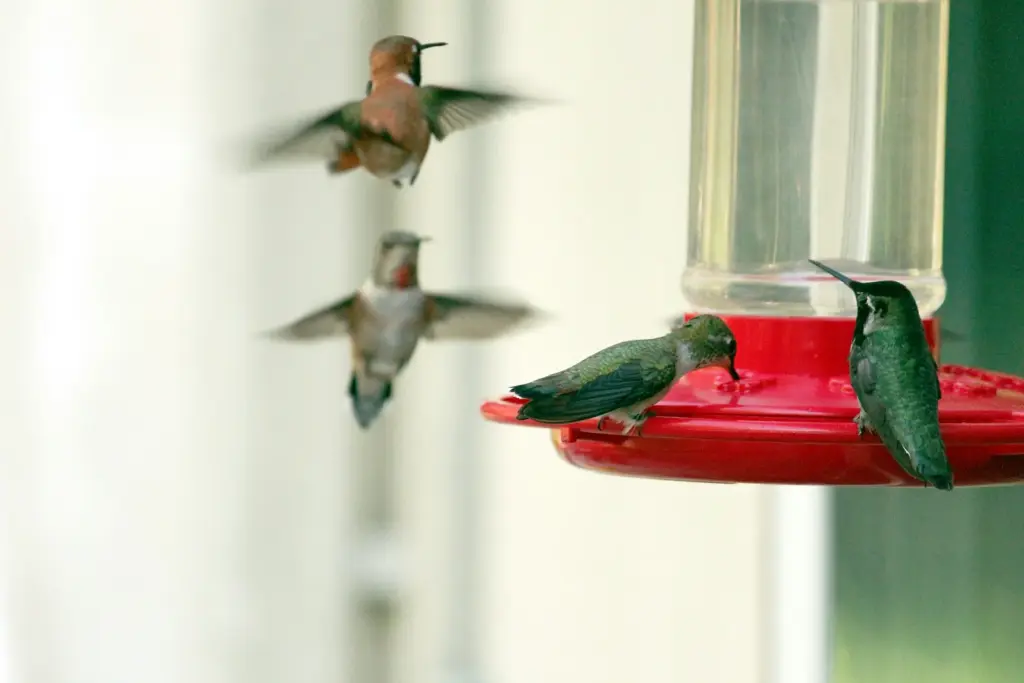
Fill the feeder with what the birds will finish in two to three days. Cornell says the best feeders are emptied every day or two, NWF says two to three days, and the Hummingbird Society says to reduce the amount if nectar remains after three days. At 8 mL per bird per day, that works out to about 20 mL per bird. Four birds drink about 80 mL (under 3 oz) in that window, and an 8 oz feeder covers roughly a dozen. Most yards see only a few birds at a time.
Cornell also notes that four tiny single-port feeders spread around the house will attract and hold more hummingbirds than one large eight-port feeder, because the birds defend their territory.
Ants, Bees and Wasps at the Feeder
Insects foul the nectar and crowd out the birds. The Hummingbird Society says ants crawling into a feeder can introduce bacteria, and wasps can turn territorial and chase hummingbirds away.
- Use an ant moat. Fill it with plain water. Cornell says ants cannot swim across, and that water works as well as oil without matting a bird’s feathers.
- Keep grease off. Current guidance from Cornell and the Hummingbird Society is no petroleum jelly, cooking oil or sticky traps near the feeder.
- Choose red, not yellow. Audubon, Cornell and the Hummingbird Society all say yellow parts attract bees and wasps. Yellow bee guards can backfire for the same reason.
- Pick the right design. Cornell calls saucer feeders inherently bee- and wasp-resistant because the nectar sits too low for insects to reach. Dripless feeders keep ants from finding the feeder, and the Hummingbird Society says to wipe up spills right away.
- Move it. If insects persist, shift the feeder a few feet or take it down for a day or two (Cornell).
When to Put Feeders Out and Take Them Down
Hang feeders about a week before hummingbirds normally arrive (Audubon). Audubon’s yard guide says to check eBird for first spring sightings and hang feeders a couple of weeks ahead. The Smithsonian’s National Zoo gives these windows:
- Gulf Coast and southern US: mid-February to early November
- Middle latitudes: early-to-mid April through late October
- Farther north: early May to late September
Clemson recommends feeders up by around March 15 for ruby-throated hummingbirds in South Carolina.
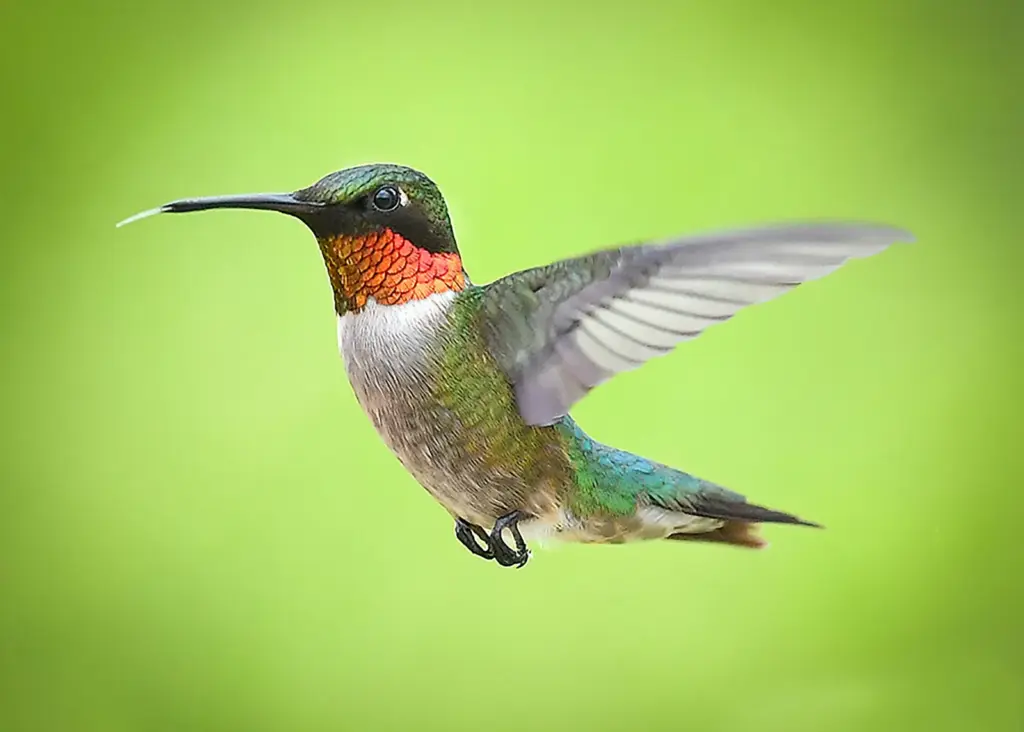
In fall, keep feeders up for two weeks after you see the last bird (Audubon). Cornell suggests several weeks, in case a straggler needs fuel for the trip south. Where hummingbirds live year-round, there is no need to take feeders down.
Feeders do not delay migration
The belief that late feeders keep hummingbirds from leaving is a myth. Cornell says feeders have no influence on when a bird starts south, and the most significant trigger is day length. The Smithsonian, Audubon and Cornell’s BirdNotes say the same. A feeder left up gives late travelers a refuel stop and does not hold them back. Learn more about the characteristics of migratory birds. Feeders supplement flowers rather than replace them, so also look at the signs your garden has good biodiversity.
Frequently Asked Questions
What is the correct ratio for hummingbird food?
Mix 1 part plain white granulated sugar with 4 parts water by volume, written 4:1 or 1:4. That is 1/4 cup of sugar per 1 cup of water, or 1 cup of sugar in 4 cups of water. Cornell allows up to 1/3 cup per cup (3:1) in cold, rainy weather. Never add honey, dye or brown sugar.
Do you have to boil hummingbird nectar?
No. The Smithsonian's National Zoo and Clemson say boiling is unnecessary if the sugar is fully dissolved and you change the nectar often. Audubon recommends boiling for one to two minutes. Cornell and the Hummingbird Society say to boil only when you make extra to refrigerate. Always let nectar cool to room temperature before filling the feeder.
Is red dye bad for hummingbirds?
Red dye is unnecessary, and its effect on birds is unknown. Audubon, Cornell, the Smithsonian, NWF and the Hummingbird Society all advise against it. Flower nectar is clear, and the red parts on the feeder are what attract hummingbirds. Skip the dye and fill the feeder with plain sugar water, which works just as well.
Can you use honey or brown sugar in a hummingbird feeder?
No. Honey ferments and grows fungus quickly, and the USGS says mouth yeast infections in hummingbirds are widely attributed to contaminated feeders and honey-based nectar. Brown, raw and turbinado sugar can carry molasses, which contains iron; the Smithsonian says never to use raw sugars. Use only plain refined white granulated sugar. Powdered sugar contains cornstarch.
How often should you change hummingbird nectar?
Change it by temperature: every 7 days below 60°F, every 5 days from 60 to 70°F, every 3 days from 70 to 80°F, every 2 days from 80 to 90°F and daily above 90°F. Halve the interval if the feeder hangs in direct sun. Replace nectar immediately if it turns cloudy or shows mold, whatever the schedule.
How long does homemade hummingbird nectar last in the fridge?
Up to one week in a sealed container, according to the Smithsonian's National Zoo, the National Wildlife Federation and the Hummingbird Society. Clemson says 7 to 10 days, and older Cornell material says two weeks, but the newer sources are shorter. Throw it out if you see mold, and bring it to room temperature before filling a feeder.
Why does hummingbird nectar turn cloudy?
Cloudy nectar means bacteria or fungus are growing in it. Hummingbird bills and tongues introduce microorganisms every time they drink, and heat and direct sun speed the growth. Pour out cloudy nectar immediately, whatever the schedule, scrub the feeder with hot water and a bottle brush, rinse well and refill with fresh nectar. Mold, streaks or floating debris call for the same response.
How much sugar do I need for an 8 oz or 16 oz hummingbird feeder?
At 4:1 by volume, an 8 oz feeder takes 1 cup of water plus 1/4 cup of sugar, and a 16 oz feeder takes 2 cups of water plus 1/2 cup of sugar. Dissolved sugar adds volume, so each batch makes slightly more than the feeder holds. The calculator above trims the water so the feeder fills exactly.
How do you keep ants and bees away from a hummingbird feeder?
Hang the feeder with an ant moat filled with plain water, not oil or petroleum jelly. Choose a feeder with red parts and no yellow, since yellow attracts bees and wasps, and pick a saucer style or add bee guards. Wipe up drips. If insects persist, move the feeder a few feet or take it down for a day or two.
When should you take hummingbird feeders down?
Keep them up for at least two weeks after you see the last hummingbird; Cornell suggests several weeks to help late migrants. Feeders do not delay migration, because day length triggers it. If hummingbirds live in your area year-round, leave feeders up all year and keep changing the nectar on schedule.
Sources
- Audubon: Hummingbird Feeding FAQs, How to Make Hummingbird Nectar, How to Create a Hummingbird-Friendly Yard, Keep Your Hummingbird Feeder Free from Pests
- Cornell Lab, All About Birds: Feeding Hummingbirds, What’s the best recipe for hummingbird nectar?, Red food coloring, Feeding in fall and migration, Unwanted yard visitors, How to Clean Your Bird Feeder
- Cornell Lab and FeederWatch: BirdNotes 02, Attracting Hummingbirds
- Smithsonian’s National Zoo: Hummingbird Nectar Recipe and FAQ
- National Wildlife Federation: Your Guide to Hummingbird Feeders
- International Hummingbird Society: Hummingbird Feeder Recipe, How to Clean Feeders and When to Change the Nectar, Feeding Hummingbirds, Keeping Bees, Wasps and Ants Out
- USGS National Wildlife Health Center: Presumptive Candida Stomatitis in a Broad-Tailed Hummingbird
- USDA FoodData Central: Sugars, granulated (FDC 169655)
- Clemson Home and Garden Information Center: Now Is the Time to Put Out Hummingbird Feeders
- Penn State Extension: Hummingbird Feeders
- US Fish and Wildlife Service: Humming into Autumn
- Johnson and Nicolson (2008), Biology Letters 4:49-52: nectar concentration in bird-pollinated flowers
- Roberts (1995), The Auk 112:456-463: Hummingbird Licking Behavior and the Energetics of Nectar Feeding
- Heyneman (1983), Oecologia 60:198-213: energy intake and nectar concentration in hover-pollinated flowers
- Powers and Nagy (1988), Physiological Zoology 61:500-506: field metabolic rate and water flux in Anna’s hummingbirds