TLDR
- Manitoba’s worst invasive species are aquatic. Zebra mussels and spiny waterflea are already established in several of the province’s biggest waters, including Lake Winnipeg. Quagga mussels and Asian carps are the ones still being kept out.
- Plants and insects do quiet damage on land: purple loosestrife in wetlands, leafy spurge on pasture, emerald ash borer in Winnipeg’s ash trees.
- If you boat, you have to clean, drain and dry, stop at inspection stations, and decontaminate if your boat has left a control zone.
- Report anything unusual to the province’s AIS Unit at AIS@gov.mb.ca or 1-877-867-2470.
Table of contents
- What counts as an invasive species in Manitoba
- Quick reference: species, status and location
- Aquatic invasive species in Manitoba
- Where zebra mussels are now
- Manitoba invasive plants and how to recognize them
- Terrestrial pests: emerald ash borer and Dutch elm disease
- The rules: Clean Drain Dry, decontamination and inspection stations
- What homeowners and cottagers can do
- How to report an invasive species
- FAQ
What counts as an invasive species in Manitoba
An invasive species is a plant, animal or microbe that arrives from somewhere else, spreads without natural checks, and harms the ecosystem, the economy or both. The “harms” part matters. Plenty of introduced species, like most garden vegetables, never cause trouble. Invasive ones take over. For the national picture, see the complete list of invasive species in Canada.
Manitoba is vulnerable for a plain reason: it sits at the end of a drainage system. Water from the prairies flows through the Red River and the Saskatchewan River into Lake Winnipeg, then north along the Nelson River to Hudson Bay. A species that gets into one link of that chain can ride the current to the next. Add thousands of trailered boats moving between Manitoba, Ontario, Minnesota and the Dakotas every summer, and you have a province that gets a steady supply of hitchhikers.
The provincial StopAIS program names five freshwater species as its main concerns: zebra mussels, spiny waterflea, rusty crayfish, quagga mussels and Asian carps. The list of designated species under the Aquatic Invasive Species Regulation is longer, and it covers fish, invertebrates, plants and algae.
Quick reference: species, status and location
| Species | Type | Status in Manitoba | Where |
|---|---|---|---|
| Zebra mussel | Aquatic invertebrate | Established | Lake Winnipeg, Lake Manitoba, Cedar Lake, Red River, Nelson River, St. Malo Reservoir, and new 2026 detections in Lake Winnipegosis and Waterhen Lake |
| Spiny waterflea | Aquatic invertebrate | Established | Lake Winnipeg, Winnipeg River, Shoal Lake, Cedar Lake, Nelson River system |
| Rusty crayfish | Aquatic invertebrate | Limited populations | Falcon Lake, Birch River near Prawda, Manitoba waters of Lake of the Woods |
| Quagga mussel | Aquatic invertebrate | Not yet present | Great Lakes and the U.S. |
| Asian carps (bighead, silver, grass, black) | Fish | Not established | U.S. waters to the south |
| Common carp | Fish | Established | Red River, Lake Winnipeg and many southern waters |
| Purple loosestrife | Plant | Established | Wetlands, ditches, shorelines |
| Leafy spurge | Plant | Established, regulated weed (Tier 2) | Pasture, roadsides, riverbanks |
| Nodding thistle | Plant | Established, regulated weed (Tier 2) | Mainly southwestern Manitoba |
| Wild parsnip | Plant | Established, regulated weed | Roadsides, ditches, field edges |
| Emerald ash borer | Insect | Established in Winnipeg | City of Winnipeg regulated area |
| Dutch elm disease | Fungus | Established | Elm trees across the province |
Aquatic invasive species in Manitoba
Zebra mussels
This is the species that matters most right now. Adults are about 25 mm (an inch) long, with dark or light bands on the shell, and they glue themselves to anything hard using fine threads called byssal threads.
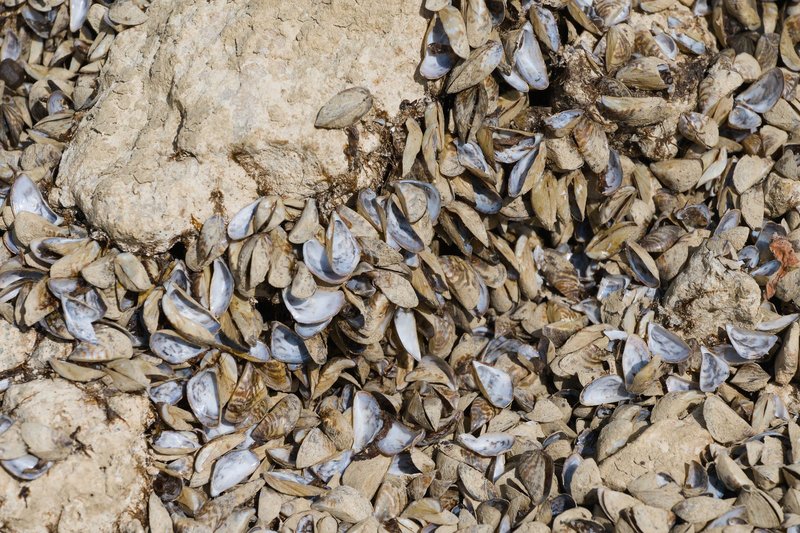
A single female can produce up to a million eggs a year, and the larvae are microscopic and drift with the current. The mussels filter huge volumes of algae out of the water, which starves the base of the food chain. They also clog water intake pipes, ruin boat cooling systems, and smother native mussels. Their shells pile up on beaches and cut bare feet, including dogs’ paws.
Adults can live out of water for up to 30 days depending on temperature and humidity, which is exactly why a trailered boat can carry them from one lake to the next. The province’s zebra mussel profile says uncleaned equipment is suspected of having brought them to Lake Winnipeg.
Spiny waterflea
This one is tiny, about 1 cm long, and easy to miss until it shows up on your fishing line. Look for a long, barbed tail that makes up most of the animal’s body length. Clumps on a line look like gelatinous blobs with dark specks, a bit like wet pins.
Spiny waterflea eats the zooplankton that young walleye and other fish depend on. Females can clone themselves, so one animal can start a population. Their eggs resist drying and can survive digestion by a fish, which means bait can spread them. According to the Manitoba government, they have been detected in the Winnipeg River, Lake Winnipeg, Shoal Lake, Cedar Lake and several waters on the Nelson River system.
Rusty crayfish
Rusty crayfish are bigger and more aggressive than Manitoba’s native northern crayfish. Look for brown or olive claws with black tips, an oval gap between the claws when they’re closed, and a rusty patch on each side of the shell. Native northern crayfish have blue claws and no gap.
They strip underwater vegetation, eat fish eggs, and push out native crayfish. They turned up in Falcon Lake in 2007, and the province set a zero possession limit for crayfish in 2008 after that find. They have also been found in the Birch River near Prawda and in the Manitoba waters of Lake of the Woods.
Quagga mussels and Asian carps
Neither is established in Manitoba. They’re the reason inspection programs exist.
Quagga mussels look like zebra mussels but tolerate colder, deeper water and can do even more damage to a lake’s food web. Asian carps (bighead, silver, grass and black carp) are large fish that eat the plankton native fish rely on. Silver carp are the ones that leap out of the water when a boat motor passes, and they’ve injured boaters in the U.S. Midwest. Fisheries and Oceans Canada tracks both species as threats to the Prairie provinces.
Common carp
Common carp are an older invader, brought to North America in the 1800s, and they’re now part of the furniture in the Red River and many southern waters. Feeding carp stir up bottom mud and uproot plants, which clouds the water and removes habitat for ducks and fish. Marshes like Delta Marsh on Lake Manitoba have been hit hardest.
Where zebra mussels are now
The first Manitoba detection was in Lake Winnipeg in 2013. Since then the list has grown steadily:
- Manitoba portion of the Red River, 2015
- Cedar Lake, 2015 (confirmed in 2021)
- Assean Lake, Upper Nelson River, 2019
- Lower Nelson River to Hudson Bay, Echimamish River, 2021
- Lake Manitoba, 2021
- Lake Winnipegosis and Waterhen Lake, detected in September 2026
The Winnipegosis and Waterhen Lake detections matter because they move zebra mussels into the western lake system, where they hadn’t been found before. Check the province’s active detections page before you launch anywhere new, because the control zone list changes as new lakes are added.
Manitoba invasive plants and how to recognize them
Plants get less attention than mussels, and they shouldn’t. Under The Noxious Weeds Act, species are sorted into three tiers. Tier 1 weeds must be destroyed. Tier 2 weeds are managed based on the size of the infestation. Tier 3 weeds must be controlled when uncontrolled growth would cause harm.
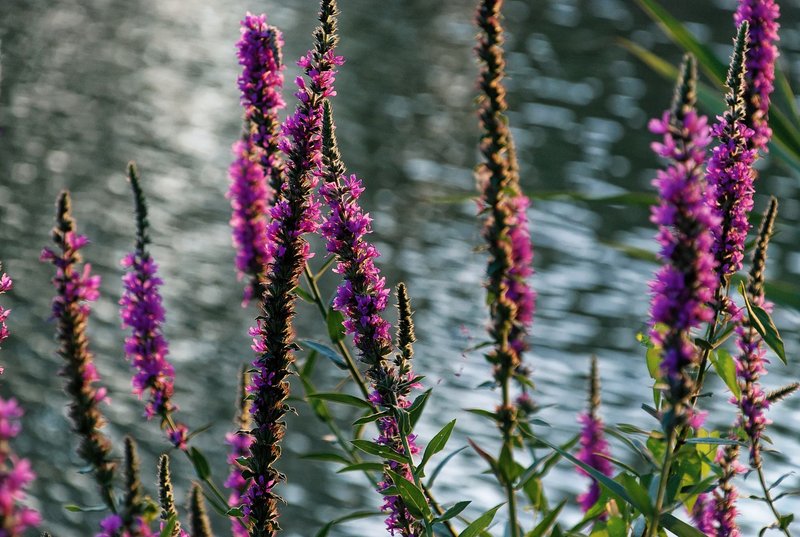
Purple loosestrife
The easiest invader to spot in July and August. Tall spikes of magenta-purple flowers crowd wetland edges, ditches and shorelines, on stems that stand 1 to 2 metres tall. The stem is square, which sets it apart from similar native plants. Loosestrife forms dense stands that crowd out cattails and sedges, and that wipes out nesting cover for marsh birds. Biological control with Galerucella leaf beetles is used in Manitoba wetlands.
Leafy spurge
A yellow-green plant with small, bract-like flower clusters that look yellow in early summer, and milky white sap when you snap a stem. It runs on deep root systems that make it nearly impossible to pull. Cattle avoid it, so it takes over pasture. It’s a Tier 2 weed.
Nodding thistle
A tall, spiny thistle with large, drooping purple flower heads. It’s concentrated in southwestern Manitoba and is also a Tier 2 weed. If you have rangeland in that part of the province, you probably already know it.
Wild parsnip
Looks like a yellow dill with flat-topped clusters of yellow flowers and grooved stems. The danger is the sap. If it touches skin and then sunlight hits it, you get painful blisters that can leave marks for months. Wear long sleeves and gloves if you’re cutting it back, and don’t use a string trimmer, which sprays sap.
Terrestrial pests: emerald ash borer and Dutch elm disease
Winnipeg is a city of boulevard trees, which makes it a good target for tree-killing pests.
Emerald ash borer, a metallic green beetle from Asia, was confirmed in Winnipeg in December 2017, the first time it was found in Manitoba. The Canadian Food Inspection Agency responded by adding the City of Winnipeg to its regulated areas in January 2018. Moving firewood of any species, ash trees, ash nursery stock or ash wood out of the regulated zone requires written permission from the CFIA. The grubs feed under the bark and cut off the tree’s water flow, and untreated ash trees usually die within a few years of infestation.
Dutch elm disease is the older problem. This fungus, spread by elm bark beetles, has been killing elms in Manitoba since the 1970s. Never move or store elm firewood, since the beetles breed under the bark.
The rules: Clean Drain Dry, decontamination and inspection stations
Manitoba backs this up with law, not just advice. The Aquatic Invasive Species Regulation covers everyone who moves a boat, and fines apply year-round.
Clean, drain, dry. Before you leave a lake: remove plants, mud and debris from your boat, trailer and gear. Drain all water, including live wells, bilges and bait buckets. Pull the drain plug and keep it out while you drive. Then let everything dry completely before it touches another lake.
Inspection stations. If you’re towing or transporting a watercraft, you have to stop at an AIS inspection station when one is operating. Staff will ask where you’ve been, check the hull, motor and trailer, and decontaminate if needed.
Decontamination. If your boat or equipment has been in a lake designated as an AIS control zone, you must decontaminate it before launching into another waterbody or control zone. In practice, that makes it one boat, one lake: once you’ve used a boat in an infested lake, it stays out of other waters until it’s been decontaminated. Inspection stations will do this for free. If you do it yourself, the province’s decontamination methods are:
- Hot water: Spray exterior surfaces with water at least 60 °C, then treat the engine, compartments and ballast tanks, and dry everything before launching again.
- Freezing: Expose the boat to temperatures below -10 °C for three consecutive days, then dry it completely.
Do the work on land, away from drains and ditches, and skip the car wash, since its water may not be hot enough. Use high-pressure washing only to remove dead mussels after the heat treatment has killed them.
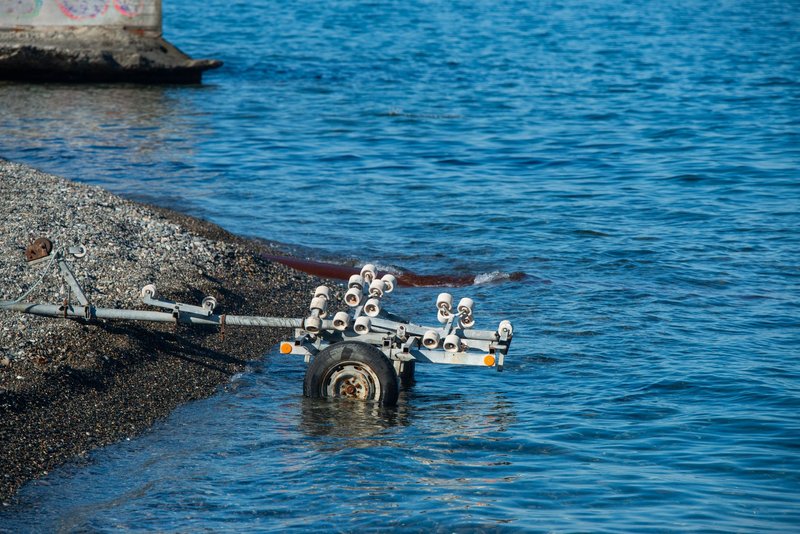
Bait. Don’t dump bait or bait water into a lake, and don’t move it between waterbodies. Spiny waterflea eggs can ride along.
What homeowners and cottagers can do
Most of the prevention work lands on people with a cottage or a yard.
- Check your dock and boat lift. Mussels settle on anything left in the water. Before you pull a dock, boat lift or swim raft out of a lake and move it, check every surface by touch. Zebra mussels feel like small, rough grains.
- Never dump an aquarium. Aquarium plants and animals can carry invasive species, and releasing them into a pond or lake is how many invasions begin.
- Buy garden plants carefully. Purple loosestrife was sold as an ornamental. Avoid it and its cultivars, and ask nurseries what’s in their wildflower mixes.
- Clean your boots. Seeds from leafy spurge and thistles ride in tread, on dog fur, and on mower decks.
- Don’t move firewood. Buy it where you burn it, especially in and around Winnipeg.
- Dispose properly. Bag plant waste and put it in the trash. Don’t compost loosestrife or spurge.
How to report an invasive species
Time matters. A zebra mussel found early in a lake can be tracked, and one found late is just a record. The provincial AIS Unit takes reports by email at AIS@gov.mb.ca, by phone at 1-877-867-2470 (toll free), or through an online form.
Give them the water body or nearest town, the date, GPS coordinates if you have them, and a photo. Don’t keep the specimen, since possessing some invasive species is illegal. A photo with a coin or a hand for scale does the job.
FAQ
What is the most harmful invasive species in Manitoba?
Zebra mussels, by cost and reach. They’re in Lake Winnipeg, Lake Manitoba, Cedar Lake, the Red River and the Nelson River, and in 2026 they were detected in Lake Winnipegosis and Waterhen Lake. They clog infrastructure, alter food webs and are almost impossible to remove once established.
Are quagga mussels in Manitoba?
No. They’re listed as a threat but haven’t been established here. They’re the reason the watercraft inspection program checks boats coming from the Great Lakes region.
What is Clean Drain Dry?
It’s the three-step routine for preventing spread: clean off plants and mud, drain all water from the boat and gear, and dry everything fully before using it in another lake.
Do I have to stop at a watercraft inspection station?
Yes, if you’re transporting a watercraft and an inspection station is operating on your route. Fines apply for failing to stop.
Is it illegal to move invasive species?
Yes. Possessing, transporting, releasing or bringing in a species designated under Manitoba’s AIS Regulation is prohibited. That includes rusty crayfish, zebra mussels and spiny waterflea.
What invasive plants are in Manitoba?
The ones you’re most likely to see are purple loosestrife, leafy spurge, nodding thistle and wild parsnip. Leafy spurge and nodding thistle are Tier 2 noxious weeds.
Can I decontaminate my own boat?
Yes. Use water at least 60 °C or freeze the boat below -10 °C for three days, and dry everything completely afterward. Inspection stations will do it for free.