
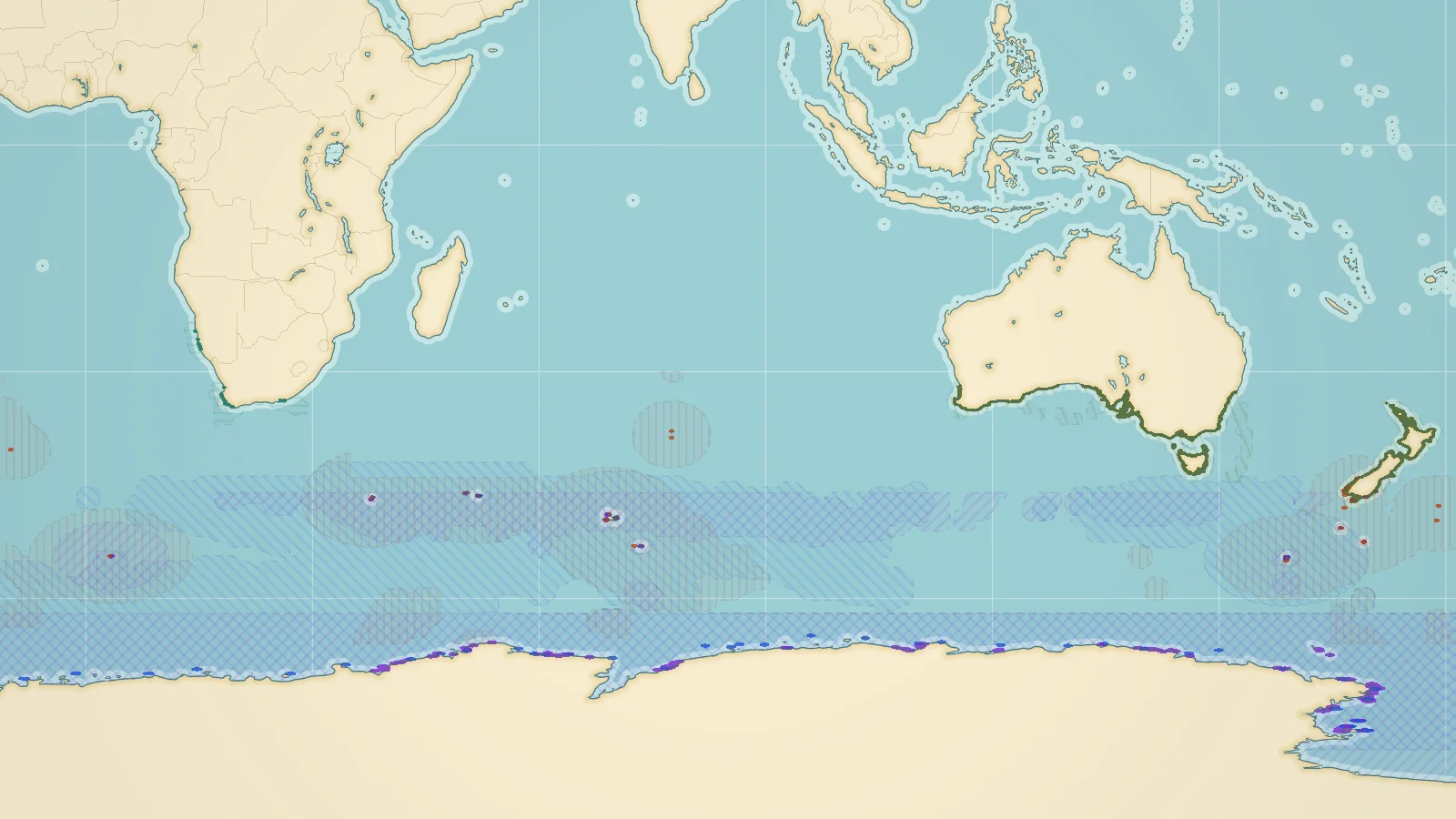
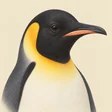
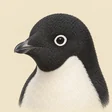
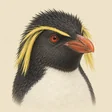
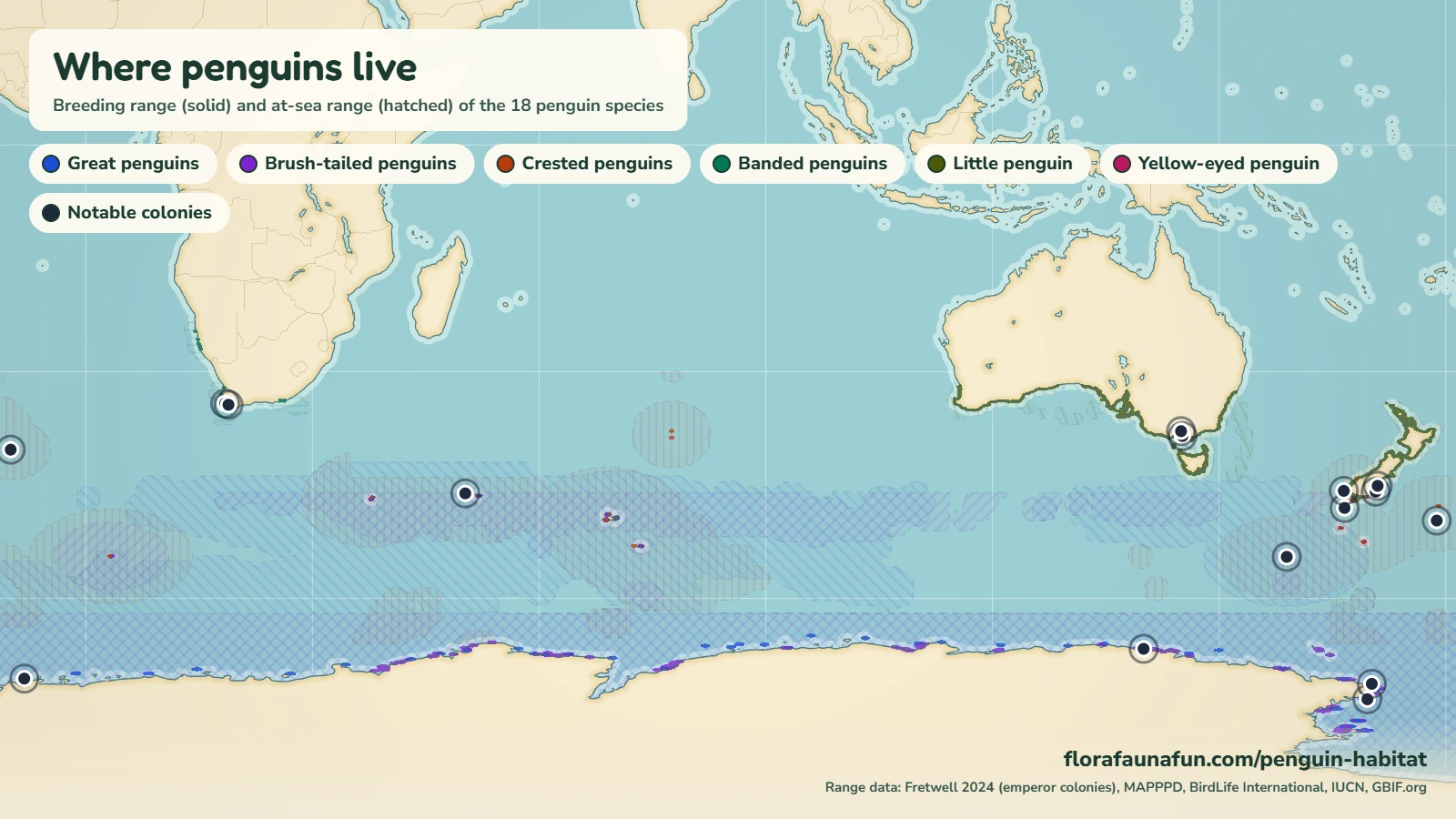
Where do penguins live? Every wild penguin breeds in the Southern Hemisphere, apart from a few Galápagos penguins on the equator. Penguin habitat runs from the sea ice of Antarctica to the sub-Antarctic islands, the cold coasts of South America, southern Africa, southern Australia and New Zealand. There are 18 penguin species in six groups, and each group has its own colour on the map above. Solid colour marks the coasts and islands where penguins breed. Hatching marks the ocean where they feed and spend the winter.
More maps of where animals live are on the animal habitat maps page.
Penguin habitat at a glance
| Species | Where it breeds | Breeding habitat | Population | IUCN status |
|---|---|---|---|---|
| Emperor penguin | Antarctica, about 66 colonies | Sea ice fixed to the coast | About 228,000 adults | Endangered |
| King penguin | South Georgia, Crozet, Kerguelen, Marion, Heard, Macquarie, Falklands | Beaches and flat tussock ground | 1 to 2 million pairs | Least Concern |
| Adélie penguin | Antarctic coast and nearby islands | Bare rock, nests of stones | About 10 million adults | Least Concern |
| Chinstrap penguin | Antarctic Peninsula, South Shetland, South Orkney, South Sandwich, Bouvet | Rocky slopes | About 8 million adults | Least Concern |
| Gentoo penguin | Falklands, South Georgia, Antarctic Peninsula, sub-Antarctic islands | Ice-free coast and grassland | About 774,000 adults | Least Concern |
| Macaroni penguin | South Georgia, Kerguelen, Crozet, Heard, Prince Edward, Bouvet, southern Chile | Steep rock and tussock | Not reliably counted | Vulnerable |
| Royal penguin | Macquarie Island only | Beaches and terraces | About 1.5 million adults | Least Concern |
| Southern rockhopper penguin | Falklands, southern Chile and Argentina, sub-Antarctic islands | Cliffs and boulder fields | About 2.5 million adults | Vulnerable |
| Northern rockhopper penguin | Tristan da Cunha, Gough, Amsterdam, Saint-Paul | Cliffs and boulder fields | About 413,700 adults | Endangered |
| Fiordland penguin | South-west South Island, Stewart Island, New Zealand | Rainforest, sea caves | 12,500 to 50,000 adults | Near Threatened |
| Snares penguin | Snares Islands, New Zealand | Coastal forest | 29,009 nests (2013) | Vulnerable |
| Erect-crested penguin | Bounty and Antipodes Islands, New Zealand | Bare rock | 34,226 nests on the Antipodes (2011) | Endangered |
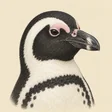
| African penguin | South Africa and Namibia | Burrows on islands and beaches | About 9,900 pairs (2023) | Critically Endangered |
| Humboldt penguin | Peru and Chile | Burrows, caves, desert coast | About 23,800 adults | Vulnerable |
| Magellanic penguin | Argentina, Chile, Falklands | Burrows and bushes | 1.1 to 1.6 million pairs | Least Concern |
| Galápagos penguin | Galápagos Islands, Ecuador | Lava caves and crevices | About 1,200 adults | Endangered |
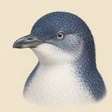
| Little penguin | Southern Australia, Tasmania, New Zealand | Burrows in sand and soil | Hundreds of thousands | Least Concern |
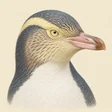
| Yellow-eyed penguin | South Island and Stewart Island, Auckland and Campbell Islands | Coastal forest and scrub | 2,600 to 3,000 adults | Endangered |
Statuses are from the IUCN Red List, through BirdLife International. The emperor penguin was moved to Endangered in April 2026, and the African penguin to Critically Endangered in 2024. Eleven of the 18 species are now in a threatened or near-threatened category. Some bird lists count 19 species because they split the eastern rockhopper from the southern rockhopper. This map follows the 18-species list used by BirdLife.
How to read the penguin habitat map
The map has one colour per penguin group, or genus: great penguins, brush-tailed penguins, crested penguins, banded penguins, the little penguin and the yellow-eyed penguin. Solid colour shows where each group breeds. Most colonies are a few hundred metres across, so every breeding site is drawn as a circle at least 60 km wide. Without that, the islands of the Southern Ocean would disappear on a world view.
The hatched areas show the at-sea range: the ocean where adults hunt during the breeding season and where they travel once the chicks have left. Penguins spend most of their lives in the water, so the at-sea range is far larger than the breeding range.
Tap a group in the legend to highlight it and read about each species in it. Type a country into the box to see whether wild penguins live there and which species. The dark pins mark 30 notable colonies, from Cape Crozier in Antarctica to Boulders Beach in South Africa. Tap one for its latest count.
Where do penguins live? Penguin location by region
Penguins live wherever cold, food-rich water meets a safe place to nest. Cold currents carry that water a long way north from Antarctica, which is why penguins breed as far north as Peru, Namibia and the Galápagos.
Antarctica
Four species breed on the Antarctic continent and its nearby islands: the emperor, Adélie, chinstrap and gentoo penguins. The emperor breeds at about 66 known colonies between 66 and 77 degrees south. Adélie penguins nest all around the coast, with large colonies at Cape Adare (337,361 nests in 2023) and Cape Crozier (242,681 nests in 2024). The southernmost penguin colony is the Adélie colony at Cape Royds on Ross Island, at 77.55 degrees south. Chinstraps and gentoos breed mainly on the Antarctic Peninsula and the islands off it.
The sub-Antarctic islands
The islands of the Southern Ocean hold the greatest mix of species. South Georgia has king, gentoo and macaroni penguins, and the nearby South Sandwich Islands have chinstraps. Zavodovski Island, an active volcano, holds 600,000 to 1,000,000 chinstrap pairs. The French islands of Crozet and Kerguelen, South Africa's Marion Island, Australia's Heard and Macquarie Islands and Norway's Bouvet Island all have large king, gentoo, macaroni or rockhopper colonies. The royal penguin breeds only on Macquarie Island.
South America and the Falklands
Magellanic penguins breed along the Atlantic coast of Patagonia in Argentina and on the coasts of southern Chile. Punta Tombo in Argentina is their largest colony, with 201,000 active nests in 2014. Humboldt penguins live on the desert coast of Peru and northern Chile, from Isla Foca at 5 degrees south to about 33 degrees south. The Falkland Islands have four breeding species: gentoo, Magellanic, southern rockhopper and king. About 70 percent of the Falklands' 319,163 rockhopper pairs nest on three islands: Steeple Jason, Grand Jason and Beauchene.
Southern Africa
The African penguin is the only penguin that breeds in Africa. It nests on about 27 islands and two mainland beaches along the coasts of South Africa and Namibia, from Hollamsbird Island in Namibia to Bird Island in Algoa Bay. The mainland colonies at Boulders Beach in Simon's Town and Stony Point in Betty's Bay are the easiest places in the world to see wild penguins up close. See animals of South Africa for the rest of the region's wildlife.
Australia and New Zealand
Little penguins breed along the southern coast of Australia, around Tasmania and across New Zealand, mostly on offshore islands. New Zealand has six breeding species, among the most of any country: little, yellow-eyed, Fiordland, Snares and erect-crested penguins, plus rockhoppers on the Campbell and Auckland Islands. The Snares penguin lives only on the Snares Islands, and the erect-crested penguin only on the Bounty and Antipodes Islands. Birds of Oceania covers the region's other seabirds.
The Galápagos Islands
The Galápagos penguin is the only penguin found north of the equator. About 90 percent of the population lives on Fernandina and the west coast of Isabela, where the cold Cromwell Current rises to the surface. The northern tip of Isabela reaches about 0.15 degrees north.
Penguin natural habitat by group
Great penguins: sea ice and sub-Antarctic beaches
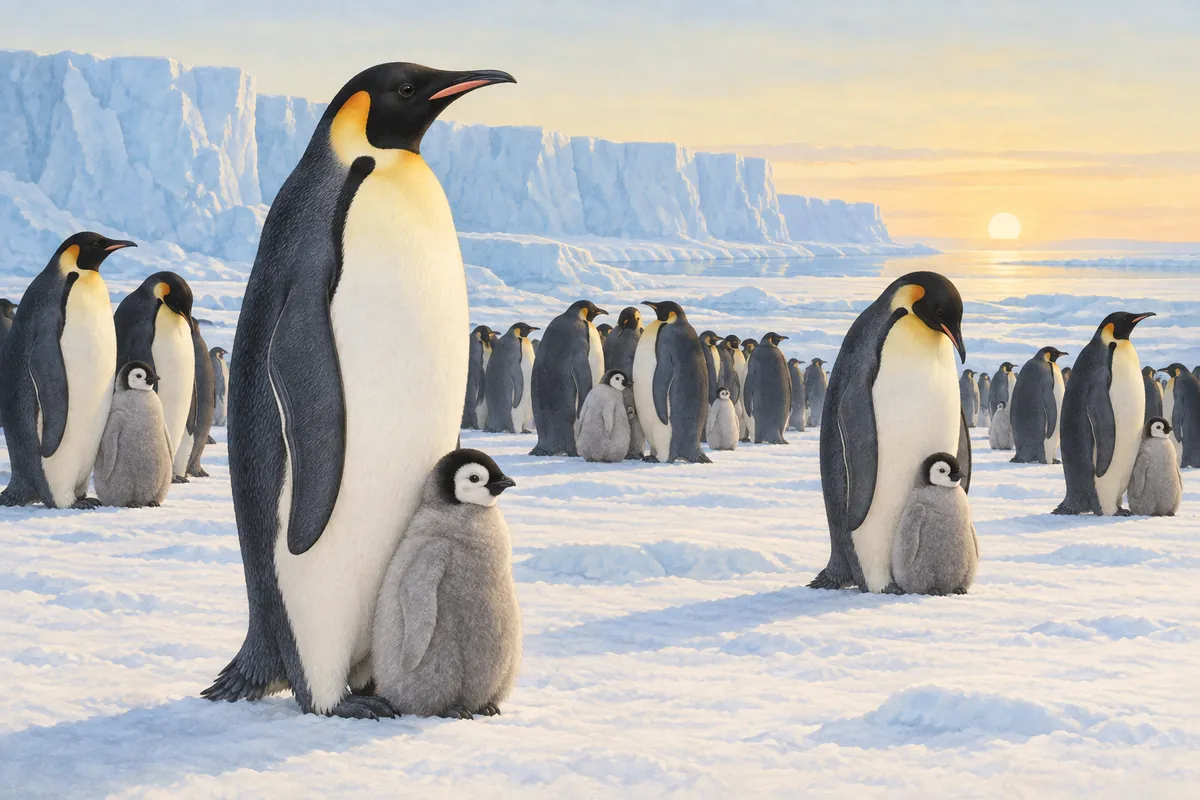
The emperor penguin (Aptenodytes forsteri) is the only penguin that breeds on sea ice. It needs fast ice, the stable sea ice fixed to the coast, from April until December, when the chicks fledge. Most colonies sit on ice up to about 18 km from shore, and only three are on land. Emperors breed through the Antarctic winter, with the males holding the egg on their feet for about two months. They hunt in the pack ice, diving as deep as 564 m and travelling up to about 500 km from the colony.
The emperor depends on sea ice that arrives on time and stays long enough. In 2022, four of the five monitored colonies in the Bellingshausen Sea lost nearly all their chicks after record-low sea ice. At Halley Bay, the ice broke up early three years running, from 2016 to 2018, and the colony raised no chicks. Most of the adults moved to the nearby Dawson-Lambton colony. In April 2026 the IUCN listed the emperor as Endangered, with about 228,000 adults left.
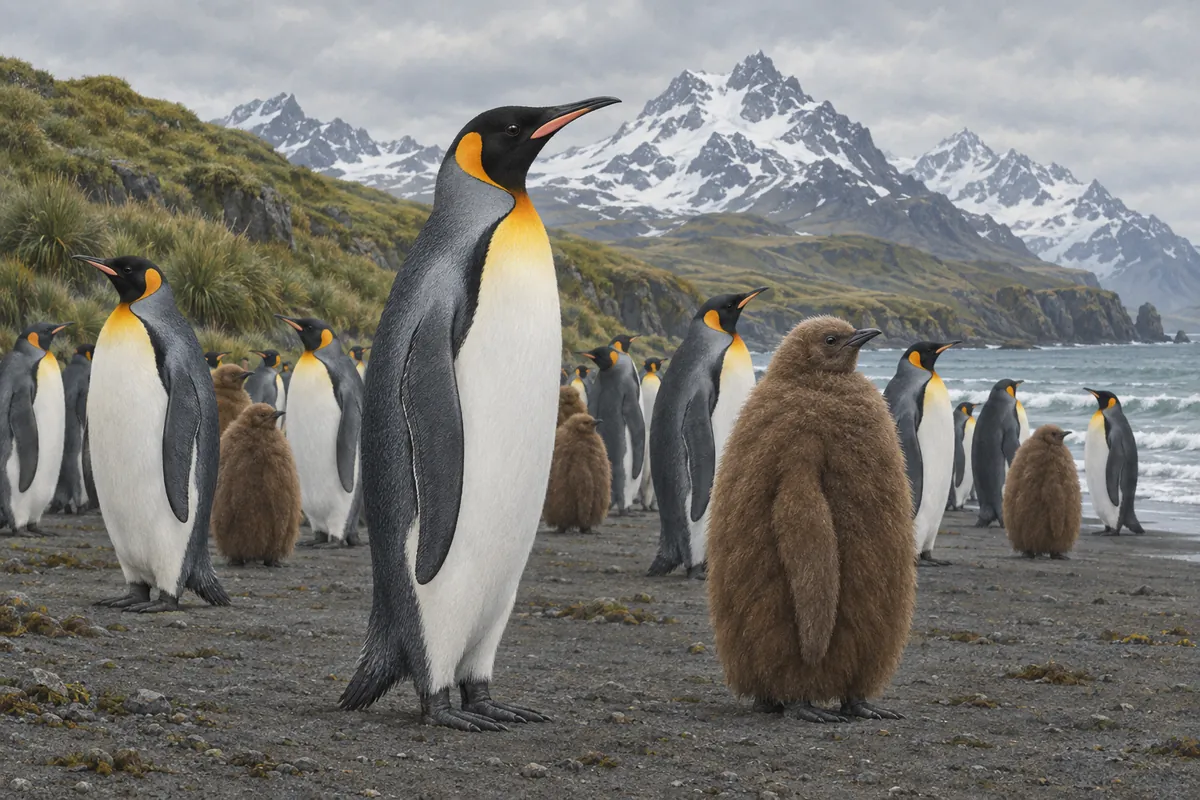
The king penguin (Aptenodytes patagonicus) breeds on ice-free beaches and flat tussock ground between 45 and 55 degrees south. It builds no nest and carries its egg on its feet. St Andrews Bay on South Georgia had about 250,000 breeding pairs in a 2019 drone count. The king colony on Ile aux Cochons in the Crozet Islands fell from 502,400 pairs in 1982 to 59,200 in 2017, and the cause is still unknown.
Brush-tailed penguins: bare Antarctic rock
Adélie, chinstrap and gentoo penguins are named for their stiff tail feathers, which sweep the ground as they walk. All three nest on ice-free rock and build their nests from small stones. Adélies never breed on ice, so their colonies are on rocky headlands and islands where snow clears in summer. The Danger Islands in the Weddell Sea held 751,527 Adélie pairs when the colony was found from satellite images in 2018.
Chinstraps nest on steep rocky slopes on the Antarctic Peninsula and the islands of the Scotia Sea. Gentoos use more varied ground, including grassland up to about 2 km inland, and they range further north to the Falklands and the sub-Antarctic islands. The gentoo is the fastest swimming bird, reaching about 36 km/h. On the Antarctic Peninsula, Adélie and chinstrap colonies are shrinking while gentoos are moving south into the gaps.
Crested penguins: cliffs, tussock and forest
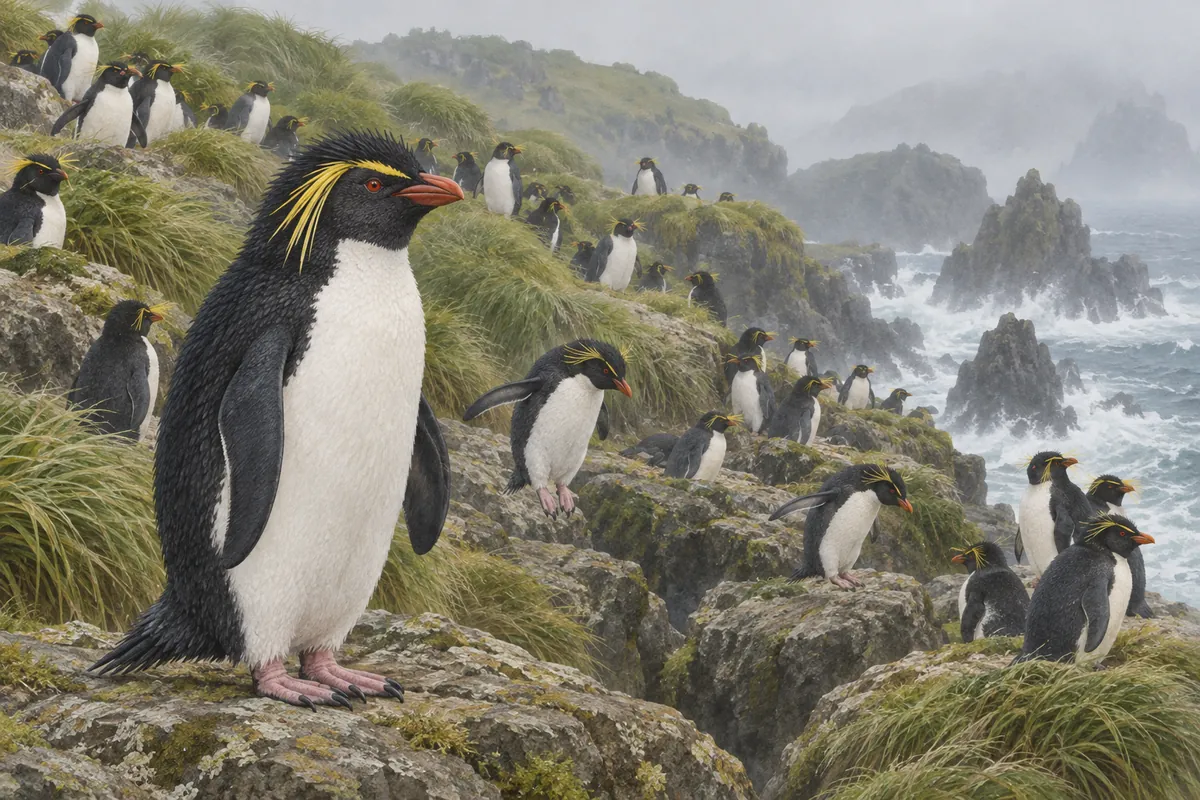
The seven crested penguins all have yellow or orange head plumes and thick red-orange bills. Most breed on exposed rock. Rockhoppers nest on cliffs and boulder fields, and they reach their colonies by hopping from rock to rock with both feet together. Southern rockhoppers breed in the Falklands, southern Chile and Argentina and on the sub-Antarctic islands, and they forage up to 157 km from the colony. The northern rockhopper breeds only on the Tristan da Cunha group, Gough Island and the French islands of Amsterdam and Saint-Paul. It has declined by about 90 percent since the 1950s.
Macaroni penguins nest on steep slopes and tussock on South Georgia and other sub-Antarctic islands, and South Georgia's population halved between the mid-1970s and the mid-1990s. Royal penguins breed only on Macquarie Island, where a 1984-85 survey counted 848,719 pairs in 57 colonies. Their nests run from the beach up terraces as far as 1.6 km inland.
Three crested penguins breed in New Zealand. The Fiordland penguin nests in temperate rainforest, in sea caves and under tree roots on the south-west coast of the South Island and on Stewart Island, and it breeds in winter. The Snares penguin nests under the low forest of the Snares Islands, and the erect-crested penguin on the bare rock of the Bounty and Antipodes Islands.
Banded penguins: burrows on warm coasts
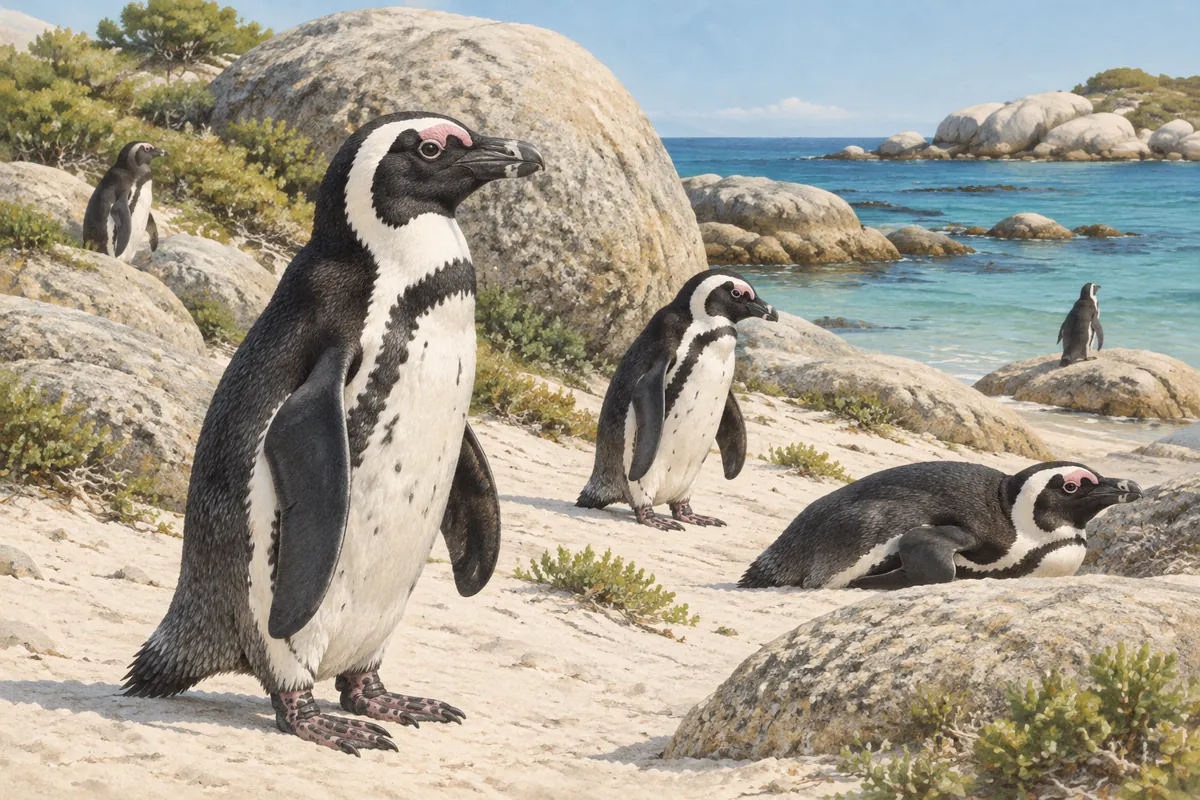
The four banded penguins have black and white bands across the chest and face. They live on temperate and tropical coasts, and most of them nest in burrows to keep their eggs and chicks out of the sun. African penguins once dug into thick layers of guano, the dried droppings of seabirds. Guano was mined for fertiliser through the 19th and 20th centuries, so many now nest under bushes or in artificial nest boxes. The African penguin fell from about 141,000 pairs in the 1950s to about 9,900 in 2023, mainly because sardines and anchovies became scarce near its colonies. In 2025 a court settlement closed the waters around six key colonies to purse-seine fishing for ten years.
Humboldt penguins nest in guano burrows, caves and hollows on the desert coast of Peru and Chile. Peru's count fell from 15,663 birds in 2022 to about 5,400 in 2025. Magellanic penguins dig burrows or nest under bushes on the Patagonian steppe and coast. They migrate after breeding, and from April to September they winter at sea as far north as southern Brazil.
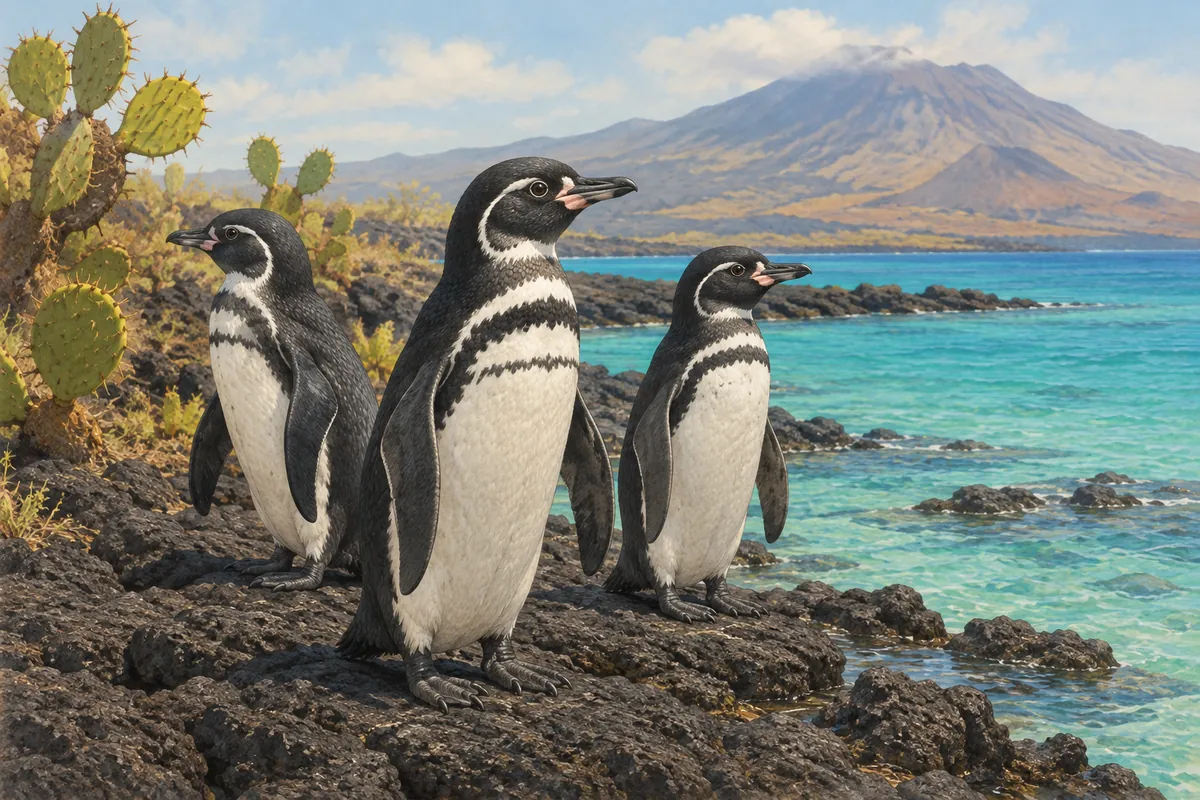
The Galápagos penguin nests in lava caves and crevices within about 50 m of the shore, out of the equatorial sun. It feeds close to its colonies, usually within 5 km. Its numbers crash in El Niño years, when warm water cuts off its food, and only about 1,200 adults remain.
Little penguin: burrows under dunes and houses
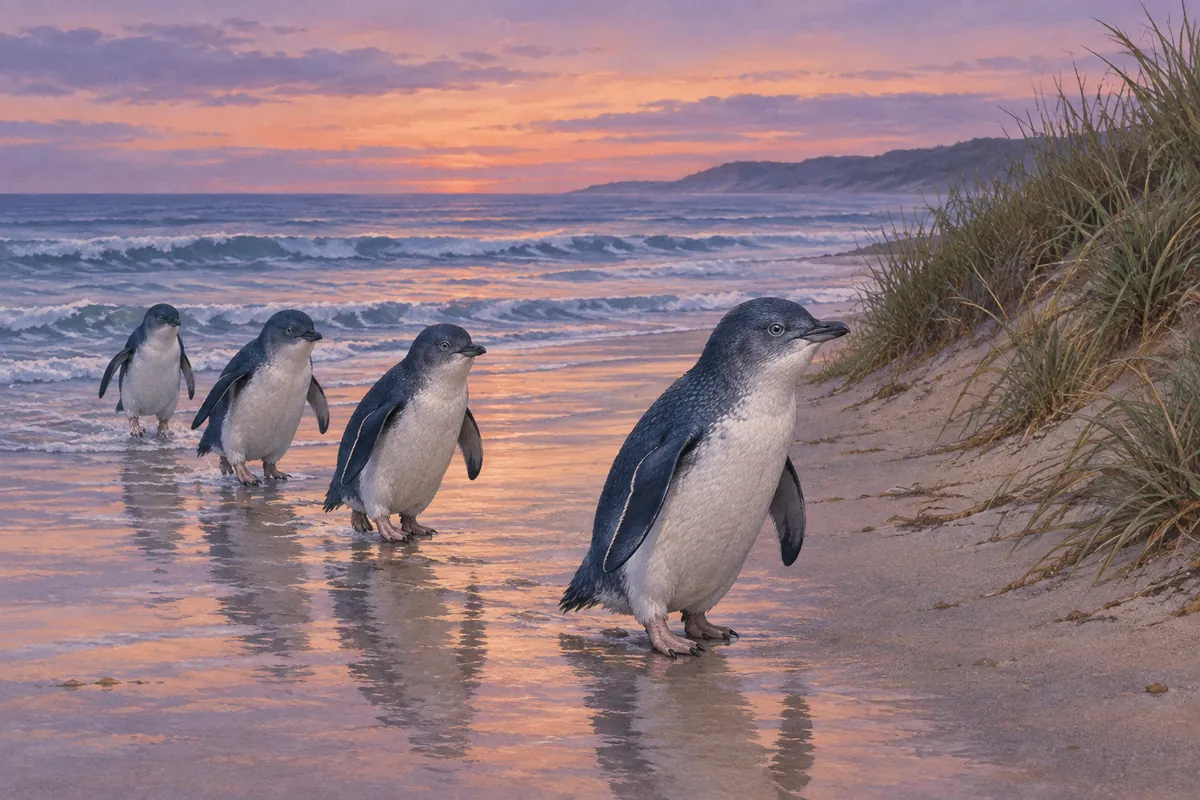
The little penguin (Eudyptula minor), also called the little blue penguin or fairy penguin, is the smallest penguin. It nests in burrows in sand and soil, in rock crevices and caves, and sometimes under houses and boat sheds. Little penguins feed at sea during the day, usually within about 30 km of the colony, and come ashore together after dark. At Phillip Island near Melbourne about 32,000 breeding birds walk up the beach each evening in the Penguin Parade, up from about 12,000 in the mid-1980s. Tasmania holds 110,000 to 190,000 pairs. See birds of Australia for more of the country's birds.
Yellow-eyed penguin: coastal forest in New Zealand
The yellow-eyed penguin (Megadyptes antipodes), or hoiho, nests alone rather than in a crowded colony. Each pair hides its nest in coastal forest or scrub, up to about 1 km inland. It breeds on the south-east coast of the South Island, Stewart Island and the Auckland and Campbell Islands. Nests on the mainland fell from 739 in 2008-09 to 143 in 2024-25. Disease, warming seas and predators such as stoats and dogs are behind the loss. Only 2,600 to 3,000 adults remain.
Life at sea: the at-sea range
Penguins come ashore only to breed and moult. The rest of the year they live at sea, and the hatched areas on the map show where. During the breeding season adults must return to feed their chicks, so they hunt close to the colony. Galápagos penguins rarely travel more than 24 km. Little penguins usually stay within about 30 km and African penguins within about 20 km of the shore. Southern rockhoppers forage up to 157 km away and emperors up to about 500 km.
After the breeding season many species spread out. Emperors and Adélies follow the pack ice as it grows north in winter. Macaroni and rockhopper penguins can travel hundreds of kilometres from their islands. Magellanic penguins swim north along the coast of South America, which is why they wash up on beaches in Uruguay and Brazil every winter. The deepest diver is the emperor, at 564 m. Most other penguins hunt in the top 100 m, catching krill, fish and squid.
Penguin habitat facts
- No penguins live in the Arctic. Every penguin colony is in the Southern Hemisphere or on the equator. The puffins and auks of the Arctic look similar but are not related.
- The Galápagos penguin is the only penguin that lives north of the equator, on the northern tip of Isabela Island.
- The southernmost penguin colony is the Adélie colony at Cape Royds, Antarctica, at 77.55 degrees south.
- The emperor penguin is the only penguin that breeds on sea ice, and it lays its egg in the Antarctic winter.
- The African penguin is the only penguin that breeds on the African mainland, at Boulders Beach and Stony Point.
- The royal penguin breeds only on Macquarie Island, and the Snares penguin only on the Snares Islands.
- The Danger Islands in Antarctica held 751,527 Adélie pairs, about 1.5 million birds, when the colony was found in 2018.
- Zavodovski Island, home to 600,000 to 1,000,000 chinstrap pairs, is an active volcano.
- The Fiordland penguin nests in rainforest and breeds in the southern winter.
- Little penguins sometimes nest under houses and boat sheds in coastal towns in Australia and New Zealand.
- Penguin breeding range is tiny compared with their at-sea range: most colonies cover less than a square kilometre, but the birds feed across thousands of square kilometres of ocean.
- New Zealand has six breeding penguin species, and three of them breed nowhere else: the yellow-eyed, Snares and erect-crested penguins. The Fiordland penguin is a fourth that breeds only in New Zealand.
Threats to penguin habitat
The biggest threats to penguins are loss of food and loss of sea ice. Emperors need sea ice that lasts until their chicks fledge, and the Antarctic sea ice has reached record lows several times since 2016. Fishing for sardines, anchovies and krill takes the food that African, Humboldt and Antarctic penguins depend on. Guano mining removed the nesting material of African and Humboldt penguins. Oil spills, introduced predators such as cats, stoats and rats, and diseases including avian malaria and bird flu add to the losses. More endangered polar animals are covered in endangered species in Antarctica, and polar birds covers the other birds of the far south.
Other habitat maps show where the bald eagle, gray wolf, red fox, rhino and peacock live.
Frequently asked questions
Where do penguins live?
Penguins live in the Southern Hemisphere. They breed in Antarctica, on the sub-Antarctic islands, on the coasts of South America, South Africa and Namibia, in southern Australia and New Zealand and in the Galápagos Islands. They spend most of their lives at sea in the Southern Ocean and the cold currents of the South Atlantic and South Pacific.
What is a penguin's habitat?
A penguin's habitat has two parts: the ocean, where it feeds, and a coast or island where it breeds. Breeding habitat varies by species. Emperors breed on sea ice, Adélies on bare rock, kings on beaches, Fiordland penguins in rainforest and African penguins in burrows on sandy islands.
How many types of penguins are there?
There are 18 species of penguins in six groups, according to BirdLife International. Some bird lists count 19 because they treat the eastern rockhopper penguin as a separate species.
Do penguins live in the Arctic?
No. No penguin lives in the Arctic or at the North Pole. All penguin colonies are in the Southern Hemisphere, and the only penguin that crosses the equator is the Galápagos penguin.
Do penguins only live in Antarctica?
No. Only four of the 18 species breed in Antarctica: the emperor, Adélie, chinstrap and gentoo. The other 14 breed on sub-Antarctic islands and on the coasts of South America, Africa, Australia, New Zealand and the Galápagos.
Are there penguins in Australia?
Yes. Little penguins breed along the southern coast of Australia and around Tasmania, including the colony at Phillip Island near Melbourne. Australia's Macquarie Island has king, royal, gentoo and rockhopper penguins, and Heard Island has kings, gentoos, macaronis and rockhoppers.
Are there penguins in South Africa?
Yes. The African penguin breeds on islands and two mainland beaches in South Africa and Namibia. Boulders Beach near Cape Town is the best-known colony. South Africa's Marion Island in the Southern Ocean also has king, gentoo, macaroni and rockhopper penguins.
Are there penguins in South America?
Yes. Magellanic penguins breed in Argentina and Chile, Humboldt penguins in Peru and Chile, and gentoos, rockhoppers and kings on islands off Tierra del Fuego. Magellanic penguins reach Uruguay and Brazil in winter.
Where do emperor penguins live?
Emperor penguins live only in Antarctica. They breed at about 66 colonies around the coast, almost all of them on sea ice, and feed in the pack ice of the Southern Ocean.
Where do king penguins live?
King penguins breed on sub-Antarctic islands between 45 and 55 degrees south, including South Georgia, Crozet, Kerguelen, Marion, Heard and Macquarie, and on the Falkland Islands and Tierra del Fuego.
Which penguin lives the furthest north?
The Galápagos penguin. It breeds on the islands of Isabela and Fernandina, and the northern tip of Isabela lies just north of the equator.
Are penguins endangered?
Many are. The African penguin is Critically Endangered, and the emperor, northern rockhopper, erect-crested, Galápagos and yellow-eyed penguins are Endangered. Eleven of the 18 species are in a threatened or near-threatened category on the IUCN Red List.