A 10-year-old ball python is about 38 in human years, a 5-year-old is 22 and a 1-year-old is 9. The calculator scales each snake so that its typical captive lifespan, 22.5 years for a ball python, equals 79 human years, the US life expectancy.
Choose a species, enter your snake’s age and the snake years calculator returns the human-equivalent age, the life stage and the age at which your snake counts as a senior. It also works in reverse, from human years to snake years, and shows how the result compares with a simple ratio. This page also answers how long snakes live and how to estimate the age of a snake with no hatch date.
How to use the snake years calculator
- Pick a species, or “Not sure of the species”. The species sets the typical captive lifespan and the maturity profile. If you are unsure, pick the closest group. The snake identification quiz narrows down an unknown snake.
- Enter your snake’s age. Use years and months, or the hatch date.
- Read the result: the human-equivalent age, the life stage and the senior age.
- Switch to human to snake years to turn a person’s age into a snake age for the same species.
A snake older than its species’ typical captive lifespan is labeled “past the typical captive lifespan”. That describes where the snake sits on the scale. It is not a prognosis. The scale stops at 122 human years, the oldest verified human age.
Also own a dog, a cat or a horse? The dog years calculator, the cat years calculator and the horse years calculator work the same way. The full set of tools is on the calculators page.
Snake years to human years chart
A 1-year-old snake is 8 to 11 in human years, a 5-year-old is 20 to 45 and a 10-year-old is 34 to 88, depending on the group. The chart gives whole human years for the six groups.
| Snake age | Corn / rat / king / milk | Garter / ribbon / green | Hognose | Sand / rosy boa | Python | Boa constrictor / large boa |
|---|---|---|---|---|---|---|
| 1 | 9 | 11 | 11 | 9 | 9 | 8 |
| 2 | 15 | 16 | 16 | 15 | 15 | 12 |
| 3 | 17 | 22 | 22 | 17 | 17 | 15 |
| 4 | 20 | 33 | 26 | 20 | 20 | 17 |
| 5 | 22 | 45 | 30 | 22 | 22 | 20 |
| 6 | 27 | 56 | 34 | 26 | 25 | 22 |
| 7 | 32 | 68 | 38 | 30 | 29 | 25 |
| 8 | 36 | 79 | 42 | 33 | 32 | 28 |
| 9 | 41 | 84 | 46 | 37 | 35 | 31 |
| 10 | 46 | 88 | 51 | 41 | 39 | 34 |
| 12 | 55 | 97 | 59 | 49 | 45 | 40 |
| 15 | 70 | 111 | 71 | 60 | 56 | 49 |
| 17 | 79 | 120 | 79 | 68 | 62 | 55 |
| 20 | 85 | 122 | 84 | 79 | 72 | 64 |
| 25 | 94 | 122 | 92 | 87 | 83 | 79 |
| 30 | 104 | 122 | 100 | 94 | 90 | 85 |
| 40 | 122 | 122 | 116 | 109 | 103 | 97 |
Two things set the numbers: the maturity profile and the lifespan. Each group’s typical captive lifespan lands on 79 human years: 8 years for garter, ribbon and green snakes, 17 for corn, rat, king and milk snakes and for hognose snakes, 20 for sand and rosy boas, 22 for pythons and 25 for boas. After the first few years a garter snake ages nearly four times as fast per year as a boa.
A species can differ from its group by a year or two. A ball python, at 22.5 years, is 38 at age 10 against 39 in the python column.
Human years to snake years chart
A 10-year-old child matches a ball python of 1 year 2 months, an 18-year-old matches one of 3 years 3 months and a 50-year-old matches one of 13 years 4 months. Cells give the snake’s age in years (y) and months (mo).
| Human age | Corn / rat / king / milk | Garter / ribbon / green | Hognose | Sand / rosy boa | Python | Boa constrictor / large boa |
|---|---|---|---|---|---|---|
| 5 | 7 mo | 4 mo | 4 mo | 7 mo | 7 mo | 8 mo |
| 10 | 1 y 2 mo | 10 mo | 10 mo | 1 y 2 mo | 1 y 2 mo | 1 y 7 mo |
| 15 | 2 y | 1 y 9 mo | 1 y 9 mo | 2 y | 2 y | 3 y |
| 18 | 3 y 3 mo | 2 y 3 mo | 2 y 3 mo | 3 y 3 mo | 3 y 3 mo | 4 y 3 mo |
| 21 | 4 y 7 mo | 2 y 10 mo | 2 y 10 mo | 4 y 7 mo | 4 y 7 mo | 5 y 7 mo |
| 24 | 5 y 5 mo | 3 y 2 mo | 3 y 6 mo | 5 y 6 mo | 5 y 7 mo | 6 y 8 mo |
| 30 | 6 y 8 mo | 3 y 8 mo | 5 y | 7 y 1 mo | 7 y 5 mo | 8 y 8 mo |
| 40 | 8 y 9 mo | 4 y 7 mo | 7 y 5 mo | 9 y 9 mo | 10 y 4 mo | 12 y |
| 50 | 10 y 11 mo | 5 y 5 mo | 9 y 11 mo | 12 y 4 mo | 13 y 4 mo | 15 y 4 mo |
| 60 | 13 y | 6 y 4 mo | 12 y 4 mo | 15 y | 16 y 4 mo | 18 y 8 mo |
| 70 | 15 y 1 mo | 7 y 3 mo | 14 y 9 mo | 17 y 8 mo | 19 y 4 mo | 22 y |
| 80 | 17 y 6 mo | 8 y 3 mo | 17 y 7 mo | 20 y 8 mo | 22 y 9 mo | 25 y 10 mo |
| 90 | 22 y 9 mo | 10 y 5 mo | 23 y 9 mo | 27 y 3 mo | 30 y 2 mo | 34 y 2 mo |
| 100 | 28 y 1 mo | 12 y 7 mo | 29 y 11 mo | 33 y 10 mo | 37 y 8 mo | 42 y 6 mo |
The columns split early because of the maturity profiles: a 15-year-old person matches 2 years for a corn snake or ball python, 1 year 9 months for a hognose or garter snake and 3 years for a boa. A 79-year-old person matches a snake at its typical captive lifespan, 22.5 years for a ball python.
How long do snakes live?
Pet snakes live about 10 to 25 years in captivity, depending on the species. This calculator uses 10 years for a common garter snake, 17.5 for corn snakes and western hognose snakes, 22.5 for ball pythons and 25 for boa constrictors. Records run higher: the best-documented snake, a Colombian rainbow boa, lived 42 years.
No life table exists for pet snakes, so there is no median age at death to quote. The typical figures come from care sources: ReptiFiles guides, the MSD Veterinary Manual’s reptile table and Animal Diversity Web. They disagree: for corn snakes the MSD manual gives 10 to 15 years and ReptiFiles 15 to 25. The calculator uses the midpoint of the full range, and the table shows the range.
| Species | Typical captive lifespan (range, years) | Used here (years) | Longest recorded age (years) |
|---|---|---|---|
| Ball python | 15 to 30 | 22.5 | about 62 (estimated age, Saint Louis Zoo) |
| Corn snake | 10 to 25 | 17.5 | 32.3 |
| California kingsnake | 10 to 25 | 17.5 | 33.3 |
| Boa constrictor (red-tailed boa) | 15 to 35 | 25 | 40.25 |
| Western hognose snake | 15 to 20 | 17.5 | 19.8 |
| Rosy boa | up to 31 | 22 | 31 |
| Kenyan sand boa | up to 30 | 18 | 20.7 |
| Burmese python | 20 to 25 | 22.5 | 34.2 |
| Carpet python | 20 to 30 | 25 | None documented |
| Children’s python | up to 30 | 22 | 25.7 |
| Common garter snake | 6 to 14 | 10 | 14 |
| Green tree python | 15 to 20 | 17.5 | 20.6 |
| Honduran milk snake | 10 to 25 | 17.5 | 22.6 |
| Mexican black kingsnake | 10 to 25 | 17.5 | 33.3 |
Records for most species come from the AnAge database, which draws on older collection reports and a hobbyist list. Treat them as one animal each.
Wild versus captive lifespan
Animal Diversity Web reports a wild average of about 10 years for ball pythons against about 20 in captivity, 7 to 12 years for rainbow boas, 5.5 for eastern kingsnakes and 2 for garter snakes. These are reported averages with no field study cited.
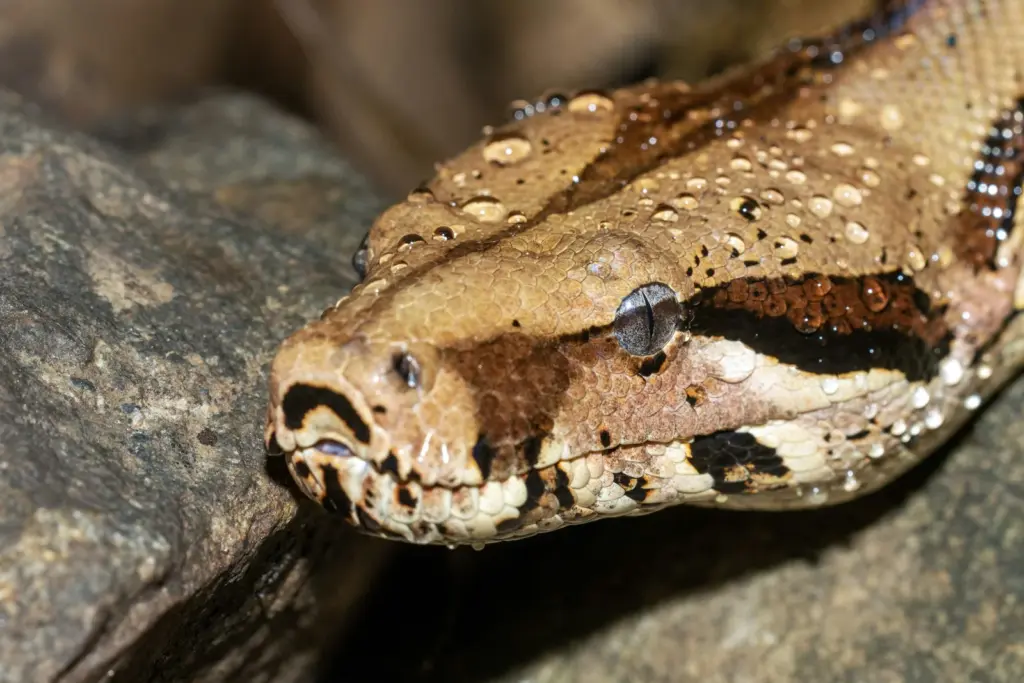
Oldest snakes on record
The best-documented record is Ben, a Colombian rainbow boa, who lived 42 years and 6 days. He was born on 31 May 1974, bought from a pet store in Peoria, Illinois that year and died in Valdosta, Georgia on 6 June 2016, according to Guinness World Records.
| Animal | Where | Age | Basis |
|---|---|---|---|
| Colombian rainbow boa “Ben” | Private keeper, Valdosta, Georgia | 42 years 6 days | Guinness World Records, best documented |
| Boa constrictor “Popeye” | Philadelphia Zoo | 40 years 3 months | Guinness World Records, died 15 April 1977 |
| Ball python | Philadelphia Zoo | about 47 years | AnAge maximum, no primary source |
| Ball python | Saint Louis Zoo | about 62 years | Estimated age, arrived 1961 |
| Corn snake | Keeper report | 32.3 years | AnAge database |
Popeye spent 34 years with a private owner before the zoo. The Saint Louis Zoo ball python arrived in 1961 at an unknown age, about 3 by one report, so her 62 years is an estimate. Records are single animals, not typical lives. The calculator caps the result at 122 human years, which a ball python reaches at 55.5, so the Saint Louis record reads 122. The corn snake record reads 106 and the boa constrictor record 97.
How long do ball pythons live?
Ball pythons live 15 to 30 years in captivity, and this calculator uses 22.5, the midpoint. The MSD Veterinary Manual gives 15 to 20 years, ReptiFiles up to 30 and Animal Diversity Web a captive average of 20. In the wild the same site reports an average of about 10 years. Claims that wild ball pythons live 30 years, or that a diet guarantees 30, have no support in the sources.
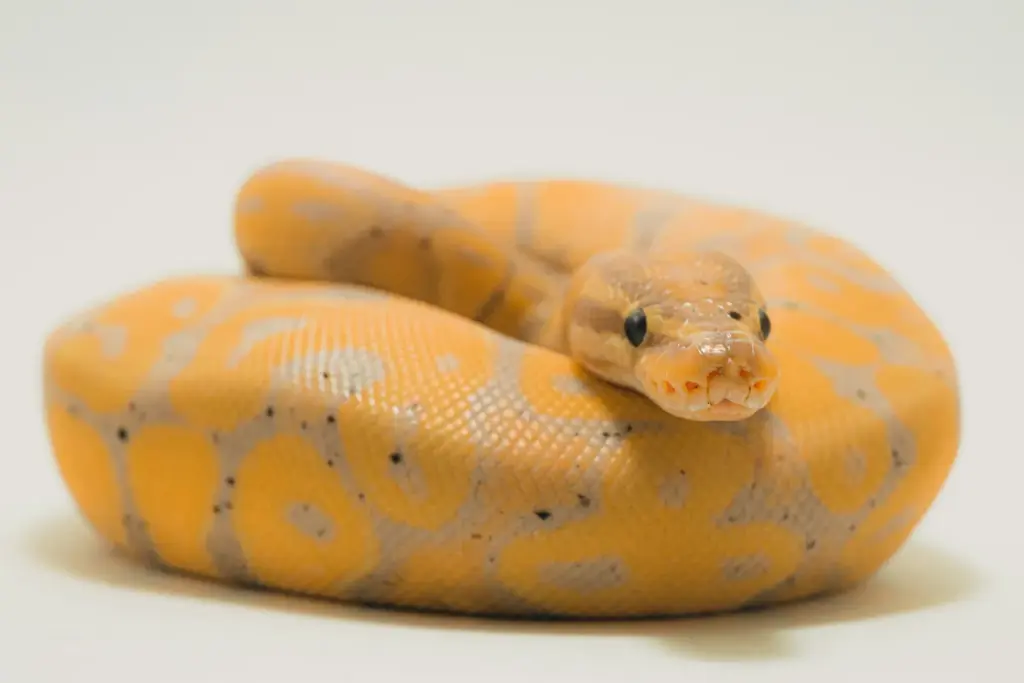
Male ball pythons mature at 16 to 18 months and females at 27 to 31 months, according to Animal Diversity Web. After age 5 a ball python gains about 3.3 human years per snake year until its typical lifespan.
| Ball python age | Human years |
|---|---|
| 1 | 9 |
| 2 | 15 |
| 5 | 22 |
| 10 | 38 |
| 15 | 55 |
| 20 | 71 |
| 22.5 (typical lifespan) | 79 |
| 25 | 82 |
| 30 | 89 |
| 40 | 102 |
| 62 (record, capped) | 122 |
The senior stage starts at 13.5 years and the geriatric stage at 18. No study shows what it takes to reach 30. The causes the sources tie to early death are in what shortens a pet snake’s life. In a UK survey of 265 keepers, first-year mortality was 1.9% for boas and pythons.
How long do corn snakes live?
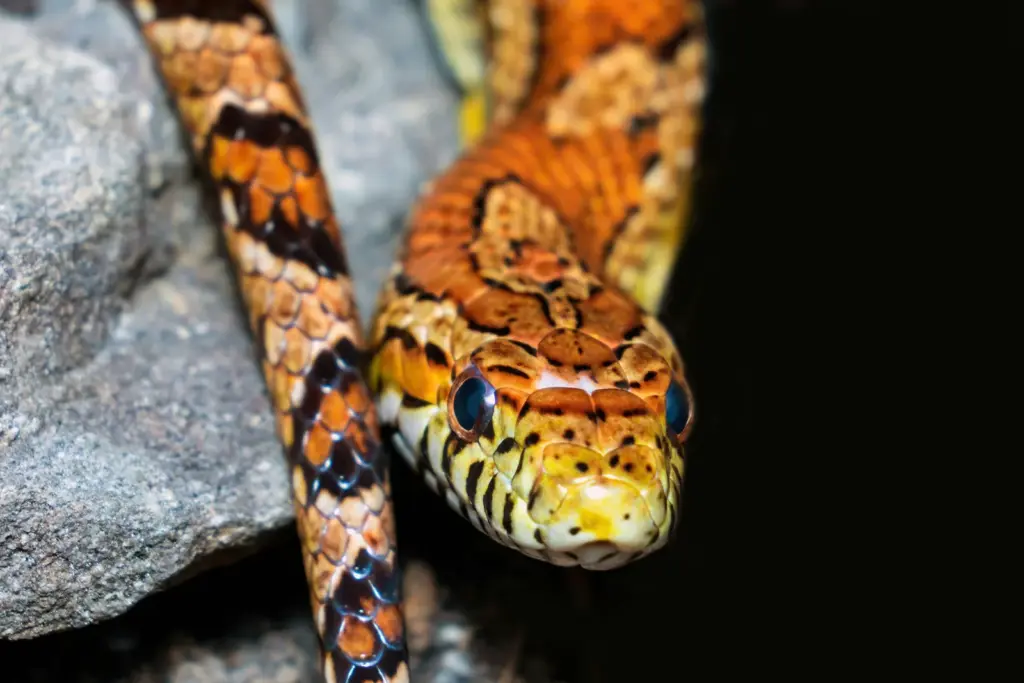
Corn snakes live 10 to 25 years in captivity, and the calculator uses 17.5. The MSD Veterinary Manual gives 10 to 15 years and ReptiFiles 15 to 25. The longest corn snake reported, 32.3 years, comes from a keeper-submitted list in the AnAge database, not from a zoo. A corn snake is mature at about 20 months, 22 in human years at 5, 45 at 10 and 84 at 20, and it becomes a senior at 10.5 years. Care for one is covered in characteristics of a corn snake.
Snake years by species
At 10 years a ball python is 38 in human years, a corn snake 45, a boa constrictor 34, a western hognose 50 and a common garter snake 79. The table covers the 14 most-kept species.
| Species | Group | Typical captive lifespan used | Senior from | 5 y | 10 y | 20 y |
|---|---|---|---|---|---|---|
| Ball python | Python | 22.5 y | 13.5 y | 22 | 38 | 71 |
| Corn snake | Corn / rat / king / milk | 17.5 y | 10.5 y | 22 | 45 | 84 |
| California kingsnake | Corn / rat / king / milk | 17.5 y | 10.5 y | 22 | 45 | 84 |
| Boa constrictor (red-tailed boa) | Boa constrictor / large boa | 25 y | 15 y | 20 | 34 | 64 |
| Western hognose snake | Hognose | 17.5 y | 10.5 y | 30 | 50 | 83 |
| Rosy boa | Sand / rosy boa | 22 y | 13.2 y | 22 | 39 | 72 |
| Kenyan sand boa | Sand / rosy boa | 18 y | 10.8 y | 22 | 44 | 83 |
| Burmese python | Python | 22.5 y | 13.5 y | 20 | 36 | 70 |
| Carpet python | Python | 25 y | 15 y | 20 | 34 | 64 |
| Children’s python | Python | 22 y | 13.2 y | 22 | 39 | 72 |
| Common garter snake | Garter / ribbon / green | 10 y | 6 y | 38 | 79 | 112 |
| Green tree python | Python | 17.5 y | 10.5 y | 20 | 42 | 84 |
| Honduran milk snake | Corn / rat / king / milk | 17.5 y | 10.5 y | 22 | 45 | 84 |
| Mexican black kingsnake | Corn / rat / king / milk | 17.5 y | 10.5 y | 22 | 45 | 84 |
Few sources give a lifespan for the Kenyan sand boa, so treat its row as a rough guide. The common garter snake is the shortest-lived species in the table, with a typical captive lifespan of 10 years and a record of 14. See characteristics of a garter snake for its habits.
Snake years vs the simple ratio and “times 3”
One snake year is not 3 human years. A 1-year-old ball python is 9 in human years in this calculator, 3.5 under a simple ratio and 3 under times 3. The methods differ most in the first years of life.
| Ball python age | This calculator | Simple ratio | Times 3 |
|---|---|---|---|
| 1 | 9.0 | 3.5 | 3 |
| 2 | 15.0 | 7.0 | 6 |
| 5 | 22.0 | 17.6 | 15 |
| 10 | 38.3 | 35.1 | 30 |
| 20 | 70.9 | 70.2 | 60 |
| 25 | 82.3 | 87.8 | 75 |
| 30 | 88.8 | 105.3 | 90 |
| 40 | 101.8 | 140.4 | 120 |
No popular snake-years chart exists. The few online calculators use a flat ratio of 1 to 3 and one admits it has no source. The simple ratio in the table keeps the same share of a typical life: 79 times the snake’s age divided by its typical lifespan.
The ratio fails in the first years. A ball python is sexually mature at about 2 years, which this calculator sets at human 15, and the ratio gives 7. Past the typical lifespan the ratio overshoots, reaching 140 at age 40 and 211 at 60. Times 3 runs below this calculator through age 25 and above it from 30.
Snake life stages, from hatchling to geriatric
A ball python is a hatchling in its first year, a juvenile until 2 years, a young adult until 5, an adult until 13.5 years and a senior from then on, which is 49.7 in human years. The geriatric stage starts at 18 years (64.3). The table below uses the python group’s 22-year lifespan, so its ages are slightly lower. The first three boundaries come from the maturity profile: fast, standard or slow. Senior starts at 60% of the typical captive lifespan and geriatric at 80%.
| Group | Profile | Typical lifespan | Juvenile from | Young adult from | Adult from | Senior from | Geriatric from |
|---|---|---|---|---|---|---|---|
| Corn / rat / king / milk | standard | 17 y | 1 y (9) | 2 y (15) | 5 y (22) | 10.2 y (46.7) | 13.6 y (62.9) |
| Garter / ribbon / green | fast | 8 y | 0.5 y (8) | 1.8 y (15) | 3 y (22) | 4.8 y (42.5) | 6.4 y (60.8) |
| Hognose | fast | 17 y | 0.5 y (8) | 1.8 y (15) | 3 y (22) | 10.2 y (51.3) | 13.6 y (65.2) |
| Sand / rosy boa | standard | 20 y | 1 y (9) | 2 y (15) | 5 y (22) | 12 y (48.6) | 16 y (63.8) |
| Python | standard | 22 y | 1 y (9) | 2 y (15) | 5 y (22) | 13.2 y (49.5) | 17.6 y (64.2) |
| Boa constrictor / large boa | slow | 25 y | 1 y (8) | 3 y (15) | 6 y (22) | 15 y (49) | 20 y (64) |
Cells give the snake age in years with the human-equivalent age in brackets.
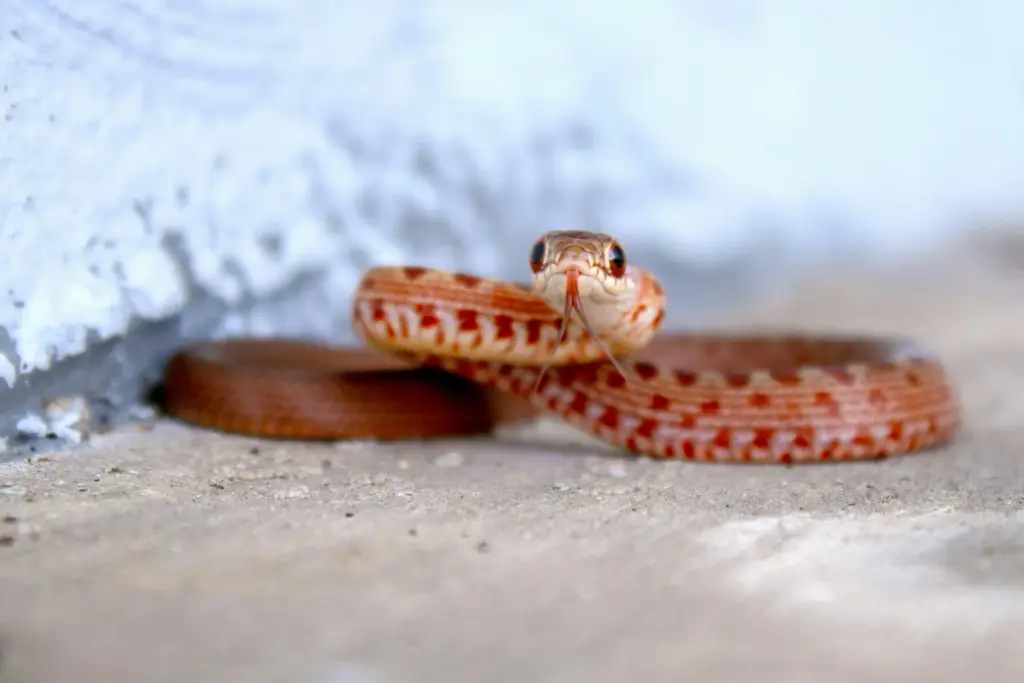
- Hatchling (to 6 or 12 months, human 0 to 8 or 9): garter and hognose snakes leave it at 6 months and the rest at 12.
- Juvenile (to 1.8 to 3 years, human 8 or 9 to 15): still growing toward sexual maturity.
- Young adult (human 15 to 22): sexual maturity falls at the start of this stage: about 20 months for corn snakes, 24 for hognose and garter snakes and 36 for boa constrictors and Burmese pythons.
- Adult (from 3 to 6 years, human 22 and up): near adult size, where growth slows. The evidence is indirect: ReptiFiles says boa growth is fastest in the first 6 years.
Maturity in snakes depends on size more than age, and faster feeding moves it by a year or more. The profile ages are typical values, not deadlines, and the senior ages are not veterinary definitions.
How to tell a snake’s age when the hatch date is unknown
Only a hatch date or a breeder record gives a snake’s age with certainty. Length and weight give a rough range at best, because snakes mature by size more than by age and the feeding rate moves maturity by a year or more.
Adult length is a ceiling, not a clock. Typical adult lengths are 3.6 to 4.5 feet (110 to 137 cm) for a ball python, 3 to 5 feet (91 to 152 cm) for a corn snake, 5 to 8 feet (152 to 244 cm) for a boa constrictor and 1.2 to 2 feet (37 to 61 cm) for a western hognose. A snake well short of its species’ length is likely under 3 to 6 years old, and a full-length snake could be 5 or 15.
This page has no teeth chart like the horse page, because none of the sources describe a way to age an adult snake from a physical exam. Ask the breeder, seller or rescue for the hatch or clutch date. Failing that, enter a low and a high guess in the calculator and compare the two results.
What shortens a pet snake’s life
The MSD Veterinary Manual links reptile respiratory disease to unfavorable temperatures, unsanitary conditions, parasites, malnutrition and vitamin A deficiency. The sources support these points:
- Temperature, humidity and ventilation. The MSD manual says reducing ventilation to keep heat or humidity “frequently causes skin and respiratory disease”. Low temperature and excess humidity predispose reptiles to fungal disease.
- Respiratory viruses. A virus found in 8 of 8 diseased ball pythons and 0 of 57 healthy snakes is a candidate cause of their respiratory disease, but is not proven (Stenglein et al. 2014).
- Inclusion body disease. It affects boas and pythons, is fatal and has no treatment, with wasting, neurological signs and secondary infections. Arenavirus-like viruses were found in 6 of 8 confirmed cases and 0 of 18 controls (Stenglein et al. 2012).
- Overfeeding. ReptiFiles says forcing growth in a Burmese python may cause organ dysfunction, obesity and a shortened lifespan.
The senior stage is a marker on the scale, not a diagnosis. The sources give no age-specific care schedule for snakes, so a reptile vet can set the check-up schedule for an older snake.
How this calculator works
The model
- Anchors by maturity profile. Birth is 0. The end of the hatchling year is human 8 or 9, typical sexual maturity is 15 and near adult size is 22. The fast profile, used for garter and hognose snakes, puts those at 6, 21 and 36 months. The standard profile, for corn, king and milk snakes, ball pythons and small boas, uses 12, 24 and 60. The slow profile, for boa constrictors and other large boas and pythons, uses 12, 36 and 72.
- Linear to the typical captive lifespan. From the last anchor the scale is a straight line chosen so that the typical captive lifespan maps to 79, the US life expectancy. The python group gains 3.35 human years per snake year and the boa group 3.00.
- A slower tail. Past the typical lifespan each snake year counts 0.4 of an earlier one, which is 1.34 human years for pythons and 1.20 for boas. The factor is a modeling choice. The result is capped at 122.
- Species and groups. A species uses the midpoint of its care-source range, so a ball python at 15 to 30 years is 22.5. “Not sure of the species” uses the group value.
Data
Maturity ages come from Animal Diversity Web and AnAge. Lifespans come from ReptiFiles, the MSD Veterinary Manual and Animal Diversity Web. Records come from Guinness World Records, zoo reports and AnAge.
Validation
- Human age never decreases as snake age rises: 0 violations across 32,882 pairs of profile and age, covering 6 groups and 25 species from 0 to 70 years.
- Every group and species is exactly 79 human years at its typical captive lifespan.
- Converting a human age back to snake years returns the original age to within 0.05 snake years.
Limitations
- The typical captive lifespan is an estimate for a well-kept pet, not a prognosis. The calculator does not predict how long an individual snake will live.
- The care sources disagree, by a factor of two for corn snakes and ball pythons, and no life table exists to settle it. The midpoint is a judgment.
- Maturity depends on size and feeding. The near-adult-size anchor has the least support.
- Three rat and gopher snake lifespans are estimates, set at half the longevity record.
- No measurement defines a snake’s “human age”. Every conversion, including this one, is a model.
Sources
- MSD Veterinary Manual, reptiles: management and husbandry, disorders and diseases, mycotic diseases and viral diseases.
- Animal Diversity Web: Python regius and Boa constrictor.
- AnAge longevity database: Python regius, Elaphe guttata and Boa constrictor.
- Snider AT, Bowler JK (1992). Longevity of reptiles and amphibians in North American collections, 2nd ed. SSAR Herpetological Circular 21.
- ReptiFiles care guides, including Burmese python.
- Guinness World Records. Oldest snake. Popeye the boa constrictor: Guinness World Records 2011 as quoted on Wikipedia.
- Saint Louis Zoo ball python: CBS News and IFLScience.
- Robinson JE, St John FAV, Griffiths RA, Roberts DL (2015). PLOS ONE 10(11):e0141460. doi:10.1371/journal.pone.0141460
- Stenglein MD et al. (2014). Ball python nidovirus. mBio. DOAJ record. Stenglein MD et al. (2012). mBio 3(4):e00180-12. DOAJ record.
The species and group lifespans, all conversions and the charts are florafaunafun.com calculations, and the original authors did not review or endorse them.
Frequently asked questions
How old is a 10-year-old ball python in human years?
A 10-year-old ball python is about 38 in human years. A 1-year-old is 9, a 5-year-old is 22 and a 20-year-old is 71. The calculator scales the ball python's typical captive lifespan of 22.5 years to 79 human years, so a ball python at 22.5 is 79. At 10 a ball python is an adult, and the senior stage starts at 13.5 years.
How long do snakes live?
Pet snakes live about 10 to 25 years in captivity. This calculator uses 10 years for a common garter snake, 17.5 for corn snakes and western hognose snakes, 22.5 for ball pythons and 25 for boa constrictors. The best-documented record is a Colombian rainbow boa that lived 42 years. No life table exists for pet snakes, so these are care-source figures, not medians.
How long do ball pythons live?
Ball pythons live 15 to 30 years in captivity, and the calculator uses the 22.5-year midpoint. The MSD Veterinary Manual gives 15 to 20 years, and Animal Diversity Web reports an average of about 20 in captivity against about 10 in the wild. A Saint Louis Zoo female reached an estimated 62, the longest age reported for a ball python.
How long do corn snakes live?
Corn snakes live 10 to 25 years in captivity, and the calculator uses 17.5. Care sources disagree: the MSD Veterinary Manual gives 10 to 15 years and ReptiFiles gives 15 to 25. The longest reported corn snake, 32.3 years, comes from a keeper-submitted list in the AnAge database. A 10-year-old corn snake is about 45 in human years.
Is 1 snake year 3 human years?
No. The flat times-3 rule that some online calculators use names no source. A 1-year-old ball python is 9 in human years here against 3 under times 3, because a ball python is sexually mature at about 2 years, which the calculator sets at human 15. Times 3 runs below this calculator through age 25 and above it from age 30.
What is the oldest snake ever?
The best-documented record is Ben, a Colombian rainbow boa who lived 42 years and 6 days, from 1974 to 2016, according to Guinness World Records. A boa constrictor named Popeye reached 40 years 3 months at the Philadelphia Zoo. A Saint Louis Zoo ball python is reported at about 62, but that is an estimated age because she arrived in 1961 at an unknown age.
How can I tell how old my snake is?
Only a hatch date or breeder record gives a snake's age with certainty. Length and weight give a rough range, because snakes mature by size more than age and faster feeding moves maturity by a year or more. The calculator's model puts a snake near adult size at 3 to 6 years, so length cannot separate a 5-year-old from a 15-year-old.
How accurate is a snake years calculator?
It is an estimate, because no one has measured a snake's human age. The early ages rest on maturity: a corn snake matures at about 20 months and a hognose at about 24, which the calculator sets near human 15. Later ages depend on a care-source lifespan for a well-kept pet, not a prognosis, and no life table exists to check it.