Most “rainforest plants” lists bury the actual flowers under a pile of rubber trees, palms, and banana plants. You came for the blooms — the lobster-claw reds, the orchids that mimic insects, the flower that smells like a corpse on purpose. So that’s what this is.
These 18 species are real flowers, not foliage plants with a footnote. They’re grouped by who pollinates them, because in a rainforest the flower’s shape, color, and smell are almost always an advertisement aimed at one specific animal. A red tubular flower isn’t red for you. It’s red because hummingbirds see red and bees mostly don’t. Once you know that, half the rainforest starts making sense.
Table of Contents
- How to read a rainforest flower
- Flowers built for hummingbirds
- Flowers built for bats
- Flowers built for insects (and a few that cheat)
- The giants: largest and strangest blooms
- Quick comparison table
How to read a rainforest flower
A flower’s design is a contract with a pollinator. The deal is simple: the animal gets nectar or pollen, the plant gets its genes carried to the next flower. The details of that contract are written into the petals.
Red and orange tubular flowers usually mean birds — hummingbirds in the Americas, sunbirds in the Old World. Birds have good color vision skewed toward red and poor sense of smell, so these flowers are loud and scentless.
Pale, dull, musky flowers that open at night and hang away from the foliage mean bats. Bats need a clear flight path and a strong smell to find the flower in the dark.
Bright, sweet-smelling flowers with a “landing platform” of broad petals mean bees and butterflies. And the weird ones — the flowers that smell like rotting meat or look like a female wasp — are running a con on flies and male insects, offering no reward at all.
Keep those four categories in mind and the list below reads less like a catalog and more like a strategy guide.
Flowers built for hummingbirds
These are the red-and-orange tubes of the Neotropics. If it looks like it was designed for a long, thin beak, it was.
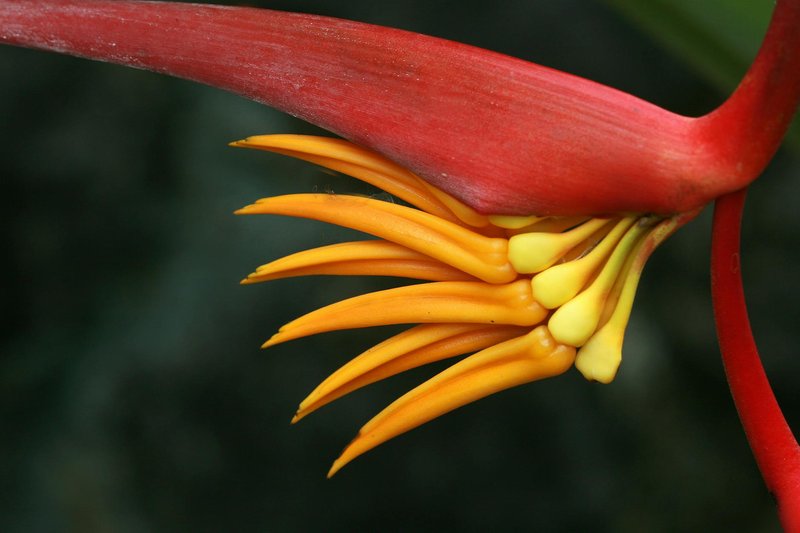
1. Lobster-Claw Heliconia (Heliconia rostrata) The stacked red-and-yellow bracts everyone pictures when they think “rainforest flower” aren’t actually the flower — they’re modified leaves called bracts. The real flowers are small and tucked inside each “claw,” holding nectar at the bottom of a tube only a hummingbird’s tongue can reach. Native to the Amazon basin of Peru, Bolivia, and Ecuador. The bracts on this species hang downward, which is why it’s also called hanging lobster claw.
2. Red Passion Flower (Passiflora coccinea) A flat scarlet disc with a fringe of filaments in the center, native to the Amazon. The structure is so intricate that 16th-century missionaries read the whole crucifixion story into its parts, which is where “passion” flower comes from. Hummingbirds work the nectar; the plant’s leaves separately feed Heliconius butterfly caterpillars, making it a cornerstone of one of the most studied co-evolution stories in biology. Those larvae are just one of the many rainforest caterpillars whose entire life cycle is locked to a single host plant.
3. Hot Lips (Psychotria elata) The famous part — two waxy red “lips” — is, again, a pair of bracts, not petals. The actual white star-shaped flowers emerge from between them for only a few days. Found in the rainforests of Costa Rica, Panama, and Colombia, it draws hummingbirds and butterflies. The puckered look is pure billboard: by the time the small flowers open, the red bracts have already done the advertising.
4. Bird of Paradise (Strelitzia reginae) Technically a native of South Africa rather than a true rainforest endemic, it’s so common in tropical gardens worldwide that it belongs in the conversation. The orange-and-blue crest sits on a horizontal stalk that works as a perch. When a bird lands to feed, the blue petals snap open and dust its feet with pollen — a tiny mechanical trap.
5. Cardinal’s Guard (Pachystachys coccinea) Slender scarlet tubes poking out of green bracts, native to the Amazon and Guianas. The flowers are spaced and angled so a hovering hummingbird can hit several in one visit, which is exactly the high-efficiency arrangement bird-pollinated plants tend toward.
Flowers built for bats
Nighttime pollinators get a different design language: pale colors that show up in low light, robust flowers that can take a bat’s weight, and a musky or fermented smell. Bat pollination is more common in tropical forests than most people realize.
6. Calabash Tree Flower (Crescentia cujete) Greenish-purple, slightly fleshy flowers that grow straight out of the trunk and main branches — a habit called cauliflory. They open at night, smell faintly of mold, and are pollinated by nectar-feeding bats. Trunk flowering isn’t an accident: it gives a bat a clear, obstacle-free approach. The large gourd-like fruits that follow have been used for bowls and instruments across the Americas for centuries.
7. Banana Passionflower (Passiflora mollissima) A high-Andes relative of the red passion flowers, with soft pink blooms. Its long floral tube is too deep for most insects, and in its native range it’s serviced by both long-billed hummingbirds and, at the right elevations, nectar bats. According to the IUCN, passion-vine relatives across the tropics depend heavily on these specialized pollinators, which is part of why habitat loss hits them so hard.
8. Cannonball Tree Flower (Couroupita guianensis) One of the strangest flowers on this list. Thick, waxy, orange-pink blooms erupt directly from the trunk in dense tangles. Native to the Amazon and the Guianas, the flower has two kinds of stamens — one that makes fertile pollen for reproduction, and a separate set that makes sterile “food” pollen as a bribe for the bees and other visitors that do the work. The fruits that follow are heavy, round, and woody, and they really do thud to the forest floor like cannonballs.
Flowers built for insects (and a few that cheat)
The biggest and most varied group. Some play fair with nectar; some are outright frauds.
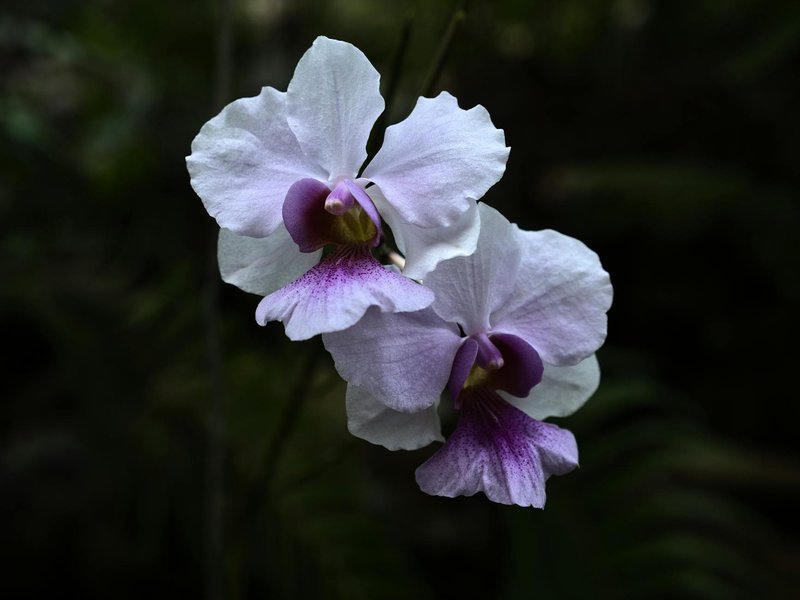
9. Orchids (family Orchidaceae) Orchids are the largest flowering plant family on Earth, and the rainforest canopy is their headquarters. Most tropical species are epiphytes — they grow on tree branches, not in soil, to reach the light. Their pollination tricks are legendary: some bucket orchids briefly trap a bee and force it through a pollen-loaded exit; others mimic the look and scent of a female insect to fool males into “mating” with the flower. No nectar, no reward, just deception.
10. Vanilla Orchid (Vanilla planifolia) The only orchid grown for food, and the source of natural vanilla. Native to Mexico and Central America, its pale green-yellow flower opens for less than a day. In its homeland a specific group of bees pollinates it; everywhere else it’s grown commercially, every single flower has to be pollinated by hand, which is why real vanilla is the second-most-expensive spice after saffron.
11. Torch Ginger (Etlingera elatior) A tall, waxy, fire-red flower head on a stalk that can top two meters, native to the rainforests of Southeast Asia. It’s pollinated by bees and the spinebill-type birds drawn to its color. In Malaysia, Thailand, and Indonesia the flower buds are a kitchen staple, chopped into laksa and sambal.
12. Flame of the Forest (Brownea grandiceps) An understory tree that produces a dense, ball-shaped cluster of red flowers, sometimes called the “rose of Venezuela.” The whole head can be the size of a grapefruit and glows against the dim forest floor. New leaves emerge limp and reddish before stiffening — a trait thought to discourage leaf-eating insects.
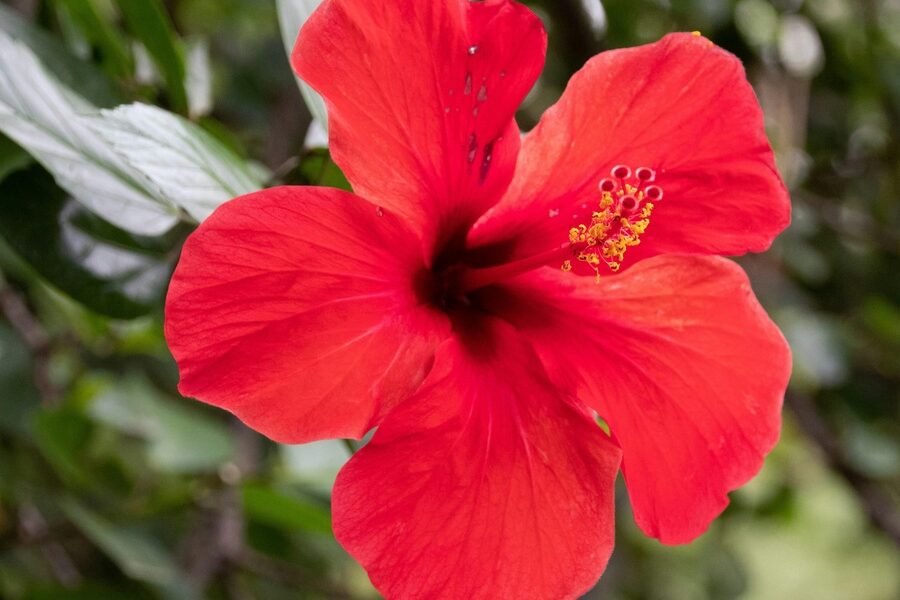
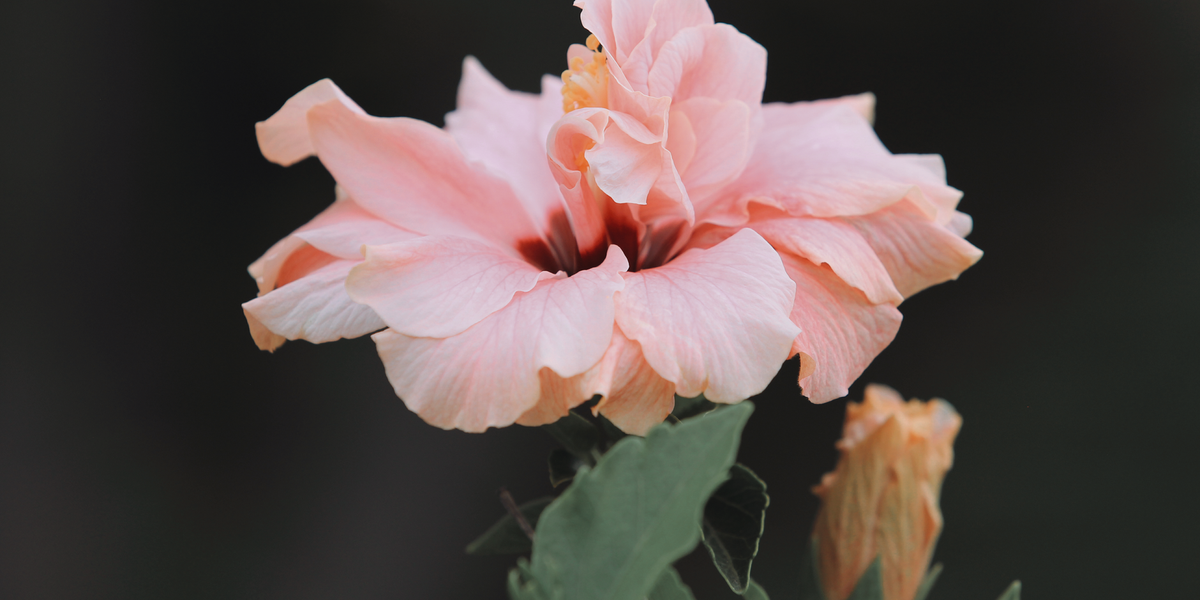
13. Hibiscus (Hibiscus rosa-sinensis) Broad, open, five-petaled flowers with a long central column of stamens that brushes pollen onto any visitor. The wide petals are a landing pad for bees and butterflies, and the long column also catches passing hummingbirds and sunbirds. Naturalized across virtually every tropical region, which is why it shows up everywhere from Hawaii to Malaysia.
14. Frangipani / Plumeria (Plumeria rubra) Famous for its scent, which it cranks up at night to attract sphinx moths. The con: plumeria offers the moths no nectar at all. The moth probes flower after flower expecting a reward, getting nothing, and pollinating the plant for free on the strength of the perfume alone.
15. Glory Bush (Tibouchina urvilleana) Deep purple five-petaled flowers from the Brazilian rainforest, with dark, curved stamens. It relies on buzz pollination — bees grab the flower and vibrate their flight muscles at a specific frequency to shake the pollen loose. Honeybees can’t do it; native bumblebees and carpenter bees can, which ties the plant to a specific set of pollinators. It’s one of many striking plants of Brazil whose reproduction hinges on a single group of native insects.
The giants: largest and strangest blooms
The flowers people travel across the world to see — not for beauty, exactly, but for sheer scale and strangeness.
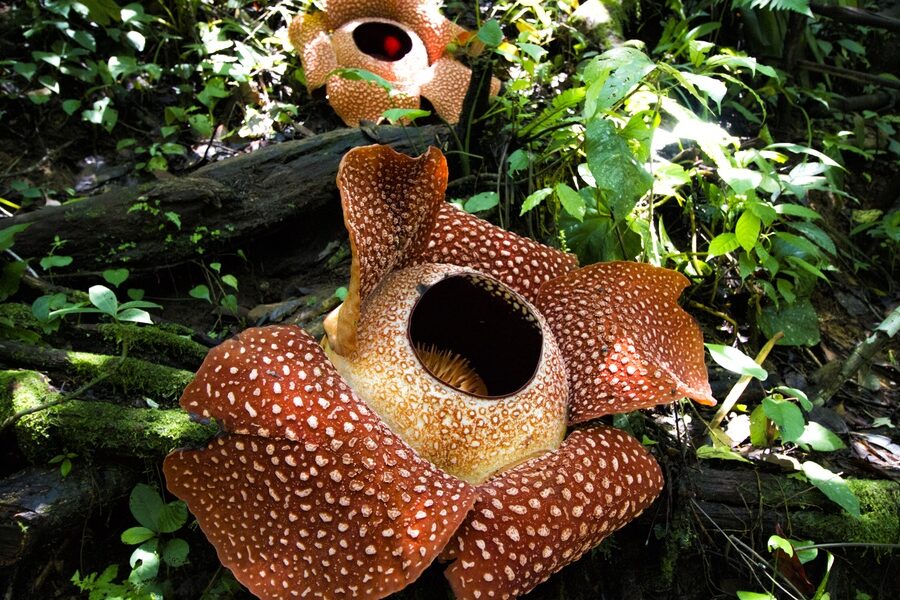
16. Rafflesia (Rafflesia arnoldii) The largest single flower in the world, reaching over a meter across and weighing up to 10 kilograms. It has no leaves, no stem, and no roots of its own. It’s a parasite that lives entirely inside a host vine in the rainforests of Sumatra and Borneo, becoming visible only when its enormous reddish-brown flower bursts out. It smells of rotting flesh to attract carrion flies, which it tricks into pollination with no reward. The bloom lasts only a few days before collapsing into black slime.
17. Titan Arum / Corpse Flower (Amorphophallus titanum) Often confused with Rafflesia, but a different giant. It produces the largest unbranched flowering structure in the world — a single spike that can clear three meters. Native to Sumatra, it heats itself to roughly human body temperature to spread a stench of rotting meat further through the still forest air, pulling in carrion beetles and flesh flies. It blooms unpredictably, sometimes once in seven to ten years, which is why botanical garden bloomings draw crowds and live cameras.
18. Jade Vine (Strongylodon macrobotrys) A cascade of claw-shaped flowers in a turquoise color almost nothing else in nature produces, native to the rainforests of the Philippines. The blue-green pigment comes from an unusual chemistry of two co-pigments — the same kind of structural and chemical trickery that makes genuinely blue coloration so rare across the natural world. In the wild it’s pollinated by bats that hang from the dangling flower clusters to drink, and it’s now endangered as its forest habitat shrinks, according to the Royal Botanic Gardens, Kew.
Quick comparison table
| Flower | Region | Pollinator | Standout trait |
|---|---|---|---|
| Lobster-Claw Heliconia | Amazon | Hummingbird | Hanging red-yellow bracts |
| Red Passion Flower | Amazon | Hummingbird | Intricate fringed center |
| Hot Lips | Central America | Hummingbird, butterfly | Red “lips” bracts |
| Bird of Paradise | Southern Africa | Birds | Snap-open perch flower |
| Calabash Flower | Neotropics | Bats | Flowers on the trunk |
| Cannonball Flower | Amazon | Bees | Trunk-borne, two stamen types |
| Orchids | Worldwide tropics | Bees, deception | Largest plant family |
| Vanilla Orchid | Mexico, C. America | Bees / hand | Source of vanilla |
| Torch Ginger | SE Asia | Bees, birds | Edible 2m flower stalk |
| Frangipani | Neotropics | Sphinx moths | Scent con, no nectar |
| Glory Bush | Brazil | Buzz-pollinating bees | Vibration-released pollen |
| Rafflesia | Sumatra, Borneo | Carrion flies | Largest single flower |
| Titan Arum | Sumatra | Carrion beetles | Tallest bloom, self-heating |
| Jade Vine | Philippines | Bats | Turquoise claw flowers |
The pattern across all of them: in a rainforest, a flower’s looks are never decoration. The color, the smell, even the temperature is a signal tuned to one animal. The hummingbird flowers are red and odorless. The bat flowers are pale and reek at night. The con artists smell like death or sex because that’s what brings in flies and male insects looking for something they’ll never get. Learn the four strategies and you can walk into any tropical greenhouse and guess, just from a flower’s design, exactly who it’s trying to talk to.