Denmark has exactly 14 native amphibian species, and most Danes can name maybe two of them. The common toad and the brown frog you find in the garden, sure. But the country also hosts a frog whose males turn sky-blue for two weeks every spring, a toad that smells like garlic when you handle it, and a tiny green tree frog that nearly went extinct before a 2023 reintroduction brought it back to one specific island.
This is the field guide that pulls all 14 together — six frogs, three toads, and five newts and salamanders. For each one you get the ID features that actually matter, where it lives, when it breeds, and what its call sounds like. Several are protected under Danish and EU law, and a few you’ll be lucky to ever see. Here’s the whole roster.
Table of Contents
- Quick-reference table
- The frogs
- The toads
- The newts and salamanders
- Where and when to spot them
- Watching responsibly
Quick-reference table
| Species | Scientific name | Group | Status in Denmark |
|---|---|---|---|
| Common toad | Bufo bufo | Toad | Common |
| Common spadefoot | Pelobates fuscus | Toad | Vulnerable |
| Green toad | Bufotes viridis | Toad | Endangered |
| Common frog | Rana temporaria | Frog | Common |
| Moor frog | Rana arvalis | Frog | Common, locally declining |
| Agile frog | Rana dalmatina | Frog | Restricted, protected |
| Pool frog | Pelophylax lessonae | Frog | Localized |
| Edible frog | Pelophylax esculentus | Frog | Common |
| Marsh frog | Pelophylax ridibundus | Frog | Localized |
| European tree frog | Hyla arborea | Frog | Recovering |
| Fire-bellied toad | Bombina bombina | Toad-like frog | Endangered, reintroduced |
| Smooth newt | Lissotriton vulgaris | Newt | Common |
| Northern crested newt | Triturus cristatus | Newt | Protected, declining |
| Alpine newt | Ichthyosaura alpestris | Newt | Introduced, localized |
A note on the count: taxonomic lists like the Wikipedia entry for Danish amphibians and reptiles put the figure at 13–14 depending on how you treat the edible frog, which is a hybrid of the pool and marsh frogs. We’re counting it, which gets you to 14.
The frogs
Denmark’s frogs split into two visual families. The “brown frogs” (common, moor, agile) are the ones most people picture — earth-toned, found in damp grass and woodland. The “green frogs” (pool, edible, marsh) are the water-bound ones that bask at the pond edge and crash-dive when you approach. Then there’s the tree frog, which looks like neither.
Common frog (Rana temporaria)
The default frog. If you find an amphibian in a Danish garden, pond, or ditch, this is the most likely candidate. Brown to olive, sometimes with a reddish or yellowish tint, with a dark mask running back from the eye and irregular dark blotches. The snout is rounded and blunt — that bluntness is your quickest way to separate it from the sharper-faced moor and agile frogs.
It’s the first amphibian to wake in spring, often breeding in late February or March while ponds still carry ice at the edges. Males produce a soft, low purring growl rather than anything you’d call a croak. The common frog gets the only dedicated species profile on most Danish nature blogs, including Wild About Denmark’s post on the common brown frog, which is fair — it’s the one you’ll actually meet.
Moor frog (Rana arvalis)
The showstopper. For most of the year the moor frog is a plain brown frog with a pointed snout and a pale dorsal stripe, easy to overlook. Then for a week or two during the spring breeding frenzy, the males turn vivid blue — a powdery, almost violet blue across the throat and back, caused by light-scattering in the skin as they fill with lymph fluid. It fades as fast as it appears.
It prefers moorland, bogs, and wet meadows, as the name suggests. The call is a low, hollow glugging, often compared to air bubbling out of a submerged bottle. If you want to see the blue, you have to be at the right bog in the right two weeks of March or April.
Agile frog (Rana dalmatina)
The jumper. Long-legged and slender with a sharply pointed snout and a clean tan-to-pinkish-brown back, the agile frog can leap distances that look impossible for its size — well over a metre. In Denmark it’s restricted and protected, found in a handful of locations, mostly on the islands and in deciduous woodland with sun-warmed breeding ponds.
It breeds early, attaching egg clumps to underwater twigs rather than letting them float free, which is a useful field clue if you find spawn but no adult.
Pool, edible, and marsh frogs (Pelophylax group)
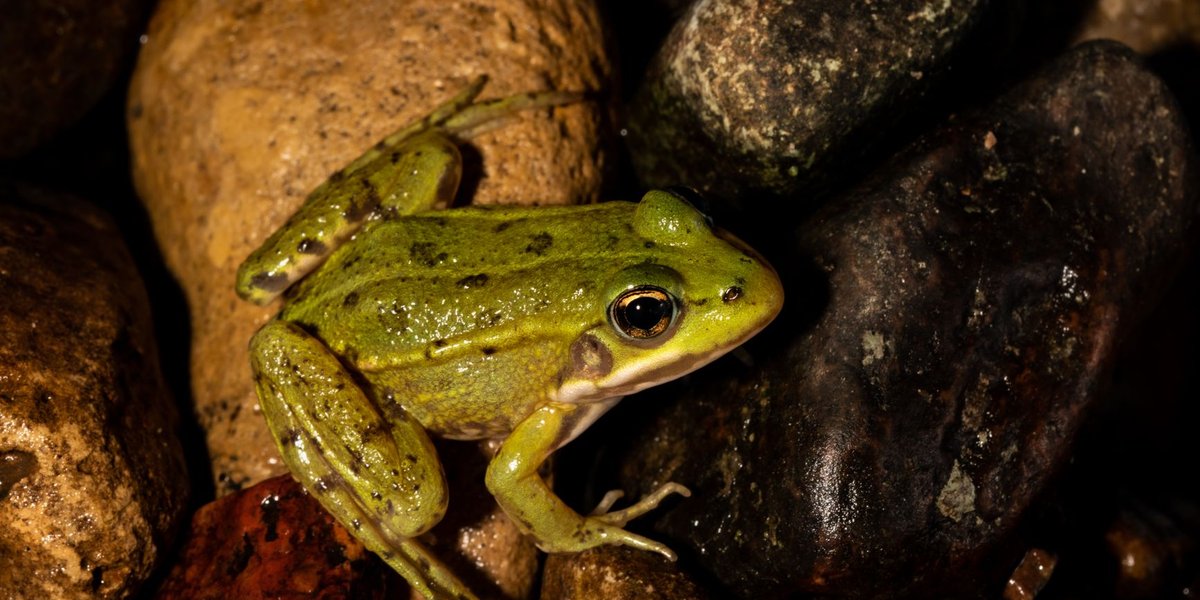
These three are the “green frogs,” and honestly, telling them apart in the field is a job for experts with a calibrated ear. The pool frog is the smallest, usually bright green with a dorsal stripe. The marsh frog is the largest, often more brown-green and noisy. The edible frog is the genetic in-between — a hybrid that reproduces in a strange way, needing one of the parent species around to keep the lineage going.
All three sit at the water’s edge, basking on lily pads and bank vegetation, and dive with a startled squeak when you get close. Their breeding chorus is a loud, laughing, rattling croak — the cartoon frog sound. They breed later than the brown frogs, into May and June, once the water has warmed.
European tree frog (Hyla arborea)
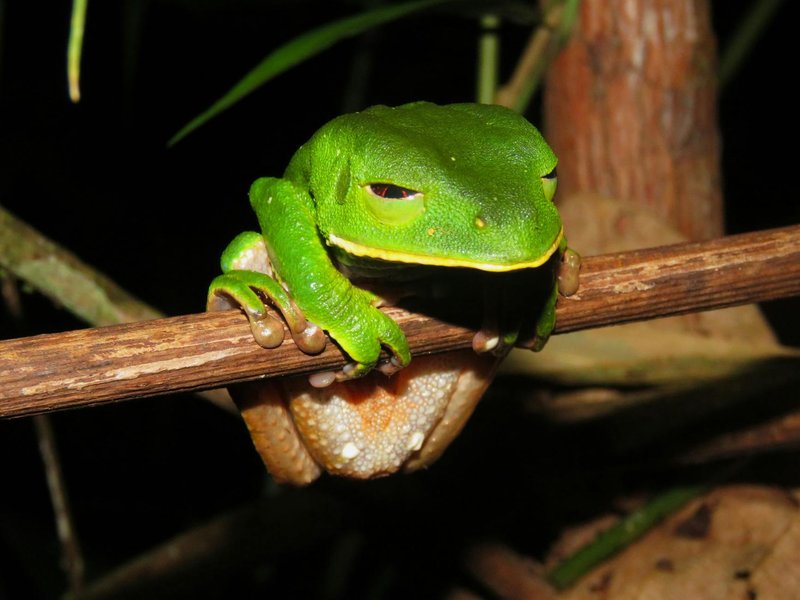
The comeback kid. A tiny, bright leaf-green frog barely 4–5 cm long, with adhesive toe discs that let it climb reeds and shrubs, and a dark stripe running from nostril to flank. The males inflate a balloon-like throat sac to produce a deafening, rhythmic “epp-epp-epp” chorus on warm spring nights — astonishingly loud for an animal you can hide under a bottle cap.
The tree frog crashed to near-extinction in Denmark in the late 20th century, surviving in pockets in southern Jutland around Sønderborg. Targeted pond restoration brought it back, and it’s now one of the conservation success stories the VisitSønderjylland tree frog guide leans on. On a still June evening near Als, the chorus can carry for kilometres.
The toads
Denmark’s true toads are the warty, short-legged walkers — they crawl rather than leap — plus the fire-bellied toad, which is technically in a different family but everyone calls it a toad anyway.
Common toad (Bufo bufo)
The big brown one. Denmark’s largest amphibian, females reaching 10–13 cm, with dry warty skin in shades of brown and olive, copper-coloured eyes, and prominent paratoid glands behind the head. It walks in a deliberate plod and, when threatened, puffs up and stands tall on stiff legs rather than fleeing.
Common toads make spectacular mass migrations to ancestral breeding ponds on the first warm, wet nights of spring — which is also when thousands die on roads, the reason you’ll see “toad crossing” volunteers with buckets in March across Denmark. The male’s call is a high, almost birdlike chirp, surprisingly delicate for such a heavy animal.
Common spadefoot (Pelobates fuscus)
The garlic toad. This one has a genuinely odd party trick: handled or threatened, it secretes a substance that smells distinctly of garlic, which is where its Danish nickname comes from. It’s pale grey-brown with darker marbling, a domed forehead, vertical cat-like pupils, and a hard pale “spade” on each hind foot for burrowing backwards into sandy soil, where it spends most daylight hours.
It’s listed as vulnerable in Denmark and tied to loose, sandy ground near breeding ponds. The call is a soft, muffled “clock-clock” made underwater, so you’re more likely to smell a spadefoot than hear one.
Green toad (Bufotes viridis)
The mosaic toad. Pale cream or grey-green ground colour overlaid with bold olive-green blotches, like a camouflage pattern someone actually designed. It tolerates dry, warm, sandy habitats better than most amphibians and turns up on coastal dunes and islands. In Denmark it’s endangered, hanging on in scattered coastal populations.
The male’s call is the prettiest of any Danish amphibian — a long, melodic, trilling warble that sounds more like a cricket or a canary than a toad, often heard on warm coastal nights in May.
Fire-bellied toad (Bombina bombina)
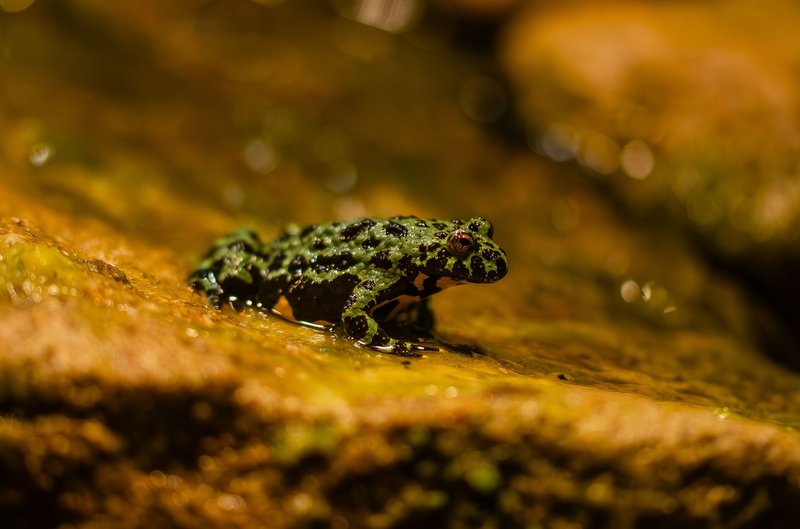
The one with the warning flag underneath. From above it’s a drab, flattened grey-brown. Flip it (or watch it arch defensively in the “unken reflex”) and the belly is a shocking mosaic of black and fiery orange-red — an advertisement that its skin secretions are toxic. It’s small, fully aquatic, and lives in shallow, sunny, plant-rich ponds.
This species nearly vanished from Denmark, and its recovery is the headline conservation story among Danish amphibians: a 2023 reintroduction project returned fire-bellied toads to the island of Als near Sønderborg, rebuilding a population that had collapsed to a handful of sites. The call is unmistakable and haunting — a soft, bell-like, mournful “oonk… oonk… oonk” that rolls across a pond at dusk, the sound that gave the whole Bombina group its German name.
The newts and salamanders
Newts are the tailed amphibians — lizard-shaped, but smooth-skinned and tied to water for breeding. Denmark has three established species, and the males in breeding condition are some of the most ornamental animals in the country.
Smooth newt (Lissotriton vulgaris)
The common one. Small, 7–11 cm, olive-brown with a pale orange belly spotted in black. In the breeding season the male grows a wavy crest running the length of the back and tail and develops bolder spotting — a miniature dragon for a few months a year. Out of water it’s drab and easily mistaken for a lizard, except newts have no scales and move much more slowly. If a slow-moving lizard-shape on land throws you, the complete list of Denmark’s reptiles is the quickest way to rule the true lizards in or out.
It breeds in almost any small pond, including garden ones, which makes it the newt most Danes are likely to encounter.
Northern crested newt (Triturus cristatus)
The big protected one. Much larger than the smooth newt at up to 16 cm, dark grey-brown to near-black with rough, granular skin and a vivid orange belly blotched with black. The breeding male grows a tall, jagged crest — deeply notched, like a cut-out paper dragon — and a silvery streak along the tail.
It’s strictly protected across the EU under the Habitats Directive, and its decline is closely tracked. Denmark’s HerpAtlas citizen-science distribution database maps where it survives, and the crested newt’s presence is one of the things developers in Denmark legally have to check for before draining or filling a pond.
Alpine newt (Ichthyosaura alpestris)
The introduced one. Not originally native to Denmark, the alpine newt has established localized populations from introductions. The breeding male is unmistakable — a smooth, unspotted slate-blue back, a bright unmarked orange belly, and a low straight crest, easily the most striking colour scheme of any Danish newt. It favours cool, shaded woodland ponds.
Because it isn’t a natural part of the Danish fauna, you’ll only find it in particular pockets where it was released and took hold.
Where and when to spot them
Timing beats luck with amphibians. The whole community is active for only part of the year, and each species has a window.
- Late February to March — common frogs and common toads wake first and migrate to breeding ponds on warm, wet nights. This is the easiest time to see large numbers of anything. Check ponds after dark with a torch.
- March to April — moor frogs turn blue (briefly), and the brown-frog chorus peaks. Bogs and wet meadows in Jutland are the place to be.
- May to June — the green frogs, green toad, and tree frog start calling once the water warms. Warm, still evenings near reedy ponds in southern Jutland and on the islands give you the tree frog and fire-bellied toad choruses.
- Spring overall — newts are in the ponds during breeding season; lift a torch beam slowly across a clear garden pond at night and you’ll often see them hanging in the water column.
For the rarities — tree frog, fire-bellied toad, green toad, agile frog — head to Sønderborg, Als, and southern Jutland, which hold most of Denmark’s protected and reintroduced populations. The fire-bellied toad and tree frog projects around Als are the reason that corner of the country is the best amphibian-watching region in Denmark. A night at the ponds also doubles as a good introduction to the country’s broader fauna, much of which is covered in our roundup of the most remarkable wildlife of Denmark.
Watching responsibly
Most of these species are protected, and several are endangered, so a few ground rules. Don’t handle amphibians unless you have to — their skin is permeable and sunscreen, insect repellent, or salt on your hands can harm them. If you do move a toad off a road, wet your hands first. Never move animals or spawn between ponds, because that’s how diseases like chytrid fungus and ranavirus spread between populations.
Keep your distance from breeding choruses; a torch and a quiet approach get you everything you need. And if you spot something noteworthy, log it on HerpAtlas — citizen records genuinely feed the conservation work that brought the tree frog and fire-bellied toad back. Fourteen species is a modest list by global standards, but for a small, flat, heavily farmed country, every one of them is worth keeping around.