Table of Contents
- Vanuatu’s Forest Zones
- Iconic & Cultural Trees
- Lowland Rainforest Trees
- Montane & Highland Trees
- Coastal & Littoral Trees
- Mangrove Trees
- Quick Reference Table
- FAQ
Vanuatu’s Forest Zones
Vanuatu compresses a remarkable range of forest types into a Y-shaped chain of eighty-plus islands. A single large island — Santo, Malekula, or Tanna — can carry lowland rainforest at sea level, transition forest on the mid-slopes, montane cloud forest above 1,000 meters, and mangrove belts wherever tidal creeks cut inland. Windward flanks of interior ridges catch over 4,000 mm of rain annually; leeward valleys feel almost semi-arid by comparison.
That gradient explains why the archipelago hosts more than 200 native tree species, with roughly a quarter of its vascular plants found nowhere else on Earth. Three forest types dominate: lowland tropical rainforest (the most species-rich zone), montane forest wrapped in cloud and colonized by conifers and tree ferns, and coastal scrub stitched together by salt-tolerant specialists. Mangroves form a fourth layer wherever sheltered bays and river mouths allow.
What follows groups twenty ecologically and culturally significant trees by zone — a tour through the islands’ ecosystems rather than a flat alphabetical catalog.
Iconic & Cultural Trees
These six species have shaped Vanuatu’s economy, diet, and ritual life for thousands of years. Most grow across multiple forest zones; their significance puts them in a category of their own.
1. Banyan — Ficus spp. (Nambanga)
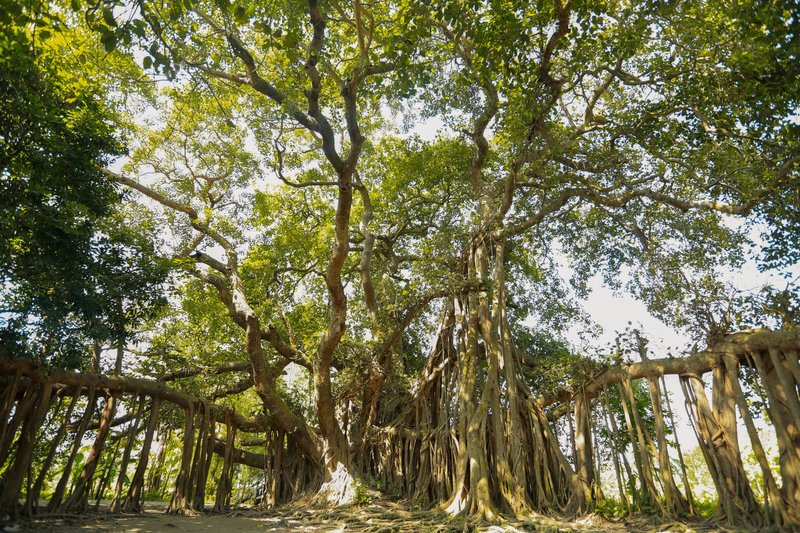
The banyan isn’t one species but a group of strangler figs — principally Ficus obliqua and Ficus virens — that ni-Vanuatu people call nambanga. Aerial roots descend from branches, touch down, and thicken into secondary trunks. Over time, a single tree can colonize an entire clearing. The banyan is Vanuatu’s national tree, appearing on the national emblem, and holds deep kastom (customary) significance: village meetings are still held beneath large banyans, and felling one typically requires ritual permission from elders.
Habitat: Lowland to mid-elevation forest, village clearings
IUCN status: Not evaluated (common)
2. Coconut Palm — Cocos nucifera
Technically a monocot palm rather than a hardwood tree, but no list of Vanuatu’s economically critical woody plants leaves it out. Coconut oil exports drove the colonial economy; copra still provides income for rural islanders today. Almost every part of the tree has a use — husk for rope, fronds for thatch, sap for fermented drinks, flesh for food and oil. Coconut palms fringe beaches across the full archipelago and often reach 25–30 meters.
Habitat: Coastal and village land throughout the archipelago
IUCN status: Not evaluated
3. Breadfruit — Artocarpus altilis
Breadfruit trees grow to about 20 meters and produce starch-dense fruit reaching 4 kg. Ni-Vanuatu communities cultivate dozens of named varieties — some islands track more than 40 cultivar names — and the fruit gets baked, roasted, boiled, or fermented (a traditional preservation method keeping the flesh edible for months). Breadfruit groves form an unofficial second canopy layer in village gardens across Efate, Santo, and Tanna.
Habitat: Cultivated lowland and village zones, sea level to ~500 m
IUCN status: Least Concern
4. Nangai / Tahitian Chestnut — Inocarpus fagifer
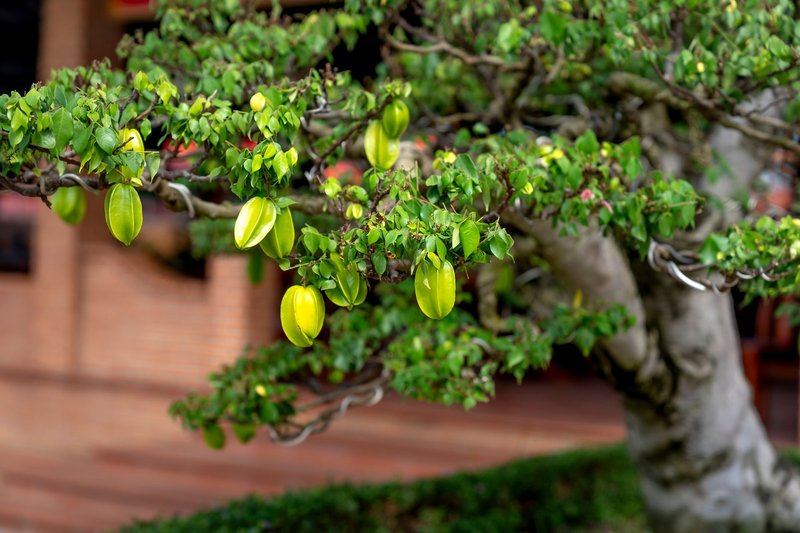
Nangai is a medium-sized legume tree (10–25 m) that produces starchy seeds wrapped in a fibrous husk. Roasted or boiled, the seeds taste closer to a chestnut than anything tropical — which is exactly where both the common name and the ni-Vanuatu term nangai come from. The tree is common along stream banks and in moist lowland forest throughout the archipelago. Bark preparations treat skin conditions in traditional practice, and the dense timber is used for canoe frames on some islands.
Habitat: Moist lowland forest and stream margins, sea level to ~400 m
IUCN status: Least Concern
5. Pacific Sandalwood — Santalum austrocaledonicum
Vanuatu’s sandalwood rush in the early nineteenth century was one of the most extractive episodes in Pacific colonial history. Ships arrived, traders loaded timber, and whole hillside populations of Santalum austrocaledonicum were stripped within decades. The species is now listed as Near Threatened on the IUCN Red List, with populations recovering slowly under government protection.
Sandalwood is a hemiparasite — its roots tap neighboring trees to supplement nutrient uptake — which makes replanting tricky. The fragrant heartwood is still traded, mostly to Asian markets for incense and cosmetics.
Habitat: Dry to moist forest, often on ridgelines, 100–600 m
IUCN status: Near Threatened
6. Pandanus / Screw Pine — Pandanus tectorius
Pandanus trees look like palms that changed their minds halfway through: a single trunk, prop roots fanning out at the base, and leaves spiraling into a tight rosette at the crown. They’re not palms at all — they belong to their own order, Pandanales. In Vanuatu, leaves are woven into mats, baskets, and roofing; the fibrous orange fruit clusters are eaten by wildlife and people; and the prop-root architecture stabilizes coastal and stream-bank soils. Pandanus grow at the edge of almost every beach, village, and mangrove margin across the islands.
Habitat: Coastal margins, stream banks, and village edges, sea level to ~300 m
IUCN status: Least Concern
Lowland Rainforest Trees
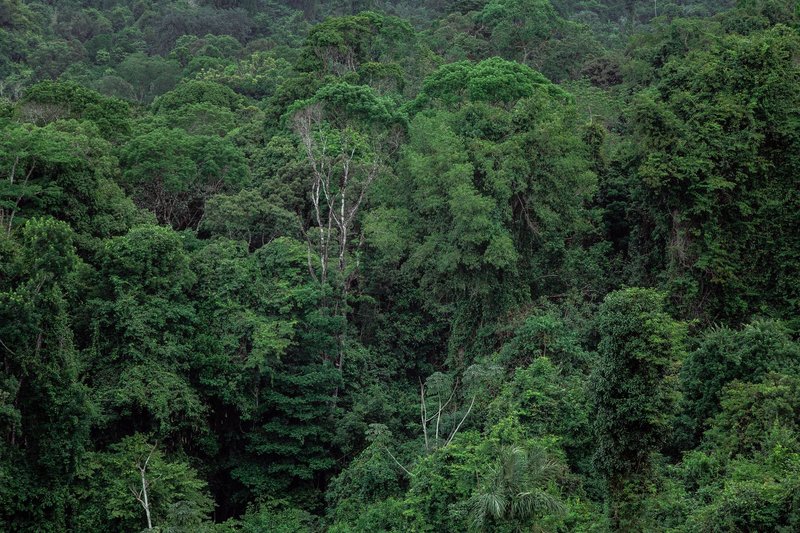
Vanuatu’s lowland rainforests — concentrated on the larger islands’ lower slopes and valley floors — are the most species-rich zone and the most heavily logged. The trees here give the forest its commercial value and ecological complexity.
7. South Pacific Kauri — Agathis macrophylla
The largest tree in Vanuatu’s forests. Agathis macrophylla is an ancient conifer — a relative of New Zealand’s kauri, part of the lineage that dominated Gondwana before the continents separated. Trunks reach 50+ meters, with bark that is smooth, pale grey, and peels in large irregular flakes to reveal yellowish-green underneath. The resin (kauri gum) has traditional and historical commercial uses.
Selective logging has significantly reduced populations. The IUCN lists Agathis macrophylla as Vulnerable, a status driven almost entirely by timber extraction on Espiritu Santo and Malekula.
Habitat: Lowland to mid-elevation rainforest, 0–600 m
IUCN status: Vulnerable
8. Natapoa — Endospermum medullosum
Endospermum medullosum is endemic to Vanuatu — found nowhere else, one of the many native species that evolved in isolation across these islands — and has historically been the most heavily harvested timber tree in the archipelago. The wood is light, straight-grained, and easy to work, which made it popular for furniture and export crating. Natapoa grows fast for a canopy tree, reaching 30–35 m, and its pale, umbrella-shaped crown is one of the easier features to identify in Vanuatu’s lowland canopy once you know what to look for. The species faces ongoing pressure from logging and forest conversion.
Habitat: Lowland rainforest, fertile valley soils, 0–400 m
IUCN status: Vulnerable
9. Tamanu — Calophyllum inophyllum
Tamanu is the kind of tree that botanists and pharmacologists keep returning to. The oil pressed from its seeds — valued across Polynesia and Melanesia for generations — has documented anti-inflammatory and wound-healing properties backed by multiple clinical studies. The tree grows 8–20 m with a dense, spreading crown, dark glossy leaves, and clusters of white flowers. You’ll find it along beaches and in coastal forest across the Pacific, including throughout Vanuatu. Its timber is also hard and rot-resistant, making it a traditional choice for boat building.
Habitat: Coastal and lowland forest, strand vegetation, sea level to ~200 m
IUCN status: Least Concern
10. Ngali Nut — Canarium harveyi
Ngali nuts — the edible seeds of Canarium harveyi — are to Vanuatu what macadamia nuts are to Hawaii: a native food eaten for millennia that is now attracting commercial interest. The tree reaches 30–40 m in mature lowland forest, with buttressed roots and aromatic resin. The nuts are eaten raw, roasted, or pressed for cooking oil; resin from the bark is burned as torches and applied in traditional medicine. Canarium species are close relatives of frankincense and myrrh — genus members across the Old World tropics have supplied resins for ritual and trade for thousands of years.
Habitat: Lowland rainforest, 0–500 m
IUCN status: Least Concern
11. Malay Apple — Syzygium malaccense
A medium-sized tree (8–20 m) from the myrtle family, with dark pink to red oblong fruit hanging directly from the trunk and larger branches — a growth pattern called cauliflory that signals fruit evolved for ground-foraging animals. The sweet, watery fruit is eaten fresh across the Pacific. Syzygium malaccense appears in village gardens and secondary forest throughout Vanuatu, and its crimson flowers make it easy to identify when in bloom: the tree looks lit from the inside.
Habitat: Village gardens, secondary and disturbed lowland forest, 0–400 m
IUCN status: Least Concern
Montane & Highland Trees
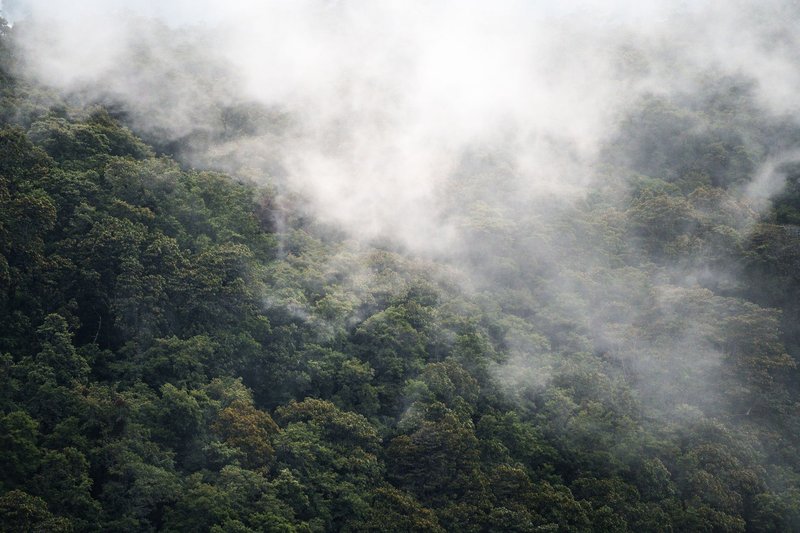
Above 600–800 meters on Vanuatu’s largest islands, the forest changes character. Canopy height drops, mosses drape every surface, tree ferns push into the understory, and two ancient lineages — podocarps and Araucariaceae — take over from the broad-leaved dominants of the lowlands.
12. Mountain Podocarp / Plum Pine — Dacrycarpus compactus
Dacrycarpus compactus is a podocarp conifer — part of the same ancient Southern Hemisphere lineage as New Zealand’s rimu, miro, and totara. In Vanuatu it’s a montane specialist: stunted, often gnarled in persistent cloud, reaching 5–15 m where lowland relatives would top 30. The fleshy red receptacle attached to its small seed is taken by pigeons and fruit doves, which disperse seeds across highland ridges. Spotting this tree is one of the clearest signs you’ve crossed into true cloud forest on Santo or Malekula.
Habitat: Montane cloud forest, 800–1,800 m
IUCN status: Least Concern
13. Column Pine / Cook’s Pine — Araucaria columnaris
Araucaria columnaris looks engineered: a perfectly conical column of horizontal branch whorls that can hit 60 meters. Native to New Caledonia, it also grows on the Torres and Banks island groups in northern Vanuatu, where it colonizes rocky ridgelines and coastal headlands. The symmetry is not coincidental — the tree leans slightly toward the equator, and early Pacific navigators used it as a compass before charts covered the area thoroughly. Old-growth specimens are genuinely impressive.
Habitat: Coastal ridgelines and dry slopes in northern Vanuatu, 0–400 m
IUCN status: Not evaluated for Vanuatu populations
14. Blue Marble Tree — Elaeocarpus angustifolius
Elaeocarpus angustifolius produces small, intensely blue drupes that look almost artificial — the kind of color that makes you want to pick one up and examine it. The tree grows from mid-elevation forest up to the highland margins (around 1,200 m) and is found across a wide Indo-Pacific range. The bright blue fruits are consumed by pigeons and fruit doves, making this a key food resource for the bird species doing the heavy lifting in rainforest seed dispersal. Seeds are hard, woody, and intricately patterned — traditionally used as beads in some communities.
Habitat: Mid-elevation to montane forest margins, 400–1,200 m
IUCN status: Least Concern
Coastal & Littoral Trees
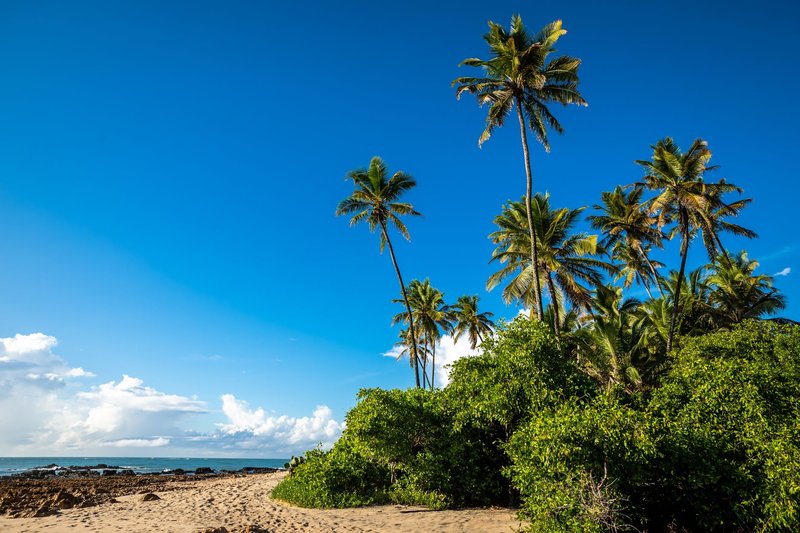
Vanuatu’s coastlines run to over 2,500 km across the archipelago. The trees occupying intertidal and littoral zones are specialists — salt-tolerant, wind-resistant, and adapted to unstable sandy and volcanic-rock substrates that would defeat most rainforest species.
15. Tropical Almond / Talis Tree — Terminalia catappa
Walk any ni-Vanuatu beach and you’ll likely end up under a Terminalia catappa at some point. The tree has a distinctive pagoda architecture — branches growing in flat, horizontal tiers — and drops large, leathery leaves that turn deep red before falling. The fruits contain a genuine almond-like kernel; bats and people both eat them. Bark and leaves are applied in traditional medicine across the Pacific for various wound and infection treatments.
Habitat: Sandy beaches, coastal strand, village margins, sea level
IUCN status: Least Concern
16. Sea Hibiscus — Hibiscus tiliaceus
Hibiscus tiliaceus is the spreading, arching tree you find bending over almost every beach creek and tidal margin in Vanuatu. Yellow flowers open in the morning and deepen to orange-red before dropping; a single tree cycles through both colors simultaneously on any given day, a trait shared with several of Vanuatu’s other flowering trees. The bark yields strong bast fiber used for cordage and traditional crafts across Melanesia. It tolerates salt spray, waterlogged soil, and intermittent storm surges in ways that most other trees cannot manage.
Habitat: Coastal margins, stream banks, beach edges, sea level to ~200 m
IUCN status: Least Concern
17. Fish Poison Tree — Barringtonia asiatica
The square-sectioned seed pod of Barringtonia asiatica is one of the most recognizable objects on any Pacific beach — fibrous, buoyant, and shaped like a rounded four-sided lantern. The seeds contain saponins toxic to fish; they were traditionally pounded and thrown into tidal pools to stun fish for collection, a practice documented across Melanesia and into Southeast Asia. The flowers are extravagant: white stamens tipped with pink, opening at night and falling by morning, often carpeting the ground beneath the tree. Barringtonia grows right at the high tide line, often rooted in coral rubble.
Habitat: Coastal strand, coral sand and rubble, sea level
IUCN status: Least Concern
Mangrove Trees
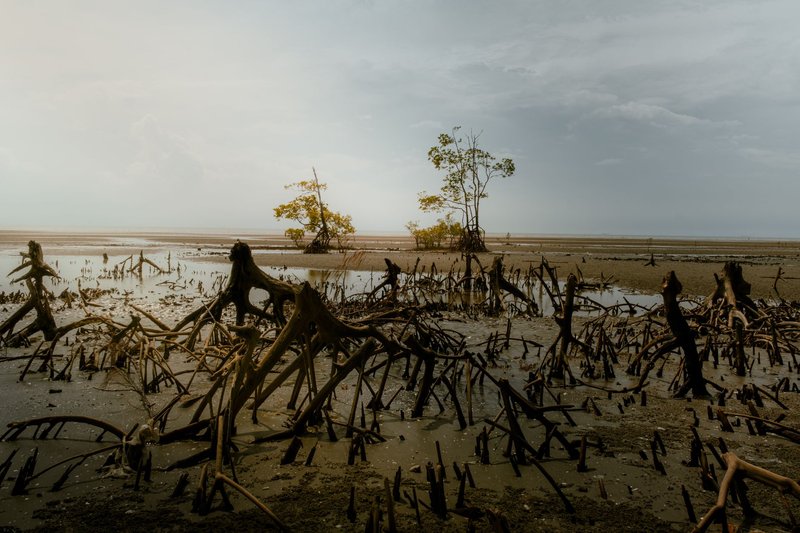
Vanuatu’s mangroves cover relatively small areas compared to larger Melanesian archipelagos, but they punch above their weight ecologically — nursery habitat for fish, storm buffers for coastal villages, significant carbon stores, and the base of food webs that extend far offshore.
18. Red Mangrove — Rhizophora apiculata
The species most people picture when they think “mangrove”: arching prop roots descending from trunk and branches into mud, holding the tree above tidal fluctuation. Rhizophora apiculata is the seaward pioneer — it colonizes open tidal flats where few other trees survive. Seeds germinate on the tree and drop as torpedo-shaped propagules that float for up to a year before lodging in suitable substrate. It’s the dominant mangrove across Vanuatu’s sheltered bays.
Habitat: Intertidal mudflats and sheltered estuaries, sea level
IUCN status: Least Concern
19. Grey Mangrove — Avicennia marina
Where Rhizophora holds the seaward front, Avicennia marina occupies the landward fringe. It handles even higher salinity through salt excretion — you can sometimes see salt crystals on the leaves — and pencil-like pneumatophores that poke vertically out of the mud to access oxygen during tidal inundation. The pale grey-green undersides of its leaves give the tree its common name. Grey mangrove is also one of the first species to recolonize after storm damage, making it critical for coastal resilience across the archipelago.
Habitat: Landward margins of mangrove systems, sheltered bays, sea level
IUCN status: Least Concern
20. Oriental Mangrove — Bruguiera gymnorhiza
The largest true mangrove in Vanuatu’s system. Bruguiera gymnorhiza can reach 25–30 m in undisturbed stands — unusually tall for a mangrove — with distinctive knee roots (pneumatophores bent upward like knees) emerging from the mud around the base. It tolerates slightly lower salinity than Rhizophora and Avicennia and tends to establish in mid-to-landward zones of mangrove systems. The bark is astringent and used in traditional practice for wound treatment and fever management; the hard, durable timber is used for poles in coastal construction.
Habitat: Mid to landward mangrove zones, sea level
IUCN status: Least Concern
Quick Reference Table
| Tree | Scientific Name | Zone | Height | Notable Use |
|---|---|---|---|---|
| Banyan (Nambanga) | Ficus spp. | Lowland / Village | 20–40 m | Ceremonial, kastom |
| Coconut Palm | Cocos nucifera | Coastal / Village | 20–30 m | Copra, food, fiber |
| Breadfruit | Artocarpus altilis | Village / Lowland | 15–20 m | Staple food |
| Nangai | Inocarpus fagifer | Lowland / Stream | 10–25 m | Edible seeds, timber |
| Pacific Sandalwood | Santalum austrocaledonicum | Dry / Mid-elevation | 5–10 m | Fragrant timber, incense |
| Pandanus | Pandanus tectorius | Coastal / Village | 5–15 m | Weaving, food, soil stabilization |
| South Pacific Kauri | Agathis macrophylla | Lowland Rainforest | 40–50+ m | Timber, resin |
| Natapoa | Endospermum medullosum | Lowland Rainforest | 30–35 m | Timber (endemic) |
| Tamanu | Calophyllum inophyllum | Coastal / Lowland | 8–20 m | Medicinal oil, timber |
| Ngali Nut | Canarium harveyi | Lowland Rainforest | 30–40 m | Edible nuts, resin |
| Malay Apple | Syzygium malaccense | Village / Lowland | 8–20 m | Edible fruit |
| Mountain Podocarp | Dacrycarpus compactus | Montane | 5–15 m | Cloud forest indicator |
| Column Pine | Araucaria columnaris | Northern / Coastal | 40–60 m | Navigation landmark, timber |
| Blue Marble Tree | Elaeocarpus angustifolius | Mid / Montane | 10–25 m | Bird food, traditional beads |
| Tropical Almond | Terminalia catappa | Beach / Coastal | 10–25 m | Edible nuts, medicine |
| Sea Hibiscus | Hibiscus tiliaceus | Coastal / Stream | 5–15 m | Bark fiber, cordage |
| Fish Poison Tree | Barringtonia asiatica | Strand | 5–15 m | Fish stun, ornamental |
| Red Mangrove | Rhizophora apiculata | Mangrove | 10–20 m | Coastal protection |
| Grey Mangrove | Avicennia marina | Mangrove | 5–15 m | Coastal resilience |
| Oriental Mangrove | Bruguiera gymnorhiza | Mangrove | 15–30 m | Timber, medicine |
FAQ
What is the national tree of Vanuatu?
The banyan (Ficus spp., locally called nambanga) is Vanuatu’s national tree. It appears on the national emblem and holds deep significance in kastom, the traditional cultural and spiritual framework of ni-Vanuatu communities.
Are there trees endemic to Vanuatu?
Yes. Roughly a quarter of Vanuatu’s native vascular plant species are endemic — found nowhere else. The most commercially notable endemic tree is Endospermum medullosum (natapoa), which has been the most heavily harvested timber tree in the archipelago’s recorded history.
What is the largest tree in Vanuatu?
Agathis macrophylla (South Pacific kauri) is the tallest tree in Vanuatu’s forests, with old-growth specimens exceeding 50 meters. It’s listed as Vulnerable by the IUCN, a status driven almost entirely by historical selective logging on Espiritu Santo and Malekula.
What happened to Vanuatu’s sandalwood forests?
Commercial sandalwood harvesting in the 1820s–1870s stripped natural Santalum austrocaledonicum populations with extraordinary speed. Ships felled entire ridge populations within years of discovery. The species is now Near Threatened, and Vanuatu has implemented forestry protections to allow remaining stands to recover.
What types of forest does Vanuatu have?
Vanuatu holds five main forest zones: lowland tropical rainforest (most species-rich), mid-elevation transition forest, montane cloud forest (with conifers and tree ferns), coastal and littoral forest (salt-tolerant specialists), and mangroves in sheltered bays and estuaries. The mix varies between northern islands (drier, more seasonal) and the wetter central and southern islands.
Which trees in Vanuatu are used in traditional medicine?
Several feature prominently. Tamanu (Calophyllum inophyllum) seed oil is applied for skin conditions and wound healing. Nangai (Inocarpus fagifer) bark preparations treat skin problems. Barringtonia (Barringtonia asiatica) seeds have dual use as fish poison and traditional medicine. The oriental mangrove (Bruguiera gymnorhiza) bark is used for wound care and fever management in coastal communities.
What are ngali nuts?
Ngali nuts are the edible seeds of Canarium harveyi, a large lowland rainforest tree native to Vanuatu and surrounding Melanesia. They’re eaten raw or roasted, pressed for cooking oil, and are attracting growing commercial interest as a Pacific superfood. The tree also yields aromatic resin used as torches and in traditional medicine.