Costa Rica packs more than 900 recorded bird species into a country roughly the size of West Virginia. That’s more species than the United States and Canada combined, in a fraction of the land. But “go to Costa Rica and see birds” isn’t a plan — it’s a wish. The quetzal you want is in a cloud forest at 6,000 feet, the macaw is in a lowland rainforest at sea level, and they don’t overlap on the map or the calendar.
This is the plan. Organized by family so you know what you’re actually looking at, mapped to the hotspots where each group concentrates, and timed to the season that gives you the best shot.
TLDR
- Best overall window: late December through April (dry season) — trails are passable, canopy is thinner, and several highland specialists are actively displaying.
- Best single hotspot for volume: Monteverde Cloud Forest, for quetzals, bellbirds, and hummingbirds in one reserve.
- Best hotspot for rarities: Corcovado National Park, Osa Peninsula — scarlet macaws, an endemic ant-tanager, and an outside shot at a harpy eagle.
- Skip the resort tour if: you’re comfortable with a rental car, a pair of binoculars, and an early alarm. Self-guided birding in Costa Rica is genuinely viable — see the section below.
Table of Contents
- Best Time to Go, By Region
- Where to Go: The Hotspots
- Toucans and Aracaris
- Hummingbirds
- Macaws and Parrots
- Trogons and the Resplendent Quetzal
- The Top 15 Must-See Species
- Endemic Birds Found Nowhere Else
- Self-Guided Birding vs. Paid Tours
- What to Pack
Best Time to Go, By Region
Costa Rica has two seasons, not four, and they don’t hit every region the same way.
Dry season (December–April) is the default answer for a reason: lower humidity, thinner canopy cover that makes spotting easier, and passable trails in places that turn to mud by June. It’s also when several highland species — the Resplendent Quetzal chief among them — are on breeding territory and calling constantly, which makes them far easier to locate than during the quiet months.
Green season (May–November) gets overlooked, and that’s a mistake if your priority is lowland rainforest birds rather than cloud forest specialists. Fruit is more abundant, toucans and aracaris are actively nesting, and the crowds thin out. September and October bring the heaviest rain and are worth avoiding regardless of region.
One planning wrinkle nobody mentions in the resort-blog guides: the Pacific and Caribbean slopes run on different clocks. The Caribbean side (Tortuguero, Sarapiquí) stays wetter year-round and never fully dries out, while Guanacaste on the Pacific side can go bone-dry by March. If you’re building a two-region trip, don’t assume one packing list covers both.
Where to Go: The Hotspots
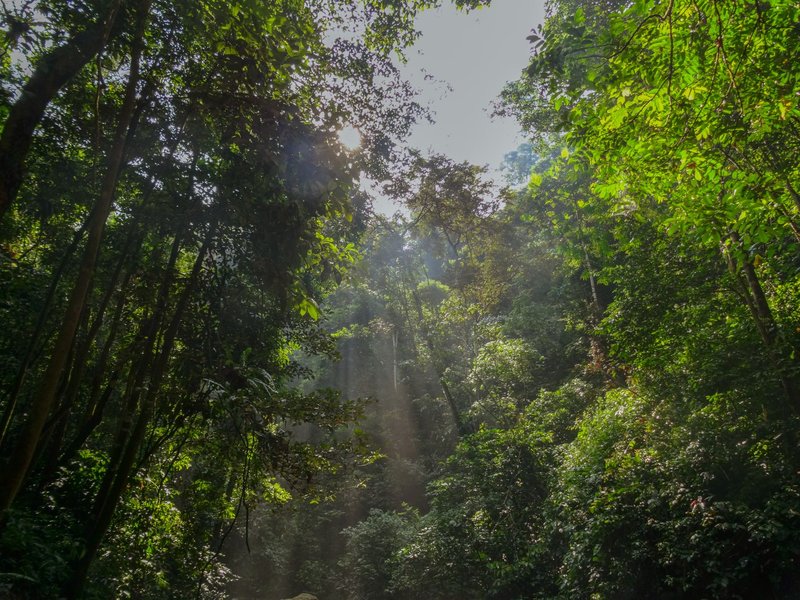
Four regions cover the bulk of what serious birders come for.
Monteverde Cloud Forest Reserve sits at roughly 4,600–6,000 feet and is the single best place in the country to see the Resplendent Quetzal alongside the Three-wattled Bellbird, Violet Sabrewing, and a long list of hummingbirds that work the reserve’s feeders. It’s also the most tourist-trafficked hotspot on this list, which cuts both ways — well-maintained trails, but you’ll share them.
Corcovado National Park, on the remote Osa Peninsula, is Costa Rica’s biodiversity heavyweight. Scarlet Macaws are common here in a way they aren’t almost anywhere else, and it’s one of the last strongholds for the endemic Black-cheeked Ant-Tanager. It requires more logistics — a guide is legally required inside the park itself — but it rewards the effort.
Tortuguero National Park, reachable only by boat or small plane, is Caribbean lowland rainforest threaded with canals. Paddle the waterways at dawn and you’ll turn up Boat-billed Herons roosting low over the water, Keel-billed Toucans, and Green Ibis working the banks.
Arenal and La Fortuna combine volcano views with dense rainforest edge habitat — good general diversity, easier logistics than Corcovado, and a solid base if you’re not building your whole trip around birds.
Worth adding if you have the days: Carara National Park on the central Pacific coast is the most reliable spot in the country for Scarlet Macaws outside Corcovado, and it’s a two-hour drive from San José — no boat, no charter flight.
Toucans and Aracaris
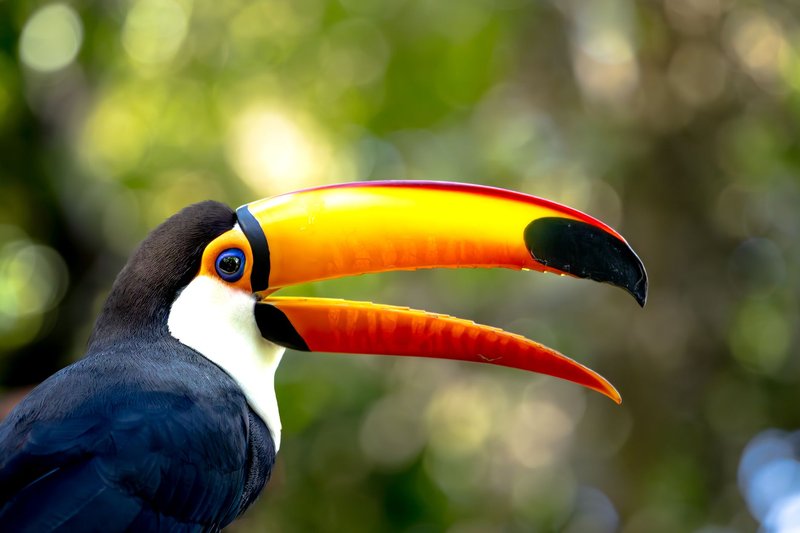
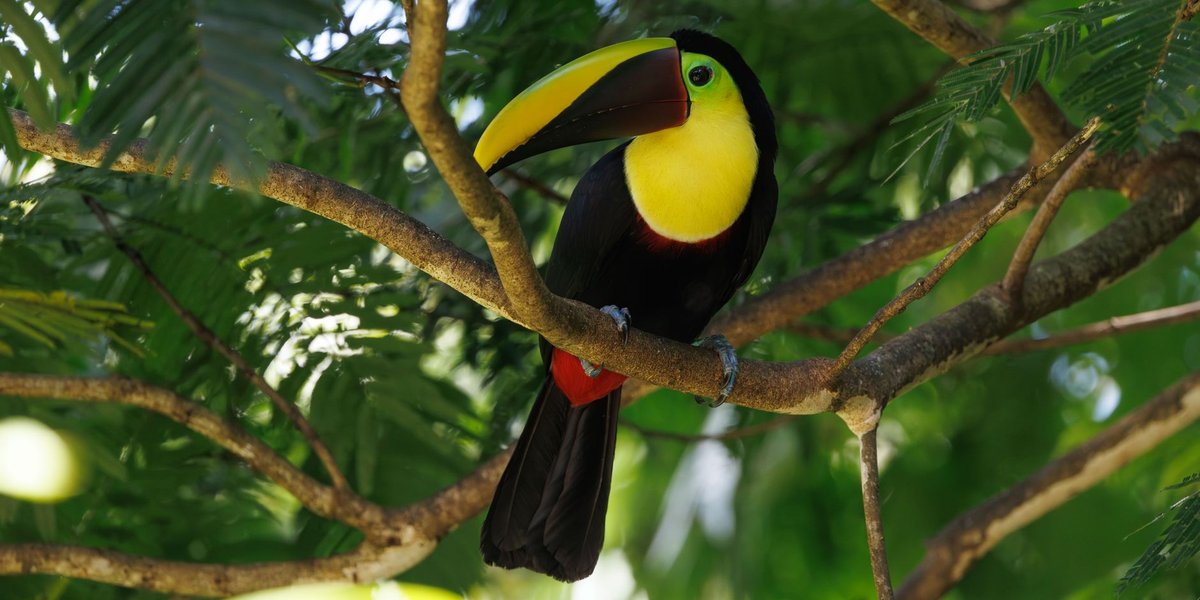
This is the family most people picture when they picture Costa Rica. The Keel-billed Toucan — the rainbow-billed one — is common in lowland forest on both coasts and calls with a frog-like croak rather than anything resembling a toucan-cereal-box squawk. The larger Black-mandibled Toucan favors Caribbean lowlands and forages higher in the canopy. The Collared Aracari, smaller and more social, moves in noisy family groups of six to twelve and is often the first toucan-relative visitors actually get a clean look at, since it perches lower and more often than its bigger cousins.
Hummingbirds
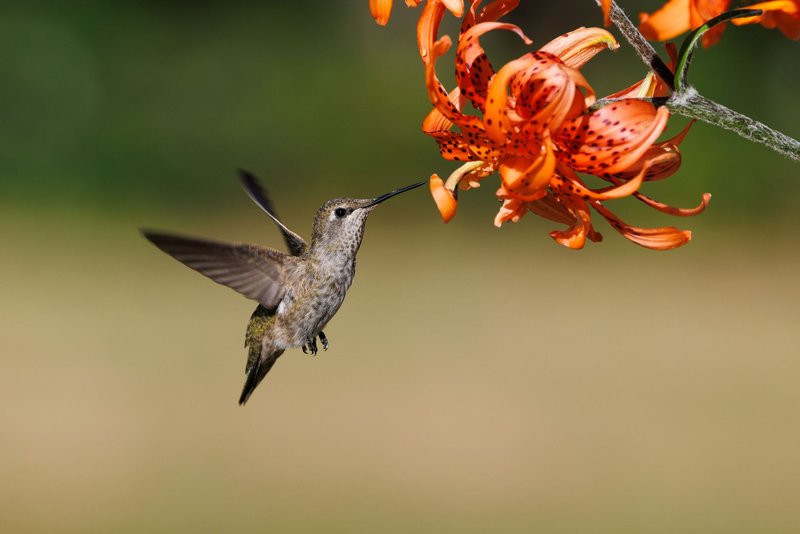
Costa Rica hosts more than 50 hummingbird species, which sounds like a lot until you’re standing at a feeder station in Monteverde watching seven species trade shifts in real time. The Violet Sabrewing is the giant of the group — nearly six inches long, with a curved bill built for the long tubular flowers of the cloud forest. The Coppery-headed Emerald is a Costa Rican endemic found almost nowhere outside the Tilarán mountain range. The Snowcap, a small jewel-toned species with a white-capped crown, is the one serious birders travel specifically to Caribbean foothill sites like Rara Avis to find — it’s uncommon enough that finding one is a genuine trip highlight, not a given.
Macaws and Parrots
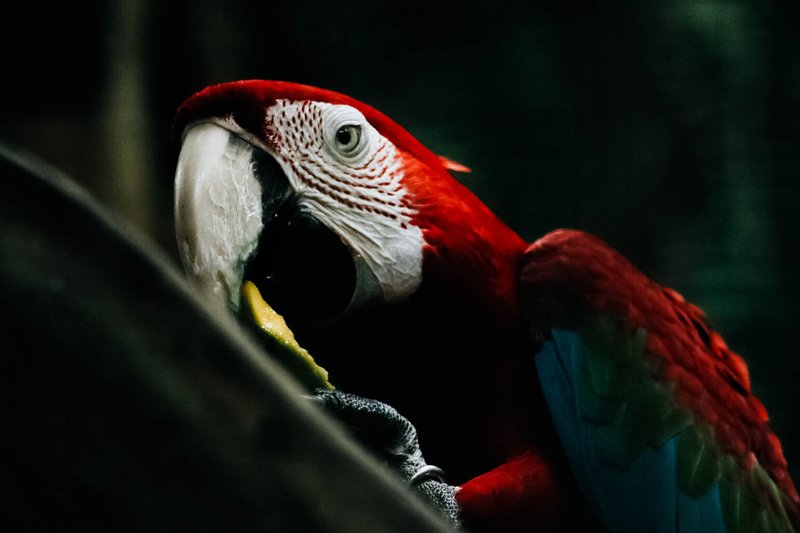
The Scarlet Macaw, one of Costa Rica’s most famous animals, is the country’s signature bird for a reason: red, blue, and yellow, loud enough to hear before you see it, and reliably present at Carara and Corcovado in pairs that mate for life. The Great Green Macaw is the harder find — critically endangered, tied closely to the mountain almond trees it nests in, and mostly restricted to the Boca Tapada and Maquenque area in the north. If a tour operator promises you both macaw species in one trip, ask which sites they’re actually visiting — Great Green Macaws don’t show up at Carara.
Trogons and the Resplendent Quetzal
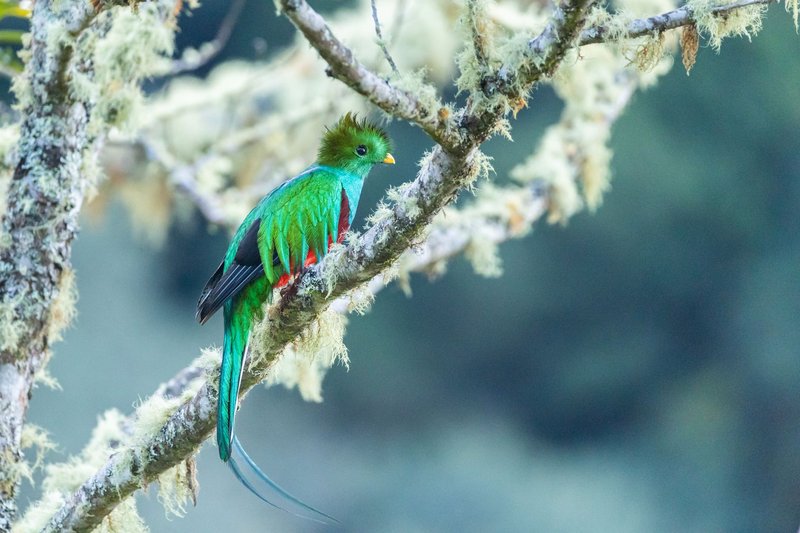
The Resplendent Quetzal is the bird half of visitors come for, and it earns the reputation. Males carry iridescent green tail streamers that can run longer than the bird’s own body, paired with a crimson belly. Best viewing is February through April, during the breeding season, when males perform display flights around nest cavities in dead trees — Cornell’s Lab of Ornithology has documented local conservation efforts around Monteverde built specifically around protecting that nesting habitat. San Gerardo de Dota, in the Talamanca highlands, rivals Monteverde as a viewing site and draws smaller crowds. Smaller relatives in the same family — the Black-throated Trogon and Orange-bellied Trogon — turn up in the same forests and are worth learning to distinguish, since a flash of red-and-green in the canopy isn’t automatically a quetzal.
The Top 15 Must-See Species
Ranked roughly by how much a birding trip to Costa Rica should be built around finding them — not by rarity alone.
- Resplendent Quetzal — the headline bird, and worth planning your travel dates around.
- Scarlet Macaw — common at Carara and Corcovado, loud, unmistakable.
- Great Green Macaw — critically endangered, Boca Tapada region only.
- Keel-billed Toucan — the rainbow bill, widespread lowlands.
- Three-wattled Bellbird — heard before seen; its metallic “BONK” call carries close to half a mile through Monteverde’s forest.
- Black-mandibled Toucan — Caribbean lowland canopy specialist.
- Violet Sabrewing — the giant hummingbird of the cloud forest.
- Snowcap — small, jewel-toned, and a genuine target bird for serious birders.
- Coppery-headed Emerald — endemic hummingbird, Tilarán range only.
- Turquoise-browed Motmot — racket-tipped tail, common in Guanacaste’s dry forest.
- Sunbittern — river-edge specialist with a sunburst wing pattern visible only in display.
- Boat-billed Heron — nocturnal, oversized-billed heron of Tortuguero’s canals.
- Black-cheeked Ant-Tanager — endemic, restricted almost entirely to the Osa Peninsula.
- Mangrove Hummingbird — endangered endemic, found only in Pacific mangrove stands.
- Collared Aracari — social, low-perching, often the easiest toucan-family bird to photograph.
Quick-reference table
| Species | Best Region | Best Season | Rarity |
|---|---|---|---|
| Resplendent Quetzal | Monteverde, San Gerardo de Dota | Feb–Apr | Uncommon, seasonal |
| Scarlet Macaw | Carara, Corcovado | Year-round | Common (locally) |
| Great Green Macaw | Boca Tapada | Dec–Apr | Rare |
| Keel-billed Toucan | Caribbean & Pacific lowlands | Year-round | Common |
| Three-wattled Bellbird | Monteverde | Mar–Sep | Uncommon, seasonal |
| Black-mandibled Toucan | Sarapiquí, Caribbean lowlands | Year-round | Common |
| Violet Sabrewing | Monteverde | Year-round | Common (locally) |
| Snowcap | Rara Avis, Caribbean foothills | Year-round | Rare |
| Coppery-headed Emerald | Tilarán mountains | Year-round | Uncommon (endemic) |
| Turquoise-browed Motmot | Guanacaste | Dec–Apr | Common |
| Sunbittern | Sarapiquí, La Selva | Year-round | Uncommon |
| Boat-billed Heron | Tortuguero | Year-round | Uncommon |
| Black-cheeked Ant-Tanager | Osa Peninsula, Corcovado | Year-round | Rare (endemic) |
| Mangrove Hummingbird | Golfo de Nicoya, Térraba-Sierpe | Year-round | Rare (endemic) |
| Collared Aracari | Lowlands, both coasts | Year-round | Common |
Endemic Birds Found Nowhere Else
Costa Rica has a small handful of true endemics — birds you cannot see anywhere else on the planet, mainland Costa Rica or bust. The Mangrove Hummingbird is the most vulnerable of them: it’s restricted to Pacific mangrove stands around the Golfo de Nicoya and the Térraba-Sierpe delta, and BirdLife International lists it as Endangered, with habitat loss to shrimp farming and salt evaporation ponds as the primary driver. The Coppery-headed Emerald and Black-cheeked Ant-Tanager round out the mainland endemics worth building a stop around — the ant-tanager in particular means a dedicated trip to the Osa Peninsula, since it barely ranges outside Corcovado’s forest.
Three additional endemics exist only on Cocos Island, roughly 340 miles offshore, and are effectively inaccessible without a dedicated multi-day boat expedition — worth knowing about, not worth planning a standard trip around.
Self-Guided Birding vs. Paid Tours
Every guide written for this topic assumes you’re booking a resort package with a birding add-on. You don’t have to.
Costa Rica’s national park system is set up for independent travel in a way a lot of countries aren’t: paved or graded roads reach most major hotspots, park entrance fees are posted and consistent, and reserves like Monteverde and Carara have marked trails you can walk without a guide (Corcovado is the exception — a licensed guide is required inside the park boundary). A rental car with 4WD, a printed eBird hotspot list for your target region, and an early start will get you 80% of what a $200-a-day guided tour offers, for a fraction of the cost.
Where a guide earns their fee: spotting scopes trained on distant canopy activity, knowledge of exactly which tree is fruiting this week, and ears trained on calls you won’t yet recognize. If your list includes genuine rarities — Great Green Macaw, Snowcap, harpy eagle — a local guide’s local knowledge closes a gap that persistence alone won’t.
A reasonable middle ground: self-guide the common, well-documented hotspots (Monteverde, Arenal, Carara) and hire a local guide for a single day at the harder sites (Corcovado, Boca Tapada).
What to Pack
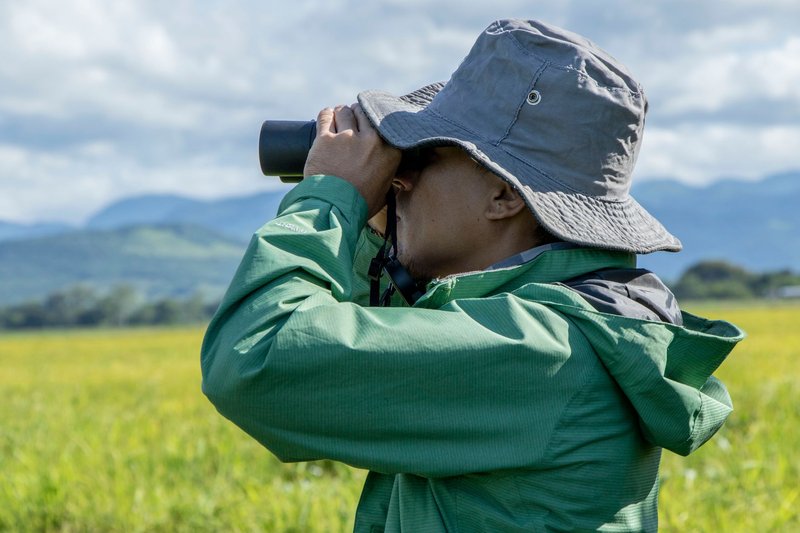
- Binoculars, 8×42. Not 10x — the wider field of view matters more than extra magnification when you’re trying to find a small bird moving fast through dense canopy.
- A rain jacket that packs small, regardless of season. The Caribbean slope doesn’t respect the dry-season calendar.
- Neutral, non-white clothing. Bright colors and white spook birds at close range; earth tones don’t.
- A printed or offline checklist — cell signal disappears fast outside San José, and an offline eBird target list beats guessing.
- A dry bag for optics if you’re doing any canal or river birding — Tortuguero’s boats and Sarapiquí’s rafts both put gear at risk of an unplanned swim.
None of this requires a tour operator’s gear list or a four-figure spotting scope. A decent pair of binoculars and a rental car will get most visitors further than they expect.
Costa Rica doesn’t need embellishment to sell itself as a birding destination — the raw numbers do that. What it needs is a plan that matches the right family to the right elevation, the right hotspot to the right season, and skips the tour upsell if you’d rather do it yourself. National Geographic’s species profile on the Resplendent Quetzal is a good next stop if that’s the bird driving your trip dates — for everyone else, Monteverde, Carara, and four days is enough to come home with a real list.