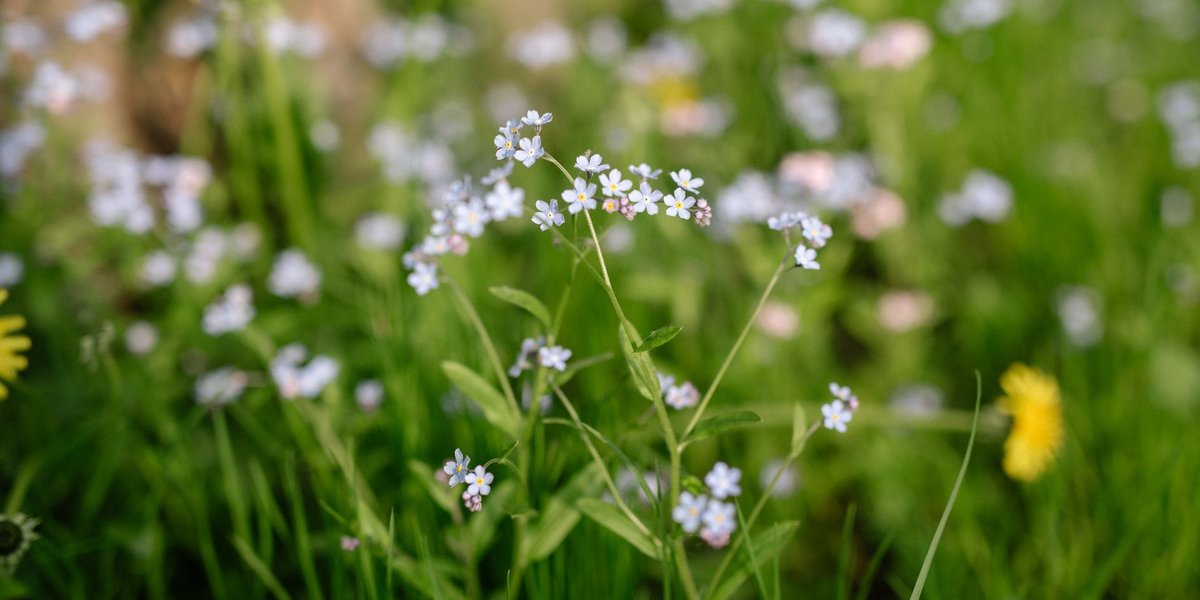
Big blooms get the photos. Tiny flowers get the garden actually planted, watered, and still blooming in August.
That’s not an exaggeration born of small-flower loyalty — it’s math. A dinner-plate dahlia gives you one showstopping bloom per stem. A patch of creeping thyme gives you thousands of quarter-inch flowers covering a square yard, all pulling their weight for pollinators, all requiring a fraction of the water. Tiny flowers do volume. They fill the gaps between your showpieces, soften hard edges, spill over pot rims, and carpet ground that would otherwise just be mulch.
The plants below aren’t filler in the dismissive sense — each one earns its spot for a specific job: a rock garden that needs texture, a hanging basket that needs a trailing skirt, a slope that needs to stop eroding. Every entry lists what it actually needs (sun, water, hardiness zone, mature size) so you’re not guessing after you’ve already bought six pots of it.
Quick picks if you’re short on time
- Toughest in drought: creeping thyme, moss verbena, cheddar pink
- Best for hanging baskets and window boxes: bacopa, trailing lobelia
- Best ground cover for full sun: creeping phlox, Mexican fleabane
- Best for cool, shady borders: forget-me-not, Johnny jump-up
- Best fragrance: sweet alyssum, cheddar pink
Table of contents
- Sweet Alyssum
- Baby Blue Eyes
- Creeping Thyme
- Evergreen Candytuft
- Forget-Me-Not
- Creeping Phlox
- Trailing Lobelia
- Dwarf Baby’s Breath
- Cheddar Pink
- Bacopa
- Mexican Fleabane
- Johnny Jump-Up
- Grape Hyacinth
- Snow-in-Summer
- Moss Verbena
- Growing Tiny Flowers Indoors
- How to Pair Tiny Flowers With Bigger Blooms
A note on zones before we start: hardiness zones tell you the coldest temperature a plant can survive over winter, not how it’ll perform in summer heat. Check yours against the USDA Plant Hardiness Zone Map before you buy — a “zones 3–9” perennial can still sulk in a zone 9 heat wave even though it technically survives there.
Sweet Alyssum
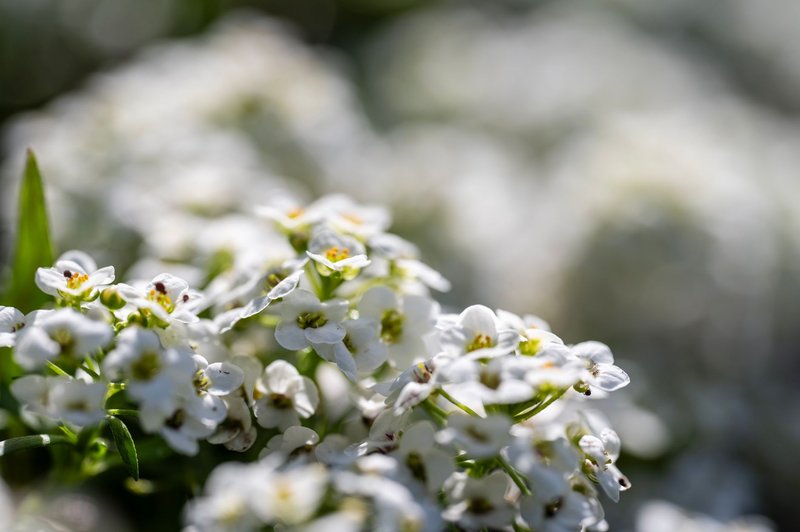
Lobularia maritima — Full sun to light shade · Zones 5–9 as an annual, hardy perennial in 9–11 · Mature size 3–6 in. tall, 8–12 in. wide
Alyssum is the plant most gardeners plant without knowing its name — the low white haze edging a nursery flat of petunias. Its individual flowers are barely a quarter-inch across, but a single plant produces hundreds of them in a mounding cushion, and the whole thing smells faintly of honey when the sun hits it. It self-sows readily and reseeds into gravel and paver cracks on its own, which makes it one of the few “plant and forget” options on this list. Once established it tolerates dry spells, though flowering slows without at least occasional water. Use it as edging, in the front row of a mixed border, or tucked into rock garden crevices where bigger plants can’t get a foothold.
Baby Blue Eyes
Nemophila menziesii — Full sun to part shade · Best in cool-summer climates, USDA zones 2–7 · Mature size 6 in. tall, 12 in. wide
This one is a California native, and it wants California-spring weather: cool nights, mild days, moist soil. Where summers run hot and muggy it burns out fast, but in coastal or high-elevation gardens it forms sprawling mats of sky-blue, white-centered flowers that look genuinely more like a watercolor wash than individual blooms. It’s an annual that reseeds under the right conditions, so treat the first year as an investment. Sow it directly where it’ll grow — it resents transplanting — and give it a spot with even moisture rather than deep occasional soaking.
Creeping Thyme
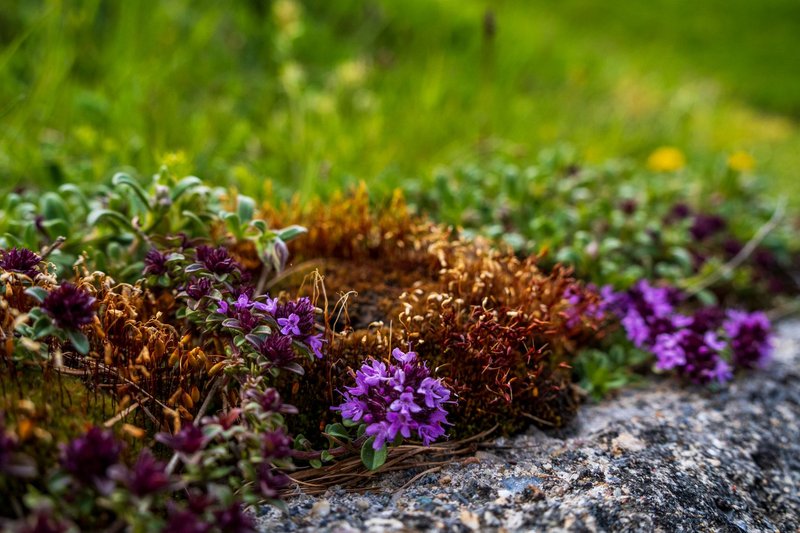
Thymus serpyllum — Full sun · Zones 4–9 · Mature size 2–4 in. tall, spreading 12–18 in.
Walk on this one and it releases scent instead of complaining — it’s one of the few flowering ground covers rated for light foot traffic, which is why it shows up between flagstones and in the cracks of dry-laid patios. The flowers are tiny pink-to-purple tubes packed so densely in midsummer that the foliage nearly disappears under them, and bees notice; a thyme lawn in bloom hums audibly. It wants sharp drainage and poor-to-average soil — rich, damp ground actually shortens its life. This is the plant for the hot, gravelly strip along a driveway where nothing else has worked.
Evergreen Candytuft
Iberis sempervirens — Full sun, tolerates part shade with reduced bloom · Zones 3–9 · Mature size 6–12 in. tall, 12–18 in. wide
Candytuft holds its dark, glossy foliage through winter — genuinely evergreen in most of its range, not just semi-evergreen the way a lot of “evergreen” perennials turn out to be — then buries itself under clusters of small white flowers in spring. According to the Missouri Botanical Garden’s plant database, it prefers well-drained soil and can struggle with excess winter moisture, so raised beds or slopes suit it better than low, soggy spots. It forms tidy, bushy mounds rather than sprawling mats, which makes it useful where you want a ground cover with a defined edge — lining a walkway, cascading over a low wall, or anchoring the front of a perennial border year-round.
Forget-Me-Not
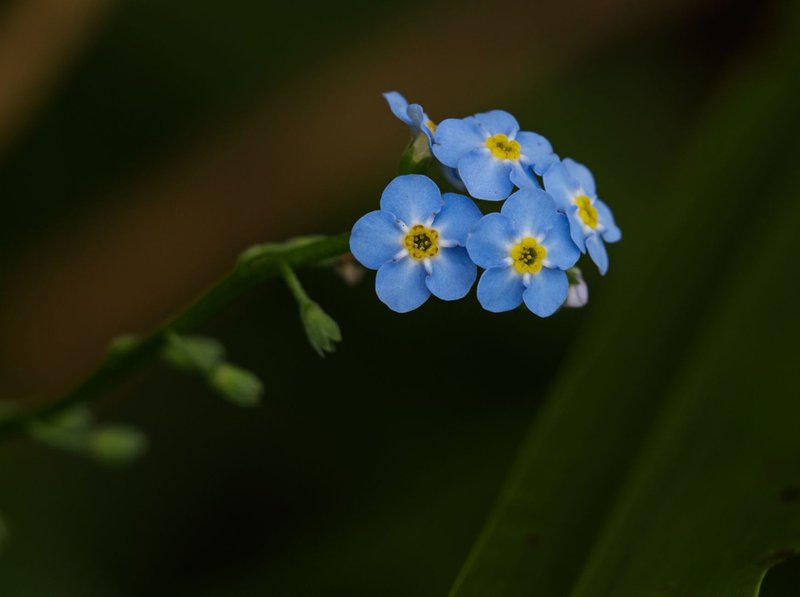
Myosotis sylvatica — Full sun to part shade, appreciates afternoon shade in hot climates · Zones 4–8 · Mature size 6–12 in. tall, 6–10 in. wide
The name comes from a piece of European folklore about a knight who drowned reaching for the flowers on a riverbank, calling out to his love to “forget me not” as he went under — which is a lot of mythology riding on a bloom the size of a pencil eraser. Each five-petaled flower is sky blue with a small yellow eye, clustered in loose sprays over mounded foliage. It’s technically a short-lived perennial but behaves like a reseeding biennial in most gardens — plant it once near moist, part-shaded ground and it tends to keep showing up. It pairs naturally with spring bulbs, filling the gap after tulips fade and before summer perennials take over.
Creeping Phlox
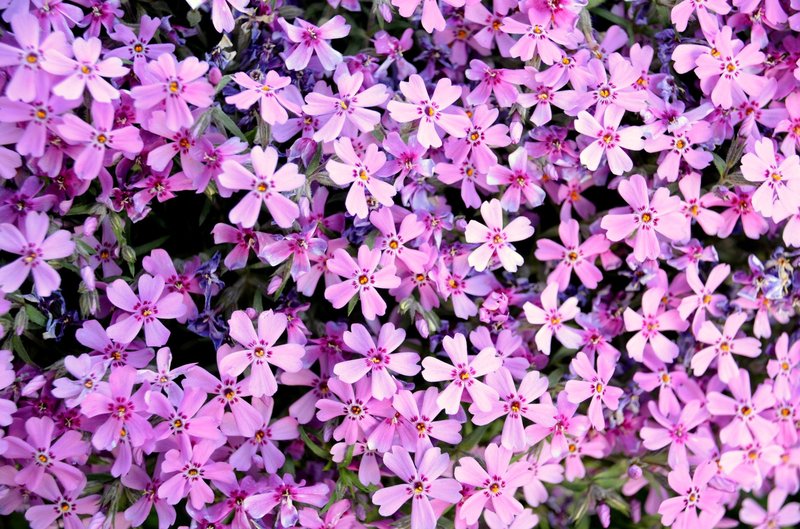
Phlox subulata — Full sun · Zones 3–9 · Mature size 3–6 in. tall, spreading 12–24 in.
If you’ve driven past a slope in April that looked like it was covered in a pink or purple blanket, that was almost certainly this plant. Creeping phlox needs a full six hours of direct sun to bloom densely — in shade it gets sparse and leggy and is prone to powdery mildew — but given that sun, it turns rock walls and hillsides into solid color for two to three weeks each spring. Overwatering, not drought, is what kills it; it wants soil on the lean, well-drained side. Semi-evergreen in mild winters, it gives you a low mat of foliage even when it’s not in bloom, which is more than most spring-flowering ground covers offer.
Trailing Lobelia
Lobelia erinus — Full sun, part shade in hot summers · Grown as an annual outside zones 10–11 · Mature size 4–9 in. tall, 8–16 in. wide
Lobelia is the classic “spiller” in a thriller-filler-spiller container, and for good reason: its thread-thin stems cascade over a pot’s edge and disappear under a wash of half-inch flowers in a blue so saturated it reads as almost electric against green foliage. It struggles once summer heat climbs — flowering stalls and stems can go bare in the middle — so gardeners in hot climates often treat it as a cool-season container plant, swapped out by midsummer. Keep it consistently moist; it doesn’t forgive drying out between waterings the way some of the drought-tolerant options on this list do.
Dwarf Baby’s Breath
Gypsophila muralis — Full sun · Grown as an annual, tolerates light frost · Mature size 8–10 in. tall, 20 in. wide
This is not the florist’s baby’s breath you’re picturing from bouquets — that’s Gypsophila paniculata, a much taller plant. G. muralis is the compact garden version: a low, airy mound of pale pink or white flowers each barely a sixteenth of an inch across, so fine they read as a haze rather than individual blooms from more than a few feet away. It’s an easy annual for rock gardens, border edges, and containers, and it holds up reasonably well as a filler in cut arrangements if you want that classic wispy texture without buying it at the grocery store.
Cheddar Pink
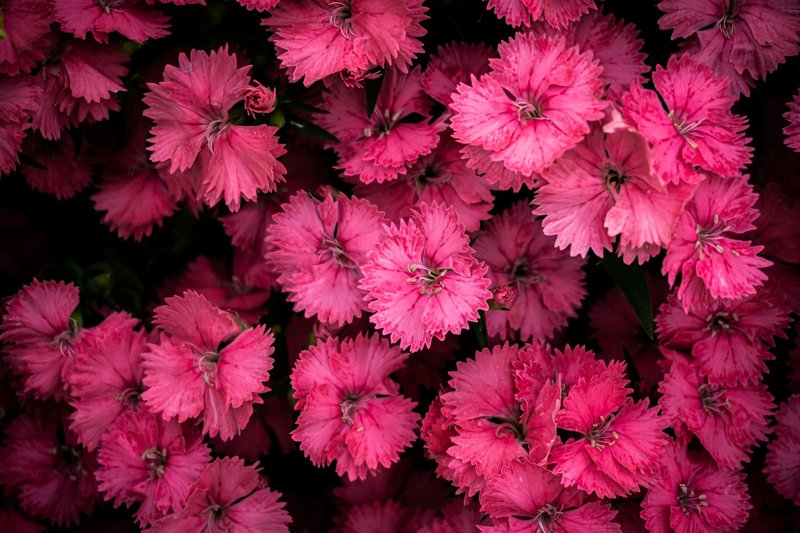
Dianthus gratianopolitanus — Full sun · Zones 4–8 · Mature size 6–8 in. tall, 8–16 in. wide
Named for the Cheddar Gorge in England, where it grows wild on limestone cliffs, this dianthus pairs blue-gray, grass-like foliage with fringed pink flowers that carry a genuine clove scent — stronger on warm afternoons. It wants neutral-to-alkaline soil and sharp drainage; if your soil runs acidic and heavy, a top-dressing of grit at planting time makes a real difference. It forms tight, low mats rather than spreading aggressively, so it stays where you put it — a rock garden, the front of a border, or edging along a path where you’ll brush against it and catch the scent.
Bacopa
Chaenostoma cordatum (also sold as Sutera cordata) — Full sun to part shade, best bloom in full sun · Zones 9–11 as a perennial, annual elsewhere · Mature size 3–12 in. tall, trailing to 3 ft.
Bacopa is bred for one job: trailing over the edge of a hanging basket or window box in a dense curtain of small white, pink, or lavender flowers, and it does that job better than almost anything else sold in nursery flats. It’s fast-growing and heavy-blooming with consistent moisture and regular feeding — let it dry out repeatedly and it thins out fast. Because it’s usually grown from cuttings rather than seed, expect to buy it as a starter plant each spring in colder zones rather than sowing it yourself.
Mexican Fleabane
Erigeron karvinskianus — Full sun to part shade · Zones 6–11 depending on source, reliably hardy in 8–11 · Mature size 6–12 in. tall, spreading up to 24 in.
Also sold as Santa Barbara daisy, this one earns its keep by colonizing places nothing else will grow — wall crevices, gravel, the gap between a patio and a foundation. Each flower opens white and fades to pink as it ages, so a single plant in full bloom shows both colors at once, giving it a shifting, watercolor look. It flowers nearly year-round in mild climates and self-seeds into cracks with real persistence — which is a feature if you want it filling every gap in a dry-stacked wall, and a maintenance task if you don’t want it there.
Johnny Jump-Up
Viola tricolor — Full sun to part shade · Zones 4–8, grown as annual/biennial in colder areas · Mature size 6–12 in. tall and wide
The wild ancestor of the modern garden pansy, Johnny jump-up keeps the small scale and cool-season toughness that breeding for bigger blooms bred out of its descendants. Each flower carries purple, yellow, and white in the same face — hence “tricolor” — and the whole plant tolerates light frost, which makes it useful for shoulder-season color when little else is blooming. The flowers are edible and occasionally show up candied on desserts or scattered over salads, though that’s a garnish, not a reason to grow it. It self-seeds freely in cool climates, often popping up in gravel and lawn edges the following spring uninvited.
Grape Hyacinth
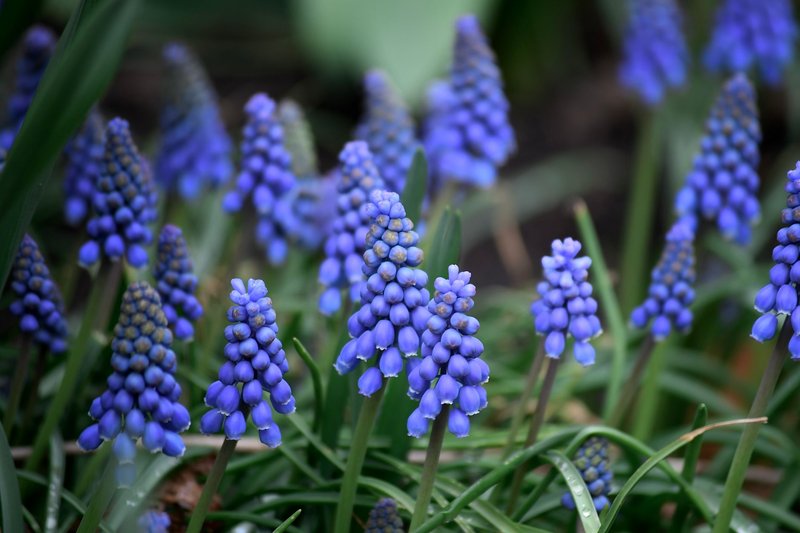
Muscari armeniacum — Full sun for best bloom, tolerates part shade · Zones 3–9 · Mature size 6–8 in. tall, clumps starting at 4–8 in. wide
Grape hyacinth is a bulb, not a bedding plant, which means the buying and planting window is narrow — fall, alongside your tulips and daffodils — but the payoff is a plant that multiplies on its own. Each spike is packed with dozens of tiny, bell-shaped flowers in a cobalt blue dense enough to read as a solid block of color from a distance, despite the individual blooms being smaller than a grain of rice. Left alone, a modest planting of a few dozen bulbs turns into a substantial drift within three or four years. Plant it under deciduous trees or at the front of a border where spring bulbs get first crack at the sun before leaf-out shades everything else.
Snow-in-Summer
Cerastium tomentosum — Full sun · Zones 3–7 · Mature size 6–12 in. tall, spreading 12–18 in.
The name describes exactly what it looks like: a low mat of silvery, felted foliage that all but vanishes under a solid sheet of small white flowers for several weeks in late spring. It’s genuinely drought tolerant once established and prefers lean, sandy soil — fertile ground makes it floppy and shortens its lifespan. The one hard limit is heat and humidity; it performs best in cooler-summer regions and struggles badly in the humid Southeast, where it’s prone to rot. If your summers stay under 85°F most days, it’s one of the toughest silver-and-white ground covers you can plant.
Moss Verbena
Glandularia pulchella (also sold as Verbena tenuisecta) — Full sun · Zones 8–11, grown as a summer annual farther north · Mature size 6–12 in. tall, spreading 3–4 ft.
Moss verbena spreads faster and wider than almost anything else on this list, and it does it in dry, poor soil that would leave most flowering ground covers struggling. Finely cut, fern-like foliage stays low while clusters of small purple flowers bloom in flushes from spring through fall in mild climates. It’s a genuine pollinator draw — butterflies work it consistently — and according to the Xerces Society, diverse, densely flowering ground covers like this one function as connective habitat between larger pollinator plantings, not just decoration. Use it on a hot, dry slope where you need fast coverage and don’t want to irrigate it through summer.
Growing Tiny Flowers Indoors
Everything above is an outdoor plant, but the same small-scale appeal works on a windowsill. Miniature African violets (Saintpaulia, dwarf cultivars) stay under 6 inches across and bloom nearly continuously in bright, indirect light. Baby’s tears (Soleirolia soleirolii) isn’t grown for flowers so much as its moss-like texture, though it does produce tiny, easy-to-miss white blooms in the right humidity. Both want the same thing tiny outdoor flowers do: consistent moisture, no soggy roots, and — because indoor light is weaker than anything the sun provides outside — a spot as close to a bright window as you can manage without scorching the leaves.
How to Pair Tiny Flowers With Bigger Blooms
Most “tiny flowers” lists stop at the plant profiles. That’s half the design problem. Small flowers do their real work in contrast — against foliage, against bigger blooms, against hard surfaces — and a border planted entirely in tiny flowers just reads as busy and formless from more than ten feet away.
Give the eye a place to land first. Plant one or two focal-point specimens — a dahlia, a peony, a flowering shrub — and let the tiny flowers work as a low, textured base around them, not as competition. The contrast in scale is what makes both look intentional.
Match bloom shape, not just size. A single large dahlia bloom next to a mass of small daisy-form flowers (Mexican fleabane, candytuft) reads as deliberate. A single large bloom surrounded by other single large blooms of similar size just reads busy in a different way — nothing recedes.
Use tiny flowers to extend the bloom season around a focal plant. Peonies bloom hard for two weeks and then sit as foliage for the rest of the year. Underplant them with creeping thyme or cheddar pink, both of which bloom before and after the peony’s window, so the bed never looks like it’s waiting for something to happen.
Repeat one small flower in multiple beds instead of scattering many different ones. A single thread of, say, sweet alyssum running through several borders ties disconnected planting areas together visually. Five different tiny flowers each appearing once does the opposite — it fragments the eye’s path through the garden.
Let color do double duty. Pick a tiny flower whose color echoes the focal plant’s — grape hyacinth under a blue-toned iris, forget-me-not near blue delphiniums — and the pairing reads as designed rather than accidental, even though the actual planning took five minutes.
None of this requires more square footage or a bigger budget. It requires putting the small stuff somewhere with a job to do, instead of just somewhere there was room.