Cuba is an island shaped like a crocodile, and it’s not a coincidence that one of the world’s rarest crocodiles calls it home. Isolated from the mainland for millions of years, the island evolved its own cast of lizards, snakes, turtles, and crocodilians — around 109 of Cuba’s 136 known reptile species live nowhere else on the planet. That’s a higher rate of endemism than almost anywhere in the Western Hemisphere.
Wikipedia’s species list will give you all 136 names and nothing else. Travel blogs will show you a dozen photogenic picks and a booking link. This is a field guide to the ones worth knowing: what they look like, what makes them unusual, and where in Cuba you can actually see them.
Table of Contents
- Why Cuba Ended Up With So Many Unique Reptiles
- Crocodilians
- Lizards
- Snakes — and Whether They’re Dangerous
- Turtles
- What’s Actually at Risk
Why Cuba Ended Up With So Many Unique Reptiles
Cuba split from the rest of the Caribbean and the American mainland long before most of its reptile lineages had finished evolving. The result is an island laboratory: species that arrived by chance — rafting on storm debris, island-hopping over millions of years — then diversified in isolation with no mainland competitors to hold them back. Anolis lizards are the clearest example. Cuba has more anole species than any other island in the world, each one wedged into its own narrow niche: some live only on tree trunks, some only in the leaf litter, some only on boulders near the coast.
That isolation cuts both ways. A species that evolves nowhere else also has nowhere else to retreat to when its habitat shrinks. Cuba’s reptile list reads as an evolutionary success story and a conservation emergency at the same time, and both halves matter to understanding what you’re looking at.
Crocodilians
Cuban Crocodile
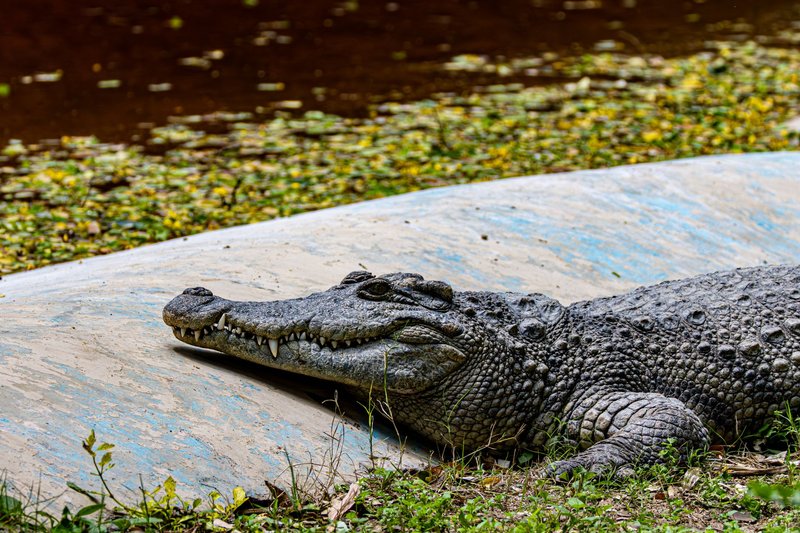
The Cuban crocodile has the smallest range of any living crocodilian on Earth — it survives in exactly two places, the Zapata Swamp and the Isle of Youth (Isla de la Juventud), and nowhere else on the planet. Males top out around 3.5 meters, shorter and stockier than most crocodile species, with powerful hind legs that let it leap clear of the water to snatch prey off low branches, a trait that’s earned it a reputation as unusually agile on land.
Fewer than 3,000 remain in the wild, which is why the IUCN Red List classifies it as Critically Endangered. Cuba has run a captive breeding program at Zapata since 1959 that now holds close to 5,000 animals — the largest reservoir of the species anywhere, according to the Smithsonian’s National Zoo. Hybridization with the more widespread American crocodile is now as serious a threat as habitat loss, since interbreeding dilutes the genetically distinct population scientists are trying to save.
Where to spot it: Guided boat tours through the Zapata Swamp’s La Boca and the Criadero de Cocodrilos breeding farm are the reliable way to see one in something close to its natural habitat.
American Crocodile
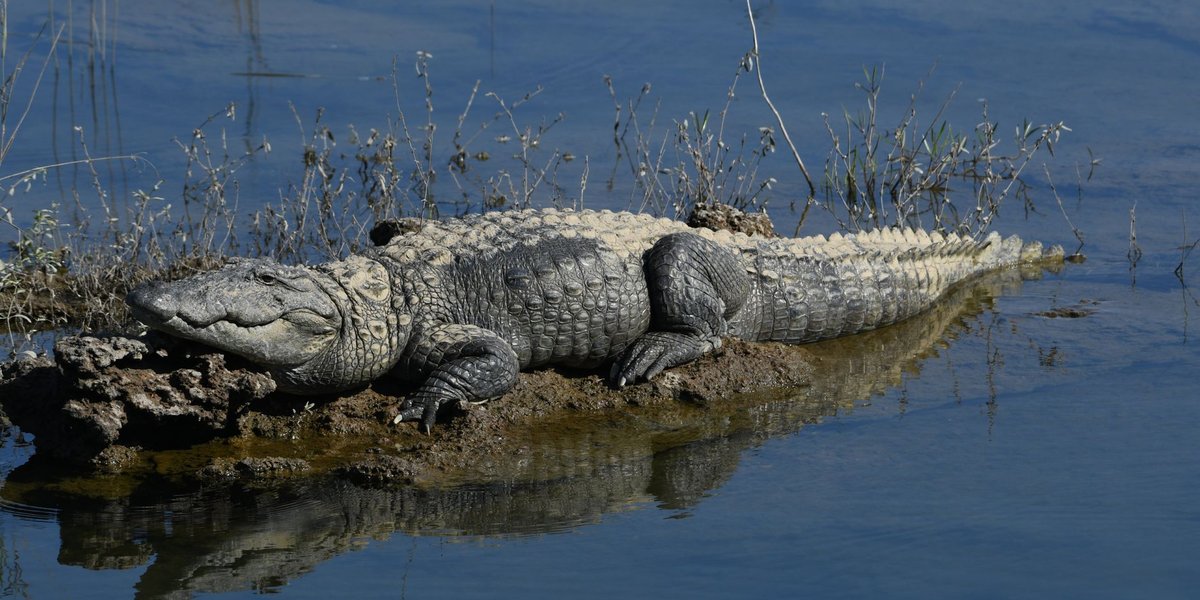
Cuba’s other crocodilian is the far more widely distributed American crocodile, found from Florida down through Central America to northern South America. On the island it overlaps with the Cuban crocodile’s range in the Zapata Swamp, which is part of the problem — the two species interbreed readily, and the hybrids are gradually eroding what makes the Cuban crocodile genetically unique. American crocodiles run longer and leaner than their Cuban cousins, with a narrower snout built for a more varied, fish-heavy diet.
Lizards
Cuban Rock Iguana
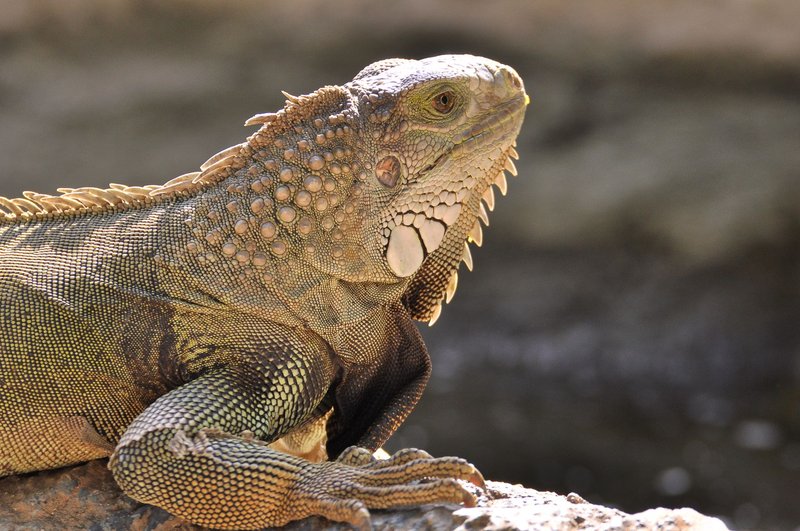
This is the reptile you’ll actually see without trying. Cuban rock iguanas bask openly on rocks and beaches across the island’s coastal colonies, and with a wild population estimated above 40,000, they’re the most secure of Cuba’s endemic reptiles by a wide margin. Adult males can reach 1.5 meters and nearly 7 kilograms, with a ridge of spiked scales running down the back that gives the species its name. They’re strict herbivores, grazing on cactus pads, flowers, and fallen fruit.
Where to spot it: Cayo Guillermo and Cayo Iguana have populations habituated enough to approach on foot, though feeding them is discouraged since it changes their diet and behavior.
Knight Anole
The largest anole species in the world is native to Cuba, not Florida, despite how commonly it turns up in Florida yard photos today (it was introduced there decades ago and thrived). Adults reach nearly 50 centimeters including the tail, bright green with a yellow stripe under the eye, and a bite strong enough to draw blood if handled carelessly — unusual for a lizard whose main defense is normally just running away. It hunts from tree trunks, ambushing smaller lizards, insects, and even nestling birds.
Peninsula Anole
At the opposite end of the anole spectrum from the knight anole is Anolis quadriocellifer, a small trunk-dwelling species found almost exclusively in Guanahacabibes National Park at Cuba’s western tip. It’s one of dozens of Cuban anoles that occupy a hyper-specific niche — in this case, the trunks of the peninsula’s palms — and it exists almost nowhere outside that one protected forest, which makes it a useful marker of how healthy the reserve’s ecosystem still is.
Cuban False Chameleon
Despite the name, this isn’t a true chameleon — chameleons never made it to the Americas — but Chamaeleolis evolved a startlingly similar toolkit through convergent evolution: a prehensile tail, slow deliberate movement, and the ability to shift color and pattern to match tree bark. It’s one of the more obscure entries on this list because it earns it, spending nearly its entire life motionless on a single tree trunk, which makes it genuinely hard to find even for researchers who know exactly where to look.
Cuban Curly-Tailed Lizard
Common along beaches, roadsides, and rocky outcrops islandwide, the curly-tailed lizard is named for the tightly coiled tail it holds arched over its back — a signal display used to warn off rivals and, some researchers think, to distract predators. It’s active in full midday heat when most other lizards have retreated to shade, and it will eat almost anything smaller than itself, including other lizards’ hatchlings.
Snakes — and Whether They’re Dangerous
The honest answer, for the vast majority of Cuba’s snakes, is no. Cuba has no cobras, no vipers, no rattlesnakes. The closest thing to a medically relevant bite comes from the Cuban racer, and even that’s a mild, localized reaction rather than a genuine hazard.
Cuban Boa
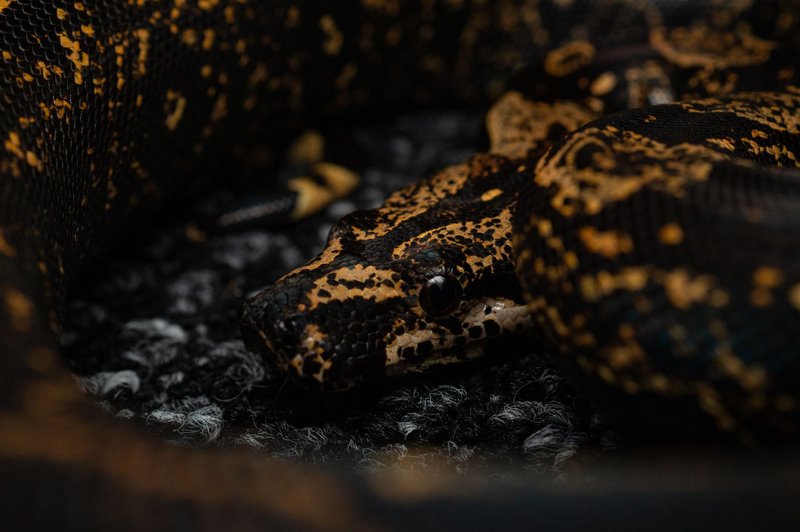
The Cuban boa is the largest snake in the West Indies and, by some measurements, the largest land vertebrate predator on the island — individuals have been documented well over 4 meters. It’s a constrictor, not venomous, and it functions as Cuba’s apex terrestrial predator in the near-total absence of large mammals, preying on hutias (native rodents) and, notably, on Cuban rock iguanas. In some cave systems the boas have learned to hang from the ceiling near colony exits and snatch bats out of midair as they leave to feed at dusk.
Cuban Racer (Jubo)
Locally called “jubo,” the Cuban racer is a fast, slender, day-active snake that’s the one species on this list worth a mention of caution — not because it’s dangerous, but because people ask. It has mildly toxic saliva delivered through enlarged rear teeth, which can cause localized swelling and irritation on the rare occasion someone gets bitten while handling one, but it poses no serious risk to a healthy adult. It’s also, by a wide margin, the most frequently encountered snake on the island.
Cuban Wood Snake
The genus Tropidophis — Cuba’s dwarf boas — includes more than a dozen species on the island alone, most of them small, secretive, and rarely longer than a meter. They’re non-venomous constrictors that hunt frogs and lizards at night and, when threatened, some species will curl into a tight ball and ooze blood from their eyes and mouth, a genuinely bizarre defense mechanism that makes potential predators think twice about a meal that looks diseased.
Turtles
Cuban Slider
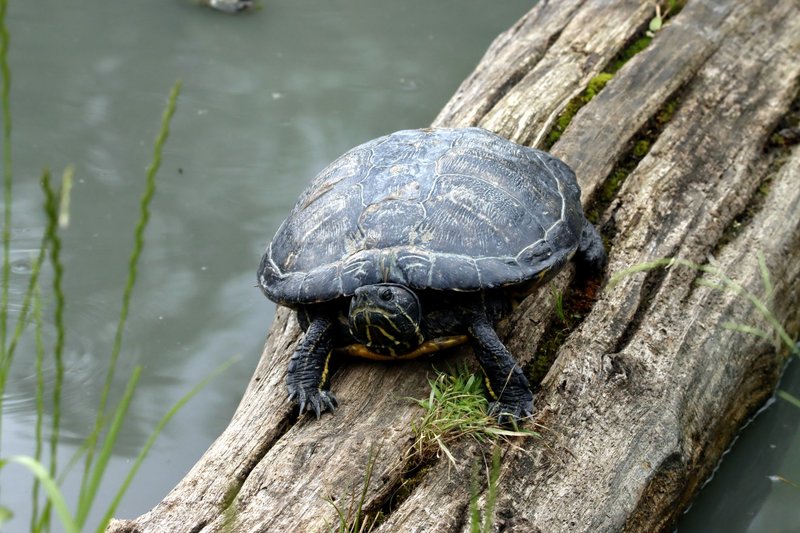
Cuba’s only native freshwater turtle, the Cuban slider inhabits ponds, slow rivers, and marshes across the island, with an olive-green shell reaching about 30 centimeters and yellow striping down the neck and legs. Two subspecies split the island roughly east-west, and the U.S. Fish and Wildlife Service tracks both as species of conservation concern due to pressure from habitat drainage and the pet trade. Juveniles eat mostly insects and small invertebrates; adults shift toward a more plant-heavy diet as they grow.
Hawksbill Sea Turtle
Cuba’s coral reefs and coastal waters are important nesting and foraging grounds for hawksbill sea turtles, recognizable by the overlapping, almost tortoiseshell-patterned scutes that made the species a historic target of the shell trade. Nesting beaches along the Guanahacabibes Peninsula and the Isle of Youth host females that return, often to the same stretch of sand where they hatched decades earlier, to lay eggs at night.
What’s Actually at Risk
Cuba’s reptile list is a genuine biodiversity asset and a genuine liability rolled into one. Because so many of these species evolved in isolation and occupy narrow niches — a single peninsula, a single swamp, a single tree species — they have little room to adapt when that habitat changes. Coastal development, wetland drainage, and the introduction of non-native predators like mongooses (brought to the island specifically to control rats, and which turned out to eat ground-nesting reptiles and their eggs instead) have pushed dozens of species toward the edge, and researchers cited by the American Museum of Natural History count several dozen Cuban reptiles as critically endangered or worse.
The upside is that Cuba has protected a real share of the habitat these species need. Zapata Swamp and Guanahacabibes are both UNESCO Biosphere Reserves, not just parks on paper, and the crocodile breeding program at Zapata is one of the more effective captive-conservation efforts in the Caribbean. Seeing these animals on their own turf — a boa working a bat cave at dusk, an iguana hauling itself onto a warm rock, a crocodile that exists in exactly two places on Earth — is still possible. That’s worth protecting on its own terms, not just as a travel footnote.