Table of Contents
- Why East Asia Has Fewer Reptiles Than Southeast Asia
- Snakes of East Asia
- Lizards of East Asia
- Turtles of East Asia
- The Region’s Only Crocodilian
- What This Says About the Region
Type “reptiles of Southeast Asia” into a search bar and you’ll drown in results — reticulated pythons, Komodo dragons, a hundred gecko species crammed onto a handful of islands. Type “reptiles of East Asia” and the internet mostly shrugs, or hands you a Wikipedia taxonomy page with no photos and no context.
That gap is strange, because China, Japan, Korea, Taiwan, and Mongolia hold a genuinely distinct reptile fauna — smaller in number than the tropics to the south, but shaped by pressures those tropical species never face: real winters, island isolation going back millions of years, and a northern edge of the reptile world where a handful of species survive at latitudes that would kill a python in a week.
Why East Asia Has Fewer Reptiles Than Southeast Asia

Reptiles run on outside heat. No internal furnace, no shivering to warm up — just basking, burrowing, and waiting out the cold. That single fact does more to explain East Asia’s reptile map than anything else.
Southeast Asia sits almost entirely in the tropics: warm year-round, humid, no winter to survive. East Asia does not. Beijing drops well below freezing every year. Hokkaido gets buried in snow. The Mongolian steppe, including the Gobi, swings from summer highs near 40°C to winter lows that would freeze a snake solid if it weren’t already underground. A reptile trying to make a living in these places has to either migrate underground for months at a time or specialize hard enough to handle cold that would be lethal to its tropical cousins.
That filter cuts the species list down fast. Southeast Asia’s warmth lets snake and lizard lineages diversify into dozens of niches on the same patch of forest floor. East Asia’s cold snaps do the opposite — they force species into narrow survival strategies, and most lineages that couldn’t adapt simply never got a foothold north of the tropics in the first place.
The flip side is island endemism. Japan and Taiwan sit far enough offshore, and have been isolated long enough, that species trapped there evolved in place with no gene flow from the mainland. The Ryukyu Islands alone — the chain running from Kyushu down toward Taiwan — hold reptiles found nowhere else on Earth, the product of millions of years on isolated, subtropical islands that never fully lost their tropical character even as the mainland went temperate. So the region ends up with two very different reptile stories layered on top of each other: a cold-hardened mainland fauna, and a set of warm-pocketed island specialists that evolved in near-total isolation.
Snakes of East Asia
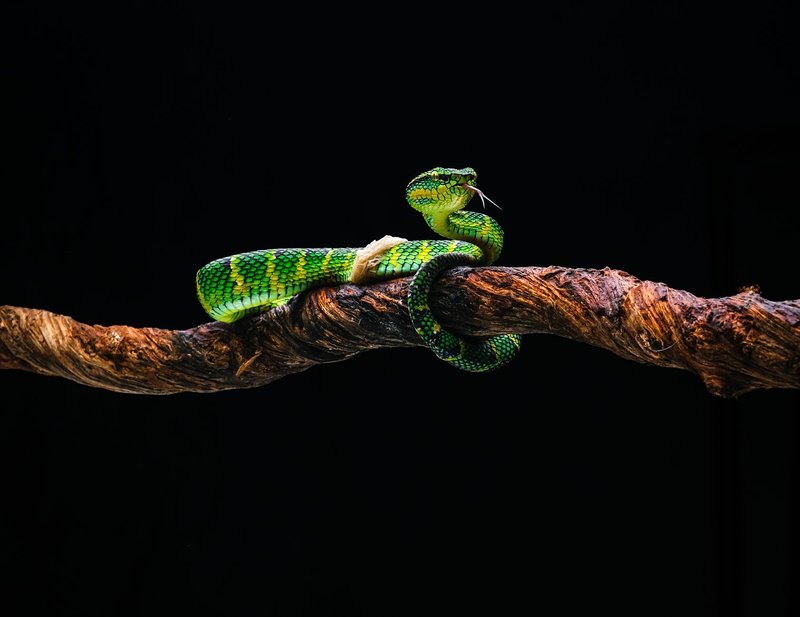
Chinese Cobra (Naja atra)
Found across southern and eastern China, Hong Kong, and Taiwan, the Chinese cobra is the elapid most people picture when they think “Asian cobra” without picturing anything specific. It’s a hooded, defensive species that would rather bluff than bite — but its venom is potent enough that it’s classified as a species of medical significance for the region, and it’s a major driver of snakebite treatment protocols in southern China.
Many-Banded Krait (Bungarus multicinctus)
Black and white bands, nocturnal habits, and a neurotoxic venom considerably more dangerous drop-for-drop than the cobra’s — the many-banded krait is the snake East Asian herpetologists actually worry about. It hunts other snakes at night and, unlike the cobra, gives almost no warning display before it bites. Most serious envenomations happen when people step on one in the dark without realizing it’s there.
Mamushi (Gloydius blomhoffii)
Japan’s most medically significant snake, the mamushi is a short, thick-bodied pit viper found from Honshu down through Kyushu, usually near rice paddies, streams, and rural farmland. It’s the reason Japanese pharmacies still stock mamushi antivenom, and the reason older farmers in the countryside carry sticks when they walk through tall grass at dusk.
Ussuri Pit Viper (Gloydius ussuriensis)
This is one of the best examples of East Asia’s cold-adaptation story. The Ussuri pit viper lives across Korea and into northeastern China and the Russian Far East, tolerating winters that would be fatal to almost any snake in Southeast Asia. It survives by hibernating communally in rock crevices, sometimes alongside dozens of other individuals, emerging only once the ground has properly thawed.
Amur Ratsnake (Elaphe schrenckii)
A large, glossy black snake with pale crossbands, the Amur ratsnake ranges across northeastern China, the Korean Peninsula, and into Russia — about as far north as any East Asian snake gets. It’s non-venomous, a strong climber, and an effective rodent controller, which is part of why it’s tolerated (and sometimes actively protected) around farms in the region.
Red-Necked Keelback (Rhabdophis tigrinus)
This snake earned a strange footnote in herpetology: it’s one of the only snakes known to sequester toxins from its prey rather than manufacture its own venom. Red-necked keelbacks that eat toxic toads in Japan and Korea store those toad toxins in glands along their neck, using borrowed chemistry as a defense against predators that would otherwise eat them.
Sakishima Habu (Protobothrops elegans)
Confined to the Sakishima Islands in Japan’s southern Ryukyu chain, this pit viper is a textbook island endemic — found on a tight cluster of subtropical islands and nowhere else. Its larger, more famous relative, the Okinawan habu, gets more attention from tourists, but the Sakishima habu is the more geographically restricted of the two and a clearer example of how isolated the Ryukyus really are.
Lizards of East Asia
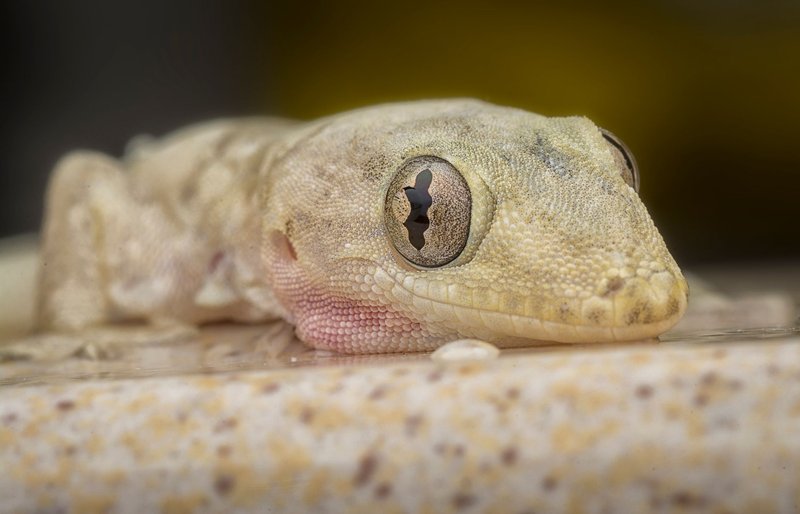
Schlegel’s Japanese Gecko (Gekko japonicus)
The gecko you’ll actually see in East Asia, full stop. It’s the one clinging to convenience store windows at night in Shanghai, Seoul, and Osaka, drawn in by the insects the lights attract. Originally native to China, Japan, and Korea, it has since spread with human shipping to parts of the southeastern United States — a reptile that adapted to cities as readily as it adapted to forests.
Amur Grass Lizard (Takydromus amurensis)
A slender, whip-tailed lizard from Korea and northeastern China, built for speed through dense grass rather than for climbing or burrowing. Its tail can run more than twice the length of its body, and like most Takydromus species it will shed that tail instantly if grabbed — a strategy that works just as well against a hawk in Korea as it does against a bird in the tropics.
Swinhoe’s Japalura (Diploderma swinhonis)
Endemic to Taiwan, this agamid lizard is common in the island’s lowland and mid-elevation forests, where males display a ridged crest and territorial head-bobbing behavior typical of the group. It’s one of several Taiwanese reptiles that exist because the island split from the mainland long enough ago for its lizard populations to diverge into their own distinct species.
Chinese Crocodile Lizard (Shinisaurus crocodilurus)
One of the rarest lizards in the region and a genuine evolutionary oddity — a semi-aquatic lizard with bony, ridged scales down its back and tail that make it look like a scaled-down crocodile. It survives in a handful of cool, forested streams in southern China (with a small population also found in northern Vietnam), and its restricted range and slow reproduction have pushed it onto conservation watch lists.
Mongolian Racerunner (Eremias argus)
This is the region’s answer to “what lizard can survive the Gobi.” Found across Mongolia, northern China, and the Korean Peninsula, it’s built for open, arid steppe rather than forest — fast, ground-dwelling, and active only during the warmest hours of the day, when the sun-baked ground gives it enough heat to move at full speed.
Blue-Tailed Skink (Plestiodon elegans)
A common East Asian skink found from China through Korea, easily recognized by the vivid blue tail juveniles carry — a color that fades to brown or gray as the lizard matures. The blue tail isn’t decoration; it draws a predator’s strike toward a body part the skink can afford to lose, buying the rest of the animal time to escape.
Turtles of East Asia
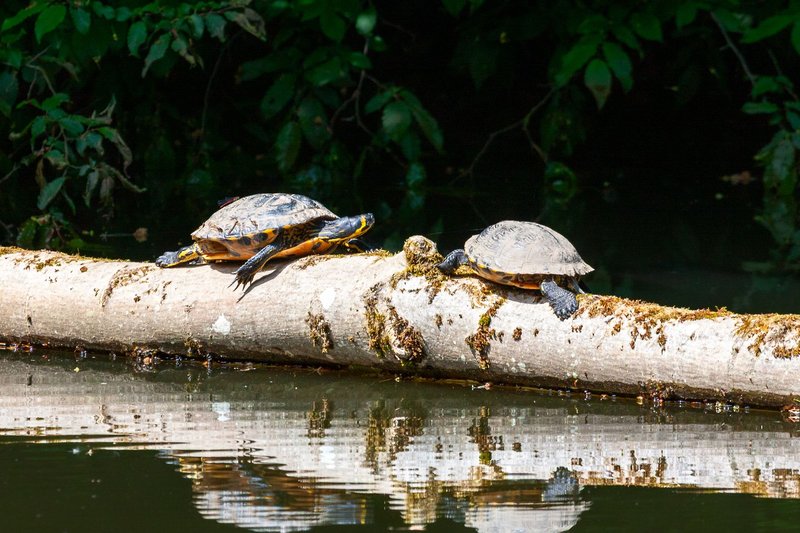
Reeves’s Turtle (Mauremys reevesii)
Also called the Chinese pond turtle, this is one of the most widely kept freshwater turtles in East Asia — common in slow rivers, ponds, and rice paddies across China, Korea, and Japan (where it may have been introduced historically). It’s also one of the most heavily traded turtles in the region’s food and traditional medicine markets, which has hit wild populations hard even though it remains common in captivity.
Chinese Softshell Turtle (Pelodiscus sinensis)
Leathery-shelled, pig-nosed, and almost entirely aquatic, this species is farmed by the millions across China for food, which paradoxically means it’s both commercially abundant and under real pressure in the wild from overharvesting and hybridization with farmed stock released into rivers.
Japanese Pond Turtle (Mauremys japonica)
Endemic to Japan and found nowhere else, this turtle inhabits slow streams and rice paddies across Honshu, Shikoku, and Kyushu. It’s a slower, more cold-tolerant relative of its Chinese cousins, and its populations have declined as rice paddy habitat gets converted or drained across rural Japan.
Golden Coin Turtle (Cuora trifasciata)
Named for the belief in Chinese traditional medicine that jelly made from its shell can treat cancer, the golden coin turtle has been trapped and traded into such scarcity that it’s now one of the most endangered turtles on the planet, with wild sightings in southern China and Vietnam becoming vanishingly rare. According to the IUCN Red List, it’s classified as Critically Endangered, and captive-bred individuals now sell for far more than any legal food or medicine market could justify — a sign of how collector demand has outpaced conservation.
Four-Eyed Turtle (Sacalia quadriocellata)
Named for the two pairs of eye-like spots on the back of its head — a pattern thought to confuse predators about which end is which — this small turtle lives in forest streams across southern China and northern Vietnam. It’s rarely seen even where it’s present, spending most of its time buried in leaf litter on the stream bottom.
Ryukyu Black-Breasted Leaf Turtle (Geoemyda japonica)
Endemic to Okinawa and a few neighboring islands, this small, terrestrial turtle has a serrated shell margin that breaks up its outline against the forest floor. It’s a clear example of the Ryukyu pattern: an ancient lineage isolated on subtropical islands long enough to become a species found absolutely nowhere else.
The Region’s Only Crocodilian
Chinese Alligator (Alligator sinensis)
East Asia has exactly one native crocodilian, and it’s in serious trouble. The Chinese alligator once ranged across the lower Yangtze River basin; today wild individuals survive in only a few protected wetlands in Anhui province, with the IUCN Red List listing the species as Critically Endangered. Ironically, it’s not rare in absolute numbers — thousands live in captive breeding centers — but wild, self-sustaining populations have nearly vanished, squeezed out by wetland conversion to farmland over the past century. It’s also the only close living relative of the American alligator, the two species having split from a common ancestor long before the Pacific Ocean took its current shape.
What This Says About the Region
East Asia isn’t a reptile desert. It’s a filter. Winters knock out species that thrive twenty degrees of latitude south, island chains breed endemics found nowhere else, and a handful of specialists — the Ussuri pit viper hibernating in a shared den, the Mongolian racerunner sprinting across baked steppe — do things no Southeast Asian reptile ever needs to.
That’s also why so many species on this list carry an endangered tag. Fewer species to begin with means less redundancy: when a golden coin turtle or a Chinese alligator gets hit hard by trade or habitat loss, there’s no equivalent species nearby to take up the slack. The reptiles that made it here earned their spot the hard way, and there isn’t a deep bench behind them.