TLDR
The United States is home to roughly 17,000 native plant species, and no single list does that variety justice — a saguaro that takes a decade to grow one inch has nothing in common with a bald cypress standing in three feet of swamp water. This guide breaks the country into six growing regions (Southwest, Southeast, Midwest/Prairie, Northeast, Pacific, and Mountain), with standout plants for each, their hardiness zones, and the one practical reason to actually grow them. It closes with a quick-reference table of official state flowers.
Table of Contents
- How Many Plants Are Native to the US?
- Southwest
- Southeast
- Midwest and the Prairie
- Northeast
- Pacific and Pacific Northwest
- Mountain West
- Official State Flowers
How Many Plants Are Native to the US?
About 17,000 species, according to botanical surveys tracked by the USDA’s PLANTS database, and that figure keeps shifting as taxonomists split and merge species. It spans everything from alpine sedges that finish their entire life cycle in six weeks of Rocky Mountain summer to live oaks in Georgia that have been standing since before the country existed.
Trying to cover all 17,000 in one place is how you end up with a Wikipedia table nobody reads past the first screen. A more useful approach: organize by region, because a plant’s native range tells you more about whether it’ll survive in your yard than any alphabetical list ever will.
Southwest
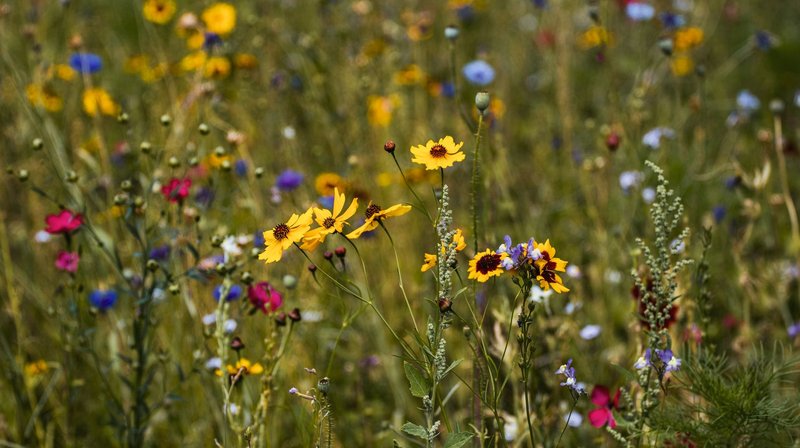
Heat, sun, and soil that drains in seconds — the Southwest’s plants aren’t tough by accident. Many of them have spent thousands of years figuring out how to do almost nothing for months and then bloom the week it rains.
- Saguaro cactus (Carnegiea gigantea), zones 9–11 — grows about an inch in its first ten years, then can live past 150. Arizona’s state flower is the blossom this thing eventually produces, once it’s decided you’ve waited long enough.
- Desert marigold (Baileya multiradiata), zones 8–11 — reseeds itself aggressively and blooms almost year-round on nothing but rainfall, which is why you see it colonizing highway medians nobody waters.
- Red yucca (Hesperaloe parviflora), zones 5–11 — despite the name it’s not a true yucca, and its coral flower spikes are a magnet for hummingbirds migrating through in spring.
- Ocotillo (Fouquieria splendens), zones 8–11 — looks dead for most of the year, then leafs out within days of a single rainstorm. Locals plant it as a living fence.
- Chuparosa (Justicia californica), zones 8–11 — one of the few desert shrubs that flowers through winter, which makes it a lifeline for overwintering hummingbirds.
The practical case for Southwest natives isn’t just drought tolerance — it’s that non-native lawns and ornamentals in this region can burn through municipal water supplies that are already stretched thin, something the USDA Forest Service has flagged in arid-land management for years.
Southeast
Humidity, long growing seasons, and rich bottomland soil produce a completely different plant palette — big canopy trees, wetland specialists, and pollinator plants that bloom through brutal summers.
- Southern magnolia (Magnolia grandiflora), zones 6–10 — evergreen, with blooms that can hit a foot across and a citrus scent strong enough to notice from the sidewalk.
- Bald cypress (Taxodium distichum), zones 4–10 — one of the few conifers that drops its needles every fall, and the only tree that grows the knobby “knees” you see poking out of swamp water. These wetland ecosystems support specialized herbivores adapted to life in waterlogged soil.
- Muhly grass (Muhlenbergia capillaris), zones 6–10 — turns entire roadside medians pink-purple every October, low maintenance, and deer mostly leave it alone.
- Pinewoods milkweed (Asclepias humistrata), zones 8–10 — drought-tolerant despite the region’s rainfall, and one of the earliest milkweeds monarchs find on their spring migration north.
- Lanceleaf coreopsis (Coreopsis lanceolata), zones 4–9 — tolerant of both drought and poor soil, and it pulls in a wider range of pollinators than most showier garden flowers.
Midwest and the Prairie
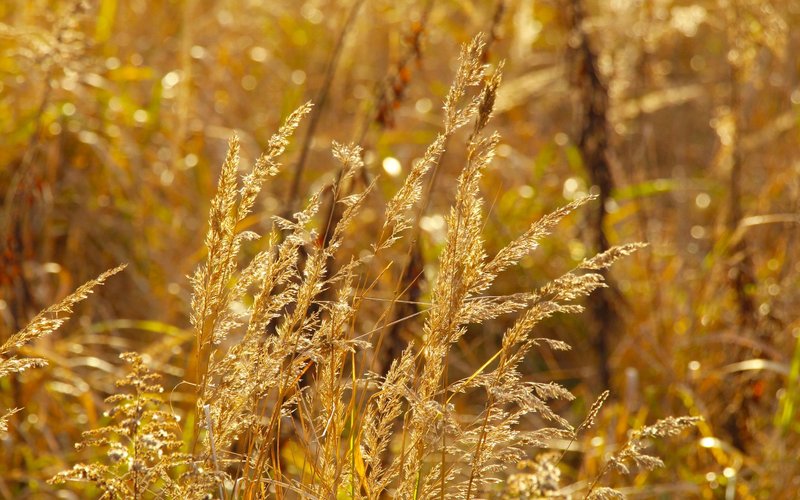
Before it was farmland, most of the Midwest was tallgrass prairie — and the plants that built it evolved root systems deep enough to survive fire, drought, and bison grazing in the same decade.
- Big bluestem (Andropogon gerardii), zones 4–9 — Illinois’s state grass, with roots that can reach ten feet down, which is a big part of why prairie topsoil got so deep in the first place.
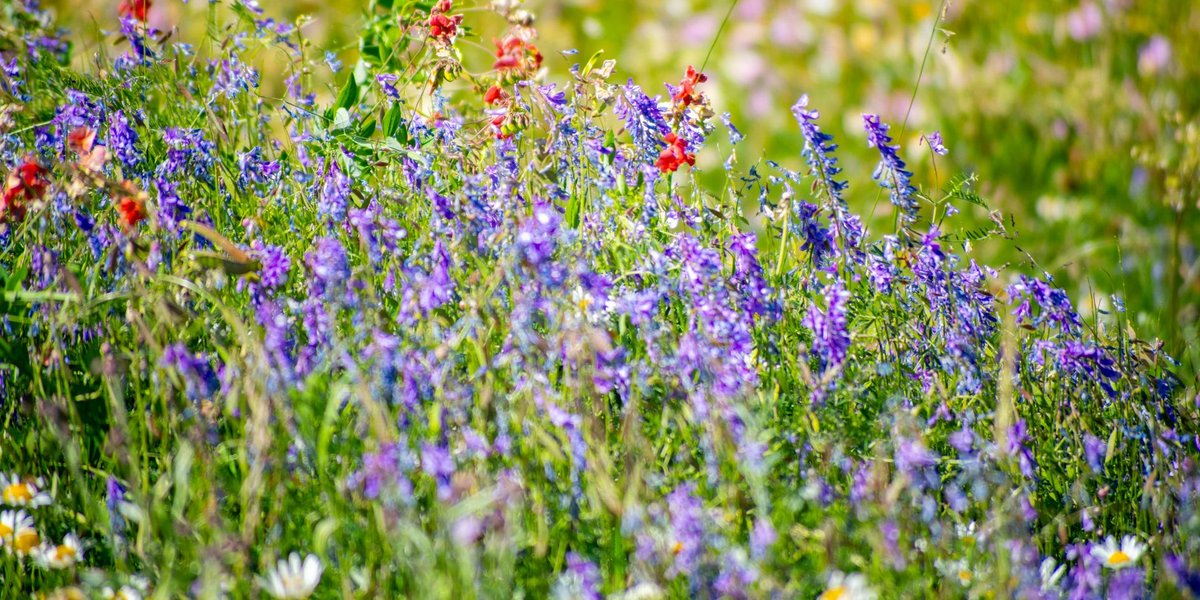
- Purple coneflower (Echinacea purpurea), zones 3–8 — the plant behind the herbal supplement, and one of the most reliable draws for native bees and butterflies in Midwest gardens.
- Blazing star (Liatris spicata), zones 3–9 — blooms top-down instead of bottom-up, an odd trait that makes it easy to identify from across a field.
- Switchgrass (Panicum virgatum), zones 4–9 — now widely studied as a biofuel crop, but it’s been holding prairie soil in place since long before that was a research topic.
- Prairie dropseed (Sporobolus heterolepis), zones 3–9 — famous among native-plant gardeners for smelling faintly of buttered popcorn or coriander when it flowers in late summer.
Northeast
Cold winters and a long dormant season shaped a plant community built around spring ephemerals and woodland edges — plants that get their growing done before the tree canopy leafs out and blocks the light.
- Wild columbine (Aquilegia canadensis), zones 3–8 — its nodding red-and-yellow flowers are shaped specifically for hummingbird tongues and long-tongued bees, almost nothing else can reach the nectar.
- Wild lupine (Lupinus perennis), zones 3–8 — the sole host plant for the endangered Karner blue butterfly, which means losing lupine populations in sandy Northeast soils directly threatens the butterfly.
- New Jersey tea (Ceanothus americanus), zones 4–8 — colonists reportedly brewed its leaves as a tea substitute during the Revolutionary War, hence the name.
- Foxglove beardtongue (Penstemon digitalis), zones 3–8 — tolerates the clay soil that frustrates a lot of other perennials in this region.
- Golden ragwort (Packera aurea), zones 3–8 — spreads by rhizome into a dense groundcover, useful on the damp, shaded slopes where grass tends to give up.
Pacific and Pacific Northwest
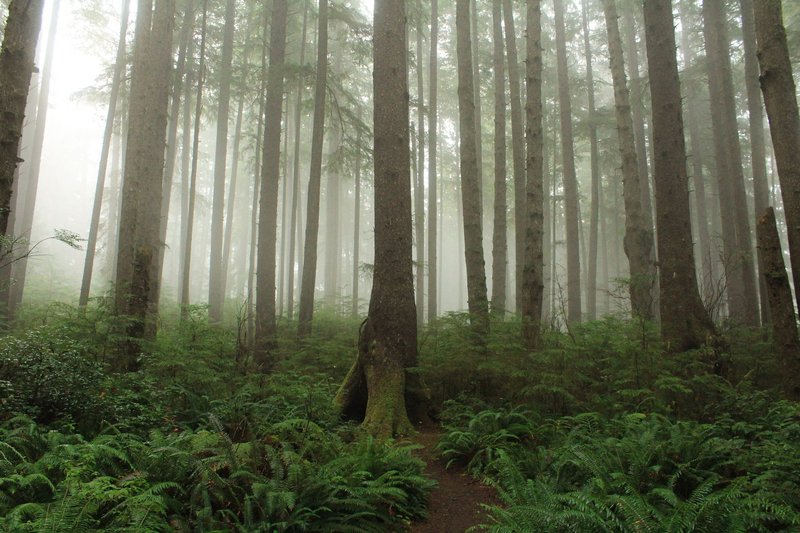
Coastal fog, acidic forest soil, and (depending on how far up the coast) serious winter rain built a plant community heavy on conifers and evergreen shrubs.
- Douglas fir (Pseudotsuga menziesii), zones 4–6 — not a true fir, and one of the tallest tree species on the continent, regularly topping 250 feet in old-growth stands.
- Pacific rhododendron (Rhododendron macrophyllum), zones 6–9 — Washington’s state flower, thriving in the acidic, well-drained soil under a conifer canopy.
- Oregon grape (Mahonia aquifolium), zones 5–9 — Oregon’s state flower, with holly-like leaves and blue berries that are edible but sour enough that most people leave them for the birds.
- Salal (Gaultheria shallon), zones 6–9 — a dense evergreen groundcover so common in Pacific Northwest forest understories that florists use its glossy leaves as filler greenery nationwide.
- Manzanita (several Arctostaphylos species), zones 7–10 — smooth red bark and drought tolerance once established, which makes it a go-to for low-water Pacific Coast landscaping.
Mountain West
High elevation means a short growing season, intense UV exposure, and wide temperature swings — plants here tend to be compact, fast-blooming, and built to survive a hard frost in July.
- Colorado blue columbine (Aquilegia coerulea), zones 3–8 — Colorado’s state flower, and it’s actually illegal to pick it on public land in the state.
- Quaking aspen (Populus tremuloides), zones 1–7 — spreads through root suckers rather than seed, so an entire hillside of “trees” can technically be one genetic organism.
- Indian paintbrush (Castilleja species), zones 3–9 — hemiparasitic, meaning it taps into the roots of neighboring plants for nutrients, which is why it’s notoriously hard to transplant.
- Rocky Mountain bee plant (Cleome serrulata), zones 3–9 — a heavy pollen and nectar source for native bees, and historically used by Indigenous groups in the region as a food and dye plant.
- Blue flax (Linum lewisii), zones 3–9 — flowers close by early afternoon most days, so it’s a morning-only show even in peak bloom.
Whatever region you’re gardening in, the Xerces Society’s pollinator-friendly native plant lists and the US Fish and Wildlife Service’s pollinator garden guidance both break recommendations down by ecoregion, which is a more precise filter than state lines if you’re close to a border.
Official State Flowers
State flowers get chosen by legislatures, garden clubs, and schoolchildren voting in the early 1900s — which explains why a few of them (looking at you, Delaware’s peach blossom) aren’t native at all.
| State | State Flower | Scientific Name |
|---|---|---|
| Alabama | Camellia | Camellia japonica |
| Arizona | Saguaro cactus blossom | Carnegiea gigantea |
| California | California poppy | Eschscholzia californica |
| Colorado | Rocky Mountain columbine | Aquilegia coerulea |
| Florida | Orange blossom | Citrus sinensis |
| Georgia | Cherokee rose | Rosa laevigata |
| Hawaii | Hawaiian hibiscus | Hibiscus brackenridgei |
| Illinois | Violet | Viola sororia |
| Kansas | Sunflower | Helianthus annuus |
| Louisiana | Magnolia | Magnolia grandiflora |
| Maine | White pine cone and tassel | Pinus strobus |
| Oregon | Oregon grape | Mahonia aquifolium |
| Texas | Bluebonnet | Lupinus texensis |
| Washington | Pacific rhododendron | Rhododendron macrophyllum |
That’s a sample rather than the full fifty — the complete roster, including the handful of imports like Delaware’s peach blossom, is maintained by Wikipedia’s list of U.S. state and territory flowers if you want every state in one place.
If you’re picking plants for your own yard rather than trivia night, start with your region above, then narrow by your specific hardiness zone — a plant rated for zones 4–9 will handle more of the country than one rated 8–11, but “will survive” and “will actually thrive” are different bars, and native plants tend to clear both.