TLDR
Most eight-legged animals are arachnids: spiders, scorpions, ticks, mites, harvestmen, camel spiders, vinegaroons and pseudoscorpions. Two outsiders also have eight legs and aren’t arachnids at all: sea spiders and tardigrades. Octopuses have eight arms, not legs, and crabs, lobsters and insects don’t fit the count.
In this post
- Why so many animals have eight legs
- 1. Spiders
- 2. Scorpions
- 3. Ticks
- 4. Mites
- 5. Harvestmen
- 6. Camel spiders
- 7. Vinegaroons
- 8. Pseudoscorpions
- 9. Sea spiders
- 10. Tardigrades
- Lookalikes that don’t qualify
- FAQ
Why so many animals have eight legs
Ask someone to name an animal with eight legs and you’ll hear “spider” within a second. It’s the right answer, and it’s also the least interesting one. Spiders belong to a much bigger group, the arachnids, and every arachnid is built on the same plan: two body sections, no antennae, no wings, and four pairs of walking legs.
That body plan has been around for more than 400 million years, and it has been remarkably productive. The list below covers eight-legged animals you’ve probably met without realizing it, plus a few you’d need a microscope or a scuba tank to find.
One caveat before we start. “Eight legs” is the rule, not a law. Some young arachnids hatch with six, and a few mites get by with four. Each entry flags the exceptions where they apply.
1. Spiders
- Size: from under 1 mm to a leg span of about 28 cm (11 in) in the goliath birdeater
- Habitat: every continent except Antarctica, from rainforest canopy to your basement
- Danger to humans: low; a few species, such as widows, recluses and Sydney funnel-web spiders, have medically significant venom
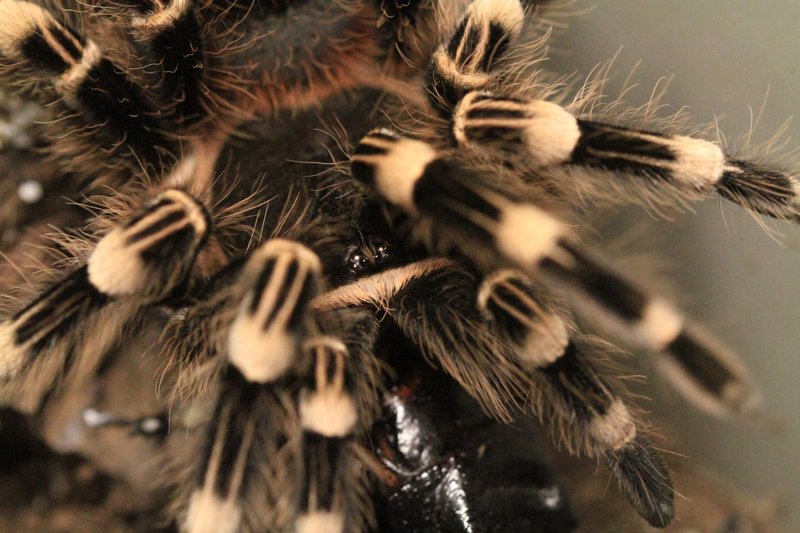
The World Spider Catalog, maintained by the Natural History Museum Bern, lists more than 50,000 described species, and new ones turn up every year. Nearly all of them make venom. Only a small minority can hurt a person. For a closer look at the species that live in woodland, the guide to forest spiders covers 40 of them with habitat notes.
Spiders also carry two extra appendages near the mouth called pedipalps. They look like short legs, but they’re feelers and, in males, sperm-transfer tools. They don’t count toward the eight.
The detail worth knowing: spiders extend their legs with blood pressure, not muscle. Their muscles can only pull the legs in. That’s why a dead spider curls up. The pressure is gone, and the flexors win.
2. Scorpions
- Size: about 1 cm to roughly 20 cm (8 in), depending on species
- Habitat: deserts, grasslands, rainforests and caves on every continent except Antarctica
- Danger to humans: about 25 of roughly 2,800 species have venom that can kill a person
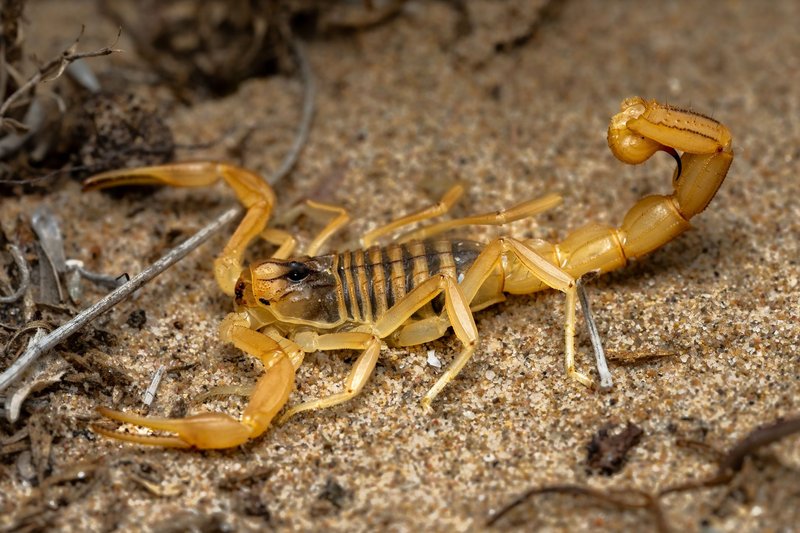
Scorpions are the arachnids with the famous tail, a segmented tail ending in a stinger. The big pincers up front are pedipalps, so the walking legs are the four pairs behind them.
Under ultraviolet light, a scorpion glows blue-green. The cuticle contains compounds that fluoresce, which is why hunters with UV flashlights can find them at night. Scientists still argue over what the glow is for, if anything.
Mothers give birth to live young and carry them on their backs until the first molt.
3. Ticks
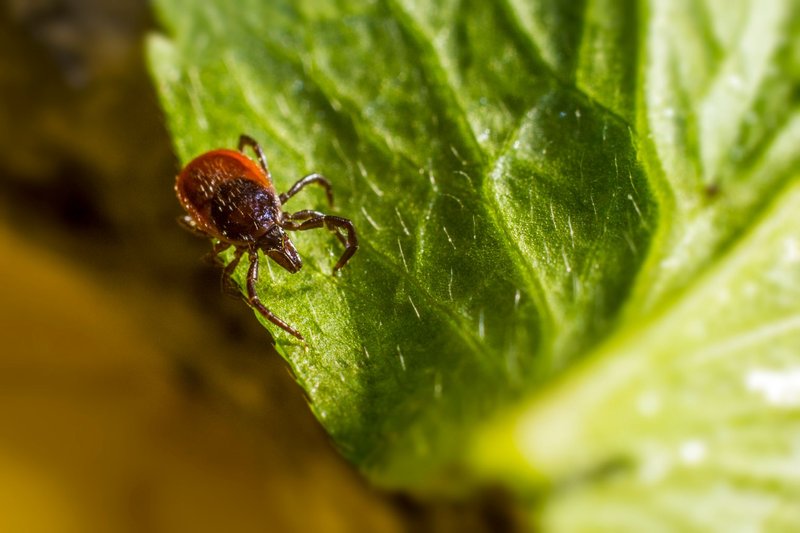
- Size: 2 to 10 mm before feeding, swelling to about 1 cm or more when engorged
- Habitat: grass, brush and leaf litter, waiting for a host to brush past
- Danger to humans: real; ticks transmit Lyme disease, Rocky Mountain spotted fever and other illnesses
Ticks are the arachnids that make people check their ankles. The CDC’s tick pages cover which species carry which diseases in the United States, and how to remove one properly.
Here’s the leg-count exception. A tick larva hatches with six legs. After its first blood meal and molt, it becomes a nymph with eight. A tick that has never fed on blood is, for a while, a six-legged arachnid.
Some species can go months, even years, between meals.
4. Mites
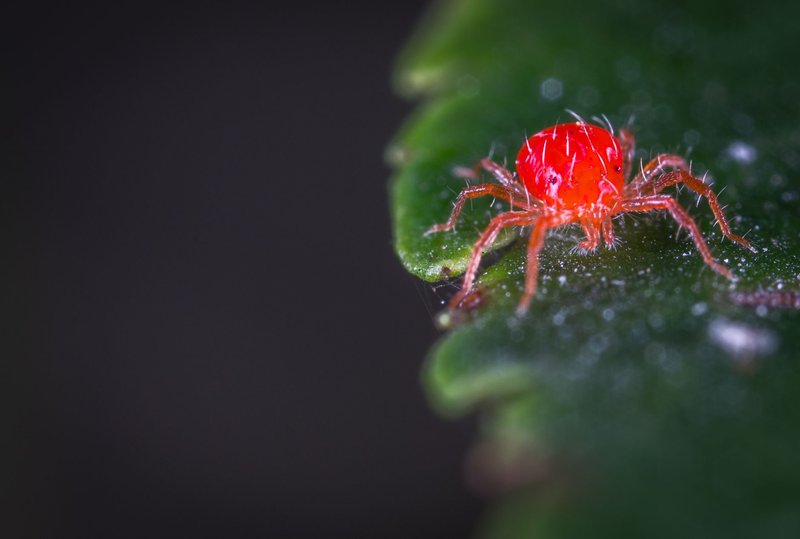
- Size: usually under 1 mm
- Habitat: soil, water, plants, animals, and household dust
- Danger to humans: mostly harmless; dust mite allergens trigger asthma, and scabies mites cause intense itching
Mites are the quiet majority of the arachnid world. More than 55,000 species have been described, and specialists think that’s a small slice of the real number. They live in soil, on leaves, on bees and, in the case of follicle mites, on your face.
Most adults host Demodex mites in their eyelash and facial hair follicles. They’re about 0.3 mm long, eat skin oils, and almost never cause trouble.
Mites break the eight-leg rule in two ways. Larvae hatch with six legs, and the gall mites in the family Eriophyoidea keep just four for life.
5. Harvestmen
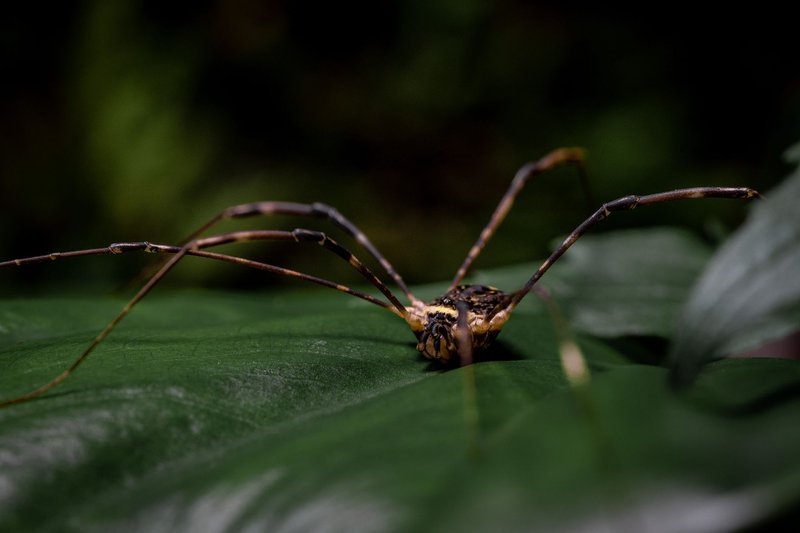
- Size: bodies of a few millimeters, with legs up to many times the body length
- Habitat: forest floors, caves, gardens, under logs and stones
- Danger to humans: none
Harvestmen are the long-legged things you flick off a porch rail and call daddy longlegs. They aren’t spiders. A spider has a narrow waist between its two body sections. A harvestman’s body is one fused oval. They have no silk and no venom glands, and the myth that they carry the deadliest venom in the world is simply false.
When a predator grabs a leg, the harvestman drops it. The severed leg keeps twitching for minutes, which holds the attacker’s attention while the owner leaves. The leg doesn’t grow back, so a harvestman with six legs is common and not a mistake in your count.
There are more than 6,500 known species.
6. Camel spiders
- Size: large species reach about 15 cm (6 in), including legs
- Habitat: deserts and arid scrubland on most continents, though not Australia
- Danger to humans: no venom; a large one can give a painful bite
Camel spiders, also called wind scorpions or solifuges, are neither camels nor spiders. They’re a separate arachnid order with more than 1,000 species.
They look like they have ten legs. Count carefully and you’ll find eight walking legs plus a long pair of pedipalps up front, which they use as feelers and to grab prey. Those pedipalps have a sticky tip that helps them climb and catch.
The real weapon is the jaws. The oversized chelicerae work like shears, which is also why the stories about camel spiders eating a sleeping soldier’s flesh need to stay stories.
7. Vinegaroons
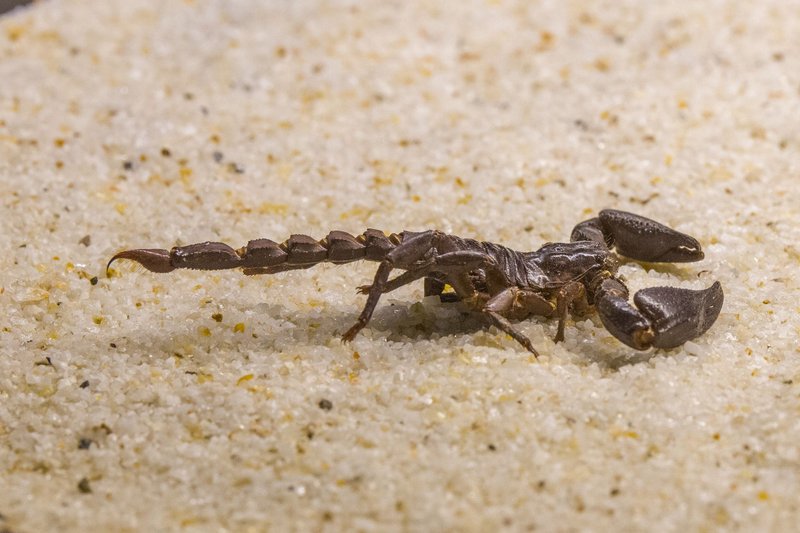
- Size: about 2 to 6 cm (up to 2.5 in)
- Habitat: burrows and under logs in the southern United States, Mexico and the tropics
- Danger to humans: harmless unless you provoke one, then it sprays
Vinegaroons are also called whip scorpions, and the name fits: a scorpion’s body, no venomous sting, and a thin whip-like tail. When threatened, the giant vinegaroon of the American Southwest sprays acetic acid from the base of its tail. It’s the acid in vinegar, and it smells like it.
Their front legs are long and thin and work as feelers, held out like antennae. Vinegaroons walk on the other three pairs, which makes them eight-legged animals that move on six.
Mothers carry the eggs in a sac, and the newly hatched young ride on her back.
8. Pseudoscorpions
- Size: 2 to 8 mm
- Habitat: leaf litter, soil, bark, caves, and old books
- Danger to humans: none; they’re too small to bite you
A pseudoscorpion looks like a scorpion that was shrunk and had its tail removed. The pincers are real, and they hold venom glands used to subdue springtails and other tiny prey. Over 3,000 species are known.
The best part is how they travel. Pseudoscorpions hitch rides by clamping onto the legs of flies, beetles and other flying insects, a behavior called phoresy. It’s how a 4 mm animal gets from one rotting log to the next.
9. Sea spiders
- Size: a few millimeters to a leg span of around half a meter in some deep-sea species
- Habitat: the seafloor in every ocean, from tide pools to deep trenches, especially in polar seas
- Danger to humans: none
Sea spiders aren’t spiders and aren’t true arachnids. They’re a separate group of marine arthropods called Pycnogonida, with roughly 1,300 species. Most have eight legs, though some species have ten or twelve.
Their bodies are so slender that the gut and reproductive organs extend into the legs. Males carry the fertilized eggs on a special pair of limbs, and they keep carrying the young for a while after hatching.
10. Tardigrades
- Size: typically 0.3 to 0.5 mm
- Habitat: moss, lichen, leaf litter, soil, and freshwater and marine sediments
- Danger to humans: none
Tardigrades, or water bears, are the odd entry. They have their own phylum, Tardigrada, and they’re not arachnids or even close relatives. What they share with the rest of this list is four pairs of legs, stubby ones tipped with claws.
They’re famous for surviving things that should end them. Dried out, a tardigrade pulls in its legs and shrinks into a dormant state called a tun, and it can stay that way for years. In 2007, tardigrades were exposed to the vacuum of space on a European Space Agency mission, and some survived and went on to reproduce after returning.
Lookalikes that don’t qualify
These animals show up in “eight legs” searches. None of them belong.
- Octopuses have eight arms, not legs. The arms are lined with suckers and packed with neurons, and an octopus uses them to taste and grip as well as move. A squid has eight arms plus two longer tentacles, which makes ten.
- Insects have six legs, three pairs. Ants, beetles and flies all follow it, and so do the six-legged young stages of ticks and mites mentioned above.
- Crabs, lobsters and shrimp have ten legs. Their group name, decapods, literally means ten-footed. In crabs and lobsters, the front pair is turned into claws.
- Centipedes and millipedes have far more than eight. A centipede has one pair per body segment, and millipedes have two pairs per segment.
FAQ
How many legs do spiders have?
Eight. They also have two pedipalps near the mouth, which look like short legs but work as feelers and, in males, mating tools.
What’s the difference between insects and arachnids?
Insects have six legs, three body sections, antennae and often wings. Arachnids have eight legs, two body sections, no antennae and no wings.
Are legs and pedipalps the same thing?
No. An arachnid has six pairs of appendages at the front: chelicerae (mouthparts), pedipalps, and four pairs of legs. Pedipalps are the reason camel spiders and scorpions seem to have extra limbs.
Is a scorpion a spider?
No. Both are arachnids, but they sit in different orders. Scorpions have pincers and a tail with a stinger. Spiders have fangs and spinnerets.
Do octopuses have legs or arms?
Arms. Octopuses are cephalopods, and by biological convention their eight limbs are called arms. Calling them legs is common but technically wrong.
Are all eight-legged animals dangerous?
No. Most are harmless to people. The ones that matter are ticks, because of disease, and a small number of spiders and scorpions with potent venom.